 Eurasia Press & News
After years of the decline of the health sector in the eastern countryside of Aleppo, especially in the city of Deir Hafer, and in light of the damage to most medical centers and the departure of a number of them from service, the Directorate of Health of Aleppo announced the launch of mobile medical clinics, in cooperation with the World Health Organization and UNICEF, according to what was reported by the province of Aleppo, Sunday, February 1.
The health sector in the eastern countryside of Aleppo suffers from poor coverage and lack of medical staff, as a result of damage to infrastructure during the past years.
This service decline comes after a stage in which the region was under the control of the Syrian Democratic Forces (SDF), where most health centers went out of service, and regular health support programs stopped, which contributed to the low level of medical coverage, especially in rural areas.
Includes three zones
In light of this reality, the Aleppo Health Directorate has relied on mobile clinics as a temporary solution, along with plans to rehabilitate a number of affected health centers according to specific priorities, until the operational capacity of the health sector is restored more broadly.
The official of the media office in the Directorate of Health of Aleppo, Munir al-Mohammad, said that the Directorate launched five mobile medical clinics to cover areas in the eastern countryside of Aleppo, as part of an emergency response to the acute shortage of health services after a large number of medical centers were damaged.
In an interview with Enab Baladi, Al-Mohammad explained that the mobile clinics were distributed to three main areas, including the first area of Manbij, where it covers the towns of Maskana, Al-Khafsa, Umm Hajra, Abu Kahf, Al-Haya, and Al-Farat, in addition to the Deir Hafer area, which includes the city of Deir Hafer and the villages of Humaima and Drawing Al-Haram Al-Imam.
The third region includes the Ambassador Area, which includes the Ambassador, Banan, Khanasir, Tal Hassel, and Turkan.
He pointed out that the clinics provide primary health care services, including medical consultations in the specialties of the interior, children and women, as well as nutrition services, provision of medicines, and the implementation of child vaccination campaigns.
He added that each clinic includes an integrated medical staff, consisting of an internal doctor, a pediatrician, a gynaecologist, a midwife, a nutrition nurse, and an assistant nurse for the doctor, in addition to two nurses specialized in the vaccine, stressing the availability of medicines within these clinics.
With regard to the reality of fixed health centers, Al-Mohammad pointed out that the Directorate is working to restore and rehabilitate a number of centers in the eastern countryside according to the principle of priority.
The current phase includes the centers of Kuweires, Seine, the destroyed and the homeless, pointing out that the level of health coverage is still low compared to the size of the need.
He explained that the approved health plan aims to gradually raise the coverage rate, through the rehabilitation and activation of the affected centers, in addition to continuing to send mobile clinics and mobile teams to the unserved areas with fixed centers.
The Directorate, according to Al-Mohammad, also relies on qualitative mobile teams, including vaccine teams, the fight against leishmaniasis, tuberculosis, and the follow-up of chronic diseases such as diabetes, in an attempt to reduce the health gap in the eastern countryside of Aleppo.
Ambulatory Solutions
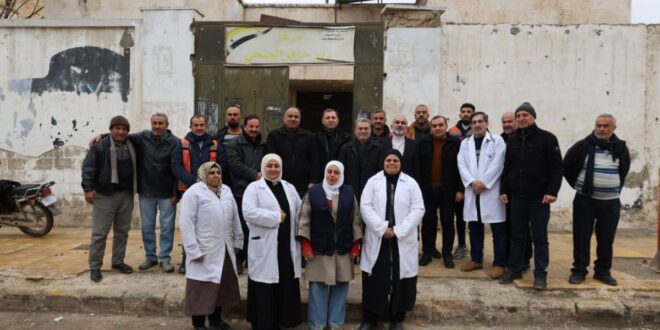
The Ministry of Health announced, on January 17, that the Aleppo Health Directorate has officially started receiving health centers in the city of Deir Hafer in the eastern countryside of Aleppo.
She said that the move aims to reactivate the medical sector and provide treatment services to the population, after a period of decommissioning most health facilities.
As part of the procedures described as ambulance, the Directorate began to run mobile medical clinics to the city and its countryside, in addition to equipping a number of ambulances, in order to ensure immediate health coverage and provide basic care, pending the completion of maintenance and rehabilitation of fixed health facilities damaged during the previous period.
In the same context, the Ministry of Health stressed that these steps are part of a broader strategy to strengthen the health reality in the areas that the government has regained control of.
She pointed to her commitment to provide medical staff and the necessary supplies, in an attempt to alleviate the suffering of the people and improve the level of health services provided, according to the ministry.