 Eurasia Press & News
Toplines
US President Donald Trump and Israeli Prime Minister Benjamin Netanyahu will meet in Washington, DC, on February 11 to discuss Iran. Israeli media and officials stated on February 7 that Trump and Netanyahu will discuss the United States’ negotiations with Iran.[1] Israeli media reported on February 8 that Israeli defense officials told US officials that Iran’s ballistic missile program poses an existential threat to Israel.[2] The Israeli officials noted that Israel is prepared to launch a unilateral attack against Iran to destroy its missile stockpiles and production facilities if Iran crosses an unspecified ”red line.“[3] Israeli officials have also consistently said that negotiations must include limitations on Iran’s ballistic missile program.[4] The Israeli Prime Minister’s office publicly announced that Netanyahu will travel to the United States at 1350 ET, hours after Trump said that a deal with Iran that ”only covers nuclear [issues]” would be acceptable to him.[5] No other US officials have repeated Trump’s purported position that a narrower deal focused only on the nuclear issue would be acceptable.
Iran has not changed its negotiating position, which makes a diplomatic breakthrough in future talks unlikely unless the United States alters its negotiating position. Iran and the United States held talks in Muscat, Oman, on February 6 to establish a framework for future negotiations.[6] The United States has reportedly told Iran that it expects Iran to make tangible concessions on its nuclear program, according to two sources familiar with the matter who spoke to Israeli media.[7] Iran remains unlikely to compromise on limits to its ballistic missile program, support for its proxies and partners in the region, and enrichment levels. Iranian Foreign Minister Abbas Araghchi stated on February 8 that the issue of missiles and “the region” are off the negotiating table.[8] Araghchi added that Iran would never accept zero enrichment and reiterated that Iran has the “right“ to enrich uranium.[9] The United States and Iran will hold a new round of talks sometime early in the week of February 8.[10]
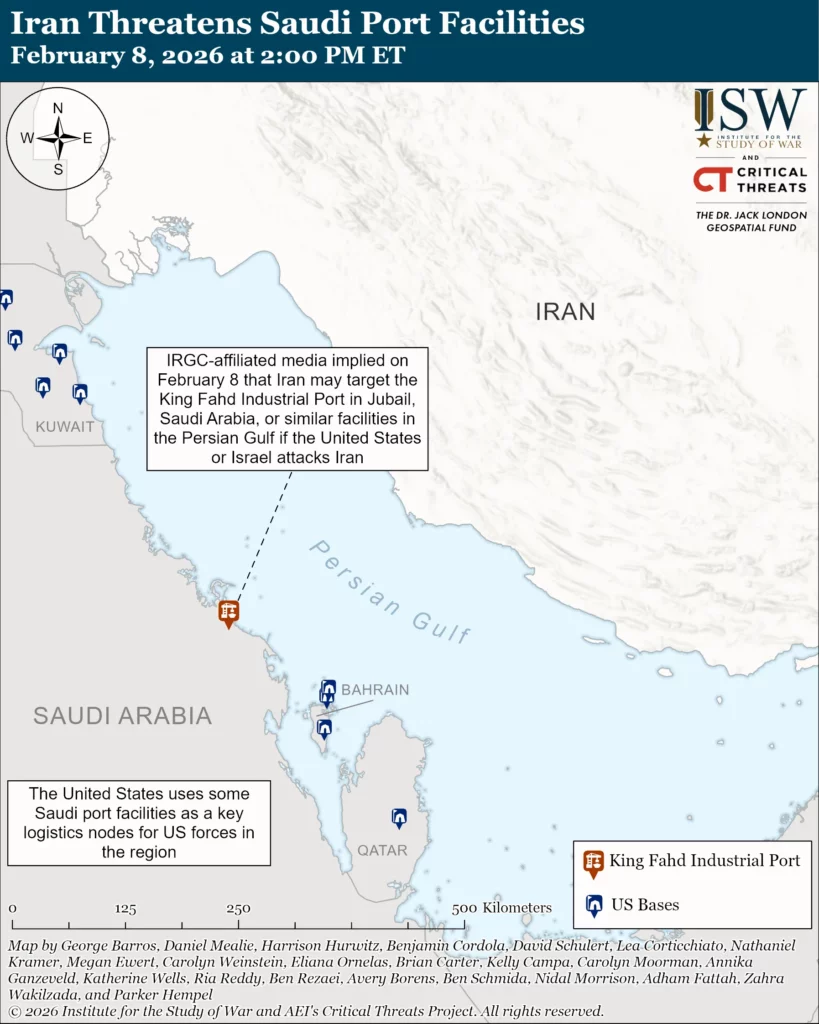
Islamic Revolutionary Guard Corps (IRGC)-affiliated Fars News reported on February 8 that Iran may target supply centers and ports in the region if the United States or Israel attacks Iran.[11] Fars News implied that Iran may specifically target the King Fahd Industrial Port in Jubail, Saudi Arabia, or similar facilities in the Persian Gulf.[12] The King Fahd Industrial Port in Jubail is one of the largest industrial ports in the Middle East, and it handles approximately 20 percent of Saudi trade throughput and approximately one-fifth of Saudi total transits.[13] The United States uses Saudi port facilities as a key logistics and prepositioning point for US forces in the region.[14] Fars News warned that an Iranian attack targeting a Persian Gulf port facilities such as the King Fahd Industrial Port, could cause the port to close, which would have significant economic impacts on oil exports and the global market.[15]
The Saudi Defense Ministry announced on February 7 that the United States and Saudi Arabia conducted a joint naval exercise at the King Faisal Naval Base in Jeddah.[16] US and Saudi naval forces conducted a series of field and tactical scenarios designed to simulate realistic maritime threats in the Red Sea as part of the exercise.[17] The exercise sought to enhance military cooperation and exchange expertise between the two navies.[18]
Key Takeaways
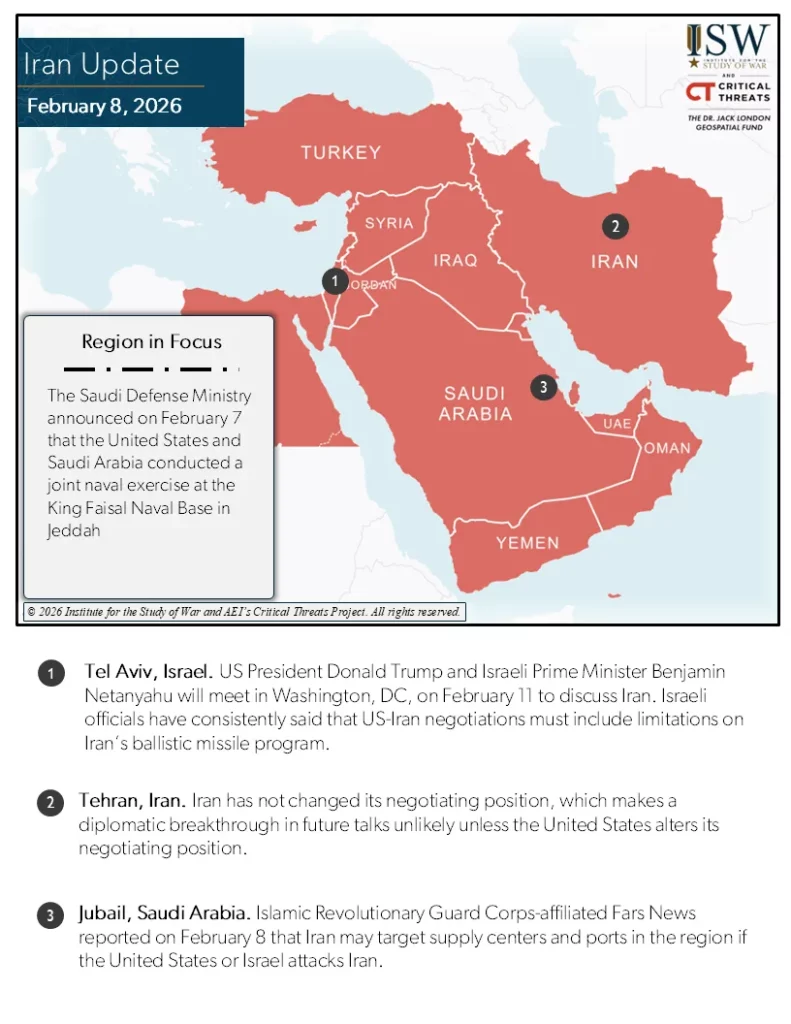
US-Israel Talks: US President Donald Trump and Israeli Prime Minister Benjamin Netanyahu will meet in Washington, DC, on February 11 to discuss Iran. Israeli officials have consistently said that US-Iran negotiations must include limitations on Iran’s ballistic missile program.
US-Iran Negotiations: Iran has not changed its negotiating position, which makes a diplomatic breakthrough in future talks unlikely unless the United States alters its negotiating position.
A Potential Iranian Retaliatory Attack: Islamic Revolutionary Guard Corps (IRGC)-affiliated Fars News reported on February 8 that Iran may target supply centers and ports in the region if the United States or Israel attacks Iran.
US-Saudi Naval Cooperation: The Saudi Defense Ministry announced on February 7 that the United States and Saudi Arabia conducted a joint naval exercise at the King Faisal Naval Base in Jeddah.
Iran
Iranian security forces seized weapons and arrested Kurdish militants in northwestern Iran on February 7. Kurdistan Province Border Guards arrested a weapon smuggler and seized five Kalashnikov rifles, 36 handguns, 729 rounds of ammunition, and seven smuggled handheld wireless devices in Sarvabad, Kurdistan Province, on February 8.[19] IRGC Ground Forces at the Najaf Ashraf base arrested 11 Kurdistan Free Life Party (PJAK) leaders in a separate incident on February 7 in Kermanshah Province.[20] IRGC Ground Forces reported that the PJAK leaders operated in two cells and were planning to carry out attacks in Iran.[21] PJAK seeks to establish an “autonomous Kurdish region within a federal political structure in Iran” and has previously targeted Iranian security forces.[22] Iran has previously accused Kurdish opposition groups of inciting protests in western Iran and cooperating with Israel to facilitate attacks in Iran.[23]
Iran reportedly deployed and tested the Khorramshahr-4 ballistic missile over the last week, likely to demonstrate and practice its capabilities ahead of a potential conflict with the United States. Regime-owned media reported on February 5 that the IRGC deployed the Khorramshahr-4 ballistic missile at an underground missile facility.[24] Iranian Armed Forces General Staff-affiliated media reported on February 8 that Iran recently conducted a launch test of the Khorramshahr-4 ballistic missile during the recent US-Iran negotiations.[25] Regime-affiliated media reported that the Khorramshahr-4 ballistic missile has a 1500-kilogram payload, a top speed of Mach 8 within the atmosphere, a 2,000-kilometer range, and a circular error probability of 30 meters.[26] Iranian defense officials view ballistic missiles as a critical piece of their defense strategy.[27]
Iraq
Nothing significant to report.
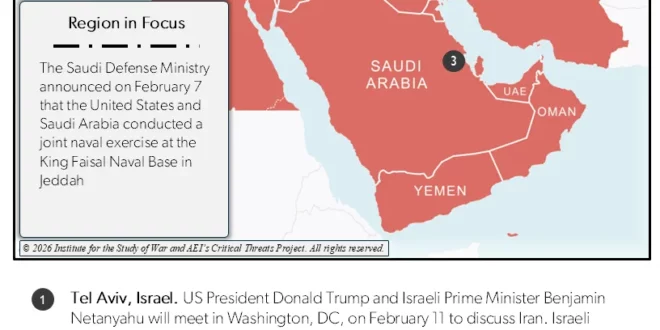
Syria
The Syrian government and Syrian Democratic Forces (SDF) began to take steps on February 8 to transfer control of Qamishli Airport from the SDF to Syrian forces as part of the Syrian government and SDF’s January 30 agreement.[28] The 14-point January 30 agreement stipulates that the SDF will hand over Qamishli Airport and border crossings and oil fields in northeastern Syria.[29] Hasakah Province Internal Security Commander Brigadier General Marwan al Ali and other Syrian officials met with the SDF-proposed Hasakah Province Deputy Internal Security Director Siamand Afrin and SDF officials at the Qamishli airport on February 8 to begin the process.[30] Syrian government technical teams will arrive at the airport on February 9 to conduct readiness tests and emergency maintenance on the airport’s infrastructure. SDF internal security forces (known as Asayish) that have integrated into the General Security Services (GSS) will oversee the airport handover.[31] Kurdish sources reported that the airport will resume domestic flights in the next 20 days.[32] Syrian forces and the SDF are also working to prepare for the SDF to hand over border crossings and oil fields to the Syrian government.[33] Kurdish sources reported that a Syrian government delegation, with an Asayish escort, will visit the Rumaylan oil field, Hasakah Province, on February 9.[34]
The Syrian government and SDF continued to negotiate over the GSS’s deployment to Kobani, Aleppo Province, and measures to end the siege on Kobani on February 8.[35] An Asayish delegation met with Aleppo Province GSS Commander Colonel Mohammad Abdul Ghani in Aleppo City on February 8 to discuss implementing the Syrian government-SDF January 30 agreement and lifting the government’s siege on Kobani.[36] Residents in Kobani have been without water or electricity since January 20.[37] The officials agreed to take steps ”in the coming hours” to implement the January 30 agreement and end the siege.[38] The January 30 agreement stipulates that SDF forces in Kobani will integrate into a single brigade under an unspecified Aleppo-based division, but does not specify GSS deployments to Kobani, unlike in Hasakah City and Qamishli.[39] The Syrian government presumably seeks to deploy GSS forces to Kobani to integrate Asayish forces into the GSS as part of the agreement. SDF officials have recently rejected any GSS deployment to Kobani, however. An SDF commander said in a February 4 interview that no GSS forces would enter Kobani under the January 30 agreement because the Asayish already operates there.[40]
Arabian Peninsula
CTP-ISW has temporarily suspended its coverage of Yemen beginning on January 9.
Palestinian Territories & Lebanon
Nothing significant to report.