 Eurasia Press & News
Toplines
Some Iranian regime elements are signaling that Iran may offer relatively insignificant, nuclear-only concessions, but only if the United States offers complete sanctions relief.[1] The concessions under discussion in the Iranian policy and media space are less significant than the concessions Iran offered in the 2015 nuclear deal, when it was relatively stronger compared to its position today. Iranian officials have not indicated any willingness to offer concessions beyond the nuclear program. The Iranian regime’s official policy continues to assert that uranium enrichment is an inherent right and that Iran will not negotiate over its missile program. Some regime officials are now suggesting that Iran may be willing to dilute its enriched uranium from 60 percent to 20 percent, but only if the United States provides substantial, reciprocal concessions such as complete sanctions relief.[2] The 2015 nuclear deal forced Iran to cap its enrichment at 3 percent for a period of 15 years.
Iranian officials have floated these concessions publicly after US President Donald Trump said that he would be open to a deal limited to the nuclear program, although no other US official has said the same.[3] US Vice President JD Vance stated on February 9 that Trump will decide if the United States will allow limited uranium enrichment and where the United States will draw any “red line” in the negotiations with Iran.[4] Recent statements by Iranian officials nonetheless suggest that Iran is attempting to test whether it can trade limited nuclear steps for maximal sanctions relief without constraining its missile or regional activities.
Iranian Supreme National Security Council (SNSC) Secretary Ali Larijani will visit Oman on February 10, possibly to convey details about potential nuclear concessions to Omani interlocutors.[5] Iran has commonly used Oman as an interlocutor with the United States and Gulf countries.[6] Larijani has reportedly been attempting to shape Iran’s negotiating position. He is officially meeting with Omani officials to discuss “regional developments.”[7] Larijani previously tried to convince Iranian leaders in August 2025 to reduce enrichment from 60 percent to 20 percent to avoid snapback sanctions and further US and Israeli strikes, according to a senior Iranian official speaking to the Telegraph. Larijani’s past efforts suggest that his Oman visit could be designed to float possible nuclear concessions to the United States.[8]
An agreement that lifts sanctions on Iran without seriously decreasing Iran’s ability to expand its ballistic missile and drone program or its proxy networks would pose a long-term threat to US interests in the region by enabling Iran to reinvest in these capabilities and its proxy networks. Iran has repeatedly used its missiles and regional partners to threaten and attack the United States and its allies.[9] Iran has ordered or conducted attacks against US forces and interests in the region that have killed hundreds of Americans. More recently, Iran and its regional partners have previously targeted US forces in the region in response to perceived and real Israeli activity. Iranian-backed militias in Iraq began their attack campaign against US forces in Iraq and Syria during the October 7 War after a Palestinian militia rocket fell short and exploded at al Ahli Hospital in the Gaza Strip, an incident that the militias blamed on Israel. This escalation ultimately led to an attack by Iranian-backed proxy group Kataib Hezbollah on a US position in Jordan, which killed three US servicemembers.[10] Iran has also used ballistic and cruise missiles, either directly or via its partners, to strike US regional partners, such as Saudi Arabia and the United Arab Emirates.[11] Iran’s ballistic missile program and its proxies and partners have long posed a threat to US assets and personnel in the region, not just Israel.
Russia is also engaging Oman to discuss mediation efforts and appears broadly supportive of an agreement that benefits Iran by lifting sanctions while limiting Iranian enrichment and having no effect on Iran’s ballistic missile program and the Axis of Resistance. Russian Foreign Minister Sergei Lavrov held a phone call with Omani Foreign Minister Badr al Busaidi on February 9. Lavrov told Busaidi that Russia welcomes Oman’s mediation efforts and noted that Russia is in “constant contact” with Iran.[12] Lavrov’s phone call is almost certainly related to Larijani’s visit to Oman (see above). Larijani met with Russian President Vladimir Putin on January 30 as part of a flurry of diplomatic efforts by Iranian officials to avert US military action against Iran.[13] Russia seeks a ”broadly acceptable agreement that supports regional security,” which indicates that Russia seeks to head off a potential US strike by promoting a negotiated outcome that reduces the risk of military escalation against Iran.
The Iranian regime is cracking down on Iranian reformists, which may be part of the regime’s efforts to control the narrative about the recent Iranian protests. The regime has arrested several critical figures within the Iranian reformist front, including the head of the reformist front, Azar Mansouri, former Deputy Foreign Minister for American Affairs Mohsen Aminzadeh, and National Unity Party Central Council member Ali Shakouri Rad.[14] The regime also summoned several other reformists, including former Iranian diplomat Mohsen Armin and former Association of Iranian Journalists secretary Badrolsadat Mofidi. Several of these summoned and arrested figures made statements criticizing the regime’s recent crackdown on protests.[15] Mansouri, for example, issued a statement on January 26, stating that the Reformist Front is disgusted and angry at those who “ruthlessly and recklessly“ killed the young people of Iran, likely referring to Iranian security forces.[16] The arrest of these reformists suggests that the Iranian regime could be temporarily escalating against these reformists in response to their inflammatory criticisms of the regime.
The regime’s crackdown could be the beginning of a new level of censorship to silence any regime critics within Iran, however. These recent arrests, if broadened to include more Iranian reformists or moderates, could indicate that the regime is severely cracking down against any criticism of its response to the recent protests. The arrest also indicates that the regime is not receptive to any feedback or reform to address the public grievances that triggered the recent protest movement. The regime’s refusal to address these underlying grievances could cause protests to resume.
Key Takeaways
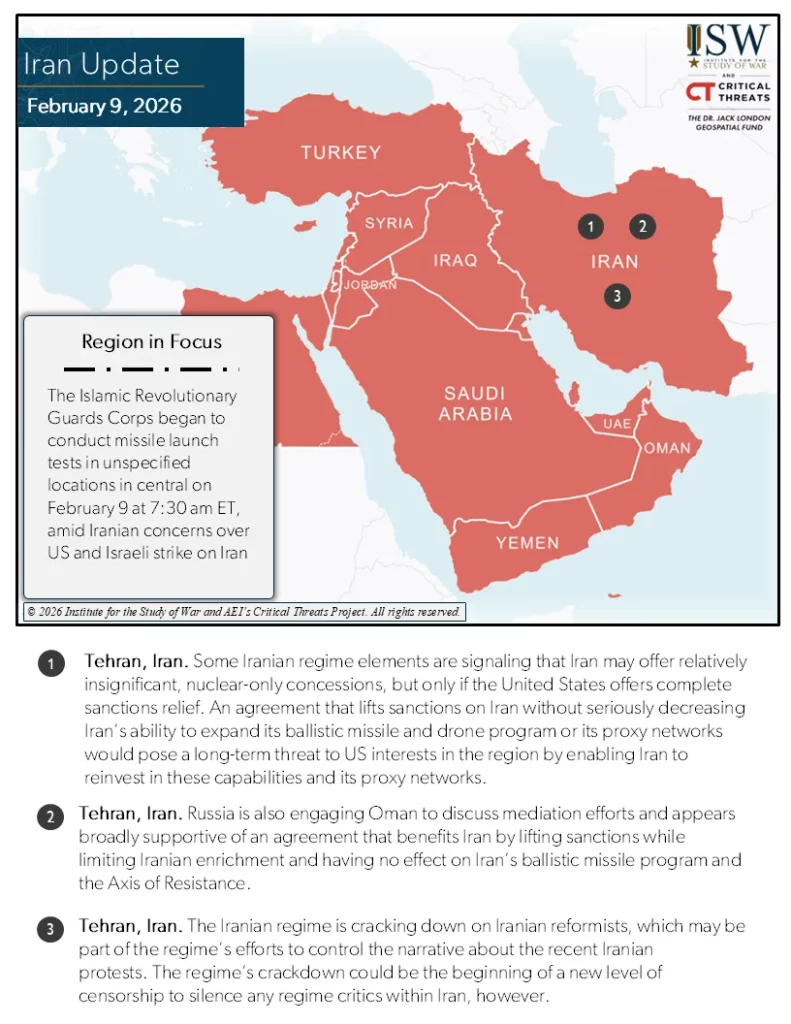
 US-Iran Negotiations: Some Iranian regime elements are signaling that Iran may offer relatively insignificant, nuclear-only concessions, but only if the United States offers complete sanctions relief. An agreement that lifts sanctions on Iran without seriously decreasing Iran’s ability to expand its ballistic missile and drone program or its proxy networks would pose a long-term threat to US interests in the region by enabling Iran to reinvest in these capabilities and its proxy networks.
Russian-Iranian Relations: Russia is also engaging Oman to discuss mediation efforts and appears broadly supportive of an agreement that benefits Iran by lifting sanctions while limiting Iranian enrichment and having no effect on Iran’s ballistic missile program and the Axis of Resistance.
The Iranian Regime’s Crackdown on Reformists: The Iranian regime is cracking down on Iranian reformists, which may be part of the regime’s efforts to control the narrative about the recent Iranian protests. The regime’s crackdown could be the beginning of a new level of censorship to silence any regime critics within Iran, however.
Iran
Anti-regime militant activity has continued in southeastern Iran, which creates additional security challenges for the Iranian regime. Mobarizoun Popular Front (MPF), which is a coalition of Baloch organizations, fighters shot at a vehicle transporting a local judiciary official in Khash City, Sistan and Baluchistan Province, on February 9.[17] The attack injured two armed Law Enforcement Command (LEC) officers.[18] The Sistan and Baluchistan Province LEC Information Center announced that the LEC is conducting security operations in the surrounding area to find the perpetrators.[19] MPF later claimed responsibility for the attack on February 9 and claimed that the judiciary official played a role in repression efforts by the regime in Khash County.[20] The MPF, which was formed in December 2025, and Jaysh al Adl, the principal MPF predecessor organization, have also historically operated in Khash County.[21] MPF fighters conducted two other similar attacks against LEC personnel in Iranshahr and Dashtiari County, Sistan and Baluchistan Province, on January 7 and 11.[22]
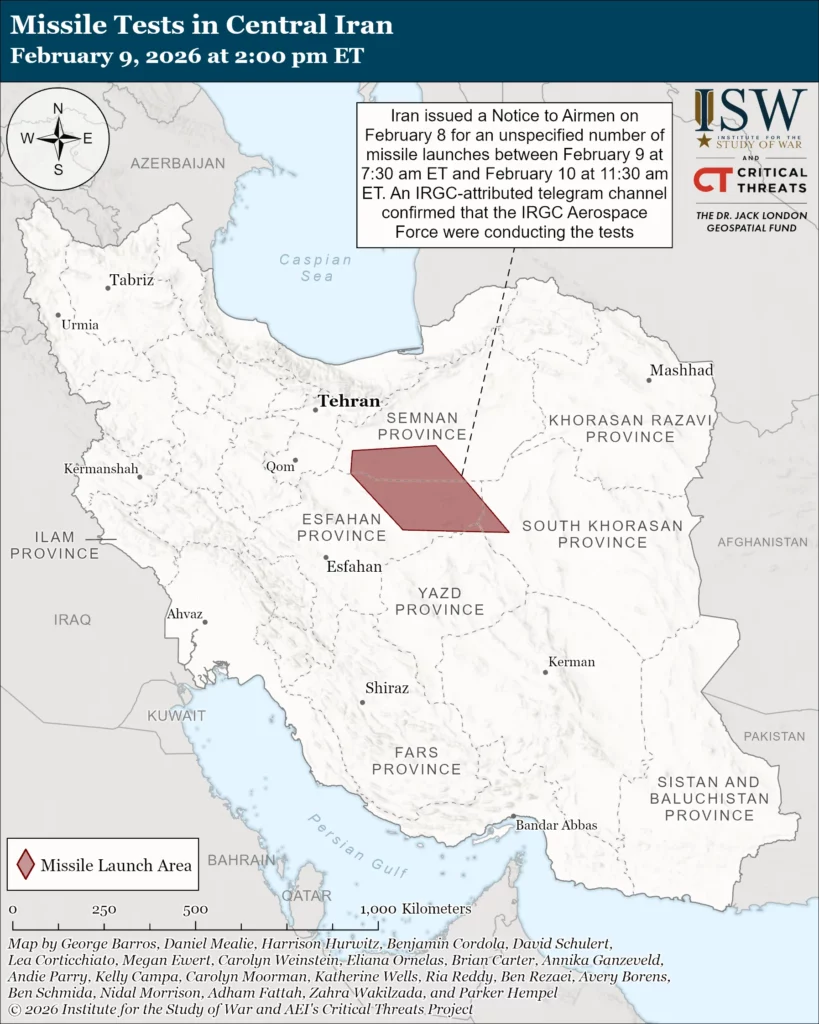
The Islamic Revolutionary Guards Corps (IRGC) began to conduct missile launch tests in unspecified locations in central Iran (see map below) on February 9 at 7:30 am ET, amid Iranian concerns over a US and Israeli strike on Iran.[23] These tests will end on February 10 at 11:30 am ET. Iran issued a Notice to Airmen (NOTAM) on February 8 for an unspecified number of missile launches across Semnan, Esfahan, Yazd, and South Khorasan provinces.[24] An IRGC-attributed Telegram channel reposted the NOTAM on February 8, reporting that the IRGC Aerospace Force is conducting the launches on February 9.[25] Iranian regime-affiliated media confirmed that the IRGC deployed and conducted a launch test of the Khorramshahr-4 ballistic missile in an unspecified location on February 5 and 8.[26] The Khorramshahr-4 ballistic missile has a top speed of Mach 8 within the atmosphere, a 2,000-kilometer range, and a circular error probability of 30 meters.[27]
Iraq
The Shia Coordination Framework continues to debate its selection of the next Iraqi prime minister amid the main Iraqi Kurdish political parties’ continued lack of progress towards agreeing on a president. The framework announced its nomination of State of Law Coalition head and former Prime Minister Nouri al Maliki as prime minister-designate on January 24, but Maliki continues to face domestic and US opposition.[28] Iraqi media reported on February 9 that unidentified framework members met privately to discuss Maliki’s nomination ahead of the State Administration Alliance meeting on February 8.[29] The State Administration Alliance, which contains the parties that compose the government and includes the framework and the main Sunni and Kurdish parties, meets periodically under the prime minister’s purview.[30] Unidentified framework parties, almost certainly those opposed to Maliki, reportedly suggested nominating a consensus candidate for the premiership, such as Badr Organization-affiliated Iraqi intelligence chief Hamid al Shatri or current Prime Minister Mohammad Shia al Sudani’s Chief of Staff Ihsan al Awadi.[31] Iraqi media separately reported on February 9 that two unspecified framework parties recently proposed expanding the powers of Sudani’s government via parliament.[32] Sudani currently leads a caretaker government with limited powers.[33] Asaib Ahl al Haq head Qais al Khazali and National State Forces Alliance head Ammar al Hakim have been leading the intra-framework opposition to Maliki, but Iraqi media noted Khazali’s absence at the framework meeting, at which the unidentified framework members proposed expanding Sudani‘s powers.[34] Khazali and several other framework leaders have opposed granting Sudani another term as prime minister.[35]
The State of Law Coalition reiterated its support for Maliki on February 9.[36] A Badr Organization parliamentarian disregarded the United States’ recent threats to sanction Iraq if Maliki becomes prime minister again in an interview on February 9.[37] The Iraqi Parliament did not discuss the presidency during its session on February 9 as the Kurdistan Democratic Party and the Patriotic Union of Kurdistan continue to negotiate which party will hold the position.[38] Parliament must elect a president before the prime minister designate can attempt to form a government.[39]
Syria
The Syrian Government and the Syrian Democratic Forces (SDF) began preparations on February 9 for the SDF to hand over SDF-controlled oil infrastructure to the Syrian government as part of the Syrian government and SDF’s January 30 agreement.[40] The 14-point January 30 agreement stipulates that the SDF will hand over airports, border crossings, and oil fields in northeastern Syria to the Syrian government.[41] Syrian and SDF officials visited the Rumaylan and al Suwaydiyah oil fields in Hasakah Province on February 9.[42] The state-owned Syrian Petroleum Company (SPC) also participated in the visit and conducted an exploratory tour of the SDF-controlled oil fields to assess the operational and technical status of the fields in preparation for the government’s takeover.[43] The SPC vice president told Syrian media after the visit that the fields’ infrastructure and oil wells are in ”good condition.”[44] The SCP has recently signed several agreements with international oil companies, including Chevron, Conoco, and Adis, to develop Syria’s energy infrastructure soon.[45]
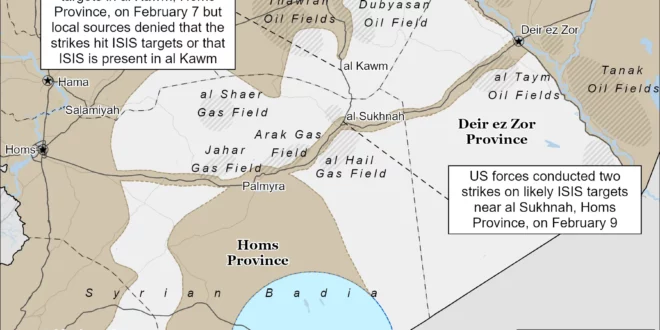
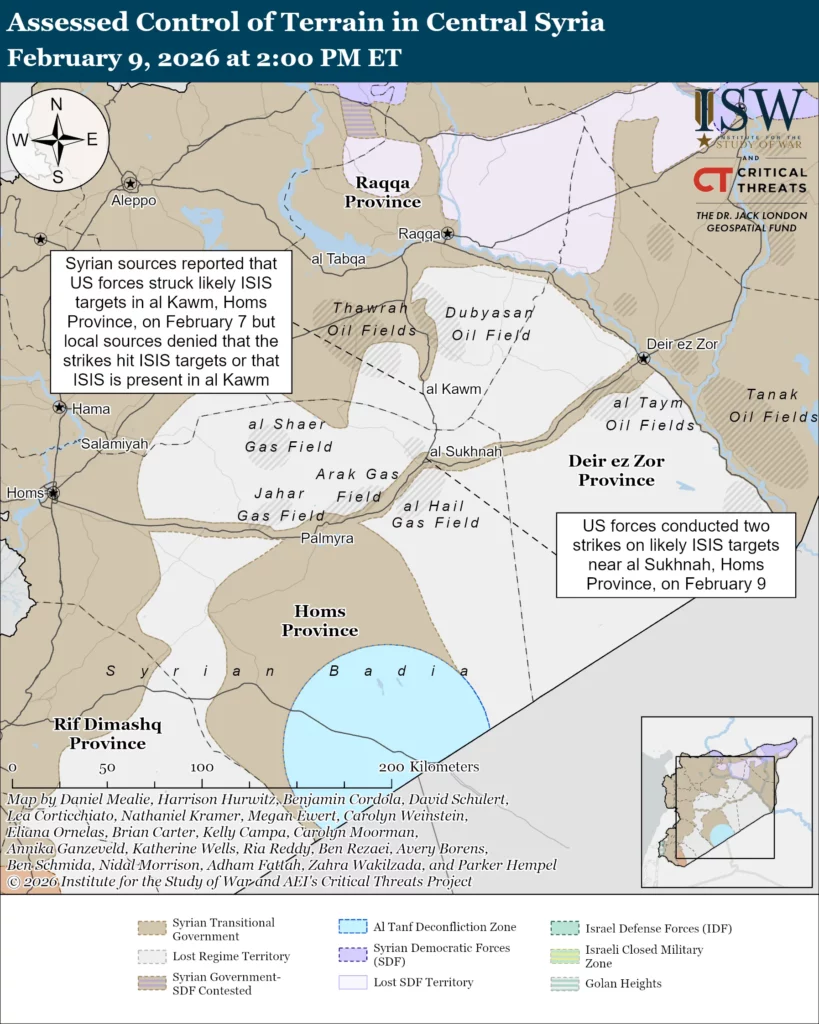
US forces conducted airstrikes on likely Islamic State in Iraq and al Sham (ISIS) targets in the central Syrian desert on February 7 and 9. Local Syrian sources denied that the strikes hit ISIS targets, however. Syrian sources reported that US forces struck likely ISIS targets in al Kawm, Homs Province, on February 7, destroying six abandoned homes.[46] Local sources denied that the strikes hit ISIS targets or that ISIS was present in al Kawm, although ISIS has frequently operated in and around al Kawm.[47] Syrian sources separately reported that US forces conducted two strikes on likely ISIS targets near al Sukhnah, Homs Province, on February 9.[48] A local source commenting on the strike said that recent US airstrikes in the central Syrian desert have only hit empty sites, such as abandoned ISIS hideouts.[49]
Arabian Peninsula
CTP-ISW has temporarily suspended its coverage of Yemen beginning on January 9.
Palestinian Territories & Lebanon
Lebanon’s international partners, including the United States and France, are continuing to pressure the Lebanese Armed Forces (LAF) to take steps to disarm Hezbollah across Lebanon. Several US officials have recently stated that the LAF needs to implement its disarmament plan at a “faster pace” and noted that the United States has “higher expectations” for the LAF’s next disarmament phase.[50] French Foreign Affairs Minister Jean Noel Barrot echoed a similar sentiment on February 6, stating that the LAF must begin its next phase and present its operational plan in the “coming days.”[51] The LAF has not finalized its operational plan or taken steps to disarm Hezbollah between the Litani and Awali River despite being “ready,” according to the Lebanese deputy prime minister, since December 2025.[52] The LAF has noted that it is cautiously approaching the issue of disarmament north of the Litani River, likely because Hezbollah has framed its disarmament north of the Litani as an existential issue.[53]
The Lebanese government’s tepid progress in taking meaningful steps to disarm Hezbollah north of the Litani River may undermine efforts to prevent a renewed conflict in Lebanon. Israeli, US, and European officials have warned since October 2025 that Israel will launch an expanded operation in Lebanon if the Lebanese government does not take action to disarm Hezbollah.[54] Israel previously delayed an operation in December 2025 to allow for greater dialogue with the Lebanese government and to allow the Lebanese government time to implement its plan.[55] Israeli media noted on January 19, however, that the United States is intensifying pressure on the Lebanese government and may “grant” Israel “greater freedom of action” north of the Litani River if the Lebanese government does not demonstrate “a genuine willingness” to disarm Hezbollah.[56]
The LAF, enabled by US intelligence, raided a Hezbollah weapons depot and seized 348,000 rounds of ammunition in Halousiyeh, Tyre District, on February 4, according to a US official speaking to Saudi media.[57] The US official told Saudi media on February 9 that the LAF’s raid is part of its efforts to investigate Hezbollah sites that the ceasefire monitoring committee has identified.[58] The United States has previously provided the LAF with intelligence on at least two other Hezbollah sites in southern Lebanon.[59]