 Eurasia Press & News
Toplines
Ukrainian President Volodymyr Zelensky reiterated Ukraine’s willingness to compromise ahead of trilateral US-Ukrainian-Russian talks in Geneva, Switzerland, on February 17 to 18. Zelensky stated on February 14 that Ukraine is ready to hold elections as quickly as possible, provided a sustained ceasefire, and called for a two-month ceasefire and security guarantees in order to do so.[1] Zelensky noted that if a two-month ceasefire is not possible, then Ukraine at least needs “many days” to prepare for elections.[2] Zelensky stated that any security guarantees agreement must precede any war termination agreement.[3] Meaningful security guarantees are crucial to any future peace agreement that allows Russia to occupy parts of Ukraine. Concluding peace agreements ahead of security guarantees entails Ukrainian surrender of critical territory with no assurance of Ukraine receiving necessary guarantees against future Russian aggression.[4]
Russian officials continue to insist that the issues and terms impeding a peace agreement go beyond Russia’s territorial demands. Russian State Duma Defense Committee Deputy Chairperson Alexei Zhuravlyov, who often acts as a bullhorn for the Kremlin’s true diplomatic and military aims, reiterated on February 14 that Russia “will not be satisfied” with only Ukraine’s surrender of Luhansk, Donetsk, Zaporizhia, and Kherson oblasts, and that Russia must additionally achieve regime change in Kyiv to remove any allegedly “Russophobic” and neo-Nazi government.[5] Senior Kremlin officials have similarly recently claimed that post-war Ukraine must be “friendly” to Russia, implying that Russia will only be satisfied with a Ukraine led by a pro-Russian government that implements pro-Russian policies.[6] Kremlin officials have repeatedly rejected meaningful Western security guarantees for Ukraine and demonstrated their commitment to achieving Russia’s war goals militarily if it cannot do so diplomatically.[7] US Secretary of State Marco Rubio notably stated on February 14 that negotiations to end the war have “narrowed” to the “hardest questions to answer,” but that the United States is unsure if Russia is serious about ending the war.[8] Rubio stated that the United States does not know under what terms Russia is willing to end the war or whether the United States can find terms that are acceptable to Ukraine and to which Russia will also agree.
Russian forces continue to suffer disproportionately high casualties in return for marginal territorial gains. NATO General Secretary Mark Rutte stated on February 13 that Russian forces are advancing at the “stilted speed of a garden snail,” yet suffered 35,000 deaths in December 2025 and 30,000 deaths in January 2026.[9] Rutte’s numbers largely cohere with data from the Ukrainian General Staff, which maintains that Russian forces suffered about 35,100 casualties in December and 31,680 casualties in January. ISW continues to assess that the Russian rate of advance, even at its relatively quicker tempo in late 2025, has been constrained to a footpace and comes at disproportionately high infantry casualty costs.[10] ISW has observed open-source evidence to assess that Russian forces advanced in or infiltrated through an estimated 462 square kilometers in December 2025 and roughly 364 square kilometers in January 2026 – suggesting that Russian forces suffered roughly 76 casualties per square kilometer seized or infiltrated through in December 2025 and 87 casualties per square kilometer seized or infiltrated through in January 2026. Ukrainian President Volodymyr Zelensky stated in an interview published on February 13 that Russian forces have recently suffered 170 casualties for every kilometer of territory gained.[11] ISW’s calculations are based only on evidence observable in the open source, and it is unclear if Zelensky is referring only to territory that Russian forces control or is also including areas in which Russian forces have infiltrated but do not control. True Russian losses are very likely higher than what is confirmable from open sources. Russian forces have long suffered such a disproportionately high casualty rate, having suffered an average of 83 casualties per square kilometer gained in all of 2025.[12] The Russian rate of advance slowed in late December 2025 and January 2026, but Russian losses did not significantly decrease, showing how these slowing advances have come at an even greater cost.[13]
Ukraine’s and SpaceX’s efforts to shut off Russian forces’ access to Starlink terminals in Ukraine are reportedly disrupting Russian Rubikon Center for Advanced Unmanned Technologies’ short- and mid-range drone strikes in the immediate term, as ISW recently forecasted. The commander of a Ukrainian unmanned systems brigade told BBC Ukrainian Service that Russian forces will likely spend about six months trying to find an alternative to Starlink.[14] The commander noted that Ukraine’s Unmanned Systems Forces (USF), unlike the Russian Rubikon Center, cannot focus exclusively on strikes against Russian logistics and the Russian operational rear, as the Ukrainian USF must also spend time and resources helping Ukrainian infantry hold the frontline and repel Russian infantry attacks.[15] Russian forces, particularly from the Rubikon Center, were using Starlink terminals to extend the ranges of their drones in order to strike further into the Ukrainian rear to generate effects of battlefield air interdiction (BAI).[16] Rubikon often publishes footage on its Telegram channel highlighting strikes against specific frontline or rear settlements, but has not offered this level of geographic detail about any of the strikes since February 4 — just days after SpaceX blocked unregistered Starlink terminals in Ukraine.[17] Rubikon has continued to post about its strikes across the frontline since February 4 but has not provided specific locational details, suggesting that SpaceX’s decision to restrict Russian forces’ access to Starlink on February 1 has been negatively impacting Rubikon’s strike campaign.[18] ISW assessed on February 5 that Ukraine’s efforts to shut down Russian forces’ access to Starlink terminals would likely impact Russian BAI efforts, preventing Russian forces from conducting these strikes at the same tempo and depth as in prior weeks.[19]
Key Takeaways
Ukrainian President Volodymyr Zelensky reiterated Ukraine’s willingness to compromise ahead of trilateral US-Ukrainian-Russian talks in Geneva, Switzerland on February 17 to 18.
Russian officials continue to insist that the issues and terms impeding a peace agreement go beyond Russia’s territorial demands.
Russian forces continue to suffer disproportionately high casualties in return for marginal territorial gains.
Ukraine’s and SpaceX’s efforts to shut off Russian forces’ access to Starlink terminals in Ukraine are reportedly disrupting Russian Rubikon Center for Advanced Unmanned Technologies’ short- and mid-range drone strikes in the immediate term, as ISW recently forecasted.
Ukrainian forces recently advanced in the Oleksandrivka direction. Russian forces recently advanced in northern Kharkiv Oblast, in the Borova and Slovyansk directions, and in the Kostyantynivka-Druzhkivka tactical area.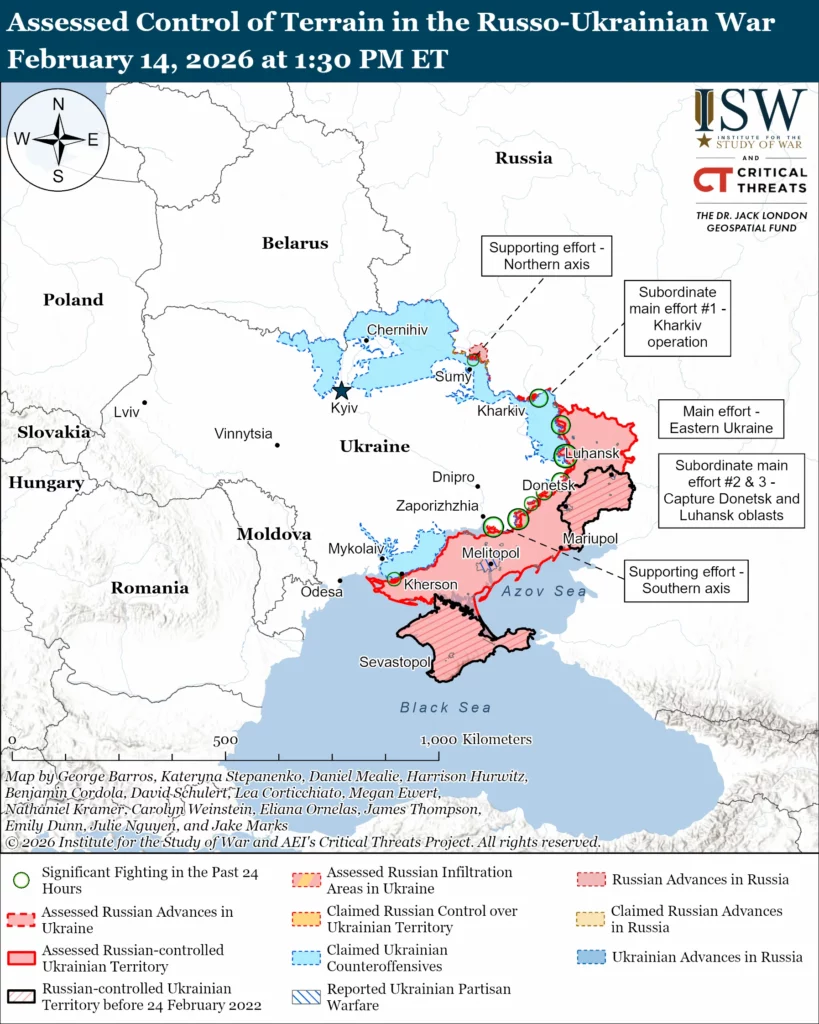
We do not report in detail on Russian war crimes because these activities are well-covered in Western media and do not directly affect the military operations we are assessing and forecasting. We will continue to evaluate and report on the effects of these criminal activities on the Ukrainian military and the Ukrainian population and specifically on combat in Ukrainian urban areas. We utterly condemn Russian violations of the laws of armed conflict and the Geneva Conventions and crimes against humanity even though we do not describe them in these reports.
Ukrainian Operations in the Russian Federation
Nothing Significant To Report.
Russian Supporting Effort: Northern Axis
Russian objective: Create defensible buffer zones in Sumy Oblast along the international border
Russian forces continued offensive operations in northern Sumy Oblast on February 14 but did not advance.
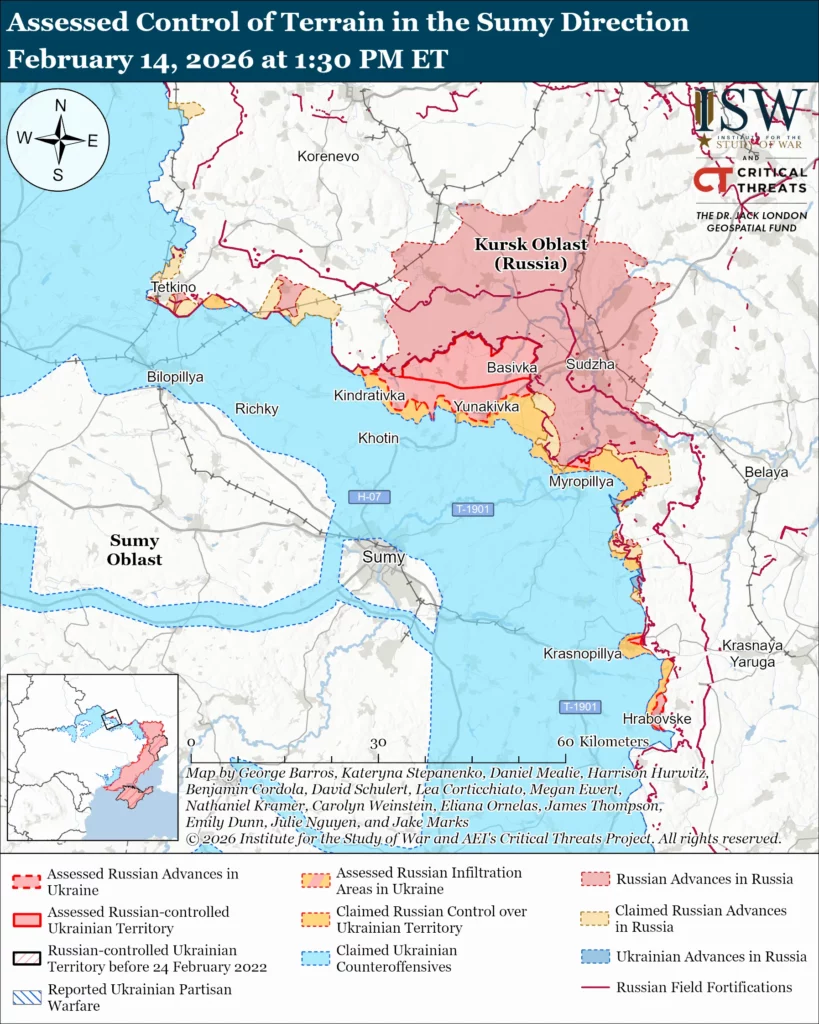
Russian forces attacked in Sumy and Kursk oblasts, including north of Sumy City near Varachyne, Kindrativka, and Oleksiivka and toward Nova Sich and southeast of Sumy City near Popivka, on February 13 and 14.[20] A Russian milblogger claimed that Ukrainian forces counterattacked near Kindrativka, Oleksiivka, and Varachyne.[21]
A Russian milblogger claimed that Russian forces are struggling to advance toward Pokrovka (southeast of Sumy City) due to the ravines in the area and the large number of Ukrainian drones.[22]
Order of Battle: Drone operators of the Russian Oprichniki drone unit are reportedly operating in the Sumy direction.[23] Drone operators of the 72nd Motorized Rifle Division (44th Army Corps [AC], Leningrad Military District [LMD]) are reportedly operating near Gordeevka, Kursk Oblast (north of Sumy City near the international border).[24]
Russian Main Effort: Eastern Ukraine
Russian Subordinate Main Effort #1 – Kharkiv Oblast
Russian objective: Push Ukrainian forces back from the international border to create a defensible buffer zone with Belgorod Oblast and approach to within tube artillery range of Kharkiv City
Russian forces recently advanced in northern Kharkiv Oblast.
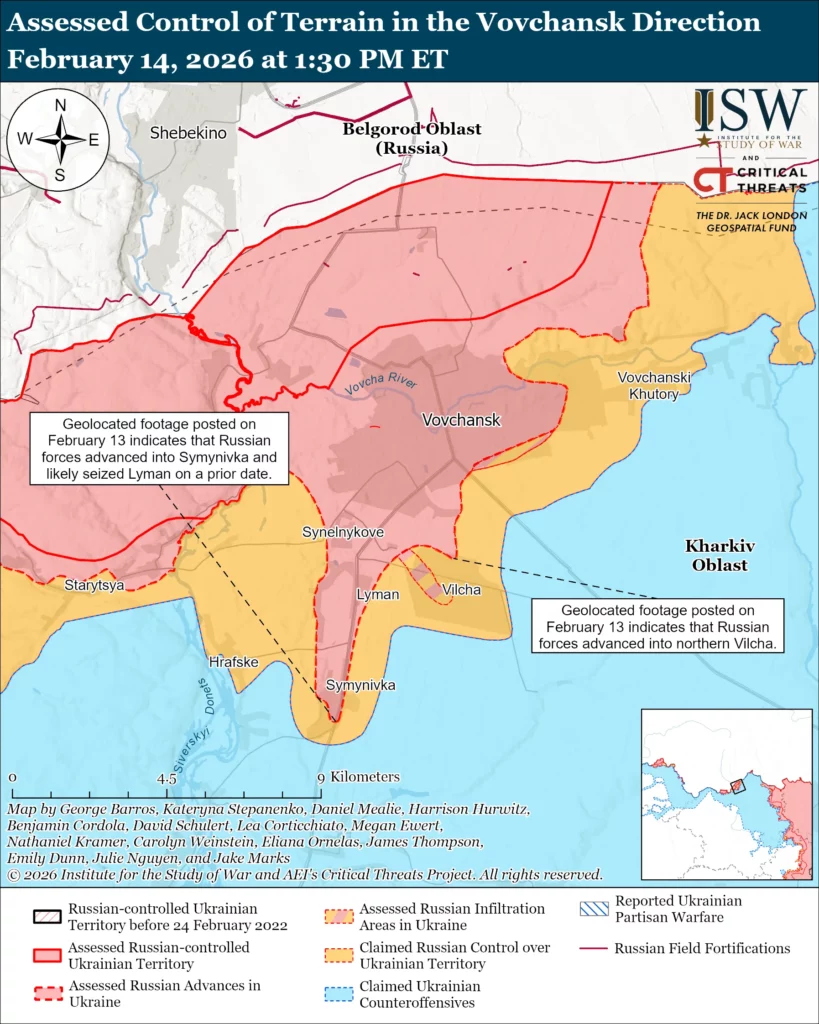
Assessed Russian advances: Geolocated footage published on February 13 indicates that Russian forces recently advanced into northern Symynivka and northwest of and into northern Vilcha (both northeast of Kharkiv City).[25] The footage also indicates that Russian forces likely seized Lyman (northeast of Kharkiv City) and advanced north of Symynivka on a prior date.[26]
Unconfirmed claims: A Russian milblogger claimed that Russian forces advanced southeast of Zelene (northeast of Kharkiv City).[27]
Russian forces attacked northeast of Kharkiv City near Lyman, Prylipka, Vovchansk, Vovchanski Khutory, Hrafske, Starytsya, Symynivka, Zybyne, Mala Vovcha, and Vilcha and toward Okhrimivka and Rybalkyne on February 13 and 14.[28]
Order of Battle: Drone operators and assault elements of the Russian Chechen Zapad-Akhmat Battalion, 116th Rosgvardia Special Purpose Brigade, and 15th Separate Spetsnaz Company (6th Combined Arms Army [CAA], Leningrad Military District [LMD]) are reportedly operating and striking Ukrainian forces near Vovchanski Khutory.[29] Drone operators and other elements of the 83rd Motorized Rifle Regiment (69th Motorized Rifle Division, 6th CAA), Chechen Akhmat Spetsnaz Vakha Battalion (204th Akhmat Spetsnaz Regiment), the Federal Security Service (FSB) Special Purpose Center, and the Rosgvardia Griden Main Center for Ensuring the Security of Senior Officials are reportedly operating in the Kharkiv direction.[30]
Russian forces continued offensive operations in the Velykyi Burluk direction on February 14 but did not advance.
Russian forces attacked northeast of Velykyi Burluk near Khatnie and southeast of Velykyi Burluk toward Kolodyazne on February 13 and 14.[31]
The Ukrainian Joint Forces Task Force reported on February 14 that as of February 13 Russian forces are accumulating personnel and means to resume offensive operations in the Velykyi Burluk direction.[32]
Russian Subordinate Main Effort #2 – Oskil River
Russian objective: Cross the Oskil River in Kharkiv Oblast and push westward into eastern Kharkiv Oblast and northern Donetsk Oblast
Russian forces continued offensive operations in the Kupyansk direction on February 14 but did not advance.
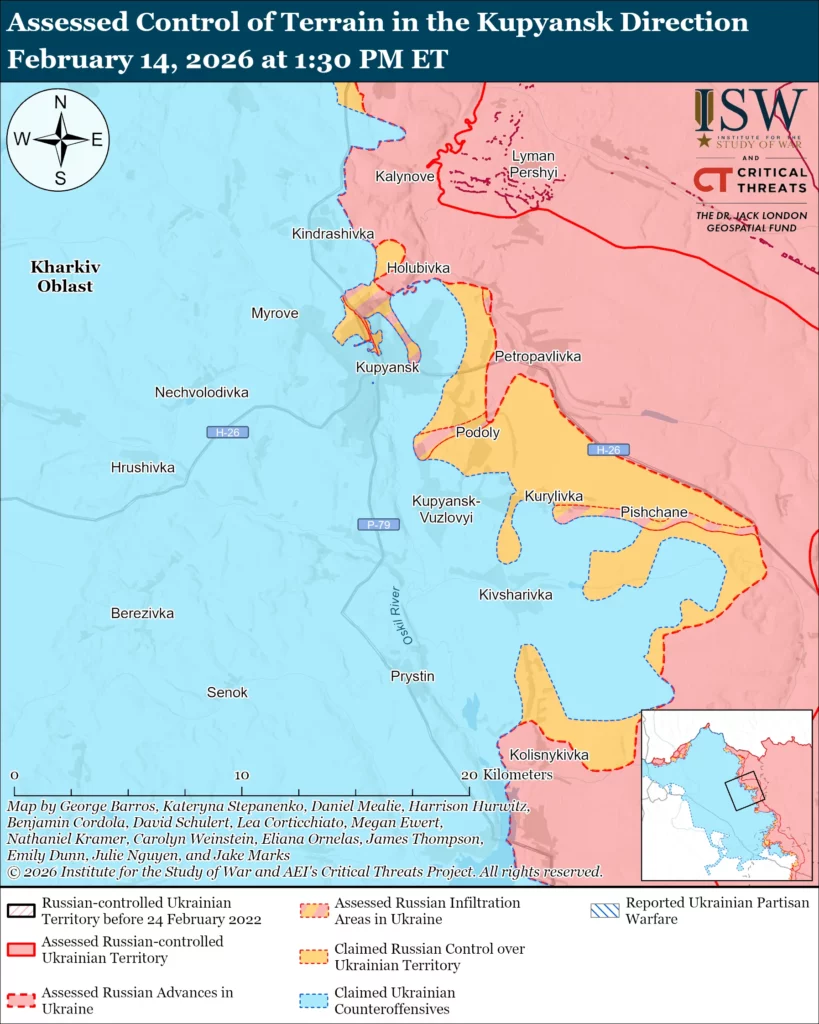
Russian forces attacked east of Kupyansk toward Petropavlivka; and southeast of Kupyansk toward Kupyansk-Vuzlovyi, Pishchane, and Hlushkivka on February 13 and 14.[33]
The commander of a Ukrainian battalion operating in the Kupyansk direction reported that the Russian forces in Kupyansk do not have stable communications or supply lines and only attempt to contact the Russian military command when absolutely necessary.[34] The Ukrainian battalion commander stated that these Russian forces do not have batteries for their radios and cannot leave their positions with the combat support that they would normally request through radio communications. The Ukrainian commander noted that these Russian personnel therefore pose minimal threat to Ukrainian forces and that Ukrainian forces can wait until these personnel surrender rather than engage these personnel in combat. The commander reported that the Russian personnel encircled in Kupyansk are regular infantry of the 27th Motorized Rifle Brigade (1st Guards Tank Army [GTA], Moscow Military District [MMD]) and that three battalions of the brigade, the brigade’s support elements, and elements of several Spetsnaz battalions are operating in the Kupyansk direction.
A Russian milblogger reportedly affiliated with the Russian Western Grouping of Forces claimed that it is difficult to map the control of terrain in Kupyansk, as there is no traditional contested “gray zone” in Kupyansk.[35] The milblogger stated that Russian forces are sending many small groups on assaults to reach Kurylivka, Podoly, and Kupyansk-Vuzlovyi (all southeast of Kupyansk), creating the false perception that Russian forces are attacking with a large wave of infantry. The milblogger noted that this tactic incurs high personnel casualties and that Russian forces have a presence in Kurylivka, Podoly, and Kupyansk-Vuzlovyi but do not have sufficient mass to control them.
Russian forces recently advanced in the Borova direction.
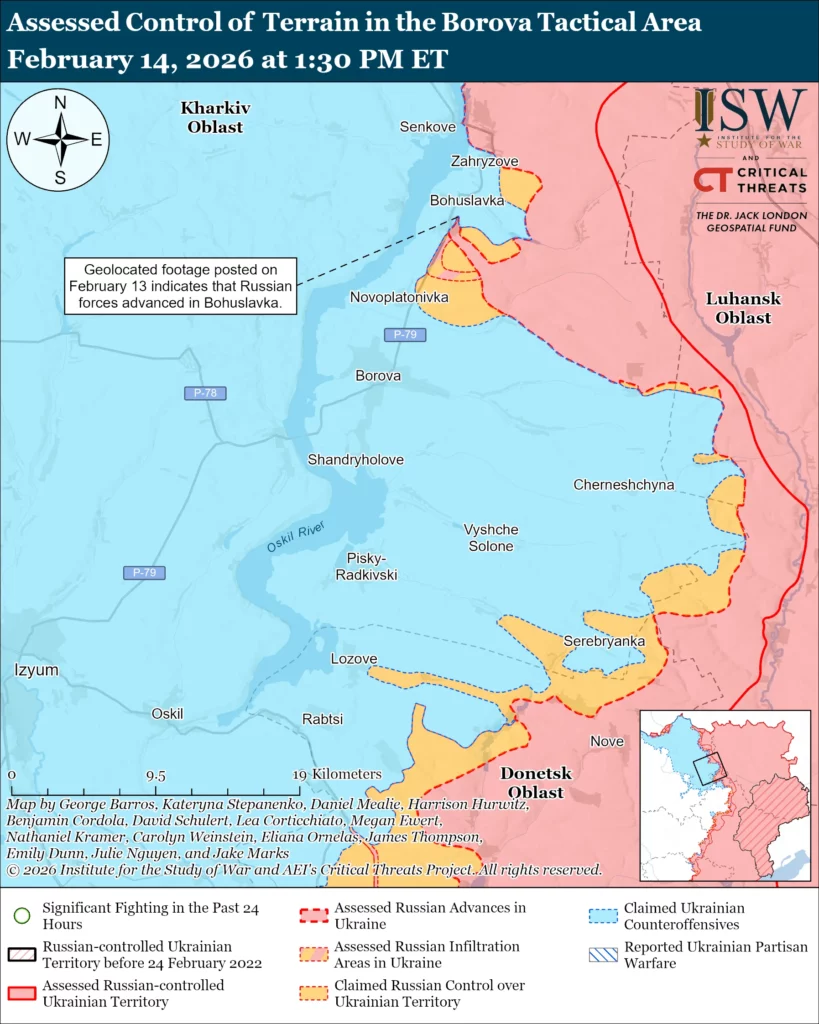
Assessed Russian advances: Geolocated footage published on February 13 indicates that Russian forces recently advanced in eastern Bohuslavka (north of Borova).[36]
Russian forces attacked north of Borova toward Bohuslavka, northeast of Borova near Borivska Andriivka, southeast of Borova near Hrekivka, Karpivka, and Serednie, and south of Borova toward Oleksandrivka on February 13 and 14.[37] A Russian milblogger claimed that Ukrainian forces counterattacked from Krymky (south of Borova).[38]
Russian Subordinate Main Effort #3 – Donetsk Oblast
Russian objective: Capture the entirety of Donetsk Oblast, the claimed territory of Russia’s proxies in Donbas, and advance into Dnipropetrovsk Oblast
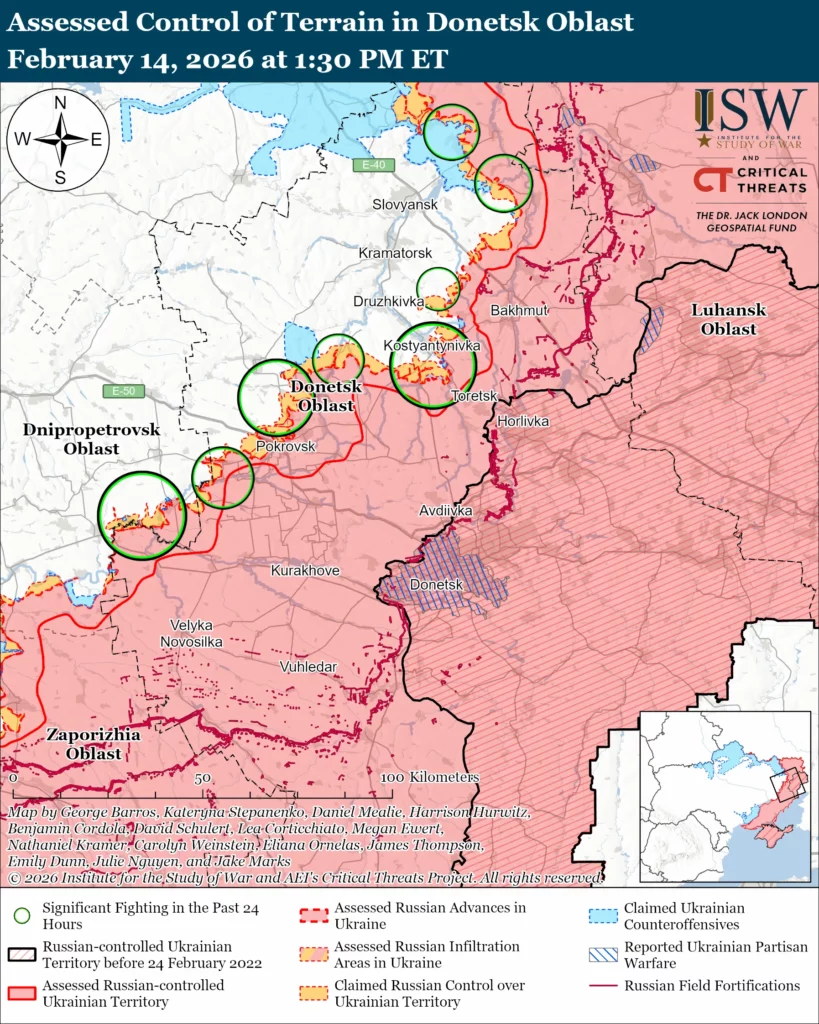
Russian forces recently marginally advanced in the Slovyansk direction.
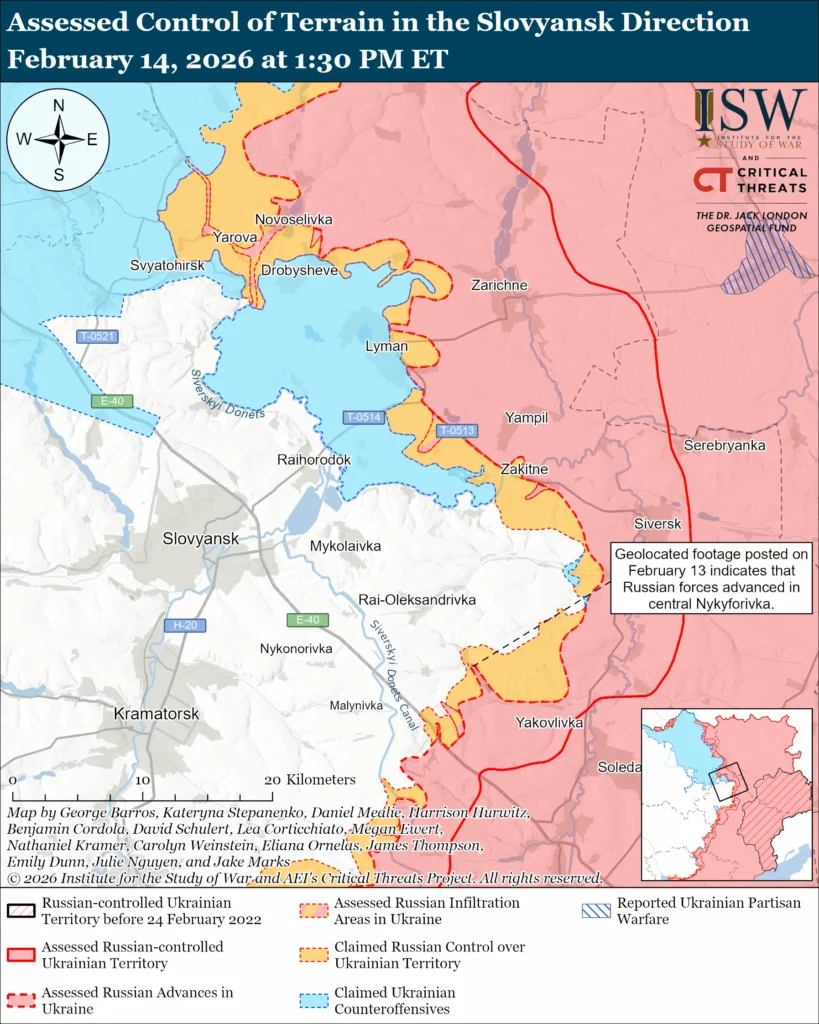
Assessed Russian advances: Geolocated footage published on February 13 indicates that Russian forces recently marginally advanced in central Nykyforivka (southeast of Slovyansk).[39]
Russian forces attacked toward Lyman itself; northwest of Lyman near Drobysheve, Derylove, and Svyatohirsk; north of Lyman toward Stavky; east of Lyman near Zarichne; east of Slovyansk near Platonivka, Zakitne, and Riznykivka and toward Rai-Oleksandrivka, Ozerne, and Kryva Luka; and southeast of Slovyansk near Nykyforivka on February 13 and 14.[40]
A Ukrainian drone group operating in the Slovyansk direction reported on February 13 that Russian forces continue to take advantage of poor weather conditions to conduct small-group attacks toward the Siverskyi Donets River.[41] The Ukrainian drone group noted that Russian forces are significantly increasing reconnaissance and strike drone operations and that Russian forces may be preparing to intensify offensive operations in the Slovyansk direction. The spokesperson of a Ukrainian brigade operating in the Slovyansk direction reported that Russian forces recently managed to cross the Siverskyi Donets River and entered Zakitne after taking advantage of poor weather conditions and a frozen section of the river.[42] The Ukrainian spokesperson noted that the frozen sections of the river have since melted in the area, but noted that Russian forces may attempt to use boats to cross the river and infiltrate into Zakitne.
A Ukrainian commander operating in the Slovyansk direction reported that the recent Starlink outages are not impacting Russian combat operations in the Slovyansk direction as Russian forces primarily use infantry in this direction and rarely send infantry with Starlink terminals.[43]
A Russian milblogger reportedly affiliated with the Russian Western Grouping of Forces claimed that the Russian military command reinforced Russian combat units attempting to overcome Ukrainian defenses in and near Lyman.[44]
Order of Battle: Drone operators of the Russian 283rd Motorized Rifle Regiment (144th Motorized Rifle Division, 20th Combined Arms Army [CAA], Moscow Military District [MMD]) are reportedly striking Ukrainian forces near Drobysheve.[45] Uragan multiple launch rocket system (MLRS) elements of the 73rd Artillery Brigade (25th CAA, Central Military District [CMD]) and drone operators of the Rubikon Center for Advanced Unmanned Technologies are reportedly operating in the Lyman direction.[46]
Russian forces recently advanced in the Kostyantynivka-Druzhkivka tactical area.
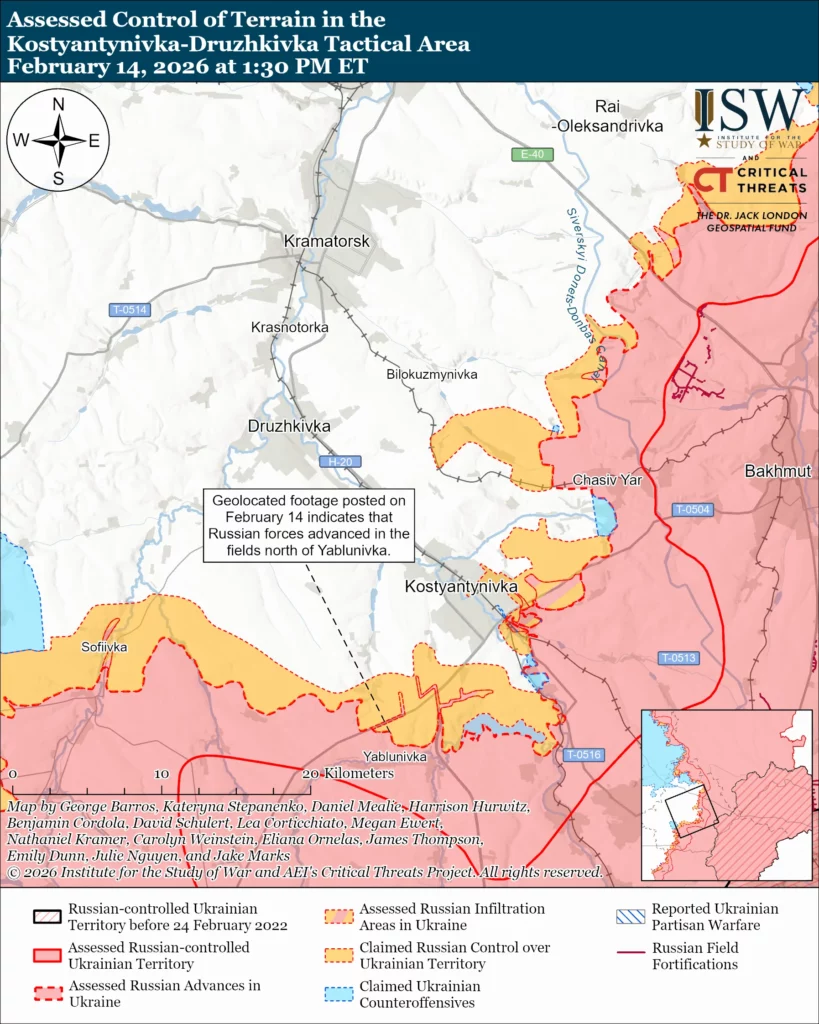
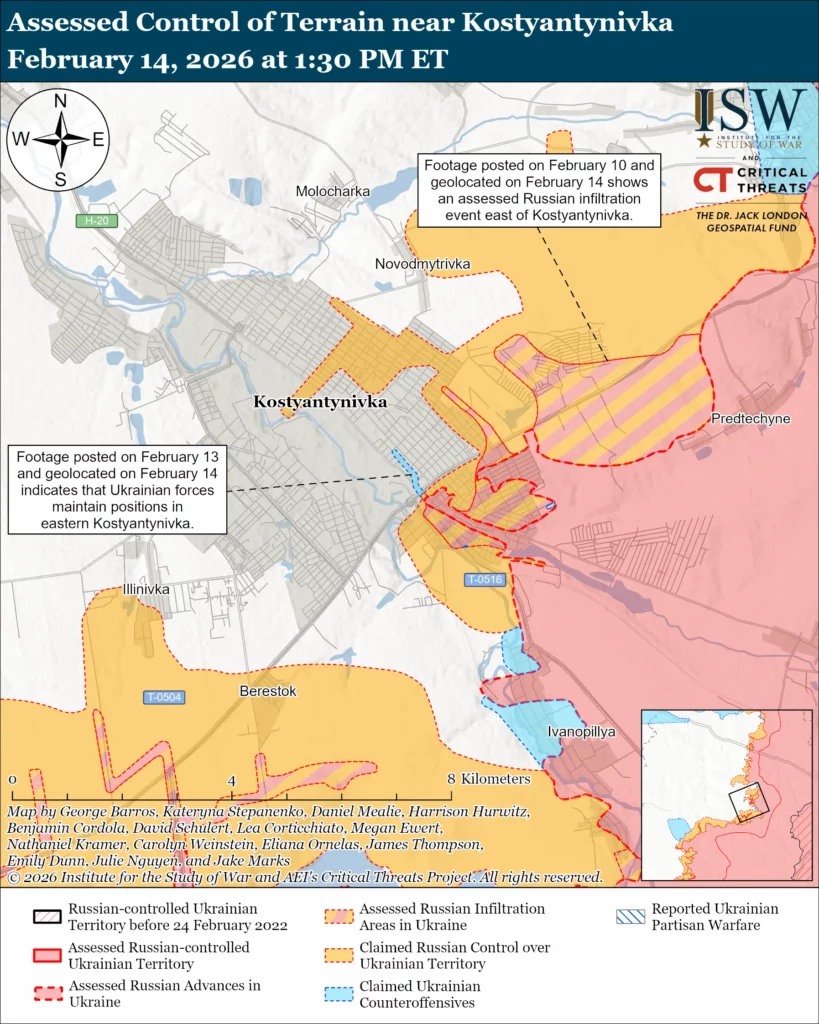
Assessed Russian advances: Geolocated footage published on February 14 indicates that Russian forces recently advanced north of Yablunivka (southwest of Kostyantynivka).[47]
Assessed Russian infiltrations: Geolocated footage published on February 10 shows Ukrainian forces striking a Russian servicemember in the eastern outskirts of Kostyantynivka during what ISW assesses was a Russian infiltration mission that did not change the control of terrain or the forward edge of battle area (FEBA).[48]
Refinement of areas under Russian infiltrations: Geolocated footage published on February 13 shows Ukrainian forces operating without cover in eastern Kostyantynivka – an area where ISW previously assessed that Russian forces conducted infiltration operations.[49] The Ukrainian 19th Army Corps (AC) reported that Ukrainian forces control the railway station in southern Kostyantynivka, contrary to Russian sources’ claims.[50]
Refinement of areas under Russian claims: Geolocated footage published on February 13 shows Ukrainian forces operating without cover in eastern Kostyantynivka – an area where Russian sources previously claimed that Russian forces maintained a presence.[51]
Russian forces attacked near Kostyantynivka itself; northeast of Kostyantynivka near Novomarkove; east of Kostyantynivka near Predtechyne and toward Novodmytrivka; southeast of Kostyantynivka near Pleshchiivka and Kleban-Byk; south of Kostyantynivka toward Illinivka; southwest of Kostyantynivka near Stepanivka; south of Druzhkivka near Rusyn Yar; and southwest of Druzhkivka near Sofiivka and toward Novopavlivka on February 13 and 14.[52]
Order of Battle: First-person view (FPV) drone operators of the Russian 150th Motorized Rifle Division (8th CAA, Southern Military District [SMD]) are striking Ukrainian positions in Pavlivka and reportedly striking Ukrainian equipment near Torske (both southwest of Druzhkivka).[53] FPV drone operators of the 103rd Motorized Rifle Regiment (150th Motorized Rifle Division) are intercepting Ukrainian drones east of Berestok (south of Kostyantynivka).[54]
Russian forces continued offensive operations in the Dobropillya tactical area on February 14 but did not advance.
Russian forces attacked northeast of Dobropillya toward Kucheriv Yar; east of Dobropillya near Vilne, Nove Shakhove, Novyi Donbas, and Toretske; and southeast of Dobropillya near Ivanivka, Dorozhnie on February 13 and 14.[55]
Order of Battle: Scalpel loitering munition operators and artillery elements of the Russian 150th Motorized Rifle Division (8th CAA, SMD) are reportedly striking Ukrainian artillery and drone operators in the Dobropillya direction.[56]
Russian forces continued offensive operations in the Pokrovsk direction on February 14 but did not advance.
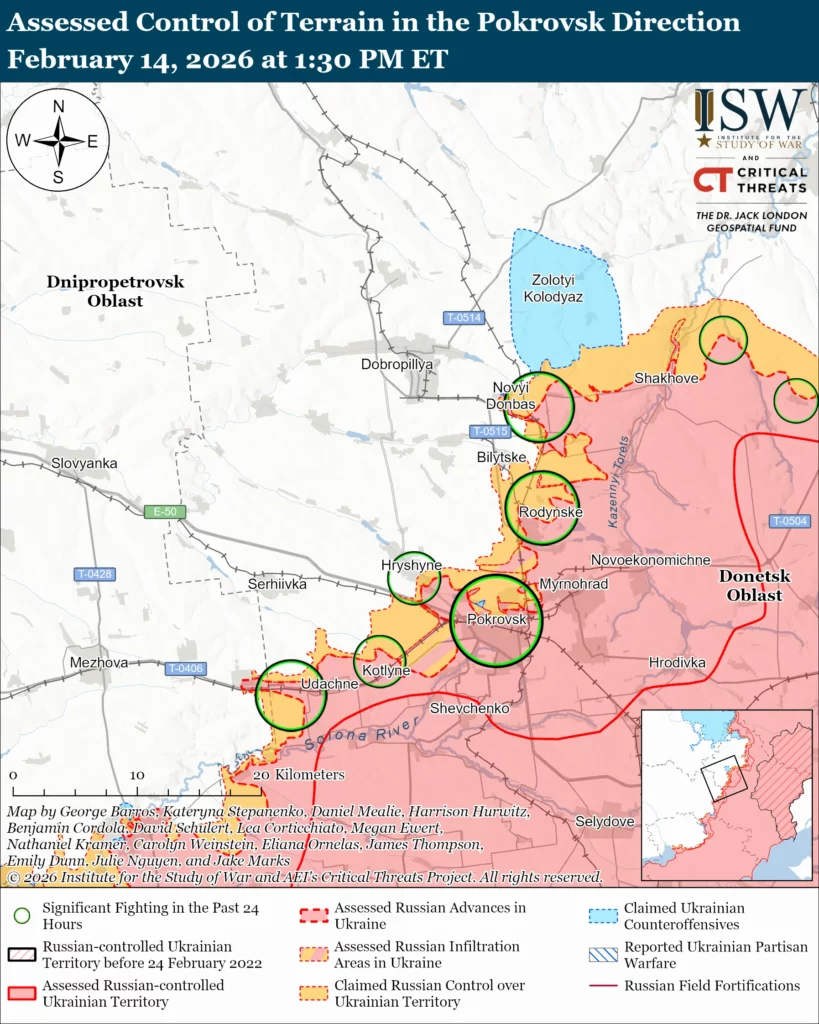
Russian forces attacked near Pokrovsk itself; north of Pokrovsk near Rodynske and Bilytske; northeast of Pokrovsk near Zatyshok and Rivne; southwest of Pokrovsk near Kotlyne, Udachne, Molodetske, and Novopidhorodne; west of Pokrovsk toward Serhiivka; and northwest of Pokrovsk near Hryshyne and toward Shevchenko and Novooleksandrivka on February 13 and 14.[57] A Russian milblogger claimed that Ukrainian forces counterattacked near Molodetske and Udachne.[58]
The Ukrainian General Staff reported that Ukrainian forces struck a Russian ammunition depot near occupied Novoekonomichne (northeast of Pokrovsk in the Russian near rear) on February 13.[59]
Order of Battle: Elements of the Russian 5th Motorized Rifle Brigade (51st CAA, formerly 1st Donetsk People’s Republic [DNR] Army Corps [AC], SMD) are reportedly operating within Myrnohrad (east of Pokrovsk).[60]
Russian forces conducted offensive operations near Novopavlivka itself, northwest of Novopavlivka near Novomykolaivka, and south of Novopavlivka near Dachne and Filiya on February 13 and 14 but did not advance.[61]
Ukrainian forces recently advanced in the Oleksandrivka direction.
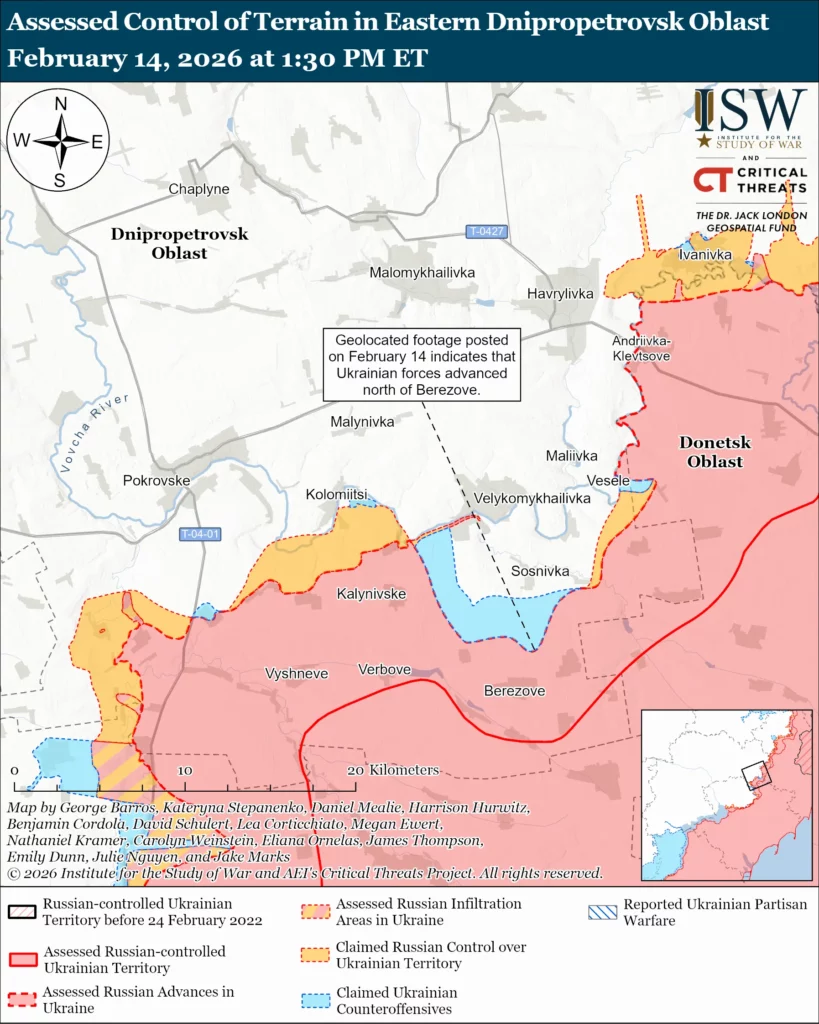
Assessed Ukrainian advances: Geolocated footage published on February 14 indicates that Ukrainian forces recently advanced north of Berezove (southeast of Oleksandrivka).[62]
Unconfirmed claims: A Russian milblogger claimed that Russian forces advanced west of Ivanivka (northeast of Oleksandrivka).[63]
Russian forces attacked toward Oleksandrivka itself, northeast of Oleksandrivka toward Ivanivka and Havrylivka, east of Oleksandrivka near Velykomykhailivka, and southeast of Oleksandrivka near Orestopil, Stepove, Berezove, and Ternove on February 13 and 14.[64] A Russian milblogger claimed that Ukrainian forces counterattacked near Hai (southeast of Oleksandrivka).[65]
A Russian milblogger claimed that the Russian blocking of Telegram exacerbated communications issues from Starlink outages in the Oleksandrivka direction and that Ukrainian counterattacks are taking advantage of these issues.[66] The milblogger claimed that Russian forces can access the internet in some places but that Russian forces can only conduct horizontal communications through Telegram.
Order of Battle: Drone operators of the Russian 14th Spetsnaz Brigade (Russian General Staff’s Main Directorate [GRU]) are striking Ukrainian forces in southern Kolomiitsi (east of Oleksandrivka) and north of Berezove.[67]
Russian Supporting Effort: Southern Axis
Russian objective: Maintain frontline positions, secure rear areas against Ukrainian strikes, and advance within tube artillery range of Zaporizhzhia City
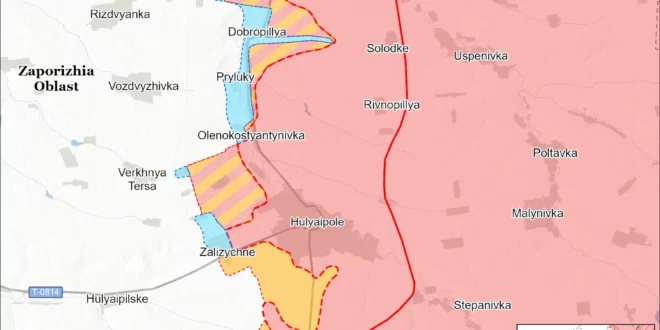
Russian forces continued offensive operations in the Hulyaipole direction on February 14 but did not advance.
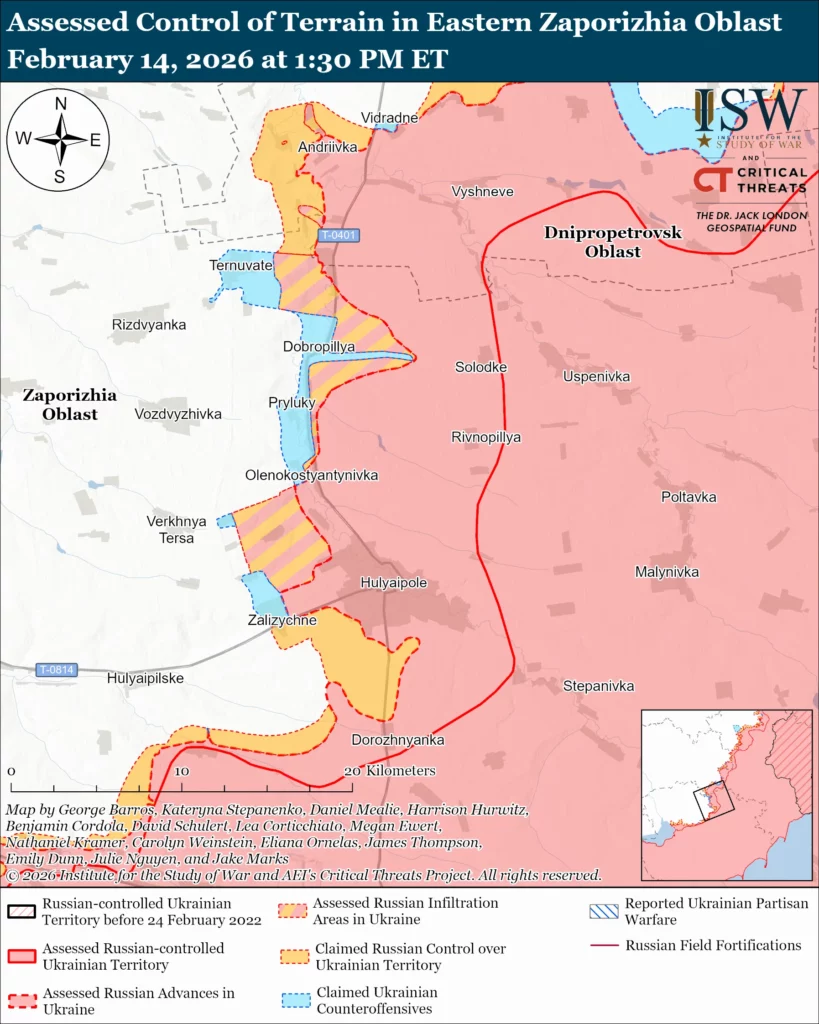
Russian forces attacked near Hulyaipole itself; northwest of Hulyaipole near Ternuvate, Kosivtseve, and Tsvitkove and toward Pryluky and Prydorozhnie; north of Hulyaipole near Dobropillya and Nechaivka; northeast of Hulyaipole near Rybne and Zlahoda; south of Hulyaipole near Dorozhnyanka; southwest of Hulyaipole near Zahirne; and west of Hulyaipole near Staroukrainka and Zaliznychne and toward Krynychne on February 13 and 14.[68] Russian milbloggers claimed that Ukrainian forces counterattacked near Staroukrainka, Zaliznychne, Rybne, Dobropillya, Ternuvate, Zahirne, Bratske, Andriivka, Nove Zaporizhzhia (all three north of Hulyaipole), Vozdvyzhivka, and Kosivtseve (both northwest of Hulyaipole).[69]
Russian milbloggers claimed that there are contested “gray zones” in Ternuvate, Kosivtseve, Prydorozhnie, and Tsvitkove.[70] Russian milbloggers claimed that Starlink outages have caused issues for Russian forces on the battlefield.[71]
Ukrainian military observer Kostyantyn Mashovets reported on February 14 that Ukrainian counterattacks are tactical in nature and that Russian sources are falsely describing the counterattacks as large-scale.[72]
Russian forces continued offensive operations in western Zaporizhia Oblast on February 14 but did not advance.
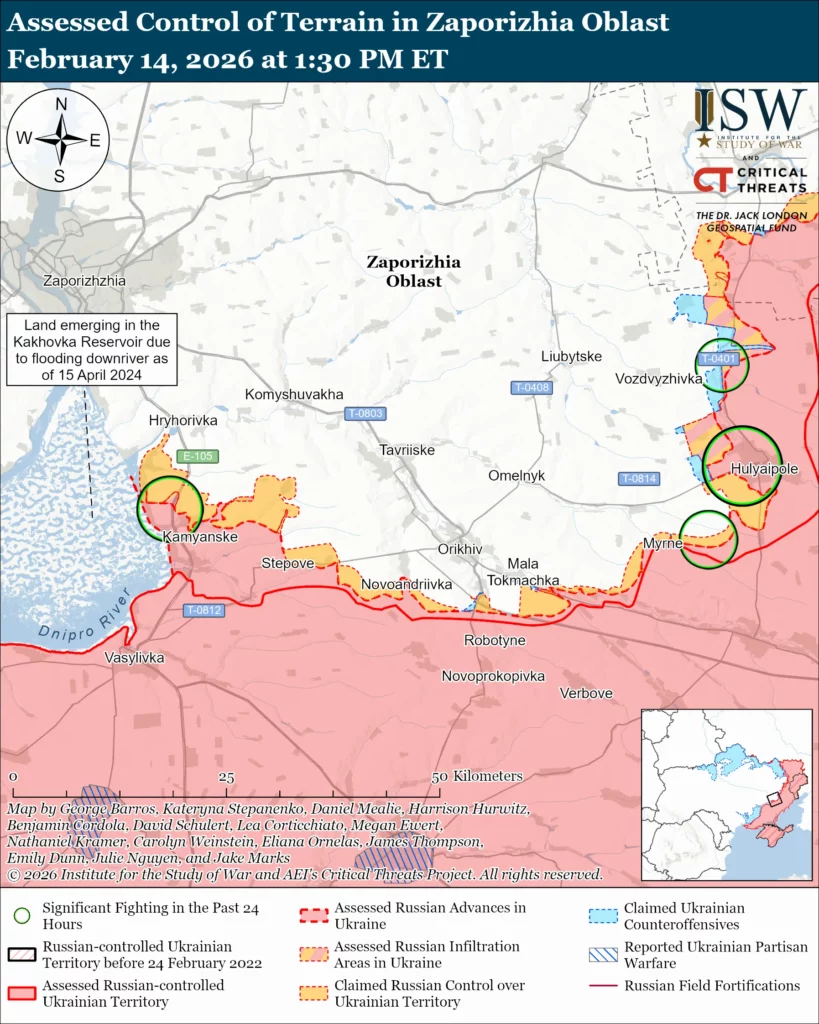
Russian forces attacked south of Orikhiv near Novodanylivka; southwest of Orikhiv toward Novoandriivka; west of Orikhiv near Prymorske, Plavni, and Mali Shcherbaky; and northwest of Orikhiv near Richne, Lukyanivske, Novoyakovlivka, Novoboykivske, and Pavlivka on February 13 and 14.[73] A Russian milblogger claimed that Ukrainian forces counterattacked in Stepnohirsk (west of Orikhiv) and that there is currently a ”gray zone” in the settlement.[74]
Order of Battle: Elements of the Russian 7th Airborne (VDV) Division reportedly continue to operate in Zaporizhia Oblast.[75]
Ukrainian forces continued their mid-range strike campaign against Russian military assets in occupied Zaporizhia Oblast on February 12. The Ukrainian General Staff reported on February 14 that Ukrainian forces struck a Russian communications hub in occupied Prymorsk (approximately 90 kilometers from the frontline).[76]
Russian forces continued limited offensive operations in the Kherson direction on February 14 but did not advance.
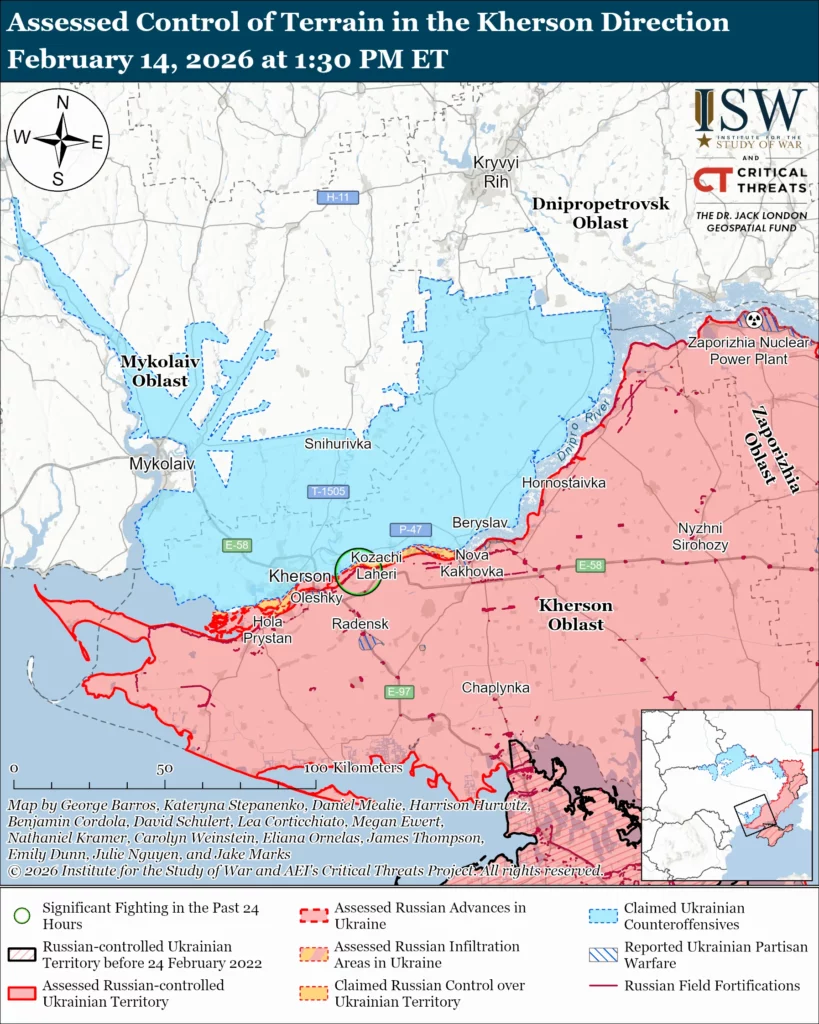
Russian forces attacked in the Kherson direction, including south of Kherson City near Kruhlyk Island, on February 13 and 14.[77]
Ukraine’s Southern Operational Command reported that Russian forces in the Kherson direction are regrouping, reconnoitering the coast and channels of the Dnipro River, establishing logistics, and striking the west (right) bank of the river.[78] A Russian milblogger claimed that Russian forces conducted two unguided glide bomb strikes against Ukrainian drone operators in Vesele (west of Kherson City on the west bank).[79]
Order of Battle: Elements of the 98th Airborne (VDV) Division, including of its 215th Separate Reconnaissance Battalion, are reportedly operating in the Kherson direction.[80]
Ukrainian forces reportedly continue to strike Russian military infrastructure in occupied Crimea. The Ukrainian General Staff reported that Ukrainian forces struck a Russian BK-16 transport and landing vessel near occupied Novoozerne (roughly 204 kilometers from the frontline) and an RSP-10 radar station near occupied Hvardiiske (roughly 185 kilometers from the frontline) on February 12.[81]
Russian Air, Missile, and Drone Campaign
Russian Objective: Target Ukrainian military and civilian infrastructure in the rear and on the front line
Russian forces conducted a series of drone and missile strikes against Ukraine on the night of February 13 to 14. The Ukrainian Air Force reported that Russian forces launched one Iskander-M ballistic missile from Kursk Oblast and 112 Shahed-, Gerbera-, Italmas-type, and other drones – of which about 70 were Shaheds – from the directions of Kursk, Oryol, and Bryansk cities; Primorsko-Akhtarsk, Krasnodar Krai; occupied Donetsk City; and occupied Hvardiiske, Crimea.[82] The Ukrainian Air Force reported that Ukrainian forces downed 91 drones, that 18 drones hit 11 locations, and that drone debris fell at two locations. Ukrainian officials reported that Russian forces struck energy, residential, and administrative infrastructure in Chernihiv, Zaporizhia, Odesa, and Dnipropetrovsk oblasts.[83] Ukraine’s Southern Operational Command reported that Russian forces launched two Kh-31 cruise missiles against Odesa Oblast during the day on February 14 but that the missiles did not reach their targets.[84]
Ukrainian President Volodymyr Zelensky stated on February 14 that Russian forces launched roughly 6,000 drones, most of which were Shahed drones; more than 150 missiles; and more than 5,000 guided glide bombs against Ukraine in January 2026.[85] Zelensky stated that Russian strikes have damaged every power plant in Ukraine. Zelensky reported that Ukrainian forces often shoot down about 90 percent of the Shahed drones that Russian forces launch almost every night but that Russian forces are constantly adapting their Shaheds, including innovations to allow the drones to fly at different altitudes, to operate with Starlink terminals, to act as “motherships” carrying first-person view (FPV) drones, and to be controllable in real time, complicating Ukrainian air defense efforts.[86]
Significant Activity in Belarus
Russian efforts to increase its military presence in Belarus and further integrate Belarus into Russian-favorable frameworks
Nothing Significant To Report.
Note: ISW does not receive any classified material from any source, uses only publicly available information, and draws extensively on Russian, Ukrainian, and Western reporting and social media as well as commercially available satellite imagery and other geospatial data as the basis for these reports. References to all sources used are provided in the endnotes of each update.