Eurasia Press & News
Toplines
Iranian officials are rejecting US offers to engage in negotiations over Iran’s ballistic missile program amid increasing US threats. Iranian Defense Council Secretary Ali Shamkhani told al Jazeera on February 13 that Iran’s missile capability is a “firmly established” element of Iran’s defense doctrine and part of its deterrence mechanism.[1] Shamkhani argued that Iran’s missile capabilities are thus included within Iran’s “defense red lines,” and are not open for negotiation.[2] Shamkhani added that it is “natural” for the “fundamental defense components of states” to be outside the scope of political negotiations.[3] Iran has also not offered concessions on its nuclear program that are close to the US demand of zero enrichment or even close to the restrictions placed on the program under the 2015 nuclear deal.
Iranian officials are refusing to negotiate limits to Iran’s ballistic missile program because the ballistic missile program forms an integral part of Iranian defense strategy. Any changes to this strategy would require a strategic rethink that would take months, if not years. Shamkhani’s remarks indicate that Iran is differentiating between negotiable issues related to the nuclear program and non-negotiable issues related to deterrence and Iran’s military capabilities, rather than signaling future flexibility on missiles after a possible nuclear deal. Iran considers its missile program as its main form of deterrence because it allows Iran to impose costs on its adversaries and compensates for Iran’s weak conventional air capabilities.[4] Former Islamic Revolutionary Guard Corps (IRGC) Commander Mohammad Ali Jafari argued in October 2025 that Iran deliberately prioritized missile and drone development over its air and ground forces to counter the superior capabilities of the United States and Israel, which underscores the reality that if Iran chose to limit its missiles, it would be agreeing to defang itself.[5]
Iran’s continued refusal to negotiate over its ballistic missile program comes after US President Donald Trump warned on February 12 that Iran has roughly one month to reach a deal.[6] Trump added that the United States “ha[s] to make a deal with Iran” or it will be “very traumatic,” adding that Iran will face “a very difficult time” if the deal is not fair.[7] Trump told Fox Business on February 10 that an acceptable deal with Iran would mean “no nuclear weapons, no missiles.”[8] Trump also decided to deploy the USS Gerald R. Ford carrier strike group to the Middle East after he met with Israeli Prime Minister Benjamin Netanyahu on February 11, according to Axios.[9]
The United States smuggled 6,000 Starlink terminals into Iran during the recent protest wave in order to help protesters “circumvent internet shut-offs” and overthrow the regime, according to US officials speaking to the Wall Street Journal.[10] The regime imposed a nationwide internet shutdown on January 8, likely to inhibit protesters’ ability to coordinate gatherings and conceal the regime’s brutal crackdown.[11] Starlink terminals allowed Iranian protesters to maintain internet access in order to communicate with each other and the international community. Iranian doctors used Starlink, for example, to tell The Times on January 17 that the regime‘s crackdown had killed 16,500 protesters and injured around 330,000 protesters.[12] Iranian security forces launched a massive operation on January 12, 2026, to search homes in several cities across Iran and seize Starlink terminal dishes, which indicates the degree of concern the regime has about the use of Starlink.[13]
The regime has taken extreme steps to stop protesters’ use of Starlink, including prior to this recent protest wave. Starlink enabled protesters to connect to the outside world when used during the Masha Amini protests, and protesters during the Mahsa Amini protest wave also demonstrated a significant degree of organization.[14] The Iranian parliament passed a law in late June 2025–after the Israel-Iran War–that criminalized the possession, use, and distribution of Starlink devices.[15] The regime’s threats and efforts to hinder Starlink use indicate that the regime is greatly concerned with the ability of Iranians to coordinate protests and expose regime brutality, as well as the regime’s desire to maintain the capability of imposing similar nationwide internet shutdowns in the future.
US Central Command (CENTCOM) completed its mission to transfer over 5,700 Islamic State in Iraq and al Sham (ISIS) detainees from Syria to Iraq on February 12.[16] ISIS detention facilities in northeastern Syria held an estimated 8,500 ISIS fighters in total prior to CENTCOM’s transfer mission.[17] US forces began to transfer ISIS detainees to Iraq on January 21 after several chaotic and uncoordinated handovers of ISIS detention centers from the Syrian Democratic Forces (SDF) to the Syrian government resulted in the escape of detainees.[18] A US-mediated ceasefire between the Syrian government and SDF enabled CENTCOM and coalition forces to transfer the detainees to Iraq, which required coalition forces to use Hasakah Province highways to transfer detainees from detention facilities to a US airbase or the Iraqi border.[19] The transfer operation sought to decrease the risk that ISIS fighters could escape and help ISIS resurge.[20] Al Qaeda in Iraq fighters freed from prison in Iraq in the early 2010s helped accelerate al Qaeda in Iraq‘s resurgence, which ultimately led to the rise of ISIS.[21]
Iraq is currently beginning its efforts to prosecute the newly transferred detainees.[22] The Iraqi government is holding the detainees at al Karkh Central Prison (formerly known as Camp Cropper), a detention facility in western Baghdad where US forces housed detainees after the US invasion of Iraq in 2003.[23] The Iraqi government transferred over 4,000 detainees from al Karkh to facilities in Babil and Dhi Qar provinces to make room for the transferred detainees from Syria.[24] Iraqi authorities said that the detainees transferred from Syria included about 3,000 Syrian nationals.[25] The other detainees are third-party nationals from about 60 countries.[26] Iraq is continuing to discuss repatriation with the governments of these third-party countries.[27] The Iraqi judge who is leading the interrogations of the ISIS detainees told Western media on February 12 that detainees who committed crimes in Iraq will stand public trial in Iraq.[28]
Syrian forces have assumed control over some but not all ISIS detention facilities and internally displaced person (IDP) camps that the SDF formally oversaw in northeastern Syria.[29] Less than 2,000 Syrian ISIS detainees remain in SDF-run detention centers that are apparently expected to be transferred over to government forces as part of the understandings under the SDF-government integration agreement.[30] People’s Protection Units (YPG) fighters reportedly still control al Sinaa Prison in Ghuwayran neighborhood, Hasakah City, at the time of this writing.[31] SDF-affiliated units also control the al Roj IDP camp, which houses about 2,500 people.[32]
The United States will reportedly withdraw US forces from bases in northeastern Syria “in the coming days and weeks.” US forces completed their withdrawal from al Tanf Garrison in the central Syrian desert as part of a “deliberate and conditions-based transition” on February 11.[33] Syrian government forces took over the base.[34] A US official told Al Monitor on February 13 that the United States is expected to withdraw further troops now that CENTCOM’s detainee transfer mission is complete.[35] Two unspecified US officials told the Washington Post on February 13 that other US bases in northeastern Syria could be transferred to the Syrian government ”in the coming days or weeks.“[36] Al Monitor reported on February 13 that ”several hundred” US troops have withdrawn from al Tanf Garrison and al Shaddadi base, south of Hasakah City.[37] The US withdrawal from key bases in Syria that it once used to support SDF operations illustrates that the United States is gradually shifting its counter-ISIS framework to engage with the Syrian government rather than the SDF, which will soon integrate into Syrian government forces.[38]
ISIS-affiliated residents of al Hol IDP camp have reportedly continued to escape from the camp on February 13, likely due in part to Syrian government forces’ lack of discipline and training. Several pro-government Syrian sources alleged on February 13 that al Hol is “almost empty” of its residents and accused some of the camp’s guards, who are now government forces, of facilitating some residents’ escapes.[39] A Syria-based journalist who cited a locally-based non-governmental organization reported that an unspecified number of Iraqi camp residents escaped through the camp’s main gate on February 13 after Syrian security forces opened the gate.[40] Camp residents later cut through other parts of the camp’s fence, and security forces reportedly did not prevent residents from departing for a nearby village with their belongings.[41] The journalist noted that the Iraqi residents fled the camp after hearing rumors that the SDF-affiliated internal security forces (known as the Asayish) would return to the camp.[42] The Asayish deployed along the road leading to the nearby town of al Hol on February 12 as part of the integration agreement.[43] Pro-SDF media alleged that Syrian government forces either ”smuggled” or ”allowed [camp residents] to leave” before the Asayish deployed to the area.[44] The Syria-based journalist reported that ”very few” Iraqi families remain in al Hol.[45] The residents of al Hol camp are technically IDPs, not ISIS detainees, and none of the camp residents would have been included in the detainee transfers to Iraq. Some significant proportion of the camp residents—particularly the third country nationals—are affiliated with or supportive of ISIS because many are ISIS family members who left the last ISIS territorial possession at Baghouz when it was captured by the SDF in 2019.[46]
Other ISIS-affiliated families have reportedly escaped from al Hol to other Syrian provinces and Lebanon in recent days, possibly with support from ISIS-affiliated networks.[47] A northern Syria-based source reported on February 13 that ISIS-affiliated networks have transported female camp residents to safehouses in Aleppo, Raqqa, and Deir ez Zor provinces.[48] A BBC Salafi-jihadi analyst noted on January 20 that IS supporters had reportedly urged online for sympathizers to travel to the al Hol area to provide shelter and transportation for escaped ISIS detainees.[49]
Insufficient training and the lack of discipline among Syrian government forces have likely contributed to these forces’ inability to maintain order in al Hol camp since assuming control over the camp on January 21.[50] Syrian Interior Ministry forces deployed to the camp after “many” detainees escaped from the camp as the Syrian army initially took control of the camp in an uncoordinated, chaotic transfer following the SDF’s withdrawal from the area.[51] Syrian Interior Ministry forces are a relatively effective and well-disciplined force that has performed well in counterinsurgency efforts against Assadist insurgents in western Syria after the Defense Ministry’s forces massacred Alawites there in March 2025.[52] Interior Ministry forces have also prevented several escape attempts from al Hol since assuming responsibility over the camp.[53] There is no open source evidence that these forces received any training in managing large and violent IDP camps before taking over al Hol, however. The lack of an organized handover means that these units are re-learning lessons that the coalition and SDF had to learn over multiple years with substantial surveillance support from US aircraft.
It is possible that certain government-affiliated fighters are facilitating the departures of the ISIS-affiliated al Hol residents due to a lack of discipline or, in some isolated cases, sympathy with camp residents. Interior Ministry forces may be relatively well-disciplined, but the Syrian government has rapidly expanded its security forces to meet the state’s security needs since the fall of the Assad regime. This approach means that the Syrian government has recruited fighters who formerly fought with al Qaeda or ISIS-affiliated groups during the civil war.[54] An Egyptian member of the 82nd Division, which contains foreign fighters from the al Qaeda-affiliated Ansar al Tawhid, successfully smuggled Egyptian and Chechen ISIS families from the camp on January 25, for example.[55] A senior US official told the Washington Post on February 13 that the United States warned the Iraqi government in Fall 2025 that it was “entirely likely” that ISIS-affiliated detainees or camp residents would be freed or break free if the Syrian government assumed control over the camps and detention facilities.[56] The lack of appropriately trained or disciplined security forces to oversee IDP camps such as al Hol presents a serious threat to counter-ISIS efforts in northern Syria.
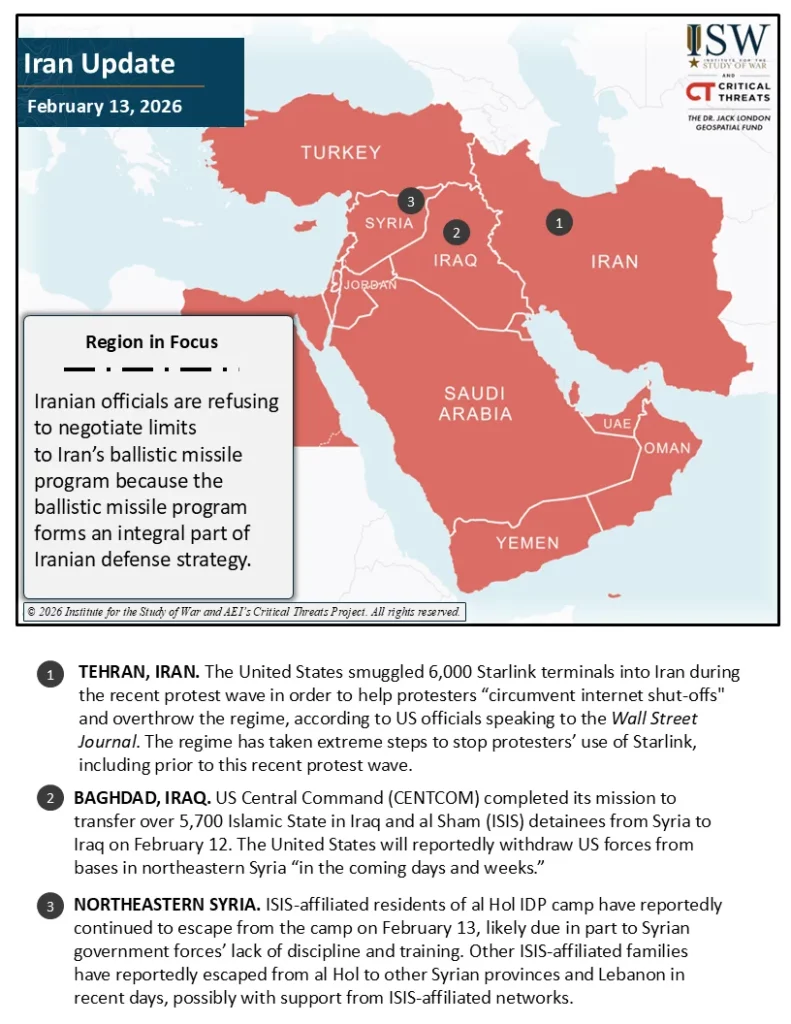
Key Takeaways
US-Iran Negotiations: Iranian officials are refusing to negotiate limits to Iran’s ballistic missile program because the ballistic missile program forms an integral part of Iranian defense strategy. Any changes to this strategy would require a strategic rethink that would take months, if not years.
US Support for Iranian Protests: The United States smuggled 6,000 Starlink terminals into Iran during the recent protest wave in order to help protesters “circumvent internet shut-offs” and overthrow the regime, according to US officials speaking to the Wall Street Journal. The regime has taken extreme steps to stop protesters’ use of Starlink, including prior to this recent protest wave.
US Transfer of ISIS Detainees from Syria to Iraq: US Central Command (CENTCOM) completed its mission to transfer over 5,700 Islamic State in Iraq and al Sham (ISIS) detainees from Syria to Iraq on February 12. The United States will reportedly withdraw US forces from bases in northeastern Syria “in the coming days and weeks.”
Escapes from al Hol Internally Displaced Persons (IDP) Camp: ISIS-affiliated residents of al Hol IDP camp have reportedly continued to escape from the camp on February 13, likely due in part to Syrian government forces’ lack of discipline and training. Other ISIS-affiliated families have reportedly escaped from al Hol to other Syrian provinces and Lebanon in recent days, possibly with support from ISIS-affiliated networks.
Iran
See topline section.
Iraq
Nothing significant to report.
Syria
High-ranking Syrian government and SDF officials met with US Secretary of State Marco Rubio in Munich, Germany, on February 13.[57] Syrian Foreign Minister Asaad al Shaibani, SDF Commander Mazloum Abdi, and Autonomous Administration of North and East Syria Foreign Affairs Co-Chair Ilham Ahmed met with Rubio on the sidelines of the 2026 Munich Security Conference.[58] Abdi described the meeting with Rubio as ”positive” and said that all parties will ”try to solve” ongoing problems with the ceasefire.[59]
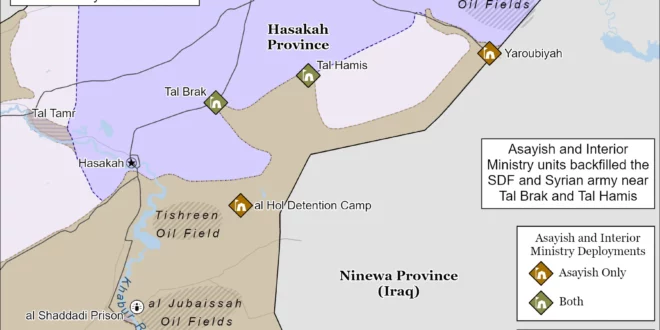
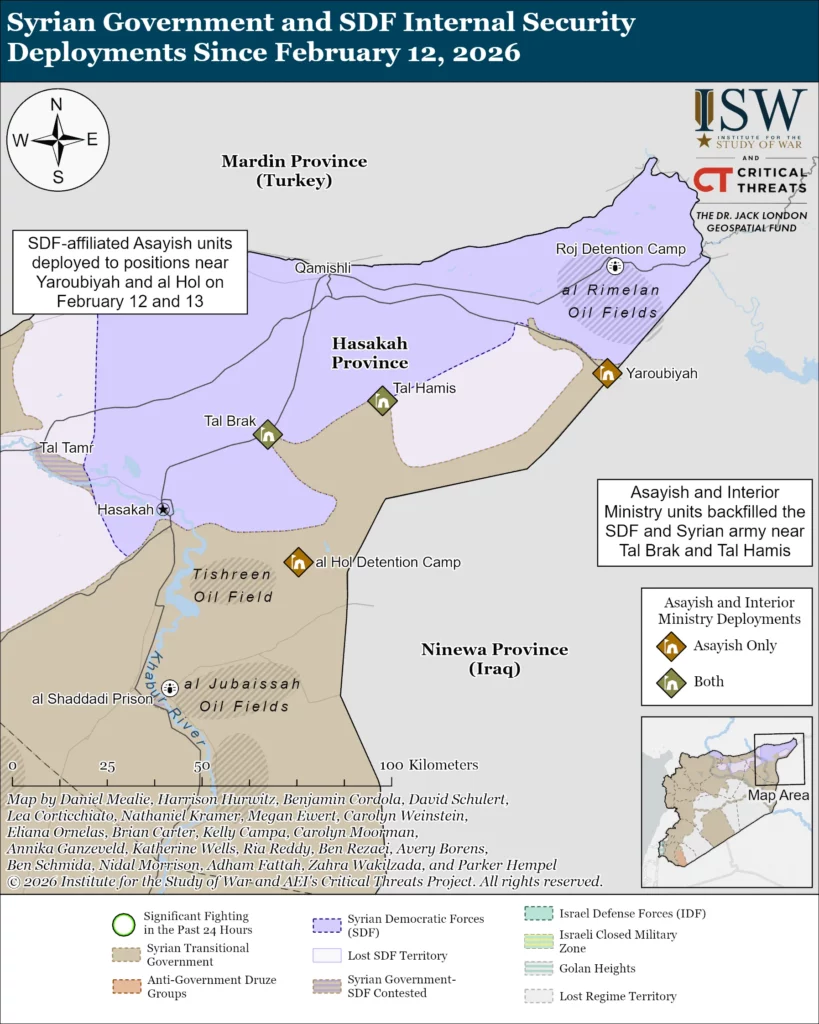
Syrian government and SDF-affiliated internal security forces deployed to positions in Hasakah Province on February 12 and 13 as part of the SDF-Syrian government ceasefire. The January 30 agreement requires Syrian army and SDF units to withdraw from frontlines and their respective internal security units to backfill these positions.[60] SDF-affiliated Asayish units backfilled the SDF in Yaroubiyah, near the Iraq-Syria border, and in Tal Hamis and Tal Brak, north of Hasakah City, on February 12 and 13.[61] Syrian Interior Ministry forces also backfilled the Syrian army in positions near Tal Hamis and Tal Brak on February 12.[62] A northern Syria-based source reported on February 13 that ”large groups” of tribal fighters arrived at the entrances to Tal Brak and Tal Hamis.[63]
Syrian President Ahmed al Shara issued a decree that formally appointed Noureddine Issa Ahmed as the governor of Hasakah Province on February 13.[64] Ahmed, who is the SDF’s nominee for governor, began his duties on February 7.[65] SDF spokesperson Farhad Shami criticized the government in an interview with Kurdish media on February 12 for not issuing an official decision to appoint Ahmed.[66]
Syrian President Ahmed al Shara’s tribal affairs adviser met with the Raqqa governor and multiple tribal leaders in Raqqa Province on February 12.[67] Shara’s Tribal Affairs Adviser, Jihad Issa al Sheikh, discussed opening an Office of Tribes and Clans Directorate in Raqqa Province with Raqqa Governor Abdul Rahman Salameh and Syrian Tribal Council Chairman Sheikh Abdel Moneim al Nassif.[68] The parties also discussed improving communication between the Syrian government and local Raqqa communities.[69] Shara appointed Sheikh in September 2025 to strengthen the Syrian government’s relationship with Syrian tribes.[70] The mobilization of Raqqa Province tribal fighters during the government’s offensive on SDF-held territory in January 2026 was instrumental to the SDF’s collapse in the province.[71] The government’s ability to build and maintain existing positive relationships with tribal leaders and communities in northern Syria will be one of the decisive factors in determining the success of Raqqa’s full integration into the state and the government’s ability to govern successfully.
Arabian Peninsula
CTP-ISW suspended its coverage of Yemen beginning on January 9.
Palestinian Territories & Lebanon
The Lebanese Armed Forces (LAF) is continuing its efforts to counter Hezbollah smuggling amid preparations for the LAF to begin the second phase of Hezbollah’s disarmament. Lebanese media reported on February 12 that Lebanese officials have recently acknowledged the LAF’s progress toward preventing Hezbollah from smuggling weapons into or within Lebanon.[72] The LAF has seized multiple weapons shipments in recent months from weapons traffickers in the Bekaa Valley’s Baalbek and Hemel districts.[73] CTP-ISW cannot confirm from open sources whether this represents all or only a small portion of LAF counter-smuggling activity, however. The LAF has continued to close illegal border crossings along the Lebanon-Syria border in recent months, including in the northern Bekaa Valley on February 12.[74] The Lebanese government estimated in July 2025 that about 136 illegal crossing points exist on the Lebanon-Syria border.[75] Hezbollah has previously worked with prominent Bekaa Valley clans who control illegal border crossings in the area to smuggle weaponry into Lebanon.[76] The LAF’s efforts come amid the LAF’s preparations to present its plan to disarm Hezbollah between the Litani and Awali rivers to the Lebanese government on February 16.[77]