Eurasia Press & News
Toplines
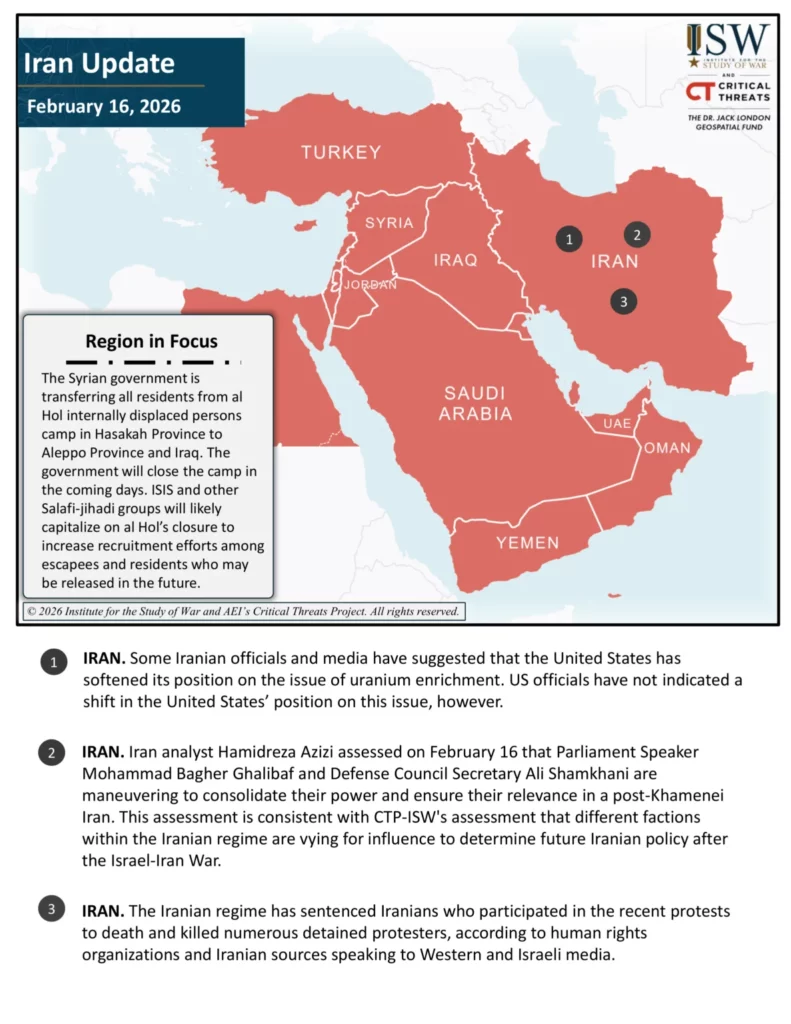
The Syrian government is transferring all residents from al Hol internally displaced persons (IDP) camp in Hasakah Province to Aleppo Province and Iraq.[1] The government will close the camp in the coming days.[2] The Syrian government had reportedly planned to close both al Hol and al Roj IDP camps by the end of 2026, but al Hol’s early closure is almost certainly a response to the reported escape of over 10,000 residents from the camp since the Syrian Democratic Forces (SDF) withdrew from the camp on January 20. The Syrian government told the United Nations (UN) that it is relocating the remaining families from al Hol to Akhtarin camp in northern Aleppo Province.[3] Syrian and Iraqi officials reportedly agreed on February 14 to transport al Hol’s remaining Iraqi population back to Iraq.[4] A significant proportion of al Hol camp residents — particularly third country nationals — are family members of ISIS fighters and left the last ISIS territorial possession at Baghouz when it was seized by the SDF in 2019.[5]
The extreme mismanagement of the al Hol IDP camp handover created the conditions for residents to escape or depart from the camp. The SDF withdrew from the camp on January 20 as its forces collapsed in the wake of the government’s major offensive to take over Kurdish-held territory in northeastern Syria.[6] Multilateral organization and aid officials told a Syria-focused analyst that at least 10,000 al Hol residents escaped from the camp during the six hours between the SDF’s withdrawal and the Syrian army’s arrival at the camp on January 20.[7]
Syrian government forces were able to briefly restore security within the camp but were unable to maintain it, likely due to insufficient training, personnel, and discipline.[8] Interior Ministry forces deployed to al Hol on January 21 and were able to briefly re-establish security at the camp.[9] CTP-ISW has not observed any evidence that these forces received training in managing large and dangerous IDP camps before taking over al Hol. The United States previously trained SDF forces at al Hol to properly manage the camp. Interior Ministry forces reportedly lacked sufficient forces to complete basic security tasks such as manning the camp’s perimeter.[10] Government forces were unable to contain a “mass riot” by Syrian residents on February 10, and “thousands” of residents reportedly escaped the camp between February 10 and 12.[11]
It is also possible that certain government-affiliated fighters have facilitated the escape of Islamic State in Iraq and al Sham (ISIS)-affiliated al Hol residents due to sympathy for these residents.[12] A local nongovernment organization (NGO) worker told news outlet the New Region on February 16 that dozens of foreign fighters affiliated with the Syrian transitional government transferred many foreign ISIS-linked women and their children from al Hol to Idlib Province.[13] The worker said that some of the women married foreign fighters in the Syrian army.[14] An unspecified source in Idlib told an analyst focused on Kurdish issues that several ISIS-linked women and children also traveled from al Hol to other camps along the Turkish border, including Firqat al Ghuraba’s camp.[15] Firqat al Ghuraba is a French, Salafi-jihadi-aligned foreign group that resides in a compound on the Syria-Turkey border in Idlib Province.[16]
ISIS and other Salafi-jihadi groups will likely capitalize on al Hol’s closure to increase recruitment efforts among escapees and residents who may be released in the future. Over 10,000 al Hol residents have reportedly escaped the camp since January 20 to other Syrian provinces and Lebanon.[17] Many of these residents have ties to ISIS, and they may have escaped from the camp with support from ISIS-affiliated networks and may support ISIS recruitment.[18] Some of the residents from al Hol are hardened ISIS supporters, and some will face severe isolation from their communities upon their return. The thousands of escapees may be unable to successfully reintegrate into Syrian society, particularly without Syrian government support. Isolation has historically led to recidivism. ISIS remains a viable insurgency in Syria that aims to recruit fighters, and isolation provides an opportunity for ISIS or other Salafi-jihadi groups to generate support networks in areas where ISIS insurgents are active or in areas where they were not previously active.[19]
The Syrian transitional government will also likely struggle to rehabilitate and integrate ISIS-affiliated families and individuals from al Hol that are transferred to Aleppo Province, which further risks creating an opportunity for ISIS recruitment in Syria. The government reportedly intends to assess residents from al Hol camp for potential release and reintegration after relocating them to Akhtarin camp in northern Aleppo Province.[20] Iraq has faced immense challenges since it began repatriating thousands of ISIS-affiliated families and IDPs in 2021. The Iraqi government struggled to integrate ISIS families and IDPs into their new communities, and returnees often faced extreme isolation and suspicion from these communities, which in many cases were victims of ISIS violence.[21] The treatment of returnees by their neighbors was not dependent on whether or not the returnees were actually ISIS supporters; their neighbors usually assumed any returnee was associated with ISIS.[22] The presence of ISIS-affiliated cells in major Syrian urban areas also increases the risk that ISIS may attempt to recruit released and reintegrated al Hol residents. Syrian security officials told United Arab Emirates (UAE)-based media on February 14 that ISIS fighters have moved from the central Syrian desert to their hometowns near major urban areas such as Aleppo, Hama, and Damascus.[23]
US Central Command (CENTCOM) has completed its withdrawal from al Shaddadi base in northeastern Syria.[24] The Syrian Ministry of Defense (MoD) announced that it assumed control of al Shaddadi base in Hasakah Province on February 15 after CENTCOM withdrew its forces from the base.[25] A local source reported that US forces prepared to withdraw from the base following the Syrian government’s offensive against the SDF in January.[26] US forces established al Shaddadi base in 2017 to support the SDF’s efforts to counter ISIS.[27] CENTCOM’s handover of al Shaddadi base to the MoD is a further indication that the United States has shifted its counter-ISIS partner from the SDF to the Syrian government. CENTCOM’s withdrawal from al Shaddadi base follows CENTCOM’s withdrawal from the al Tanf Garrison in the central Syrian desert and the successful transfer of over 5,700 ISIS detainees from northeastern Syria to Iraq.[28] The Washington Post reported on February 13 that US forces will withdraw from Syria in “the coming days and weeks.”[29]
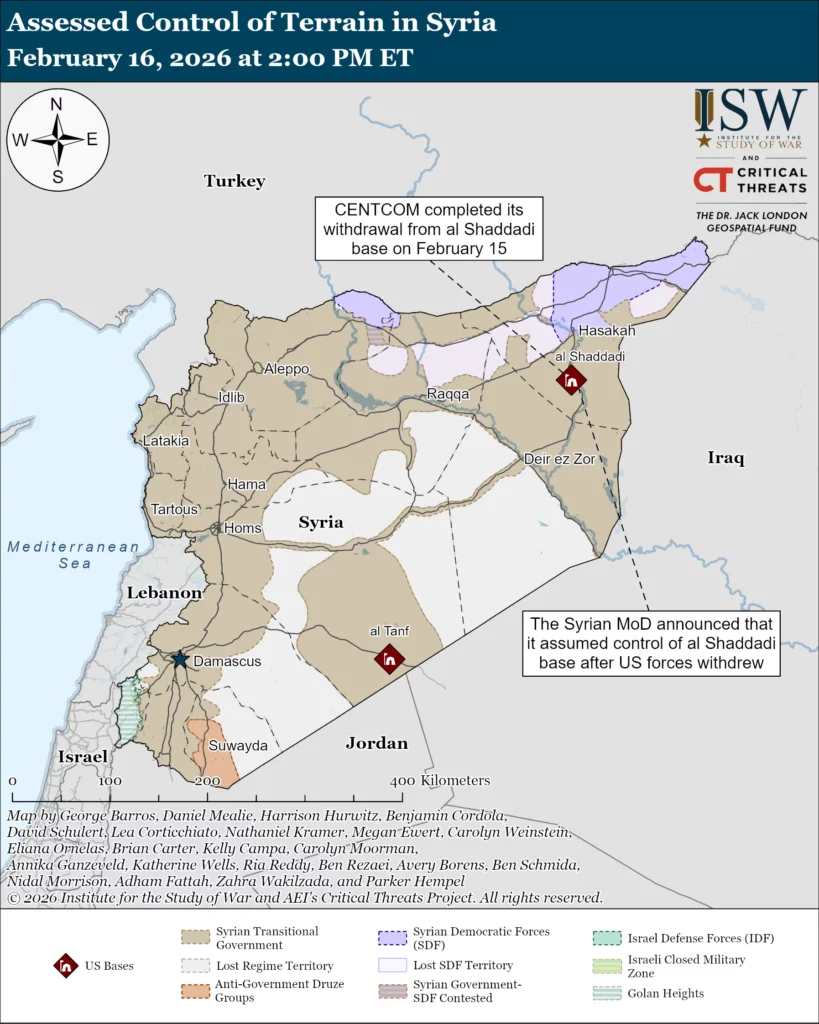
Several Arab tribes and clans in northeastern Syria, which have historically opposed the SDF, threatened to mobilize forces against the SDF if the Syrian government and the SDF continue to implement the January 30 agreement. Twelve sheikhs of Arab tribes and clans in Hasakah Province sent a letter to Syrian President Ahmed al Shara on February 15 in which they demanded that the Syrian government dissolve the SDF, including the SDF-affiliated Revolutionary Youth Movement, and halt SDF raids and arrests against Arabs in SDF territory.[30] Multiple human rights organizations have accused the SDF-affiliated Revolutionary Youth Movement of forcibly recruiting child soldiers within SDF territory.[31] The letter also called for the Syrian government to deploy the MoD and General Security Service (GSS) forces throughout Hasakah Province to establish complete state control over the province and its border crossings with Iraq.[32] The Arab tribes threatened to declare a general mobilization of tribal forces inside and outside of Syria against the SDF if the government failed to meet their demands or if the government attempted to implement the January 30 agreement “by force.” [33] The sheikhs of the Jabour tribe, the Sharabin tribe, the al Tai clan, and the al Halabsa clan were among the signatories of the letter.[34] The Jabour and al Tai clan have both historically opposed the SDF and any form of Kurdish autonomy in Syria. Both tribes previously sided with the Assad regime to suppress the 2004 Kurdish uprising in Qamishli, Hasakah Province.[35] Arab tribes inside and outside of SDF territory have repeatedly mobilized or threatened to mobilize against the SDF since the fall of the Assad regime in December 2024 for a variety of reasons.[36]
Some Iranian officials and media have suggested that the United States has softened its position on the issue of uranium enrichment. US officials have not indicated a shift in the United States’ position on this issue, however. The United States and Iran will hold a second round of nuclear talks, led by Iranian Foreign Affairs Minister Abbas Araghchi and US Special Envoy to the Middle East Steve Witkoff, in Geneva, Switzerland, on February 17.[37] Iranian Deputy Foreign Affairs Minister for Political Affairs Majid Takht Ravanchi told the BBC on February 16 that the United States understands that it must focus exclusively on the nuclear issue if it seeks to reach a deal with Iran. Ravanchi added that, “as far as Iran is concerned,” the US demand for zero enrichment is “not on the table anymore.”[38] Islamic Revolutionary Guards Corps (IRGC)-affiliated media similarly claimed on February 16 that the United States has agreed that negotiations will only address Iran‘s nuclear program and accepted the “principle of enrichment.”[39] US President Donald Trump told reporters on February 13 that the United States does not “want any enrichment,” however.[40]
Iranian officials have continued to offer limited nuclear concessions. Ravanchi stated in his interview with the BBC that Iran is willing to dilute its highly enriched uranium stockpile if the United States lifts sanctions on Iran.[41] Ravanchi did not specify what level Iran would be willing to dilute its highly enriched uranium to. Some regime officials have recently suggested that Iran could limit its enrichment to 20 percent, which is far above the 3.67 percent limit outlined in the 2015 nuclear deal.[42] An Iranian journalist close to the regime reported on February 13 that Iran rejected a recent proposal from Witkoff to halt enrichment for three to five years and then enrich uranium at 1.5 percent.[43] The journalist added that the proposal also called on Iran to transfer its roughly 400 kilograms of 60 percent enriched uranium.[44] Ravanchi stated in his interview with the BBC that it is “too early to say” whether Iran would be willing to transfer its 60 percent enriched uranium stockpile. The BBC noted that Iran previously transferred 11,000 kilograms of enriched uranium to Russia under the 2015 nuclear deal. The 11,000 kilograms included Iran’s most highly enriched uranium at the time, uranium enriched to 20 percent.[45] Iran has since produced over 400 kilograms of uranium enriched to 60 percent, which is enough uranium, if enriched further, to produce at least 10 nuclear weapons.[46]
CTP-ISW continues to assess that any agreement that lifts sanctions on Iran without seriously limiting Iran’s ability to develop its ballistic missile and drone programs or provide support to the Axis of Resistance would pose a long-term threat to US interests in the region by enabling Iran to reconstitute these capabilities. Ravanchi emphasized in his interview that Iran will not negotiate on its ballistic missile program.[47] He stated that Iran’s ballistic missiles “came to [Iran’s] rescue” during the Israel-Iran War.[48] Iran fired multiple missile barrages at Israel during the war and conducted a missile attack on al Udeid Airbase in Qatar.[49] Iran’s use of missiles during the war highlights how Iran’s missile program poses a threat to US forces and allies in the Middle East.
Iran is proposing economic incentives that are unrelated to core US demands regarding the nuclear talks, likely as part of an effort by the regime to extract US concessions on its key demands regarding Iran’s ballistic missile program and support for its proxies and partners. Iranian Deputy Foreign Affairs Minister for Economic Diplomacy and member of the Iranian negotiating team, Hamid Ghanbari, stated on February 15 that the first round of US-Iran nuclear talks on February 6 included discussions on economic cooperation in the fields of oil, gas, and minerals, as well as the possible purchase of US aircraft.[50] Ghanbari added that any deal must be economically beneficial to the United States for it to be sustainable.[51] Ghanbari’s statement echoes Araghchi’s statement on February 1 that a nuclear deal could lead to “great opportunities for economic cooperation” between the United States and Iran.[52] Iran may calculate that the United States may be more willing to focus solely on Iran’s nuclear program in the ongoing talks if Iran offers economic incentives.
Iran is continuing to try to deter and prepare for military escalation in and near the Strait of Hormuz amid US threats to attack Iran. The IRGC Navy began a “Smart Control of the Strait of Hormuz” exercise on February 16 to test the readiness of IRGC Navy units and review security plans.[53] Rapid reaction battalions reportedly practiced offensive and defensive tactics, tested missiles, and conducted operations in “electronic warfare conditions.”[54] “Smart control” may refer to targeting and preventing specific vessels from transiting the Strait of Hormuz.[55] Artesh Navy Deputy Commander Rear Admiral Faramarz Bemani separately inspected the Shahid Nezafat Naval Base in Pasabandar, Sistan and Baluchistan Province, which is located near the entrance of the Gulf of Oman, on February 15.[56] These security efforts come amid the ongoing US military buildup in the region, including the upcoming arrival of the USS Gerald R. Ford carrier strike group.[57] Trump reportedly told Israeli Prime Minister Benjamin Netanyahu on February 11 that the United States will increase economic pressure on Iran and “go full force” on its maximum pressure campaign.[58] US officials told the Wall Street Journal on February 11 that the Trump administration was considering seizing Iranian tankers transporting oil but held off due to concerns about Iran’s retaliation.[59] The IRGC Navy exercise and Artesh inspection are likely at least partially part of a broader Iranian effort to deter US action by highlighting Iran’s willingness and ability to retaliate.
Iran analyst Hamidreza Azizi assessed on February 16 that Parliament Speaker Mohammad Bagher Ghalibaf and Defense Council Secretary Ali Shamkhani are maneuvering to consolidate their power and ensure their relevance in a post-Khamenei Iran. This assessment is consistent with CTP-ISW’s assessment that different factions within the Iranian regime are vying for influence to determine future Iranian policy after the Israel-Iran War.[60] The Iranian regime established the Defense Council after the Israel-Iran War to streamline decision-making during wartime.[61] A political analyst close to the Iranian regime reported on February 5 that the Defense Council will operate independently of the Supreme National Security Council (SNSC).[62] Azizi reported on February 16 that Supreme Leader Ali Khamenei agreed to allow the Defense Council to operate independently “at the insistence” of Ghalibaf.[63] Ghalibaf’s role in making the Defense Council an independent institution is consistent with previous reports that he played a significant role in the initial establishment of the council in August 2025.[64] CTP-ISW previously assessed that Ghalibaf’s involvement in the establishment of the Defense Council was part of a broader trend of pragmatic regime elements leading the restructuring of Iran’s decision-making apparatus following the 12-day war.[65]
Shamkhani-affiliated media has also played a significant role in advocating for and supporting the Defense Council and recently reported on February 5 that President Masoud Pezeshkian had appointed Shamkhani as secretary of the Defense Council.[66] Azizi reported that the regime did not intend to publicize the Defense Council’s independence or Shamkhani’s appointment as secretary “to avoid signaling internal frictions.”[67] Shamkhani-affiliated media may have publicized Shamkhani’s appointment to highlight his prominent position within the regime, however.[68] The Defense Council’s independence may enable the council and its secretary to play an important role in shaping Iran’s security and defense policies and thereby consolidate Ghalibaf and Shamkhani’s authority within the regime.
The Iranian regime has sentenced Iranians who participated in the recent protests to death and killed numerous detained protesters, according to human rights organizations and Iranian sources speaking to Western and Israeli media.[69] Israeli media, citing Iranian sources and human rights organizations that monitor developments in Iran, reported on February 16 that the Iranian regime has sentenced hundreds of protesters to death.[70] The same sources told Israeli media that security forces have killed thousands of detained protesters.[71] The Israeli media report comes after a Western media outlet, citing Iranian lawyers defending detained protesters in Iran, reported on February 6 that the Iranian regime plans to execute thousands of protesters.[72] A human rights organization reported on February 13 that the Iranian judiciary ordered the execution of a protester in Qom Province.[73] Another human rights organization and Iranian diaspora media separately reported on February 12 and 13, respectively, that security forces killed two detained protesters.[74]
Key Takeaways
Counter-ISIS Efforts in Syria: The Syrian government is transferring all residents from al Hol internally displaced persons camp in Hasakah Province to Aleppo Province and Iraq. The government will close the camp in the coming days. ISIS and other Salafi-jihadi groups will likely capitalize on al Hol’s closure to increase recruitment efforts among escapees and residents who may be released in the future.
US-Iran Negotiations: Some Iranian officials and media have suggested that the United States has softened its position on the issue of uranium enrichment. US officials have not indicated a shift in the United States’ position on this issue, however.
Iranian Internal Politics: Iran analyst Hamidreza Azizi assessed on February 16 that Parliament Speaker Mohammad Bagher Ghalibaf and Defense Council Secretary Ali Shamkhani are maneuvering to consolidate their power and ensure their relevance in a post-Khamenei Iran. This assessment is consistent with CTP-ISW’s assessment that different factions within the Iranian regime are vying for influence to determine future Iranian policy after the Israel-Iran War.
Iranian Regime’s Crackdown on Protesters: The Iranian regime has sentenced Iranians who participated in the recent protests to death and killed numerous detained protesters, according to human rights organizations and Iranian sources speaking to Western and Israeli media.