 Eurasia Press & News
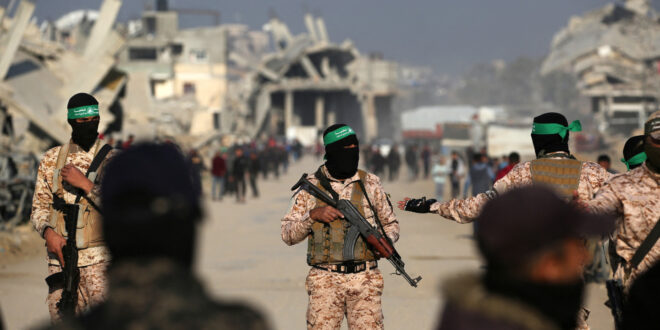
Recent threats from Hamas’s armed wing against Israeli-backed militias in Gaza have heightened concerns that tensions will escalate into open confrontation
Recent threats by Hamas’s armed wing, the Al-Qassam Brigades, against Israeli-backed militias operating in Gaza have raised fears about the possibility of an impending armed confrontation.
A complex network of clans, militias, and criminal gangs, some with links to the Islamic States, first came to prominence during the war on Gaza in the summer of 2024, receiving support from Israel to undermine Hamas’s authority.
Since the ceasefire in October, they have continued to operate in the 58% of Gaza under Israeli military control, reportedly receiving shelter, weapons, financing, and protection. Immediately after the truce last year, fierce clashes broke out with armed groups as Hamas sought to reassert control.
On 9 February, in a series of posts on the Telegram channel of the Al-Qassam Brigades, Hamas issued a series of explicit threats.
“The despicable acts perpetrated by these undercover collaborators against our people and their honourable resistance fighters reflect nothing but complete alignment with the occupation, the implementation of its agendas, and a division of roles with it,” Hamas military spokesperson Abu Obeida said.
“The dark fate of the tools of the occupation is near, and their punishment is killing and inevitable disappearance, and the enemy will not be able to protect them from the justice of our people,” he added.
In December, Hamas announced the death of Abu Obeida in an Israeli airstrike, ending months of speculation about his fate after Israel claimed to have killed him in August 2025. His replacement also bears the name Abu Obeida.
The threats, thought to be the first of their kind issued by Hamas since the ceasefire in October, follow the growing prominence of rival armed groups and an escalation in attacks.
In December, one of the most prominent armed leaders, Yasser Abu Shabab, who led the ‘Popular Forces’ militia, was shot and killed during a family dispute.
In late January, the Popular Forces published a video on its Facebook page showing Abu Shabab’s replacement, Ghassan al-Dahini, together with Adham al-Akar, a Hamas commander whom the group claimed to have captured. Al-Dahini also issued threats against Hamas, with the video prompting widespread public anger.
Some weeks earlier, Hussam al-Astal, the leader of the Counterterrorism Strike Force militia based in Khan Younis, posted a video claiming responsibility for the killing of a senior Hamas member in the southern Gaza city.
A rejection of Israeli-backed militias
Writer and political analyst Iyad al-Qarra said public opinion in Gaza is characterised by a widespread and clear rejection of armed militias, both at a social and political level.
“The recent Al-Qassam statement reinforces this general mood and grants it clear legitimacy, not only at the popular level but also at the factional level, in confronting militias,” he told Al Araby al Jadeed, the Arabic-language sister publication of The New Arab.
According to the analyst, Israel is using these armed groups in direct security operations, including assassinations, espionage, surveillance, and monitoring. This extends to Israel protecting them in a manner closely resembling the ‘Mista’arvim’, elite Israeli undercover units disguised as Palestinians.
“The danger posed by these groups has recently escalated, particularly after developments related to the Rafah crossing, where they have been accused of participating in tightening restrictions on citizens, especially those returning from Egypt, including acts of torture and violations, which constituted an additional factor prompting this clear move against them,” al-Qarra said.
“These groups enjoy no popular support, even within their own family, and are widely viewed as tools of the Israeli occupation, explaining the comprehensive rejection of them at various levels.”
At present, the armed groups thought to be operating in Gaza include the Abu Shabab gang in Rafah, the Ashraf al-Mansi militia in north Gaza, the Rami Helles gang east of Gaza City, and the Shawqi Abu Nassira militia northeast of Khan Younis, which was formed in November.
A failed experiment
“Historical experience confirms that occupation forces, when they fail to break the will of people militarily, resort to ‘engineering treason’ by manufacturing functional entities that perform the role of security agents under civilian or tribal titles,” writer and researcher on military and security affairs, Rami Abu Zubida, told Al-Araby Al-Jadeed.
Israel, he says, is planning on integrating these groups into security arrangements in post-war Gaza, a strategy which so far has been comprehensively rejected by various Palestinian political parties and Gaza’s new technocratic committee, confirming their perceived status as outlaws and collaborators.
Israel itself is also experiencing “internal divisions” in dealing with these militias, Abu Zubida says, explaining that the Shin Bet views them as “intelligence assets” it seeks to preserve and isolate in the areas of Gaza under Israeli control.
This is not out of concern for their safety, he adds, but due to the reputational damage and future ability to recruit agents if the militias collapse in a similar way to the South Lebanon Army in 2000.
Given their criminal background and even potential threat to Israeli civilians, the Israeli military establishment, specifically the Military Intelligence Directorate, views these groups as “a security and moral burden,” Abu Zubida says.
Ultimately, however, the expert says that the loyalty of these militias is governed by money, rather than ideological affiliation.