 Eurasia Press & News
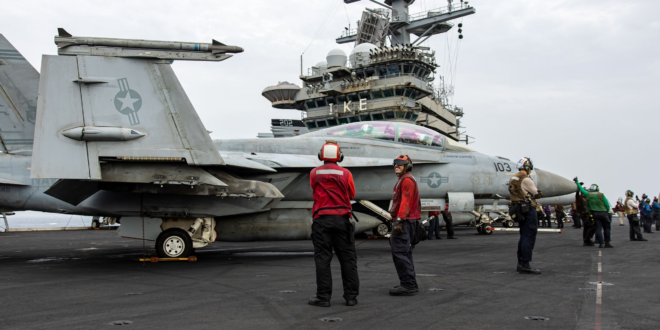
The United States’ rapid military buildup across the Gulf has triggered a familiar anxiety in Iran, but the Iranians’ reading of American intentions has grown sharper and more layered than at any point in recent years.
Iranian officials and analysts now assume that the goal is neither a full-scale war nor a symbolic show of force. Instead, they believe the US is preparing for a short, high-impact military campaign that would cripple Iran’s missile infrastructure, undermine its deterrent, and reset the balance of power after the 12-day war with Israel in June 2025.
In Tehran’s view, this is not just about forcing Iran back into nuclear compliance; it is about permanently altering the strategic equation that allowed it to strike Israel directly for the first time and suffer minimal consequences. Iran’s strategic community has been unusually candid in public. Commentators aligned with the establishment argue that Washington’s demands are no longer confined to the nuclear file.
The analysis circulating in Tehran describes American goals as a series of concentric pressures: first to limit enrichment, then to dismantle the missile arsenal, then to roll back Iran’s regional network of partners, and finally to push the Islamic Republic into a position of long-term structural weakness. Israel’s role reinforces this interpretation. In Tehran’s telling, Israeli officials now view the US military presence less as a bargaining chip and more as the opening stage of a multi-week campaign aimed at eliminating Iran’s second-strike capability.
Every new deployment confirms that belief. Yet despite the pressure, few in Tehran think Iran will “cave in.” The lesson Iranian leaders drew from the June 2025 conflict is that deterrence, not restraint — or President Donald Trump’s intervention — forced Israel to halt. The idea that Iran might offer deep concessions under the threat of force runs counter to the worldview of Supreme Leader Ali Khamenei and the security establishment. And because the regime is already under heavy domestic strain — economic exhaustion, social unrest, and what Iranian officials describe as coordinated psychological warfare — capitulation under pressure is viewed as an existential threat.
From defense to offense
Diplomacy may continue, but Tehran will not willingly dismantle the missile program that the regime believes spared the country from far greater devastation in the last war. Instead, Tehran has begun articulating what amounts to a counter-strategy of calibrated escalation. In a shift unprecedented since the 1980s, senior military officials now openly describe a move from a defensive posture to an offensive doctrine.
The chief of staff of the Armed Forces, Maj. Gen. Abdolrahim Mousavi, recently stated that Iran has “revised its defense doctrine and shifted to an offensive doctrine … [in which] our action will be swift, decisive, and unconstrained by America’s calculations.” The Defense Council went further, declaring that “the Islamic Republic does not consider itself limited to responding only after an attack; objective signs of threat are now part of its security calculus.”
In parallel, the country’s supreme leadership has framed the next conflict not as a limited exchange but as a region-wide confrontation. “If you start a war, it will become a regional war,” Ayatollah Khamenei warned recently, a line that dovetails with the emerging doctrinal emphasis on multi-domain, multi-geography retaliation.
Rather than wait for a US strike, Iranian commanders now hint that Tehran may widen or regionalize the conflict the moment it begins — or even pre-empt it altogether. This resembles the “madman strategy” that Iranian writers increasingly describe: If cornered and forced to choose between war and surrender, Iran would opt for a form of controlled chaos — one that places US bases, Gulf oil installations, and regional shipping within immediate reach of missile and drone fire. The aim is not to defeat the United States but to raise the costs of continuation so sharply that Washington hesitates before a second round.
This shift is not without its critics inside the Islamic Republic. Some in Iran’s political sphere caution that enthusiasm for confrontation is dangerous, and that those who treat war casually misread the moment. Elsewhere, influential voices — including establishment analysts such as Mostafa Khoshcheshm — warn against taking war lightly, emphasizing that Donald Trump seeks only a low-cost show of force, not a real conflict, and that miscalculation could trigger uncontrollable escalation.
Still, for all of these warnings, Iran’s leaders appear to believe that the conditions today differ fundamentally from earlier crises. In the past, Tehran issued maximalist threats while acting with caution. Today, however, the regime’s survival is being seriously questioned in ways that it has not for decades, and senior officials frame the confrontation as existential. This is why Iran’s emerging doctrine seems to accept far greater risk: It cannot deter a strike, but it can raise the price of any continued conflict to a level that forces the United States to think harder before escalating. In Tehran’s view, this time the struggle is not about bargaining leverage — it is existential.
Potential off-ramps
Within this strategy, off-ramps exist, but they are narrow and politically fraught. The indirect talks in Geneva created a set of “guiding principles” for a possible agreement, and both sides claim the atmosphere has improved. But the framework is skeletal, and the gap between what the United States demands and what the Islamic Republic of Iran is willing to concede remains enormous.
Tehran may accept technical steps to reduce enrichment levels or allow the International Atomic Energy Agency (IAEA) access to specific sites, but it will not negotiate over its missile program under pressure, nor will it suspend its regional alliances to satisfy the US or Israel. That is its position as of today. According to Iranian officials and analysts, for a true diplomatic breakthrough to occur, the United States would need to offer sanctions relief with credible guarantees, and Iran would have to accept intrusive oversight by an agency it deeply distrusts.
That agency — the IAEA — still occupies a strange but important place in the crisis. Rafael Grossi, its director-general, has cast the Geneva process as a fragile but real opening. He emphasizes that the IAEA’s technical solutions can still verify peaceful intent and provide a foundation for broader diplomacy. But many in Tehran now see the IAEA’s role as political, not technical. After Israel’s June 2025 strikes and the US decision to hit three nuclear facilities itself, Iranian officials concluded that inspections were being weaponized to create pretexts for pressure, not to build trust. Grossi’s insistence that the agency can serve as a bridge matters diplomatically, but in Tehran the perception is growing that the bridge may lead to disaster.
Iran suspects the inspection framework is meant to give diplomatic cover to a path that ends in a limited but decisive military strike. That logic points toward the scenario many analysts now consider most likely: a short, intense conflict — larger than the 12-day war but short of a full-scale invasion. Washington can say it took decisive action, Israel can argue it has broken Iran’s deterrent, and Iran can retaliate enough to claim defiance without triggering a broader regional collapse.
Such a conflict would be fraught with wider dangers, but bizarrely could be one that both sides would find preferable to the alternatives. As long as Washington does not use airstrikes to foment regime change, Tehran may be willing to take the pain of large-scale but otherwise limited strikes rather than agree to concessions it has long considered unacceptable. Likewise, Trump would be able to claim that he further degraded Iran’s military, nuclear, and missile programs, as well as inflicted the kind of pain that could bring Tehran around on negotiations either in the short or long terms. He could then walk away, as he has in other instances, while threatening to hit Iran again at some later time if it does not kowtow to his demands.
The final wild card is, therefore, the one Iranian officials fear most: that the United States and Israel will synchronize military pressure with a renewed push for internal destabilization. Iranian elites openly talk about this possibility, the so-called hybrid war option. They worry that covert action, information warfare, economic suffocation, and targeted strikes could together spark a new domestic uprising and tip the balance at a moment of maximum vulnerability.
For Tehran, the threat is not merely incoming missiles but an American-Israeli strategy that blends external attack with internal fragmentation. In that scenario, deterrence becomes more complicated, and retaliation may not be enough to restore balance. It is the scenario in which attacks on regional oil infrastructure and even the US homeland — with cyberstrikes, drones, or terrorist operations — would become plausible.
This is the landscape in which diplomacy now operates: a narrow corridor between escalating military preparations, rigid political red lines, and deep mistrust. Grossi may still believe that a technical agreement can stop the slide toward war, but every sign on the ground suggests otherwise. The Trump administration most likely aims for a limited conflict that reshapes the balance of power without trapping it in a quagmire. Iran’s leaders think they can survive such a strike as long as they retaliate hard enough to deter the next one.