 Eurasia Press & News
Toplines
Iran is unlikely to make any meaningful nuclear concessions in its upcoming draft proposal to the United States. Iran may calculate that it can delay the strikes if it offers a sufficiently conciliatory proposal, however. US President Donald Trump gave Iran on February 20 a deadline of “10 to 15 days” to agree to a nuclear deal. Current and former US officials speaking to the Washington Post on February 19 said that the United States may be ready to launch an extended military assault on Iran but is waiting for the arrival of the USS Gerald R. Ford.[1] Iranian Foreign Minister Abbas Araghchi stated in an interview with Western media on February 20 that Iran will present a proposal to the United States “in the next two or three days” that can then be “seriously” discussed in a future round of talks to occur “within a week or a little more.”[2] Araghchi also claimed that the United States did not demand zero uranium enrichment during the last round of US-Iran nuclear talks in Geneva on February 17.[3] A US official speaking to MS Now on February 20 clarified that the US negotiating team confirmed Trump‘s zero-enrichment demand but told Iran to present the safeguards it will place on its nuclear program.[4] Araghchi may have been attempting to delay future talks, which is a negotiating strategy the regime has previously adopted with the United States.[5] Iranian negotiators have previously offered to dilute enrichment levels or build a regional enrichment facility on Iranian soil, which clearly do not meet the stated US demand for zero enrichment, in order to continue negotiations without encroaching on Iran’s red lines.[6]
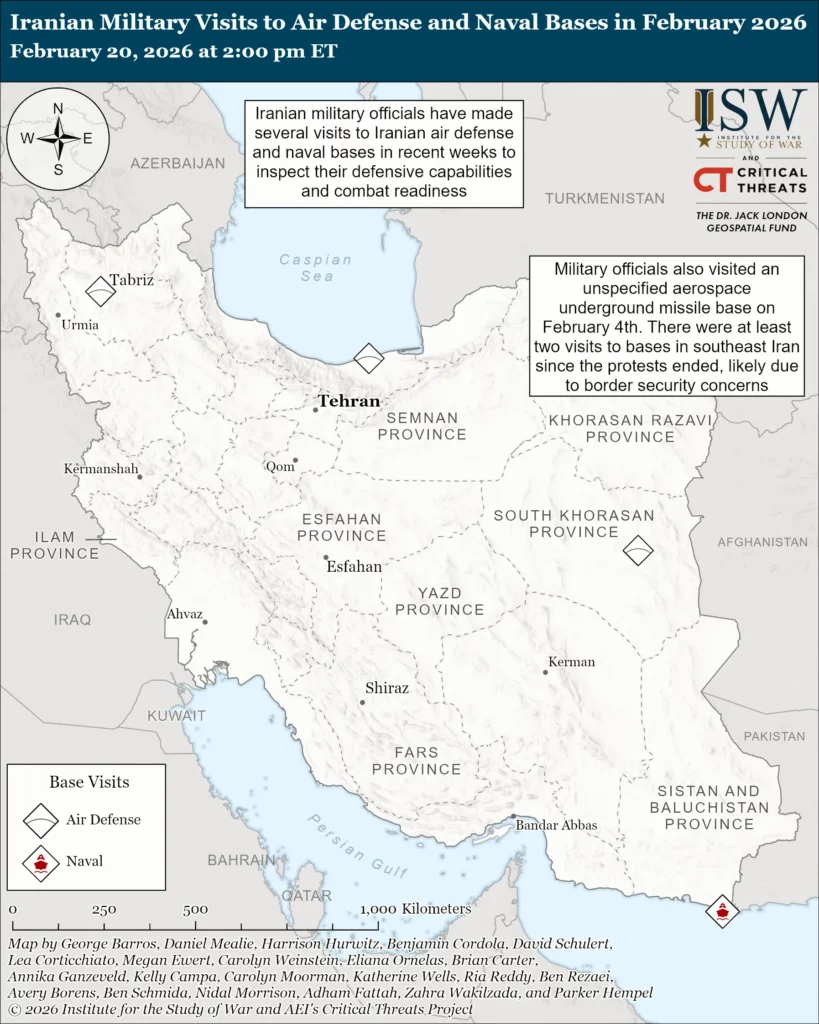
Iran could use any delay in talks to continue to prepare for a potential military conflict with the United States or Israel. Iranian military officials have made numerous visits to Iranian air defense and naval bases in recent weeks to inspect their defensive capabilities and combat readiness.[7] Khatam ol Anbiya Air Defense Headquarters Commander Brigadier General Alireza Elhami visited the Khatam ol Anbiya Northwestern Air Defense Zone Base in Tabriz, East Azerbaijan Province, on February 10, the Shahid Zarafati Group in Babolsar, Mazandaran Province, on February 18, and the Khatam ol Anbiya Eastern Air Defense Zone Base in Birjand, South Khorasan Province, on February 20.[8] Artesh Navy Deputy Commander Rear Admiral Faramarz Bemani also inspected the Shahid Nezafat Naval Base in Pasabandar, Sistan and Baluchistan Province, on February 15.[9] Armed Forces General Staff Chief Major General Abdol Rahim Mousavi and Islamic Revolutionary Guards Corps (IRGC) Aerospace Commander Brigadier General Majid Mousavi inspected an unspecified IRGC aerospace underground missile facility on February 4.[10] All of these inspections are presumably last-ditch efforts to ensure that the Iranian armed forces are as prepared as possible.
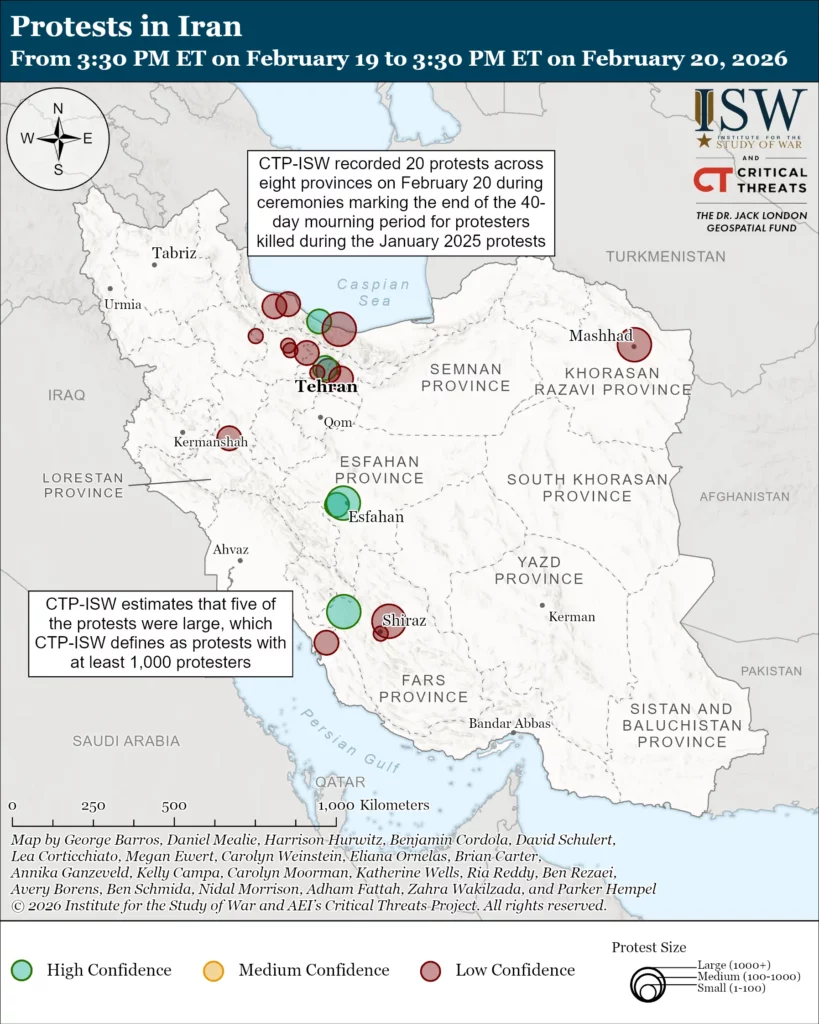
Iranians held 20 protests on February 20—one more than on February 19—which indicates continued public anger and frustration with the regime for its refusal to address the people’s grievances. CTP-ISW recorded 20 anti-regime protests on February 20 across eight provinces at memorials that marked the end of the 40-day mourning period for protesters killed by security forces during the January 2025 protests.[11] Five of these protests involved at least 1,000 individuals.[12] Protests may be occurring beyond what CTP-ISW has recorded due to the regime’s severe internet restrictions that continue to limit the information leaving Iran. CTP-ISW observed that some protesters intentionally paused or cut their video recordings before they began chanting anti-regime slogans.[13] US President Donald Trump stated on February 20 that the regime killed 32,000 people during the recent protest wave. Trump added that the regime paused its plan to execute 837 protesters two weeks ago due to Trump’s warning that the United States would strike Iran without waiting for negotiations if the regime executes protesters.[14] The regime has reportedly sentenced at least 26 protesters to death at the time of this writing, including one minor, according to Radio Farda, however.[15] CTP-ISW assessed on January 15 that the regime had suppressed the recent protest wave, but not the proto-revolutionary movement that has driven the repeated protest waves over the last decade. The unsustainable nature of the regime’s securitization measures and the regime’s unwillingness to address the underlying issues make it difficult for the regime to stop future protest waves.[16]
Hezbollah may decide to participate in a future conflict between Iran and the United States or Israel if Hezbollah perceives that the US or Israeli war aims seek to topple the Iranian regime. Hezbollah adheres to the principle of Velayat-e Faqih and takes its orders from the supreme leader.[17] A war that Hezbollah thinks is an attempt to collapse the Iranian regime could trigger Hezbollah’s intervention even if it faces domestic limitations within Lebanon. Hezbollah is in a far weaker position militarily following Israel’s campaign in Fall 2024, which has caused the group to avoid any direct military conflict with the United States and Israel in recent months.[18] The collapse of the Assad regime in Syria has made the group’s reconstitution process more difficult.[19] This limitation is especially important because Hezbollah is also in a weaker political position compared to pre-Fall 2024. The Lebanese state has exploited Hezbollah’s weakness to launch a disarmament campaign, which caused Hezbollah to move the bulk of its combat forces from southern Lebanon to areas north of the Litani River.[20]
Hezbollah’s close relationship with Iran may mean that Hezbollah can overcome its reticence to enter a regional war, however. Hezbollah has historically taken military and political action to support Iranian objectives in the region.[21] The group remains deeply ideologically aligned with Iran and relies on Tehran for substantial financial support.[22] Sources close to Hezbollah have indicated that Hezbollah currently feels very vulnerable and is concerned that it may lose its ”top sponsor,” which refers to Iran.[23] A war that causes the collapse of the Iranian regime would be a major setback for Hezbollah and its regional goals.
This assessment assumes that Hezbollah will continue to prioritize its relationship with Iran when Iran is under existential threat over certain domestic considerations. This assessment will be invalid if Hezbollah has made or makes a decision to prioritize domestic considerations over its membership in the Axis of Resistance. CTP-ISW has observed no indications that Hezbollah has made a decision to prioritize domestic considerations over its obligations towards Iran.
CTP-ISW has identified multiple courses of action Hezbollah may take in the event of a US or Israeli strike on Iran. All of these courses rely on the assumption that Hezbollah remains ideologically aligned with and financially dependent on Iran, as noted above. These courses of action are not mutually exclusive, and any Hezbollah course could combine these options or move through them sequentially.
 Hezbollah launches a few projectiles towards open areas of northern Israel in a symbolic attack. CTP-ISW assesses that this is Hezbollah’s most likely course of action. Hezbollah has a precedent of conducting small-scale, symbolic attacks that target uninhabited areas of northern Israel in order to not to provoke a large Israeli response.[24] Hezbollah fired two rockets at an Israel Defense Forces (IDF) border position in the Israeli-controlled Shebaa Farms in early December 2024 as a “warning” against Israeli ceasefire violations, for example.[25] Israel responded aggressively to these rocket attacks, however, and Hezbollah has not conducted any similar attacks after that incident.[26] Hezbollah would pursue this course of action because it would allow the group to justify its existence and maintain its long-standing narrative that it is defending Lebanon against Israel. Hezbollah could calculate that this course would also avoid a major Israeli escalation that would threaten Hezbollah’s domestic position.
Hezbollah fires rockets, mortars, or other projectiles targeting an Israeli position in Lebanon. Israel currently maintains forces at five outposts in southern Lebanon.[27] These forces are more exposed relative to Israeli units in Israel, and Hezbollah could frame any attack on Israeli forces in Lebanon as “resistance” against an “occupier.” A direct attack on Israeli forces would risk a limited but serious Israeli response, however, and an Israeli response could increase the risk of discontent among Lebanese in southern Lebanon who are still slowly recovering from the fighting in Fall 2024.[28] Any resumed conflict in Lebanon that could be blamed on Hezbollah could have negative repercussions for the group’s image among Lebanese civilians and its Shia support base.[29]
Hezbollah fires munitions targeting IDF positions in Israel. Hezbollah has previously fired medium-range rockets at IDF positions in Israel.[30] Hezbollah largely conducted these attacks in response to Israeli kinetic action in Lebanon or the Palestinian territories, including the Israeli response in the Gaza Strip to the October 7 attacks, the killing of Hezbollah Secretary General Hassan Nasrallah in September 2024, and Israel’s October 2024 ground invasion.[31] An attack against Israel along these lines would have significant political implications for Hezbollah. Such an attack could generate more political support for the Lebanese state’s disarmament plan because these attacks would be perceived as another round of Hezbollah-initiated escalation and almost certainly evoke a large-scale Israeli response.
In a most dangerous course of action, Hezbollah launches missile and drone attacks on civilian areas across Israel in several large salvoes. Hezbollah has previously conducted such attacks, including its October 2024 drone attack targeting Israeli Prime Minister Benjamin Netanyahu’s house.[32] A missile or drone attack on Israeli civilian areas could trigger a major Israeli response that would imperil both Hezbollah’s reconstitution and support for the group from its Shia base in southern Lebanon. This option risks triggering major Israeli aerial operations in southern Lebanon at a minimum, but the IDF has conducted offensive exercises to rehearse its response to major Hezbollah operations in recent weeks as well.[33]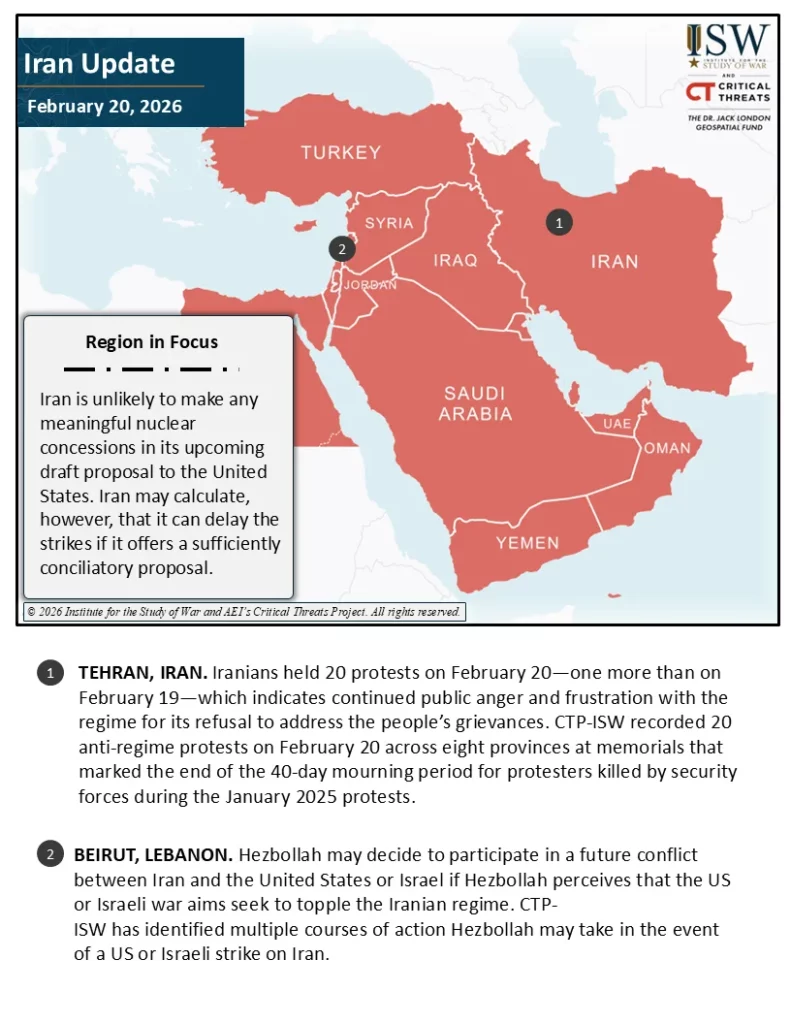
Key Takeaways
US-Iran Nuclear Negotiations: Iran is unlikely to make any meaningful nuclear concessions in its upcoming draft proposal to the United States. Iran may calculate that it can delay the strikes if it offers a sufficiently conciliatory proposal, however.
Protests in Iran: Iranians held 20 protests on February 20—one more than on February 19—which indicates continued public anger and frustration with the regime for its refusal to address the people’s grievances. CTP-ISW recorded 20 anti-regime protests on February 20 across eight provinces at memorials that marked the end of the 40-day mourning period for protesters killed by security forces during the January 2025 protests.
Hezbollah’s Participation in a Future Iranian Conflict with the United States or Israel: Hezbollah may decide to participate in a future conflict between Iran and the United States or Israel if Hezbollah perceives that the US or Israeli war aims seek to topple the Iranian regime. CTP-ISW has identified multiple courses of action Hezbollah may take in the event of a US or Israeli strike on Iran.
Iran
See topline section.
Iraq
Nothing significant to report.
Syria
Nothing significant to report.
Arabian Peninsula
CTP-ISW suspended its coverage of Yemen beginning on January 9.
Palestinian Territories & Lebanon
See topline section.