 Eurasia Press & News
Toplines
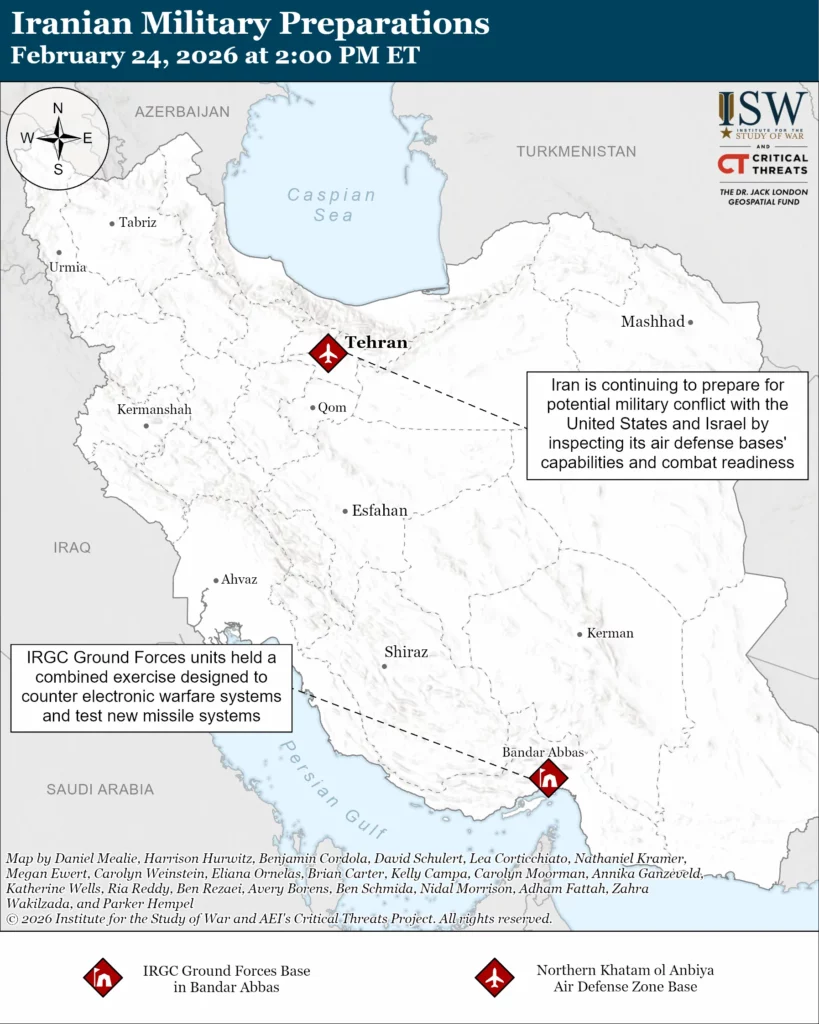
Iran is continuing to prepare for a potential military conflict with the United States. Several unspecified Islamic Revolutionary Guards Corps (IRGC) Ground Forces units held an exercise on February 24 at the Madinah ol Munawarah Operational Base in Bandar Abbas, Hormozgan Province, and on unspecified Persian Gulf islands.[1] Madinah ol Munawarah is located near the coast of the Strait of Hormuz. The unspecified islands are presumably the Nazeat Islands, which lie just west of the strait and host IRGC facilities.[2] Several senior Iranian military officials have threatened in recent weeks to attack vessels in the Strait of Hormuz in retaliation for a US attack on Iran.[3] The IRGC could use the Nazeat Islands to stage operations. AFGS-affiliated media stated that the exercise focused on “shore-to-sea fire” to target enemies that try to approach the coastline.[4] IRGC Ground Forces units practiced using roaming drones to identify targets and Shahed attack drones to hit the targets.[5] Iranian military officials stated that the forces used new missile systems and simulated ”offensive” and ”defensive” electronic warfare (EW) scenarios.[6] A Turkish outlet reported on February 21 that the IRGC Navy launched a naval version of its “Seyed-3” surface-to-air missile during its recent “Smart Control of the Strait of Hormuz” exercise on February 16.[7] The missile is designed to provide a “regional air defense umbrella” for the IRGC Navy’s most advanced vessels, like the Shahid Soleimani class.[8]
Iranian military officials have continued to visit air defense bases to inspect their defensive capabilities. Khatam ol Anbiya Air Defense Headquarters Commander Brigadier General Alireza Elhami visited the Khatam ol Anbiya Northern Air Defense Zone Base in Tehran on February 24, which is his fourth visit to an air defense base in two weeks.[9]
Iran is seeking support from US adversaries Russia and the People’s Republic of China (PRC) to prepare for war against the United States. The Financial Times, citing leaked Russian documents and several people familiar with the deal, reported on February 22 that Iran signed an arms deal with Russia in December 2025 to acquire 500 Verba shoulder‑fired Man-Portable Air-Defense Systems (MANPADS) with 2,500 9M336 infrared homing missiles for targeting drones and an unspecified number of cruise missiles and low-flying aircraft.[10] Iran reportedly requested these systems from Russia “days after” the June 2025 Israel-Iran War.[11] Reuters separately reported on February 24 that Iran is also ”close“ to buying CM‑302 anti‑ship cruise missiles from the PRC, according to six people with knowledge of the negotiations.[12] The six people added that Iran is also in discussions with the PRC to acquire MANPADS, anti-ballistic weapons, and anti-satellite weapons.”[13] These negotiations began two years ago but ”accelerated sharply” after the Israeli-Iran War, according to these sources.[14] The Chinese Ministry of Foreign Affairs told Reuters that it was not aware of these potential arms deals with Iran, and the Chinese defense ministry did not respond to comment.[15] It remains unclear whether the PRC would currently sell weapons to Iran and explicitly violate the reimposed UN arms embargo on Iran.[16]
Iran is attempting to address its air defense vulnerabilities by requesting alternative air defense components from Russia and the PRC, but the Verba cannot replace S-300s or aircraft within Iran’s integrated air defense network. An integrated air defense system (IADS) is a system of systems that works together to limit the threats posed by aerial targets. An IADS commonly uses multiple different systems to fill different roles. The Verba MANPADS or any other MANPADS cannot replace the S-300s Israel destroyed in April and October 2024.[17] Russia has since appeared unwilling to provide Iran with its more advanced S-400 systems, despite Iranian requests.[18] Russia presumably needs them in its war against Ukraine. Iran’s domestically produced ground air defense system, the Bavar 373, did not intercept US and Israeli targets and defend Iran during the Israel-Iran War.[19] Iran’s ongoing push to acquire air defense components abroad suggests that Iran recognizes that its indigenous air defense systems are not effective against US and Israeli attacks.
Iran may be learning lessons from Russia’s experience in Ukraine and creating temporary and extremely suboptimal solutions to address its air defense vulnerabilities. Russia’s Verba MANPADs can only launch 9M336 infrared homing missiles toa maximum altitude of 4,500 meters.[20] Russia has attached loaded Verba MANPADs, along with cameras and radios, on top of Iranian-designed, Russian-produced Shahed drones since at least January 2026.[21] Russia‘s adaptation increases the altitude at which the missile can engage targets and gives the Shahed drone the capacity to target adversary aircraft attempting to intercept it.[22] Russia may have shared this air defense adaptation with Iran. Iran operates several Shahed drones in operation, including the long-range Shahed 149 Gaza with a reported maximum altitude of around 10,500 meters and a payload capacity of 500 kilograms.[23] Russia uses these adapted Shaheds to work alongside and not as a replacement for its ground-based S-300 and S-400 systems in its integrated air defense system, however.[24]
The Islamic State in Iraq and al Sham (ISIS) is likely attempting to exploit the conditions created by the Syrian government’s recent offensive to recruit fighters and expand ISIS networks in Syria. The Islamic State’s (IS) spokesperson Abu Hudhayfa al Ansari declared on February 21 that IS has begun a “new chapter of resistance” in Syria targeting the Syrian government.[25] Abu Hudhayfa made these remarks in his first recorded statement in two years.[26] Abu Hudhayfa reiterated IS’s long-standing opposition to Syrian President Ahmed al Shara and his transitional government on the basis that it is an “apostate” government.[27] IS has vehemently opposed Shara since he came to power in December 2024, due in part to his cooperation with the West and relatively moderate stances.[28] Abu Hudhayfa said that there is “no obligation greater than fighting” the Syrian government, which ISIS or IS-aligned groups in Syria will likely interpret as a call to action.[29] Abu Hudhayfa’s call for a new campaign targeting the government likely immediately inspired a series of ISIS attacks targeting Syrian government forces in Raqqa and Deir ez Zor provinces (described in more detail below).
ISIS likely views the recent security conditions created by the Syrian government’s offensive as an opportunity to recruit and rebuild its networks in Syria. The Syrian government’s January 2026 offensive in northern and eastern Syria created chaotic conditions on the ground in northern and eastern Syria that created immediate opportunities for ISIS to exploit.[30] The rapid offensive and quick collapse of the SDF prevented the orderly handover of SDF positions in the Euphrates River Valley, for example.[31] The Syrian army and Interior Ministry commanders deploying to these areas in Deir ez Zor Province are therefore not familiar with the current tactical situation, which includes the areas they will occupy, the way that the enemy is arrayed, and the disposition of the unit currently occupying the area.[32] ISIS remains a viable insurgency in this area despite setbacks in recent years and has already conducted several attacks targeting government forces deployed to new positions.[33]
The chaotic closure of al Hol internally displaced persons (IDP) camp also presents ISIS and other Salafi-jihadi groups with another opportunity to increase recruitment among escapees and residents who may be released in the future. The lack of any coordination over the camp’s handover enabled between 15,000 and 20,000 people to leave al Hol without any organized system to determine where they went, according to a recent US intelligence estimate.[34] Many of these residents have ties to ISIS, and many reportedly escaped from the camp with support from ISIS-affiliated networks.[35] The Syrian government officially closed al Hol camp on February 23 after transferring the remaining few remaining families to a vacant camp in Aleppo Province.[36] CTP-ISW assessed on February 16 that ISIS and other Salafi-jihadi groups will likely capitalize on al Hol’s closure to attempt to recruit escapees or released and reintegrated al Hol residents.[37]
Abu Hudhayfa also called upon hardline jihadists to defect from the Syrian government’s ranks and join ISIS, which is part of an IS effort to leverage discontent with the Syrian transitional government among Sunni hardliners to undermine the government and expand recruitment.[38] Government fighters sympathetic to IS, including foreign fighters, have been widely accused of facilitating the escape of IS wives and children from al Hol over the past few weeks.[39] These fighters may be susceptible to ISIS recruitment.
It is unclear at this time if Abu Hudhayfa’s declaration of a “new chapter” against the Syrian transitional government indicates a practical shift in IS’s strategy in Syria. IS has praised and encouraged attacks targeting the Syrian government, particularly since Syria joined the Global Coalition to Defeat ISIS in November 2025, and ISIS conducted at least three failed assassination attempts against Shara and other senior Syrian government officials in 2025.[40] Abu Hudhayfa’s explicit call for attacks against the government as part of a ”new chapter” of resistance in Syria suggests that ISIS may seek to adopt a new strategy to achieve its aims in Syria. The United Nations and Syrian security forces have contended in recent weeks that ISIS cells have moved out of the Central Syrian Desert and established a stronger presence in major Syrian cities, which is a departure from ISIS’s prior operational approach, under which it sought to infiltrate populated areas from rural support zones.[41]
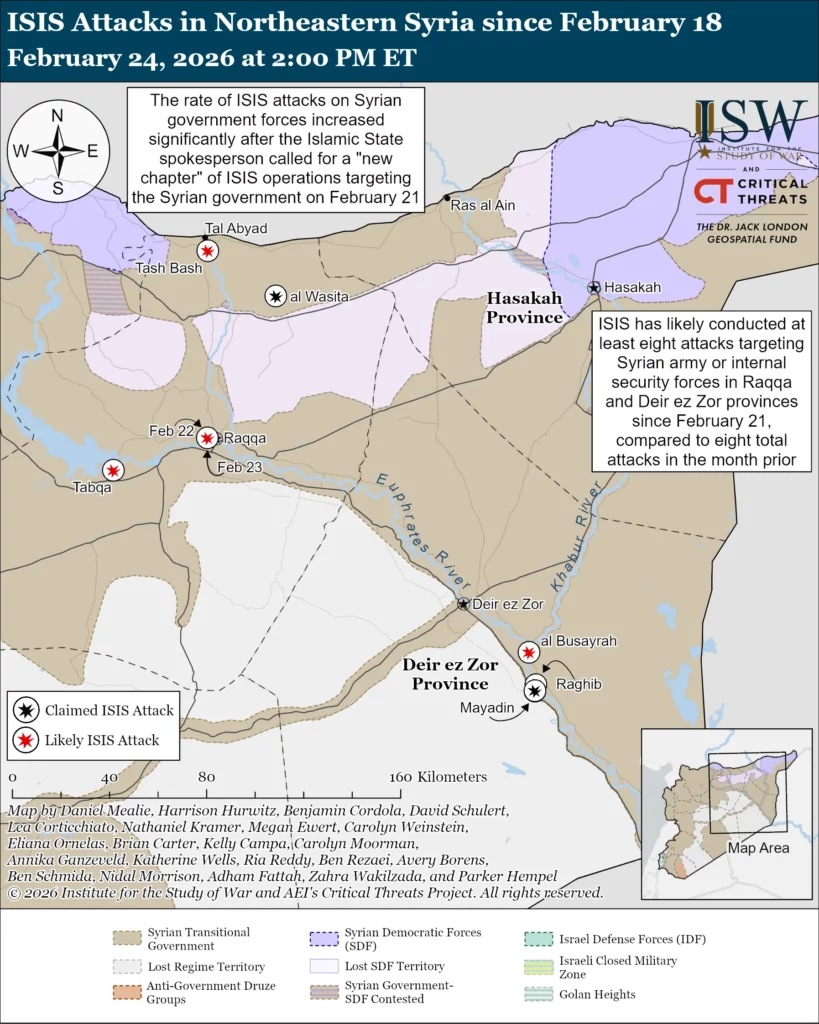
Abu Hudhayfa’s call for a new ISIS campaign against the Syrian government likely encouraged a series of ISIS attacks targeting Syrian government forces in Raqqa and Deir ez Zor provinces. The rate of ISIS attacks on Syrian government forces increased significantly in the days immediately following the release of Abu Hudhayfa’s statement on February 21. ISIS fighters or likely ISIS fighters conducted eight attacks targeting Syrian government targets, including army and internal security forces positions, between February 21 and 24.[42] ISIS or likely ISIS fighters had conducted about only about eight attacks in the month prior to February 21, suggesting that the sudden increase in the rate of attacks is tied to Abu Hudayfa’s announcement of “a new chapter of resistance” against the Syrian transitional government.[43]
ISIS fighters targeted static Syrian army or internal security positions in both rural and urban areas. ISIS fighters launched several attacks targeting positions in areas where ISIS has maintained a strong insurgent presence in recent years, such as along the eastern bank of the Euphrates River in Deir ez Zor and in the Tal Abyad countryside in northern Raqqa.[44] ISIS cells attacked newly established internal security positions in Tabqa and Raqqa City on February 21, 22, and 23.[45] The same cell attacked the same former Asayish checkpoint in western Raqqa City twice and attempted to detonate a suicide vest during one of the attempts.[46]
These fighters are likely attempting to operationalize Abu Hudhayfa’s announcement of a “new chapter“ of ISIS targeting the Syrian government. It is unclear at this time whether cells are coordinating these attacks and what tactical and operational objectives ISIS is attempting to pursue as part of any new campaign against the Syrian government. ISIS attacks in the wake of Abu Hudhayfa’s statement have killed at least nine government personnel since February 21.[47]
ISIS and ISIS-inspired fighters will likely attempt to conduct further attacks against Syrian government targets in the coming days and weeks. Reuters reported that IS-affiliated social media accounts and Telegram channels called on February 22 for intensified attacks against the government using motorcycles and firearms.[48] Abu Hudhayfa or IS supporters‘ calls to attack the government may not only motivate ISIS fighters or sleeper cells but also other ISIS-inspired or Salafi-jihadi groups operating in Syria. Saraya Ansar al Sunnah, for example, is a Salafi-jihadi group ideologically aligned with ISIS that opposes the Syrian transitional government and has conducted several attacks targeting Syrian minorities in 2025.[49] Saraya Ansar al Sunnah has, along with ISIS, attempted to assassinate Syrian President Ahmed al Shara.[50]
The Syrian government has the tools to effectively respond to a possible ISIS attack campaign, but will face temporary constraints caused by the nature of the handover of northern and eastern Syria. Government forces have responded to the recent series of ISIS attacks with a series of reactive measures, including launching immediate operations to arrest and dismantle the responsible cells in both Tabqa and Raqqa City.[51] The government also banned the use of motorcycles in the central areas of Tabqa and Raqqa cities on February 23 after ISIS attacks in both cities.[52] A northern Syria-based source observed that the SDF’s previous ban on motorcycles in Raqqa significantly curbed ISIS attacks in the city.[53] The motorcycle ban illustrates how the Syrian government is re-learning lessons that the SDF previously learned.[54] The Syrian government will need to familiarize itself with the tactical situation that the SDF was intimately familiar with, given its decade of experience fighting ISIS in the area, to successfully operate in the newly-seized ISIS support zones and other regions of northern Syria. The rapid increase of ISIS attacks on government forces comes at a time when Syrian government forces are still consolidating control over newly-seized areas, however. Syrian government forces may have limited bandwidth in these areas as a result.
The United States is continuing to withdraw US forces from bases in northeastern Syria. Three Syrian security sources told Reuters on February 23 that US forces have begun to withdraw from the US Northern Landing Zone base in Qasrak, Hasakah Province.[55] A Syrian military source briefed on US plans said that the US withdrawal from Qasrak would take around one month.[56] Multiple Syrian sources circulated footage on February 23 showing a US military convoy, reportedly consisting of over 100 trucks, leaving Qasrak and heading toward Iraqi Kurdistan.[57] Syrian government forces have backfilled US positions at al Tanf Garrison and al Shaddadi base after US forces withdrew on February 11 and February 15, respectively.[58]
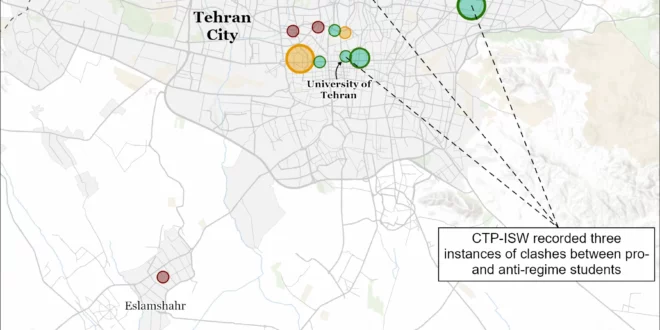
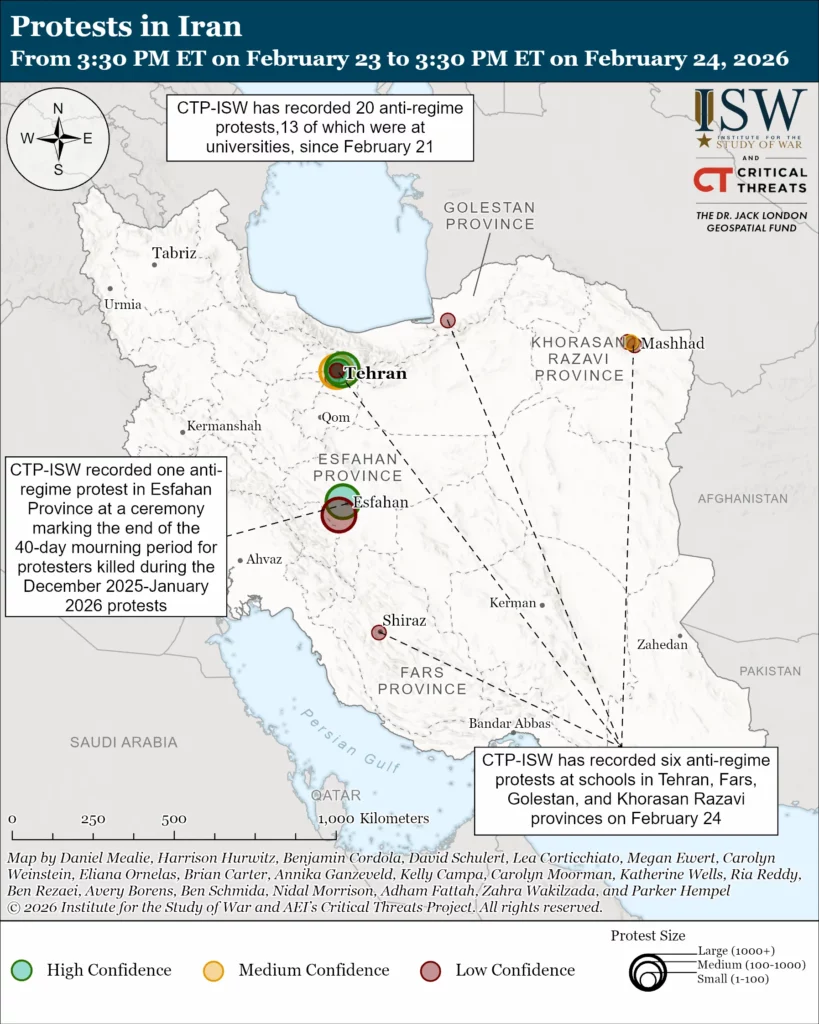
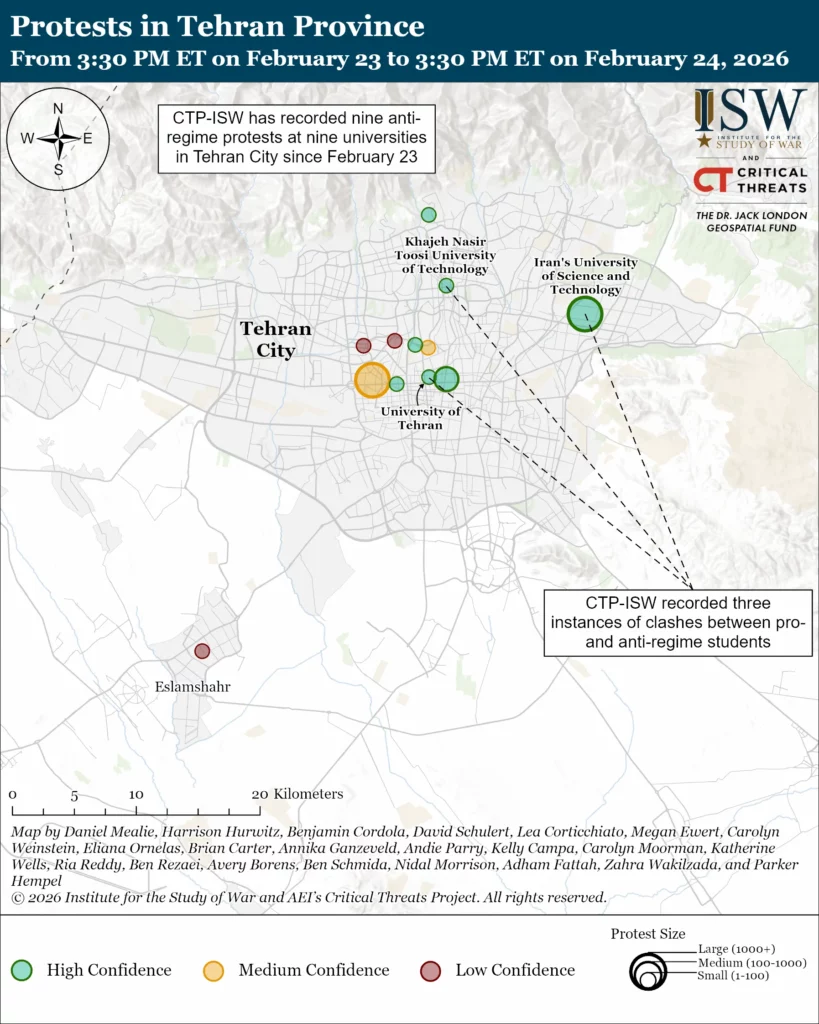
Iranian students have spearheaded the renewed protest activity in universities and high schools in Iran, which highlights the Iranian youth’s deep frustration and disillusionment with the regime. Iranians have held at least 20 protests since February 23, 13 of which were at universities across Iran.[59] CTP-ISW recorded three instances of clashes between pro- and anti-regime students at three different universities in Tehran.[60] The regime deployed drones at at least one university in Esfahan Province, presumably to monitor the campus. Senior Iranian officials have also threatened student protesters with disciplinary and judicial actions in an effort to try to deter protests.[61] The Iranian regime previously poisoned primary schoolgirls during the Mahsa Amini Movement in 2022 in order to try to intimidate the youth and broader Iranian population and suppress protests.[62]
Anti-regime student protests have expanded beyond universities to elementary and secondary schools on February 24, which signals an increase in youth participation across different age groups. CTP-ISW has recorded six small protests at schools across four different provinces.[63] The expansion of protests to include younger students represents the growing threat that the regime perceives the Iranian youth poses to the regime’s stability. The youth have grown increasingly disillusioned with the regime in recent years. Iranian youth, and specifically university students, have led anti-regime protest movements in recent years.[64] These protest movements have openly criticized the regime’s core principles, including Velayat-e Faqih, and in some cases called for the regime’s collapse.[65] Senior Iranian regime officials, including Supreme Leader Ali Khamenei, have previously called for the regime to indoctrinate Iranian youth in order to resolve the challenges the regime faces from Iranian youth.[66]
Key Takeaways
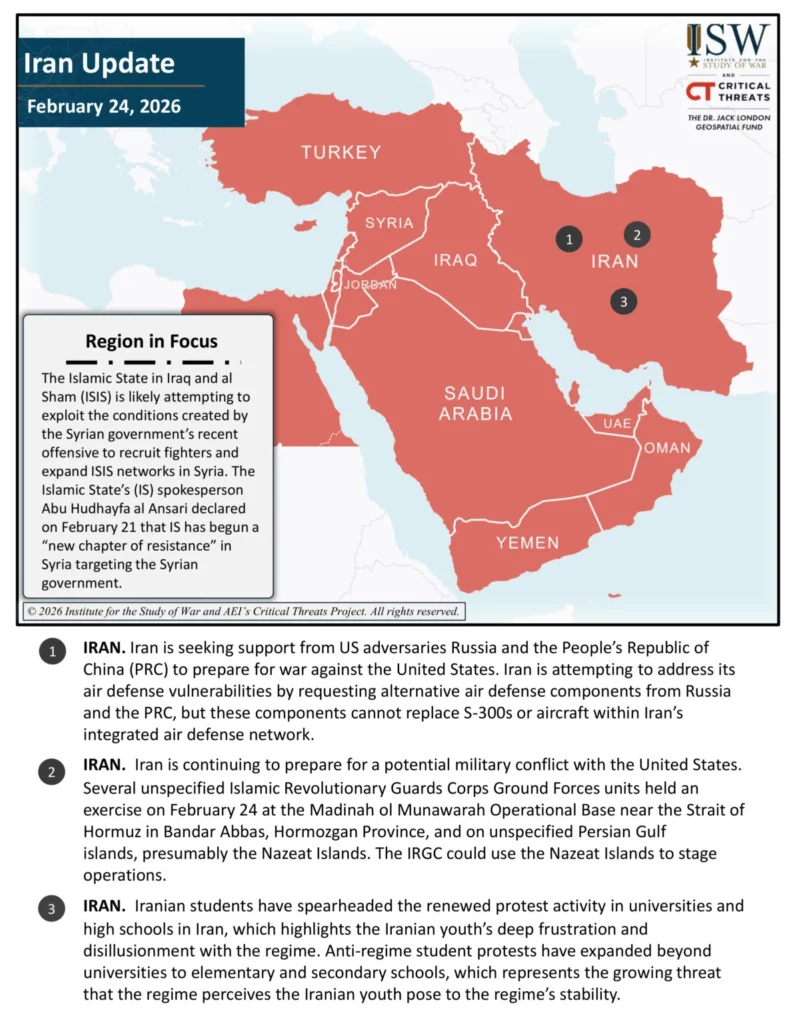
Iranian Preparations for a Potential Conflict: Iran is continuing to prepare for a potential military conflict with the United States. Several unspecified Islamic Revolutionary Guards Corps Ground Forces units held an exercise on February 24 at the Madinah ol Munawarah Operational Base near the Strait of Hormuz in Bandar Abbas, Hormozgan Province, and on unspecified Persian Gulf islands, presumably the Nazeat Islands. The IRGC could use the Nazeat Islands to stage operations.
Iranian Cooperation with US Adversaries: Iran is seeking support from US adversaries Russia and the People’s Republic of China (PRC) to prepare for war against the United States. Iran is attempting to address its air defense vulnerabilities by requesting alternative air defense components from Russia and the PRC, but these components cannot replace S-300s or aircraft within Iran’s integrated air defense network.
ISIS Activity in Syria: The Islamic State in Iraq and al Sham (ISIS) is likely attempting to exploit the conditions created by the Syrian government’s recent offensive to recruit fighters and expand ISIS networks in Syria. The Islamic State’s (IS) spokesperson Abu Hudhayfa al Ansari declared on February 21 that IS has begun a “new chapter of resistance” in Syria targeting the Syrian government. Abu Hudhayfa’s call for a new ISIS campaign likely encouraged a series of ISIS attacks targeting Syrian government forces in Raqqa and Deir ez Zor provinces. ISIS and ISIS-inspired fighters will likely attempt to conduct further attacks against Syrian government targets in the coming days and weeks.
Student Protests in Iran: Iranian students have spearheaded the renewed protest activity in universities and high schools in Iran, which highlights the Iranian youth’s deep frustration and disillusionment with the regime. Anti-regime student protests have expanded beyond universities to elementary and secondary schools, which represents the growing threat that the regime perceives the Iranian youth pose to the regime’s stability.
Iran
Islamic Revolutionary Guards Corps (IRGC) Commander Major General Mohammad Pakpour appointed Brigadier General Mohammad Hosseini as commander of the Saberin Special Forces Brigade on February 24.[67] The Saberin Special Forces Brigade has previously played a role in protest suppression and expeditionary operations in Syria.[68] Hosseini previously commanded the 110th Salman Farsi Independent Special Forces Brigade in Sistan and Baluchistan Province from October 2023 to February 2026, which indicates that he likely has experience with counter-insurgency operations in southeastern Iran.[69] Pakpour appointed Hosseini based on IRGC Ground Forces Commander Brigadier General Mohammad Karami’s recommendation.[70] Karami has held prior senior military positions in Sistan and Baluchistan, including IRGC Ground Forces Quds Operational Base commander from February 2020 to January 2023 and Special Representative of the President for Executive Affairs from July 2023 to October 2024, which suggests that Hosseini may have operated alongside, or under, Karami during his time in southeastern Iran.[71] Hosseini may have been selected, at least partly, due to his experience with internal security and counter-insurgency operations.
The Mobarizoun Popular Front (MPF), a Baloch anti-regime militant coalition, claimed on February 24 that a regime-affiliated group supported by the IRGC killed six MPF members in Saravan, Sistan and Baluchistan Province, on February 23.[72] The MPF stated that the group, operating under the name “Eastern Baluchistan Citizens‘ Rights,“ attacked MPF fighters near the Saravan border area in eastern Sistan and Baluchistan Province.[73] The MPF accused the group of previously conducting assassinations, ambushes, and arrests of Baloch militants and transferring detainees to Iranian security forces.[74] The MPF has conducted several attacks against Iranian security forces since the group formed in early December 2025.
The United States has continued to target Iran’s illicit oil exports as part of its maximum pressure campaign to drive Iranian oil exports to zero. The United States seized a US-sanctioned oil tanker, Bertha, in the Indian Ocean on February 24 as the tanker was transporting oil.[75] The seizure comes amid Iran’s continued efforts to evade US sanctions and export oil. Oil data tracker Kpler reported on February 24 that Iran’s crude oil loadings per day have almost tripled since February 15.[76] Crude oil loadings have increased to 2.3 million barrels a day in February, compared to 1.51 million barrels in January.[77]
Iraq
The Shia Coordination Framework continues to debate State of Law Coalition leader and former Iraqi Prime Minister Nouri al Maliki’s selection as prime minister-designate amid US and internal framework opposition. Maliki told Agence France-Presse (AFP) on February 23 that he will continue to seek the premiership despite US pressure on the Iraqi federal government to withdraw his candidacy.[78] US President Donald Trump warned on January 27 that the United States will “no longer help Iraq” if Maliki becomes prime minister.[79] The framework has recently been divided over whether to rescind Maliki’s nomination.[80] Some framework members met on February 23 but did not reach a final decision on Maliki’s nomination.[81] Unidentified framework officials told Iraqi media on February 24 that National State Forces Alliance leader Ammar al Hakim and Asaib Ahl al Haq leader Qais al Khazali did not attend the February 23 meeting.[82] Hakim and Khazali have led intra-framework opposition to Maliki since his nomination in January 2026.[83]
Some members of the framework are reportedly considering forming a “four-way alliance,” which could delay or block Maliki from becoming prime minister.[84] Iraqi media, citing unspecified leaks, reported on February 23 that Prime Minister and Reconstruction and Development Coalition leader Mohammad al Sudani, Badr Organization leader Hadi al Ameri, Khazali, and Hakim discussed forming a “four-way alliance” consisting of 120 parliamentarians to reject Maliki’s nomination.[85] Ameri previously supported Maliki’s nomination.[86] Only 109 parliamentarians are required to block a presidential election. Parliament must elect a president via a simple majority with a two-thirds quorum in order for the prime minister-designate to attempt to form a government.[87]
Sudani’s participation in this alliance suggests that he continues to seek the premiership despite withdrawing his candidacy on January 13.[88] This is consistent with CTP-ISW’s assessment that Sudani still likely aims to obtain the premiership amid US and domestic opposition to Maliki.[89] Iraqi media, citing unspecified leaks, reported on February 24 that Khazali and Hakim support Sudani on the condition that he would not “rebel” against the framework.[90] Many framework leaders, including Maliki, Khazali, and Ameri, have previously opposed Sudani serving a second term as prime minister due to his perceived unwillingness to follow framework direction.[91] Iraqi media reported that this alliance has considered other candidates for prime minister, including Maliki-affiliated Health Minister Saleh al Hasnawi and Badr Organization-aligned National Intelligence Service head Hamid al Shatri.[92]
Al Monitor reported on February 19 that the United States sent a letter to the Iraqi federal government outlining recommended steps for the next Iraqi prime minister to take to curb Iranian influence in Iraq.[93] These recommendations include:
“Disarm” and “reintegrate” all Iranian-backed Iraqi militias within six to twelve months.[94]
“Define and institutionalize” the role of the Popular Mobilization Forces (PMF) and “place” the PMF “strictly under” the Iraqi armed forces.[95] The PMF is an Iraqi state security service that includes a large number of Iranian-backed Iraqi militias, many of which answer to Iran instead of the Iraqi prime minister.[96]
 Combat “corruption and money laundering.”[97]
 “Reform the judiciary to curb political and factional influence.”[98]
 “Form a cabinet of competent and professional officials loyal to the Iraqi state.”[99]
 Remove “all Iranian advisers, operatives, and agents from Iraqi territory and institutions.”[100]
This letter comes amid a US effort to prevent the formation of a pro-Iranian Iraqi government following the November 2025 elections.[101] The United States recently threatened to limit the Iraqi federal government’s access to its oil revenue if Iranian-backed Iraqi militias are included in the next Iraqi government.[102] The 2026 National Defense Authorization Act conditions some US funding for the Iraqi Security Forces on the Iraqi government taking concrete steps to disarm Iranian-backed Iraqi militias.[103]
Syria
See topline section.
Arabian Peninsula
CTP-ISW has temporarily suspended its coverage of Yemen beginning on January 9.
Palestinian Territories & Lebanon
The Lebanese government is attempting to pressure Hezbollah not to participate in a potential conflict between Iran and the United States or Israel. Two senior Lebanese officials told Reuters on February 24 that Israel warned the Lebanese government that Israel would conduct “hard” strikes against Lebanon if Hezbollah participates in a potential conflict between Iran and the United States.[104] The officials stated that Israel threatened to strike civilian infrastructure in Lebanon, including the Beirut airport.[105] Lebanese Foreign Minister Youssef Rajji confirmed on February 24 that the Lebanese government received this Israeli message and stated that the government is working by “all means” to prevent Hezbollah’s participation.[106] Lebanese Parliament Speaker and long-time Hezbollah ally Nabih Berri has reportedly led intense political and security talks with Hezbollah in an attempt to prevent Hezbollah from militarily backing Iran in a possible future conflict with the United States or Israel.[107]
Hezbollah is likely weighing the threat of Israeli strikes in Lebanon as it decides whether to enter the conflict, but these threats alone will not convince Hezbollah to eschew a potential conflict. Israeli strikes in Lebanon since the November 2024 Israel-Hezbollah ceasefire agreement have further degraded Hezbollah’s capabilities and have impeded the group’s reconstitution efforts.[108] Hezbollah has not responded to these strikes presumably because of its weaker position and the inherent unpredictability of military escalation, which could rapidly spiral out of Hezbollah’s control.[109] Hezbollah’s close relationship with and financial reliance on Iran may mean that Hezbollah can overcome any reticence to enter a regional war despite the risk of Israeli airstrikes on Lebanon. Hezbollah remains deeply ideologically aligned with Iran and relies on Tehran for substantial financial support.[110] Hezbollah has previously struggled to acquire Iranian funds following the June 2025 Israel-Iran War that constrained Iran’s resources, which caused Hezbollah to be unable to maintain its financial commitments to its fighters.[111] The financial challenges ultimately generated unprecedented discontent among its Shia support base.[112] Hezbollah may calculate that the loss of Iran may be existential to the group’s survival.