 Eurasia Press & News
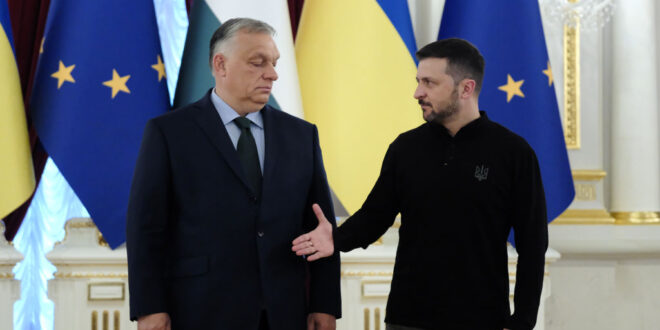
Hungary is holding the EU’s 20th sanctions package on Russia “hostage”, a senior adviser to Volodymyr Zelenskyy told Euractiv, as Budapest continues to veto Brussels’ latest round of restrictive measures against Moscow.
Vladyslav Vlasiuk, the Ukrainian president’s sanctions envoy, said Prime Minister Viktor Orbán’s refusal to approve the package is preventing the EU from cutting off services, such as insurance for ships carrying Russian crude, that are “vital” to Moscow’s war economy.
Orbán wants Kyiv to repair the Druzhba pipeline, which carries Russian oil to Hungary via Ukraine, before greenlighting the measures. Sanctions require the unanimous approval of all 27 EU countries.
“First of all, why would anyone be mixing the sanctions package with the oil pipeline?” Vlasiuk said. “And second of all, it is not us who destroyed the pipeline. We’re trying our best to restore it, but this is not that easy, as anybody can imagine.”
Orbán’s refusal “looks very much like taking the sanctions package as a hostage”, he added.
Hungary’s veto – combined with its refusal to sign off on a €90 billion EU loan to Ukraine – has sharply escalated the long-simmering diplomatic spat between Budapest and Kyiv.
The clash comes as Orbán, the EU’s longest-serving and most Moscow-friendly leader, heads into parliamentary elections on 12 April.
The far-right premier has repeatedly accused Kyiv of supporting Hungarian opposition leader Péter Magyar, whose Tisza party is leading Orbán’s Fidesz by around 20 percentage points, according to a poll released on Wednesday. Ukraine has denied the allegation.
The stand-off comes at a critical time for Kyiv, which is set to run out of money in April and has been bombarded by brutal Russian attacks on its energy infrastructure amid freezing conditions this winter.
Brussels had hoped to approve both the loan and the sanctions package by Tuesday – the fourth anniversary of Russia’s full-scale invasion – but ultimately failed to win over Budapest.
Maritime manoeuvres
The sanctions package’s flagship measure is a proposed full ban on providing maritime services, such as insurance and repairs, to ships carrying Russian oil.
Prior to Orbán’s veto, the package had been held up over disagreements among EU capitals over whether the ban should only enter into force with the support of the G7, a group of wealthy Western democracies that includes the US.
Greece and Malta, whose economies are heavily reliant on the global shipping industry, argued that a unilateral prohibition by the bloc would be counterproductive and risked empowering Indian and Chinese maritime service providers. European Commission President Ursula von der Leyen has also said the ban would be implemented “in coordination” with the G7.
Vlasiuk, however, said that a maritime ban would be “really powerful” even without G7 involvement, adding that a “conservative estimate” is that an EU ban would inflict “at least” €17 billion in losses on the Kremlin by the end of 2026.
He added: “60% of Russia’s oil is being exported through the Baltic. The role of the EU in providing the type of services that Russia’s oil fleet needs is vital.”
But Vlasiuk also predicted that Hungary’s resistance – as well as Slovakia’s, which has threatened to hold up the package over fears it would “disrupt” US-mediated peace talks between Russia and Ukraine – would ultimately be overcome.
The two Central European countries’ behaviour “was quite unexpected… and I would say quite rude”, Vlasiuk said. “But I still think that eventually it will be resolved. It was resolved 19 times before, and I think that it’s going to be resolved for the 20th time as well.”