 Eurasia Press & News
Key Takeaways: Hezbollah’s changed military and political position in Lebanon means that it poses a different threat to Israel from the one it did before the October 7 War, and that any Hezbollah intervention would likely involve a new strategy using new, longer range and low-cost weapons. Israel’s 2024 campaign significantly degraded Hezbollah’s capabilities, infrastructure, and forces, depriving Hezbollah of the ability to conduct the kind of military operation it did in 2006, October 2023, or after October 2024.[1] Hezbollah’s weakened position would require Hezbollah to adopt a new strategy in a renewed conflict, likely relying on its long-range weapons and conducting attacks from central and northern Lebanon.[2] The US and Israeli war against Iran, which explicitly seeks to encourage regime change, will likely trigger Hezbollah intervention.
Israel severely degraded Hezbollah during the 2024 conflict and has continued to challenge Hezbollah reconstitution efforts since the ceasefire in late November 2024. Hezbollah began launching almost daily drone, missile, and rocket attacks against Israel on October 8, 2023.[3] Israel eventually launched an air and ground campaign against Hezbollah in September and October 2024, respectively. Hezbollah’s attacks and limited defensive ground engagements failed to deter or impose any real cost on Israel. The Israel Defense Forces (IDF) thus inflicted far greater damage to Hezbollah in 2024 than it did in 2006 at very low cost to Israel. The IDF killed nearly all senior Hezbollah commanders and 45 percent of its fighters, decimated its weapons stockpiles, and destroyed its military infrastructure. Israel has continued to conduct near-daily airstrikes against Hezbollah in Lebanon since the ceasefire, further limiting its ability to rebuild.[4]
Hezbollah’s influence and leverage in the Lebanese government have waned since Fall 2024 as a result of the war, putting the group in a more politically vulnerable position than it was in before October 2023. Hezbollah’s weakened position contributed to the election of a new Lebanese president and the formation of a government willing to challenge Hezbollah. Lebanese Prime Minister Nawaf Salam reduced the proportion of cabinet seats Hezbollah holds and removed the group’s ability to veto cabinet decisions when he formed his cabinet in February 2025.[5] Hezbollah’s de facto veto power had often prevented the cabinet from passing legislation to constrain Hezbollah between 2008 and 2019.[6] The new Lebanese government, on the contrary, approved a Lebanese Armed Forces (LAF) plan to disarm Hezbollah in September 2025, which many Lebanese governments have previously been unable or unwilling to do.[7] Hezbollah has also struggled to keep some of its long-standing political allies due to its confrontational approach and its defeat at the hands of the IDF.[8] The Free Patriotic Movement (FPM), a Lebanese political party, ended its two-decade alliance with Hezbollah in October 2024, after the Israeli operation in Lebanon began, due to Hezbollah’s involvement in the October 7 War.[9] Some Hezbollah allies, such as Lebanese Parliament Speaker Nabih Berri and the Marada Movement, also shifted their historic positions and expressed support for the state’s monopoly on arms.[10]
Hezbollah has attempted to reconstitute and reorganize as a military organization since December 2024, but has faced unprecedented constraints that have complicated its efforts. Hezbollah has replenished at least one-fifth of its pre-war weapons stockpiles, according to Israeli intelligence assessments.[11] Hezbollah has appointed new commanders to vacant positions and attempted to recruit new fighters.[12] Hezbollah has also begun to rebuild its military infrastructure and continues to try to acquire Iranian funds.[13] The fall of the Assad regime in Syria and the Lebanese government’s crackdown on smuggling through Lebanese ports of entry have made Hezbollah’s reconstitution process more difficult.[14] The Lebanese state has implemented economic reforms and restrictions on Hezbollah’s financial institutions that challenge Iran’s ability to transfer funds to Hezbollah.[15]
The military and political setbacks Hezbollah has suffered since December 2024 have created severe military challenges that will prevent it from using the methods it has long relied on to fight Israel. Hezbollah’s inability to veto anti-Hezbollah cabinet policies, such as the LAF’s disarmament plan, has had a secondary effect on its military position. The LAF’s disarmament plan contributed to Hezbollah‘s decision to move the bulk of its combat forces north of the Litani River and essentially eliminated its military presence in southern Lebanon.[16] Hezbollah’s diminished presence in southern Lebanon would almost certainly limit Hezbollah’s ability to conduct cross-border attacks against Israel because Hezbollah’s attacks often rely on direct fire or relatively short-range indirect fire systems, like rockets or mortars.[17] It would also make it more difficult for Hezbollah to immediately resist Israeli forces at the border, which Hezbollah did in 2006 and in October 2024.[18] The diminished Hezbollah presence in the south also means that Hezbollah can no longer stage the battalions of the Radwan Forces along the Israel-Lebanon border. Hezbollah, with Iranian support, built these elite units to conduct major ground attacks into Israel in the event of war, like Hamas did on October 7.[19] The LAF also has 10,000 soldiers in southern Lebanon, which would hinder Hezbollah’s freedom of movement and complicate its ability to reestablish its positions in the area if it chooses to do so.[20] These factors would require Hezbollah to adopt a new strategy in a renewed conflict, likely relying on its long-range weapons.[21]
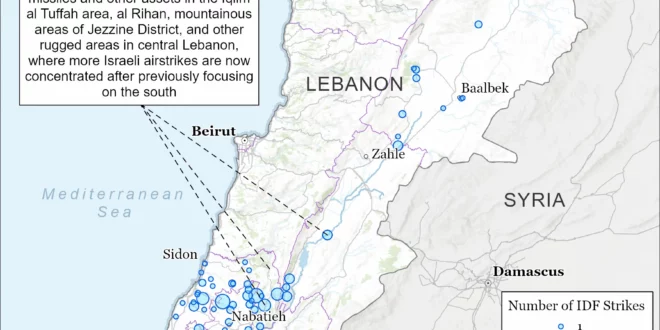
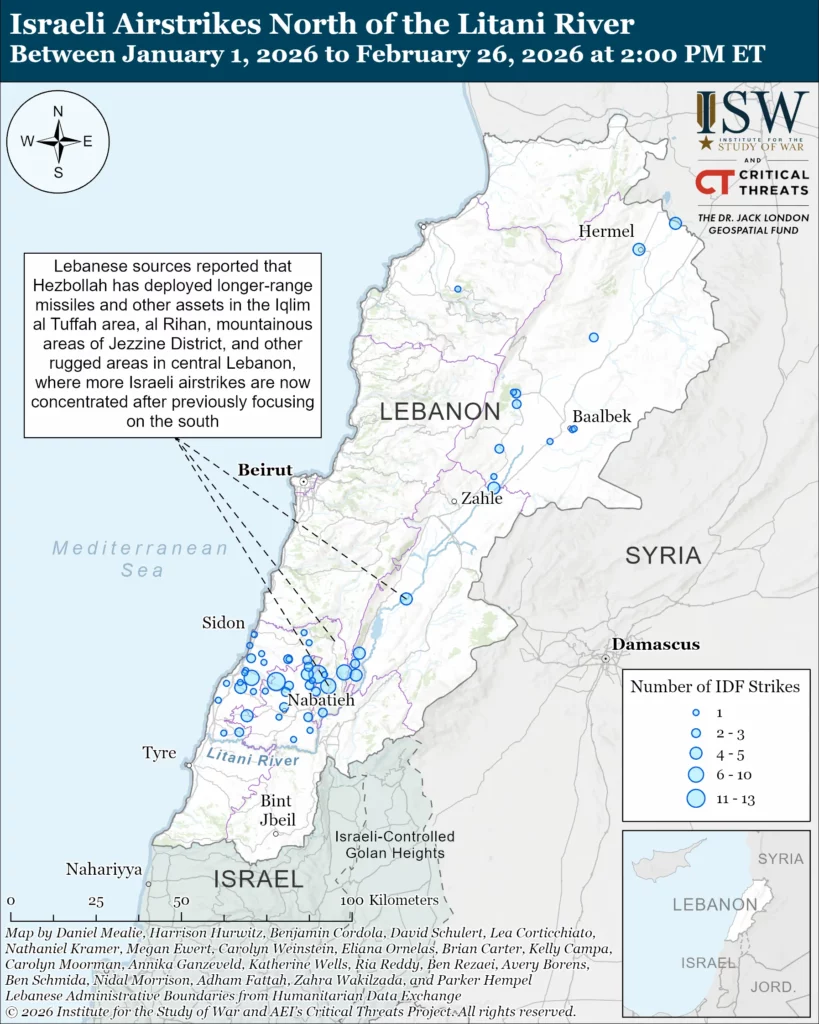
Hezbollah has likely attempted to adapt to the constraints it faces by altering elements of its military approach to emphasize longer-range attacks with domestically produced systems. The geographic distance between the border and the main Hezbollah forces, as well as the loss of Syria as a rear base and smuggling conduit, forced these changes. Hezbollah has reportedly increased its movement of weapons by sea and prioritized domestic production of low-cost weapons like drones and loitering munitions instead of precision missiles and rockets.[22] Hezbollah did not heavily rely on its drones and loitering munitions in Fall 2024.[23] Much of this work is likely still funded by Iran, which has shipped billions to the group through a variety of means.[24] Lebanese sources reported that Hezbollah has deployed longer-range missiles and other assets in the Iqlim al Tuffah area, al Rihan, mountainous areas of Jezzine District, and other rugged areas in central Lebanon, where more Israeli airstrikes are now concentrated after previously focusing on the south.[25] Hezbollah itself has framed the government’s disarmament efforts north of the Litani, which includes the mountainous areas of central Lebanon, as existential, which strongly suggests that the group is hiding something it seeks to protect in that area.[26] These assets and new deployments indicate that future Hezbollah intervention will be conducted from a different area of Lebanon and will feature different weapons, such as its longer-range missiles and drones.
The group will likely still attempt to use its older approaches in the event of a war, though probably not as its main effort. Hezbollah has received hundreds of mines, anti-tank missiles, and small arms that would help Hezbollah fighters defend against another Israeli ground attack.[27] Hezbollah would need to deploy its units back into southern Lebanon ahead of an attack in order to successfully prepare a defense, however. Some Hezbollah fighters may lob mortars or rockets across the border, but the rate and effectiveness of such fire will probably be low given the serious losses Hezbollah sustained among its missile, mortar, and rocket teams between October 2023 and December 2024.[28]
Hezbollah will likely intervene in the current war because the United States and Israel explicitly seek to encourage regime collapse and have thus crossed several Hezbollah redlines. A more limited strike will not necessarily trigger Hezbollah intervention. Hezbollah vowed its support for Iran but did not launch any unilateral attacks during the June 2025 Israel-Iran War, in part because Israel did not try to topple the regime.[29] A war that Hezbollah leadership sees as an attempt to collapse the Iranian regime could trigger Hezbollah’s intervention, however. Hezbollah officials, including the secretary general, have specified that an attack targeting Iranian Supreme Leader Ali Khamenei is Hezbollah’s “red-line.”[30] This is notable given recent reports that the United States and Israel struck Khamenei and that he is injured or possibly dead.[31] Hezbollah remains deeply ideologically aligned with Iran, adheres to the principle of Velayat-e Faqih (the state religion of the Islamic Republic that entrusts both spiritual and temporal power in the hands of the Iranian supreme leader), and takes its orders from Khamenei.[32] Hezbollah has historically taken military and political action to support Iran’s regional objectives.[33] Hezbollah’s close relationship with Iran may mean that Hezbollah might overcome its reticence to enter a regional war.
This assessment assumes that Hezbollah will continue to prioritize its relationship with Iran when Iran is under existential threat over certain domestic Lebanese considerations. This assessment will be invalid if Hezbollah leadership has decided or decides to prioritize domestic considerations over its membership in the Axis of Resistance. Such a decision would represent a major inflection in Middle East security. CTP-ISW has observed no indications that Hezbollah has decided to prioritize domestic considerations over its deepest obligations towards Iran and particularly the supreme leader at this time.
Hezbollah may take one of several courses of action in the event of a US or Israeli strike on Iran that threatens the regime’s stability. The assessment of Hezbollah’s current military approach informs these courses. These courses are not mutually exclusive and could be combined or moved through sequentially.
Hezbollah conducts a symbolic attack against Israeli forces in either Israel or Lebanon, or targets empty fields in Israel. Hezbollah has previously conducted small-scale, symbolic attacks targeting uninhabited areas of northern Israel as a warning in order not to provoke a large Israeli response.[34] Small cells operating near the border would probably conduct such an attack because Israeli leaders would likely see the use of larger, longer-range munitions as escalatory. Hezbollah could also conduct a symbolic attack targeting IDF positions in either Lebanon or Israel. Israeli forces control five outposts in Lebanon, where they are more exposed than Israeli units in Israel.[35] A direct attack on Israeli forces would risk a limited but serious Israeli response. Such an Israeli response could risk exacerbating discontent among Lebanese in southern Lebanon who are still slowly recovering from the 2024 conflict.[36] These Lebanese residents could view a Hezbollah attack as an act of aggression that endangers Lebanese civilians.

Hezbollah launches several large missile and drone salvoes on civilian areas across Israel. Hezbollah has previously conducted such attacks, including an October 2024 drone attack targeting Israeli Prime Minister Benjamin Netanyahu’s house.[37] A missile or drone attack on Israeli civilian areas could trigger a major Israeli response that would imperil both Hezbollah’s reconstitution and support for the group from its base in southern Lebanon. This option risks triggering major Israeli air operations in southern Lebanon at a minimum, but the IDF is prepared to conduct ground operations as well.[38]

Hezbollah may also conduct terrorist attacks targeting US and Israeli assets across the region and the world. Hezbollah conducted a series of terrorist attacks in the 1980s and 1990s, which included suicide bombings, kidnappings, and hijackings that targeted Western and Israeli interests.[39] Hezbollah fighters also drove two truck bombs at the US Marine barracks in Beirut in October 1983, killing 241 US servicemen, for example.[40] Such attacks would almost certainly trigger a major US or Israeli response that would further degrade Hezbollah’s capabilities and infrastructure. A terror campaign may be more palatable to Hezbollah, however, because the IDF and the US military could find it more difficult to target terrorist attack and planning cells around the world and in Lebanon. Missile and drone launch sites are relatively easier to target and suppress.