 Eurasia Press & News
Toplines
Continued Ukrainian advances in Dnipropetrovsk Oblast are likely constraining Russian offensive operations in the Oleksandrivka direction and may soon threaten Russian offensive operations in the Hulyaipole direction. Ukrainian forces have reportedly liberated more than 400 square kilometers in the Oleksandrivka and Hulyaipole directions from late January 2026 to about March 10 in two separate drives.[1] Ukrainian military observer Kostyantyn Mashovets reported on March 16 that Ukrainian forces made additional tactical penetrations within the past week (since about March 9), including: entering Sichneve (east of Oleksandrivka), reaching the eastern outskirts of Voskresenska (east of Sichneve), advancing toward Novoivanivka (southeast of Oleksandrivka), entering and advancing into southeastern Novomykolaivka (north of Novoivanivka), and seizing Rybne (southwest of Novomykolaivka).[2] Mashovets’ statements indicate that Ukrainian forces likely also liberated Sichneve and Vorone (southwest of Sichneve). Mashovets assessed that elements of the Russian 39th Motorized Rifle Brigade (68th Army Corps [AC], Eastern Military District [EMD]) operating east of the Vovcha River will likely have to withdraw to the Voskresenka-Maliivka line (northeast of Oleksandrivka) to defend against Ukrainian counterattacks.[3] Mashovets noted that Ukrainian forces advanced to within two kilometers of the Hulyaipole-Velyka Novosilka road from the north, preventing Russian forces from using the road to conduct logistics or transport equipment even though Ukrainian forces have not yet advanced across it.[4] Mashovets reported that Russian forces operating in the Oleksandrivka direction have switched to conducting an active defense, rather than active offensive operations, to constrain Ukrainian advances, which aligns with the reduced tempo of Russian ground operations in the area in recent weeks.[5]
Mashovets reported that Russian forces still hold the Berezove area and Krasnohirske (both southeast of Oleksandrivka).[6] Mashovets’ statements are likely a reflection of the dispersed and intermingled lines and positions on the battlefield in Ukraine, particularly in the Oleksandrivka direction, and are more likely refinements to ISW’s control of terrain (COT) assessment and not reflective of new Russian advances.
Ukrainian forces are also advancing in counterattacks northwest of Hulyaipole. Mashovets reported that Ukrainian forces reached the eastern outskirts of Hirke (northwest of Hulyaipole), the western outskirts of Staroukrainka (east of Hirke), and that several Ukrainian assault groups have entered Svyatopetrivka (northeast of Staroukrainka).[7] Mashovets noted that the elements of the 5th Combined Arms Army (CAA, EMD), which have been fighting northwest and west of Hulyaipole, have not been able to completely restore the battlefield situation prior to these Ukrainian counterattacks. Mashovets noted that Ukrainian advances in the Oleksandrivka and Hulyaipole directions have not yet sufficiently threatened the rear of the Russian forces operating in the Hulyaipole direction such that these Russian forces must stop conducting offensive operations in the Hulyaipole direction, however. Mashovets noted that Russian forces are maintaining their tempo of ground activity but that effective Ukrainian defenses west of Hulyaipole have slowed Russian advances to less than 1.2 to 1.5 kilometers per week.[8] Continued Ukrainian advances in the Oleksandrivka direction will likely threaten the rear of the 5th CAA elements attempting to advance west from Hulyaipole to support a push toward Orikhiv from the east and may compel the Russian Eastern Grouping of Forces to shift the focus of the 5th CAA to defending against the Ukrainian counterattacks rather than on offensive operations.
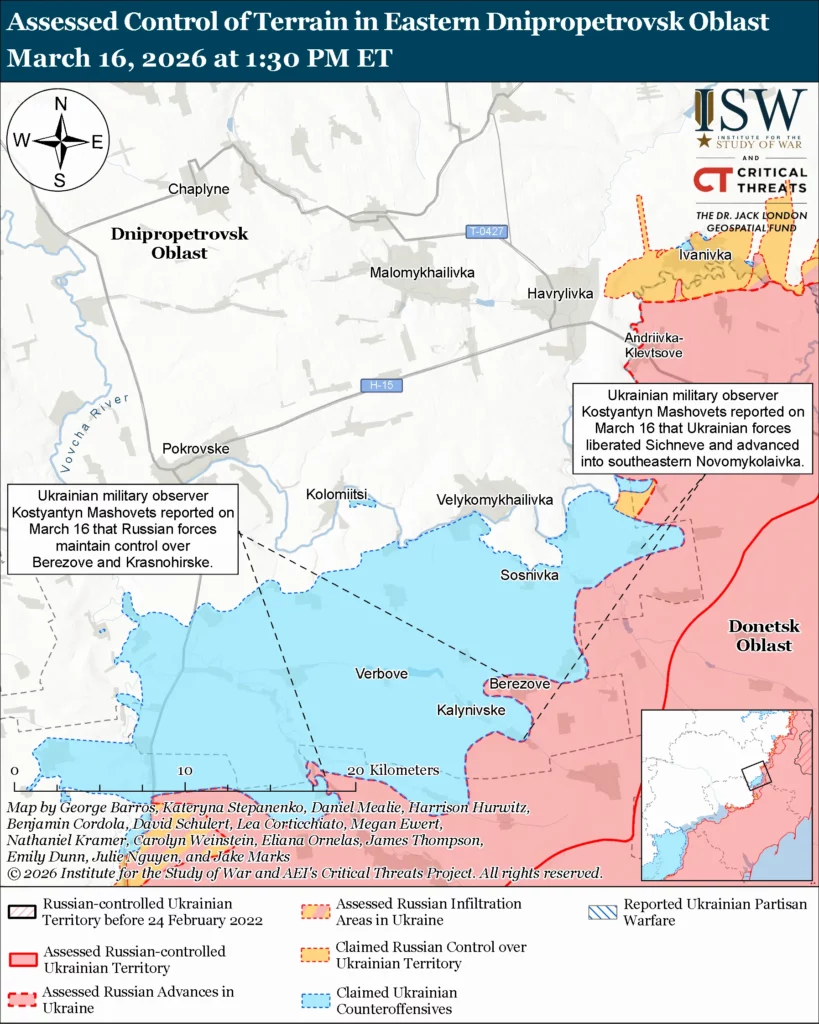
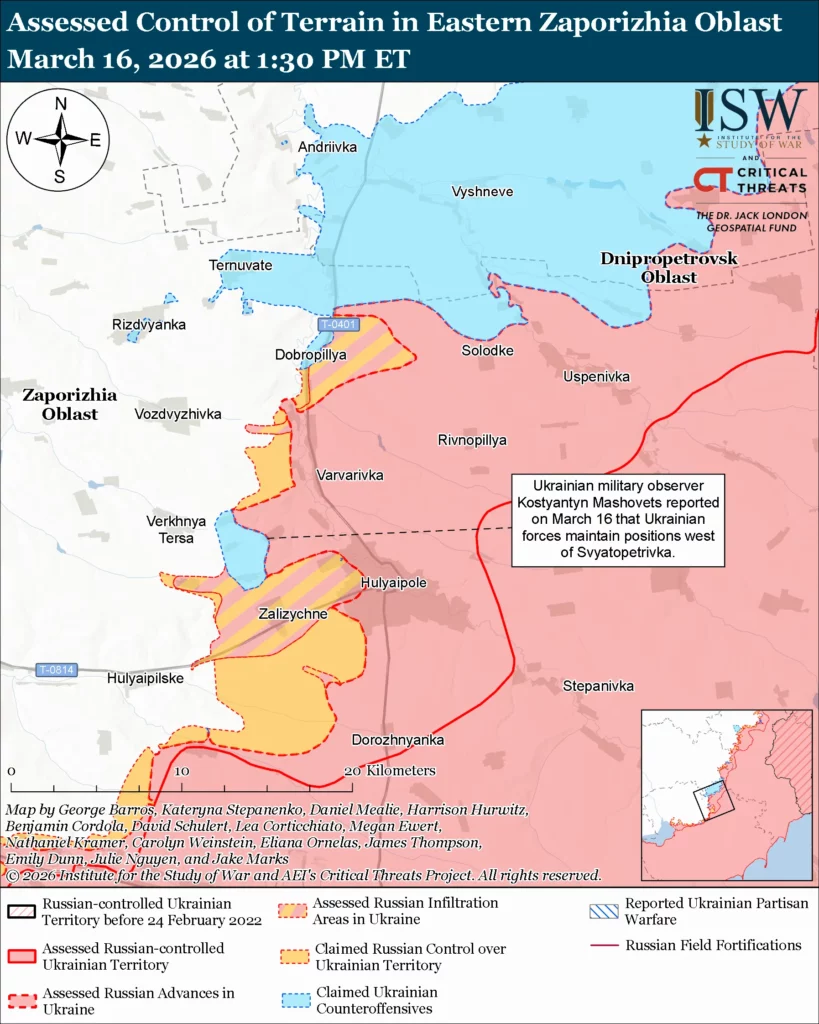
Ukrainian counterattacks in Dnipropetrovsk Oblast are forcing Russia to redeploy forces and means from other areas of the frontline and likely from operational level reserves. ISW previously observed indications that Russian forces had redeployed elements of the 40th Naval Infantry Brigade and 55th Naval Infantry Division (both Pacific Fleet) from the Dobropillya tactical area to the Hulyaipole direction as of late February 2026.[9] Mashovets reported that Russian forces have also redeployed elements of the 40th Naval Infantry Brigade and 120th Naval Infantry Division to the 36th CAA’s (EMD) area of responsibility in the Oleksandrivka direction.[10] ISW has observed elements of the 120th Naval Infantry Division operating in the Dobropillya tactical area as recently as March 11.[11] Mashovets reported that Russian forces may also pull elements of the 69th Separate Cover Brigade and 38th Motorized Rifle Brigade (both 35th CAA, EMD) from the operational reserve to defend in the Oleksandrivka direction. Russian forces may have already pulled elements from its operational reserve to defend in the Oleksandrivka direction, as a Russian milblogger claimed on March 16 that drone operators of the Russian 656th Motorized Rifle Regiment (29th CAA, EMD) are striking Ukrainian forces near Hai (southeast of Oleksandrivka).[12] ISW has not observed evidence of the 656th Motorized Rifle Regiment operating on the battlefield since August 2025, suggesting that the Russian military command had previously withdrawn this unit and may have been holding it in reserve for future offensive operations.[13] Continued Ukrainian counterattacks in Dnipropetrovsk Oblast will likely continue to force Russian forces to choose between defending against the Ukrainian counterattacks and allocating manpower and materiel for offensive operations elsewhere on the frontline, and may spoil the anticipated Russian Spring-Summer 2026 offensive.
Russian Foreign Minister Sergei Lavrov continues to reject any negotiated settlement that fails to concede to all of Russia’s demands, even if it concedes to Russia’s territorial demands. Lavrov reiterated at a March 16 joint press conference with Kenyan Prime Cabinet Secretary and Foreign Minister Musalia Mudavadi that Russia refuses to end the war even if Ukraine “recogniz[es] the realities ‘on the ground’” and fully cedes Donbas to Russia.[14] Lavrov insisted that the current democratically elected Ukrainian government is a “root cause” of the war and referred to potential post-war European peacekeeping troops that would deploy to Ukrainian-held territory as “occupying forces.” Lavrov’s depiction of European troops that would deploy to Ukrainian-held territory with Ukrainian permission, but presumably without Russian permission, demonstrates the Russian attempt to assert its control over sovereign Ukrainian territory by implying that the territory to which Ukrainian authorities would invite European troops is not part of Ukraine. The Kremlin has repeatedly used the rhetoric of “root causes” to reiterate its maximalist demands, including stipulations on NATO expansion, Ukrainian neutrality, “demilitarization” (reductions in the Ukrainian military such that Ukraine cannot defend itself), and “denazification” (the replacement of the current Ukrainian government with a pro-Russian puppet government).[15] The Kremlin has continued to publicly insist that it is unwilling to deviate from these demands even during trilateral negotiations with the United States and Ukraine.[16]
The Russian Ministry of Defense (MoD) reportedly issued orders prohibiting Russian soldiers from using Telegram. A Russian source posted on March 14 alleged leaked Russian MoD orders prohibiting soldiers from using Telegram and threatening to reassign personnel who fail to comply to assault units.[17] A Russian milblogger argued that restricting Telegram could negatively impact Russian military operations as “everything” that Russian soldiers do is “tied to Telegram.”[18] The milblogger criticized the Kremlin’s decision, noting that Kremlin Spokesperson Dmitry Peskov even recently acknowledged that Russian forces use Telegram for frontline communications. Russian milbloggers complained on March 15 that the Russian military command was forcing servicemembers to remove Telegram from their phones and to use the Russian state-controlled messaging app Max, even though Max remains inconvenient and some units have even banned Max.[19] Milbloggers also claimed on March 15 that restrictions against soldiers’ use of Telegram was previously nonuniform throughout the Russian military, and the leaked Russian MoD documents, if true, suggest that this policy is new and will require more enforcement in the coming days and weeks. Varying levels of enforcement in the meantime, and the ultimate blocking of Telegram in the Russian military, will likely degrade Russian command and control (C2) and exacerbate existing communications issues that Russian forces have been facing since the February 1 Starlink block.[20]
The Kremlin continues throttling Telegram domestically, setting conditions to block it completely. Russian information technology (IT) experts told Russian business outlet Kommersant on March 16 that Russian authorities have already begun blocking Telegram, and Kommersant cited Russian internet monitor Sboy RF as reporting that Russians reported over 12,000 complaints of Telegram outages on March 15 and 6,000 complaints on March 14.[21] The IT experts told Kommersant that Russian users have been unable to access Telegram from their home internet or via mobile data in regions where authorities have restricted access to whitelisted websites for the past day.[22] A Russian insider source claimed that Russian authorities are gradually restricting Telegram’s functionality, which is consistent with ISW’s observations that the Kremlin has been gradually increasing its censorship campaign throughout the war before escalating in late 2025 to early 2026.[23] The Telegram outages are reportedly significantly affecting residents in Moscow City and St. Petersburg, two major population centers that the Kremlin has previously sought to shield from the impacts of Russia’s war in Ukraine.[24] Russian-language media, including BBC Russian Service and Russian opposition media, reported that the highest number of complaints about Telegram outages came from Moscow City and St. Petersburg and that reports of outages have increased over the past few days.[25] Another Russian insider source claimed on March 16 that Russian authorities have implemented such extensive blocking measures that whitelisted sites and applications, including state-owned sites, are inaccessible in some places, including central Moscow City.[26]These restrictions may be disproportionately visible in Moscow and St. Petersburg for several possible reasons. These two large urban areas may have the internet infrastructure necessary to impose a sustained block on Telegram and other parts of the internet that less-developed areas of Russia may lack. The outages may be more pronounced in Moscow and St. Petersburg because their high populations make restrictions and complaints of issues more visible than in less-populated areas. The Kremlin may also view these cities as key areas where it must successfully enforce the Telegram block to implement a potential countrywide ban in the future with minimal domestic opposition. These blocks are part of the Kremlin’s recent escalation of its internet censorship campaign since late 2025 and early 2026, potentially reflecting Russian President Vladimir Putin’s waning confidence in his regime’s stability.[27] Putin will likely continue these measures in the future as he faces increasingly difficult and unpopular tradeoffs to sustain his war effort in Ukraine.
Key Takeaways
Continued Ukrainian advances in Dnipropetrovsk Oblast are likely constraining Russian offensive operations in the Oleksandrivka direction and may soon threaten Russian offensive operations in the Hulyaipole direction.
Ukrainian counterattacks in Dnipropetrovsk Oblast are forcing Russia to redeploy forces and means from other areas of the frontline and likely from operational level reserves.
Russian Foreign Minister Sergei Lavrov continues to reject any negotiated settlement that fails to concede to all of Russia’s demands even if it concedes to Russia’s territorial demands.
The Russian Ministry of Defense (MoD) reportedly issued orders prohibiting Russian soldiers from using Telegram.
The Kremlin continues throttling Telegram domestically, setting conditions to block it completely.
Ukrainian forces recently advanced in the Kostyantynivka-Druzhkivka tactical area, near Pokrovsk, and near Oleksandrivka. Russian forces recently advanced in the Kostyantynivka-Druzhkivka tactical area.
Ukrainian forces struck Russian oil and defense industrial infrastructure. Russian forces launched 211 drones against Ukraine, including in Odesa, Mykolaiv, and Kharkiv oblasts.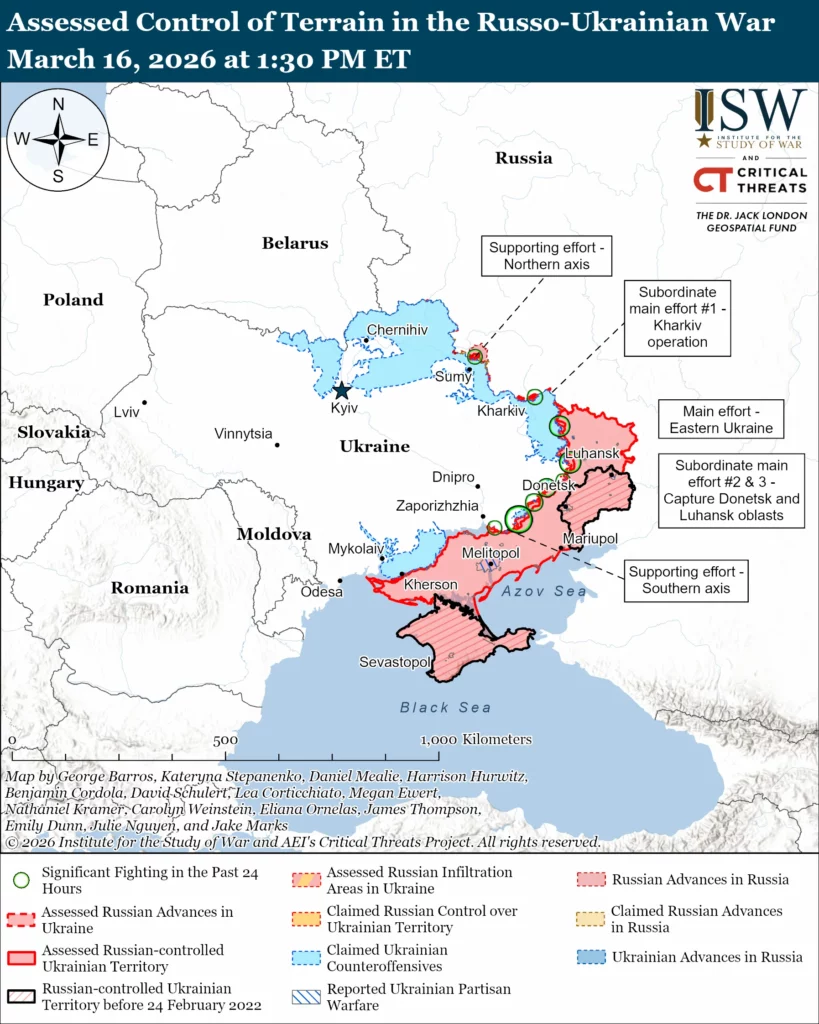
We do not report in detail on Russian war crimes because these activities are well-covered in Western media and do not directly affect the military operations we are assessing and forecasting. We will continue to evaluate and report on the effects of these criminal activities on the Ukrainian military and the Ukrainian population and specifically on combat in Ukrainian urban areas. We utterly condemn Russian violations of the laws of armed conflict and the Geneva Conventions and crimes against humanity even though we do not describe them in these reports.
Ukrainian Operations in the Russian Federation
Ukrainian forces reportedly struck a Russian aircraft manufacturing plant in Ulyanovsk Oblast on the morning of March 16. A Ukrainian source reported that Ukrainian forces struck the Aviastar aircraft manufacturing plant in Ulyanovsk City.[28] The United Aircraft Corporation produces Il-76 transport aircraft, Il-78 tanker aircraft, and An-124 transport aircraft. Ulyanovsk Oblast Governor Alexei Russky claimed that Russian forces destroyed at least five drones over the oblast and that the drones crashed in Cherdaklinsky Raion (just east of Ulyanovsk City).[29] A local Telegram channel reported that Russian authorities temporarily closed the Aviastar plant after the drone strike.[30]Ukrainian forces struck a Russian oil depot in Krasnodar Krai on the night of March 15 to 16. Geolocated footage published on March 15 shows a fire at an oil depot in Labinsk, Krasnodar Krai.[31] The Krasnodar Krai Operational Headquarters stated that a Ukrainian drone strike caused a fire at an oil depot in the Labinsk industrial zone.[32] Russian opposition media Astra geolocated footage showing a fire at the Yugnefteprodukt oil depot in northern Labinsk.[33]
Russian Supporting Effort: Northern Axis
Russian objective: Create defensible buffer zones in Sumy Oblast along the international border
Russian forces continued offensive operations in northern Sumy Oblast on March 16 but did not advance.
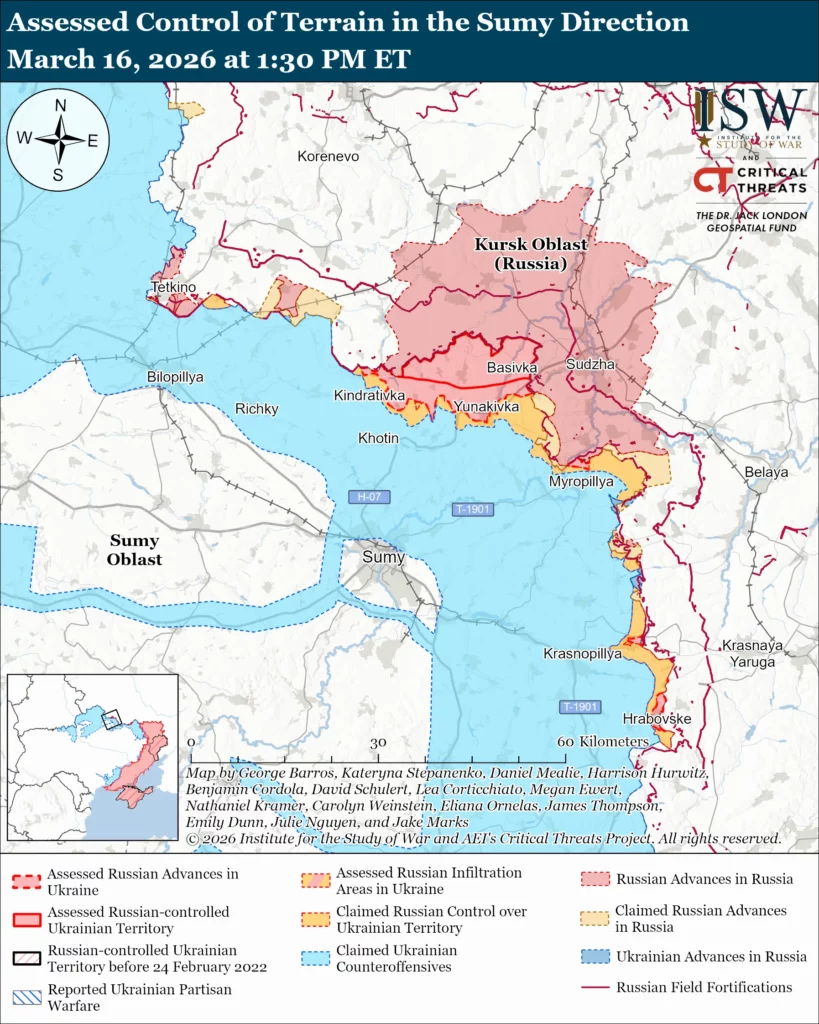
Russian forces attacked northwest of Sumy City near Sopych and north of Sumy City near Novomykolaivka and toward Nova Sich on March 15 and 16.[34] A Russian milblogger claimed that Ukrainian forces counterattacked in Sopych.[35]
The Russian military command is reportedly planning to deploy airborne (VDV) elements to respond to the deteriorating situation near Yunakivka (northeast of Sumy City). A Russian milblogger claimed on March 16 that the Russian military command plans to deploy elements of the 51st and 119th VDV regiments (both of the 106th VDV Division) to support elements of the 137th VDV Regiment (106th VDV Division) operating near Yunakivka in the coming days.[36] The source claimed that the command is “rushing” the two VDV regiments to the area to “quell” the 137th VDV Regiment’s “turmoil.” The Russian milblogger previously claimed on March 9 that the Russian command tried to redeploy elements of the 137th VDV Regiment from Sumy Oblast to Kherson Oblast, causing a “critical situation” near Yunakivka and forcing the command to redeploy most of the regiment back to Sumy Oblast.[37] ISW cannot independently verify these claims. ISW last observed reports of the 51st and 119th VDV regiments operating near Yunakivka in early March 2026 and early February 2026, respectively.[38] The Russian military command may have temporarily withdrawn elements of the 51st and 119th VDV regiments from Yunakivka but is now redeploying them to the Sumy direction.
Order of Battle: Drone operators of the Russian Anvar Spetsnaz Detachment (possibly referring to the BARS-25 Anvar volunteer detachment) are reportedly striking Ukrainian Starlink terminals, antennas, and ammunition depots near the international border in Zarichchya (northwest of Sumy City), Myropillya (northeast of Sumy City), and Moshchenka (northeast of Chernihiv City).[39] Elements of the 1427th Motorized Rifle Regiment (11th Army Corps [AC], Leningrad Military District [LMD]) are reportedly operating near Tetkino, Kursk Oblast (northwest of Sumy City).[40]
Russian Main Effort: Eastern Ukraine
Russian Subordinate Main Effort #1 – Kharkiv Oblast
Russian objective: Push Ukrainian forces back from the international border to create a defensible buffer zone with Belgorod Oblast and approach to within tube artillery range of Kharkiv City
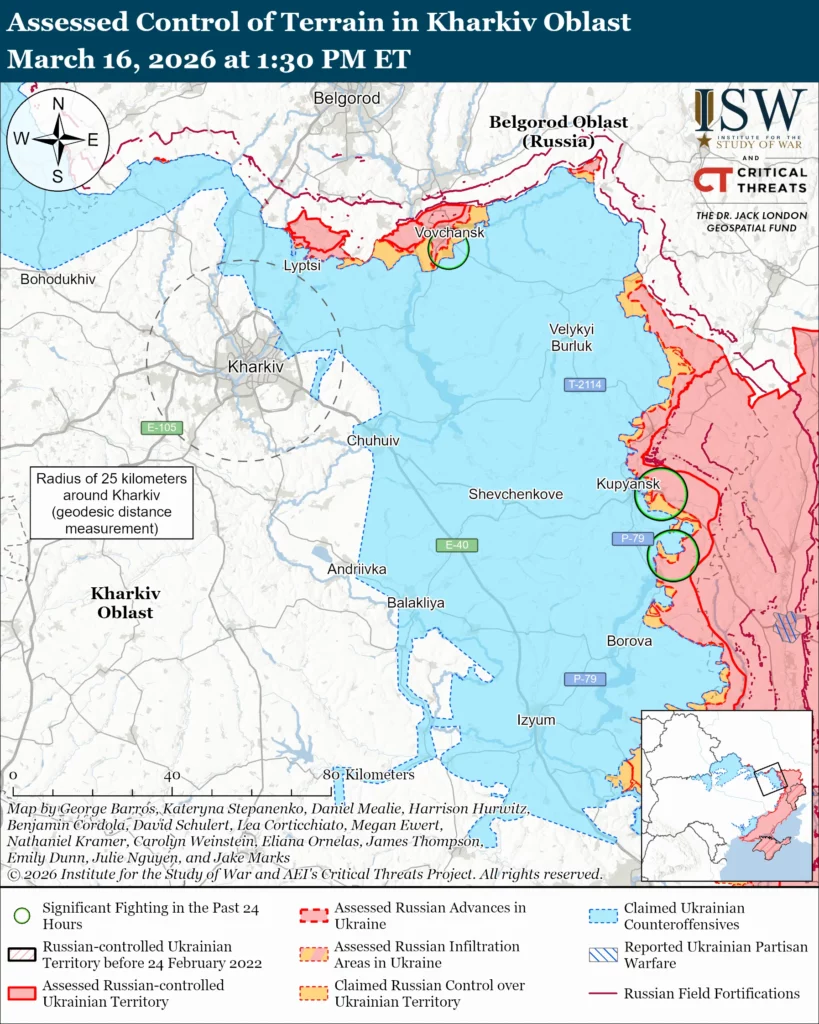
Russian forces continued offensive operations in northern Kharkiv Oblast on March 16 but did not make confirmed advances.
Unconfirmed claims: A Russian milblogger claimed that Russian forces advanced within Verkhnya Pysarivka (northeast of Kharkiv City).[41]
Russian forces attacked northeast of Kharkiv City near Starytsya, Vilcha, and Vovchanski Khutory and toward Verkhnya Pysarivka on March 15 and 16.[42]
The deputy commander of a Ukrainian battalion operating in the Kharkiv direction reported that Russian forces are not attacking in the Lyptsi direction (north of Kharkiv City) as clear weather conditions are leading to good Ukrainian drone visibility both in the day and night.[43] The deputy commander stated that Russian forces are currently focusing on bringing up reserves to the area and are awaiting reinforcements. The deputy commander assessed that Russian forces are taking a temporary tactical pause in operations, waiting for either poor weather conditions or for green foliage to appear for concealment.
Order of Battle: Drone operators of the Russian 128th Motorized Rifle Brigade (44th Army Corps [AC], Leningrad Military District [LMD]) are reportedly striking Ukrainian artillery guns in the Kharkiv direction.[44]
Neither Ukrainian nor Russian sources reported fighting in the Velykyi Burluk direction on March 16.
Russian Subordinate Main Effort #2 – Oskil River
Russian objective: Cross the Oskil River in Kharkiv Oblast and push westward into eastern Kharkiv Oblast and northern Donetsk Oblast
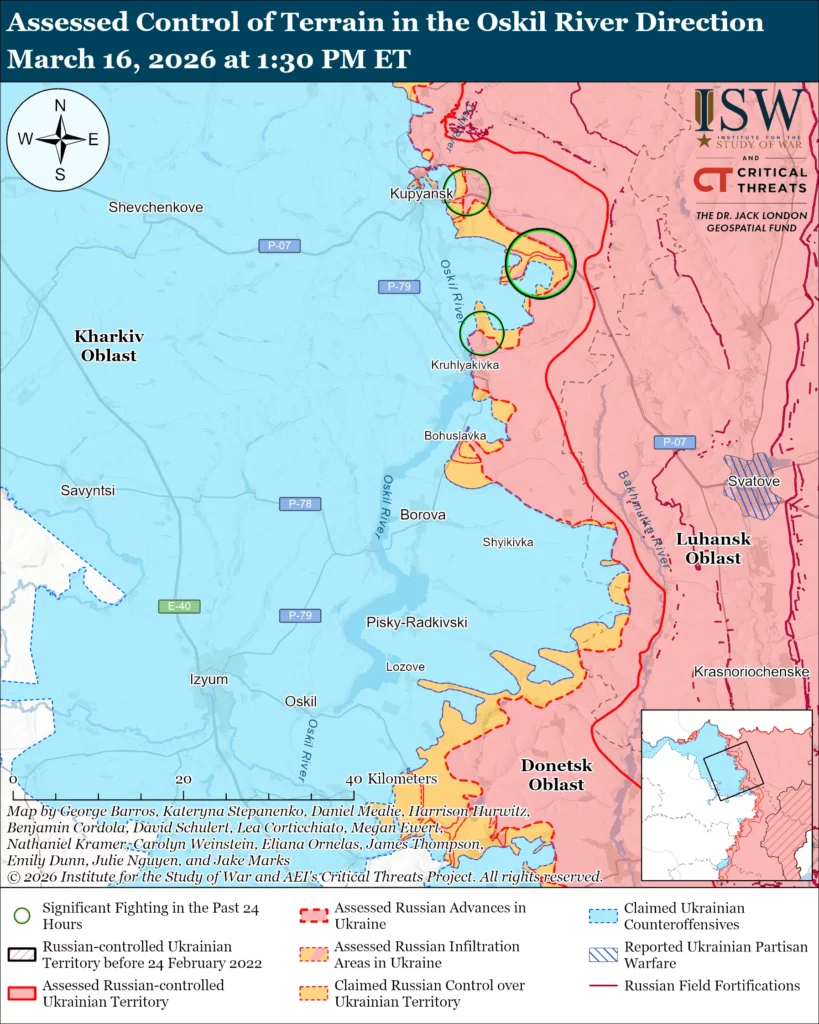
Russian forces continued offensive operations in the Kupyansk direction on March 16 but did not advance.
Russian forces attacked near Kupyansk itself; east of Kupyansk near Podoly, Kucherivka, and Petropavlivka; and southeast of Kupyansk near Pishchane and toward Hlushkivka, Kurylivka, and Novoosynove on March 15 and 16.[45] A Russian milblogger claimed that Ukrainian forces counterattacked in northern Kupyansk.[46]
Order of Battle: First-person view (FPV) drone operators of the Russian 27th Separate Motorized Rifle Brigade (1st Guards Tank Army [GTA], Moscow Military District [MMD]) are reportedly intercepting Ukrainian drones in the Kharkiv direction.[47]
Russian forces continued offensive operations in the Borova direction on March 16 but did not advance.
Russian forces attacked toward Borova itself; north of Borova near Bohuslavka; northeast of Borova near Lozova; and southeast of Borova near Hrekivka, Makiivka, and Novoyehorivka on March 16.[48] A Russian milblogger claimed that Ukrainian forces counterattacked near Borivska Andriivka (northeast of Borova).[49]
Order of Battle: FPV drone operators of the Russian 136th Reconnaissance Battalion (2nd Motorized Rifle Division, 1st GTA) are striking Ukrainian drone crews in Bohuslavka.[50]
Ukrainian forces continued their mid-range strike campaign against Russian military assets in occupied Luhansk Oblast. The Ukrainian General Staff reported that Ukrainian forces destroyed a Russian Tor-M1 air defense system near occupied Korobkyne (roughly 127 kilometers from the frontline) on the evening of March 15 or the night of March 15 to 16.[51]
Russian Subordinate Main Effort #3 – Donetsk Oblast
Russian objective: Capture the entirety of Donetsk Oblast, the claimed territory of Russia’s proxies in Donbas, and advance into Dnipropetrovsk Oblast
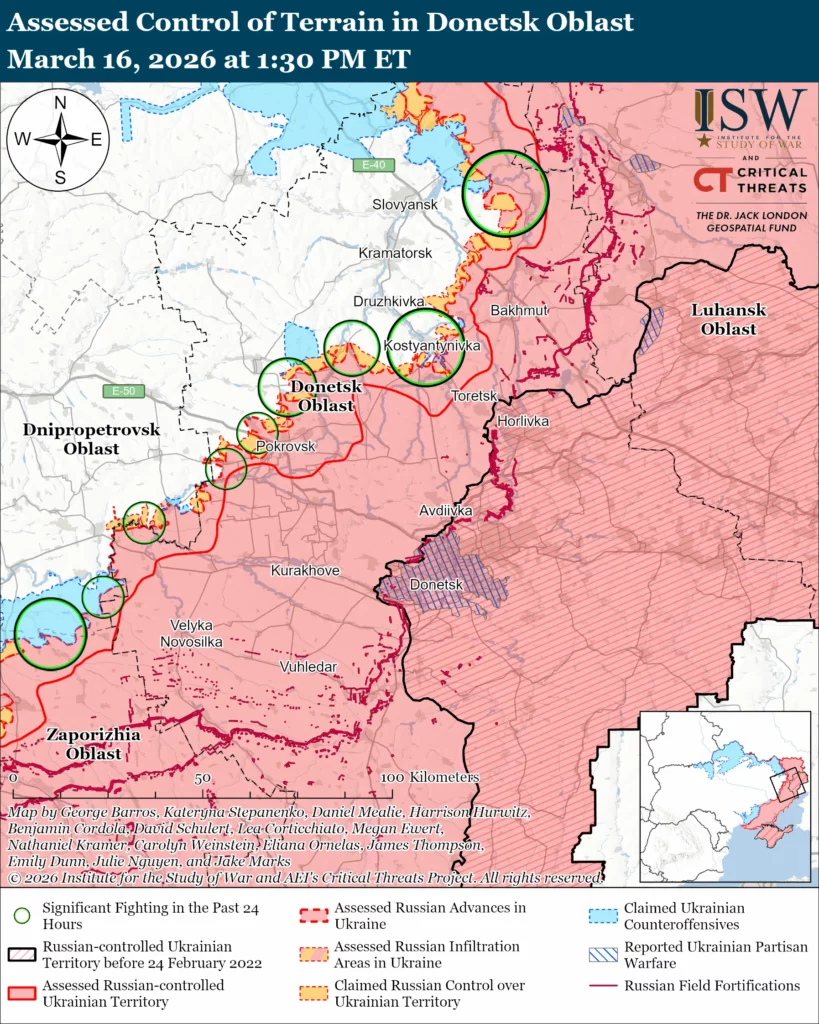
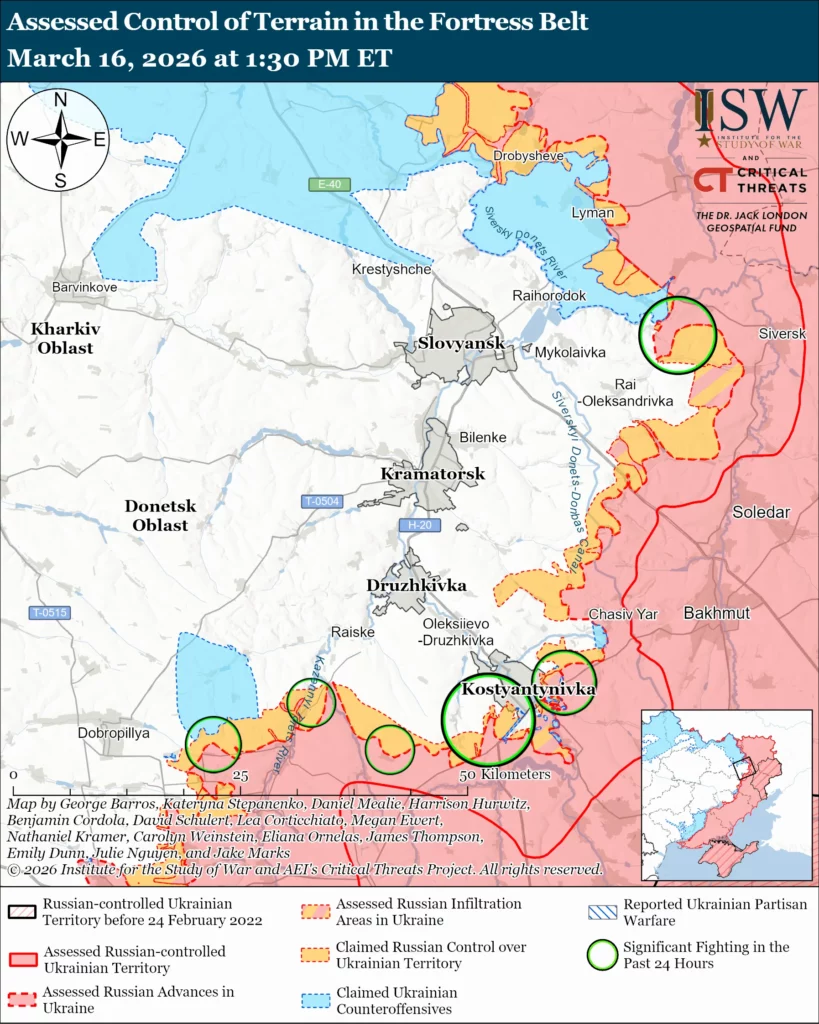
Russian forces continue offensive operations in the Slovyansk direction on March 16 but did not advance.
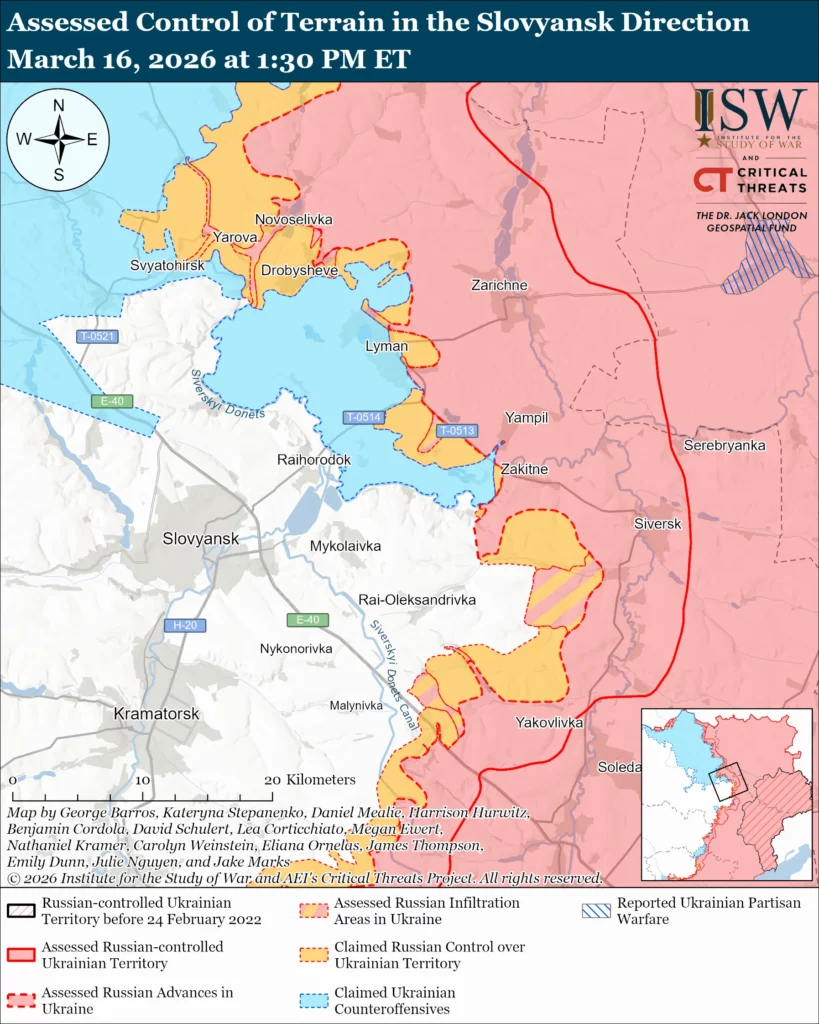
Russian forces attacked near Lyman itself; northwest of Lyman near Drobysheve and Svyatohirsk and toward Sosnove; southeast of Lyman near Ozerne, Yampil, and Dibrova; east of Slovyansk near Platonivka, Zakitne, Riznykivka, and Kryva Luka and toward Rai-Oleksandrivka; and southeast of Slovyansk near Nykyforivka and Fedorivka Druha on March 15 and 16.[52]
A Russian milblogger claimed that Russian forces struck Ukrainian positions in Lyman with a FAB-3000 guided glide bomb.[53]
Order of Battle: Molniya fixed-wing drone operators of the Chechen Akhmat Spetsnaz Shrama Detachment (204th Akhmat Spetsnaz Regiment) are reportedly striking Ukrainian forces west of Siversk (east of Slovyansk).[54] Artillery elements of the Russian 2nd Artillery Brigade (3rd Combined Arms Army [CAA], formerly 2nd Luhansk People’s Republic Army Corps [LNR AC], Southern Military District [SMD]) are reportedly striking a Ukrainian drone control center near Rai-Oleksandrivka.[55] Mavic drone operators of the 85th Motorized Rifle Brigade (3rd CAA) are reportedly conducting reconnaissance near Slovyansk.[56]
Ukrainian and Russian forces recently advanced in the Kostyantynivka-Druzhkivka tactical area.
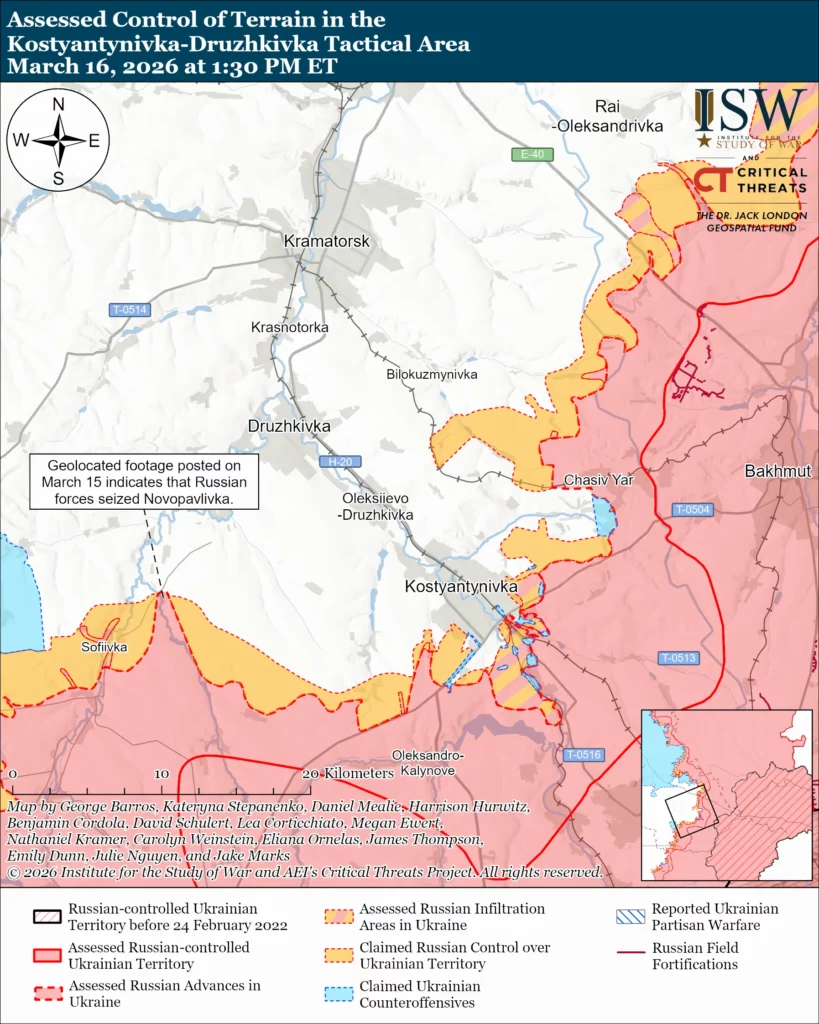
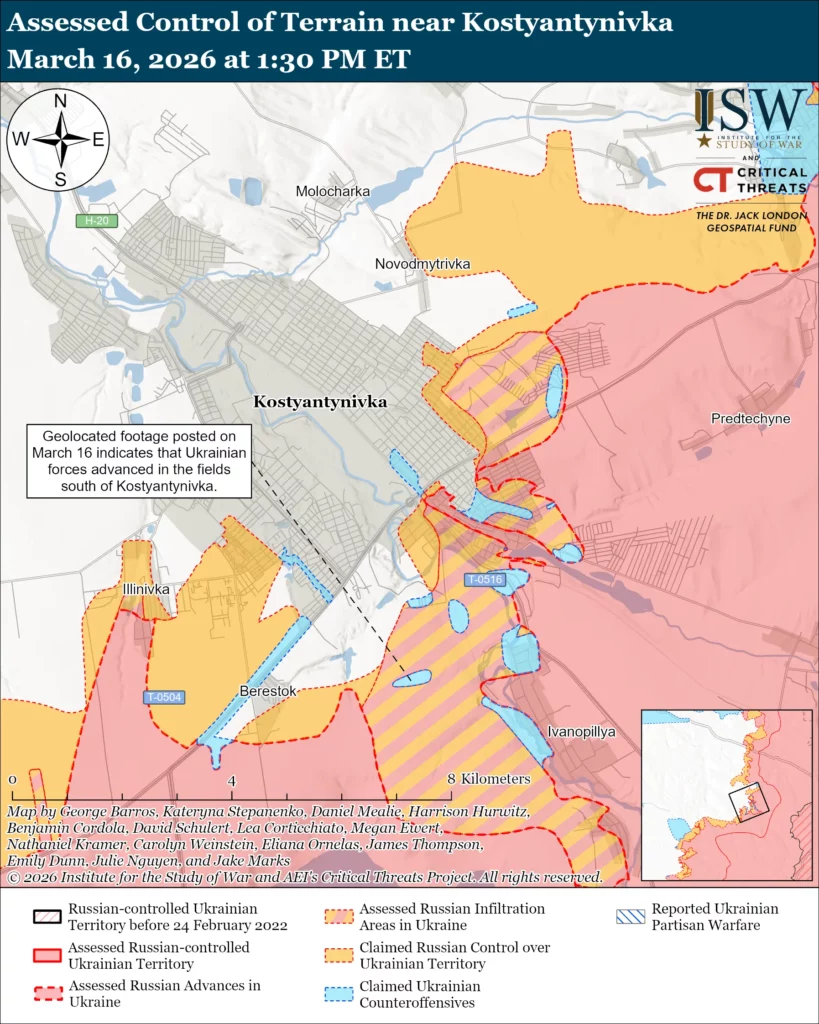
Assessed Ukrainian advances: Geolocated footage published on March 16 indicates that Ukrainian forces recently advanced south of Kostyantynivka.[57]
Assessed Russian advance: Geolocated footage published on March 15 shows Ukrainian forces striking Russian positions in northern Novopavlivka (southwest of Druzhkivka), indicating that Russian forces recently seized the settlement.[58]
Russian forces attacked near Kostyantynivka itself; northeast of Kostyantynivka near Minkivka; east of Kostyantynivka near Stupochky; south of Kostyantynivka near Pleshchiivka, Ivanopillya, and Berestok; southwest of Kostyantynivka near Illinivka and Stepanivka; south of Druzhkivka near Rusyn Yar; and southwest of Druzhkivka near Sofiivka, Novopavlivka, and Pavlivka on March 15 and 16.[59] Russian milbloggers claimed that Ukrainian forces counterattacked within Chasiv Yar (northeast of Kostyantynivka).[60]
Order of Battle: Elements of the Russian 150th Motorized Rifle Division (8th CAA, SMD) are reportedly operating near Novopavlivka.[61] FPV drone operators of the 1st and 3rd motorized rifle battalions of the 4th Motorized Rifle Brigade (3rd CAA) and the 1194th Motorized Rifle Regiment (4th Motorized Rifle Brigade) are striking Ukrainian forces within and near Kostyantynivka.[62] Fiber optic drone operators of the Rubikon Center for Advanced Unmanned Technologies are striking Ukrainian dugouts south of Kostyantynivka.[63] Artillery elements of the 1442nd Motorized Rifle Regiment (6th Motorized Rifle Division, 3rd AC, under operational control of the Southern Grouping of Forces) are striking Ukrainian positions in northern Kostyantynivka.[64] Fiber optic drone operators and artillery elements of the 1008th Motorized Rifle Regiment (6th Motorized Rifle Division) are striking Ukrainian unmanned ground vehicles (UGVs) in northern Kostyantynivka.[65] Drone operators of the 57th Spetsnaz Company (8th CAA) are reportedly striking Ukrainian positions near Rusyn Yar.[66] Drone operators of the Grachi Detachment of the 346th Spetsnaz Brigade (Russian General Staff’s Main Directorate [GRU]) are reportedly operating in the Kostyantynivka direction.[67]
Russian forces attacked east of Dobropillya near Novyi Donbas, Vilne, Toretske, and Nove Shakhove and southeast of Dobropillya near Zapovidne on March 15 and 16 but did not advance.[68]
Ukrainian forces recently advanced in the Pokrovsk direction.
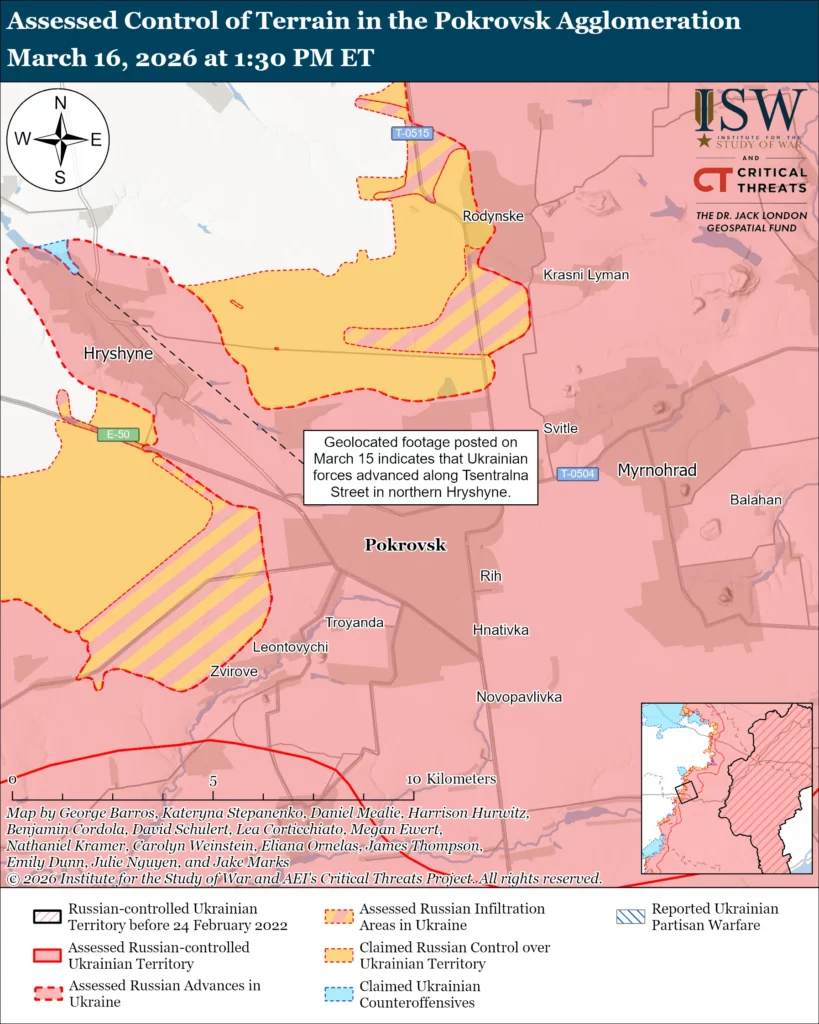
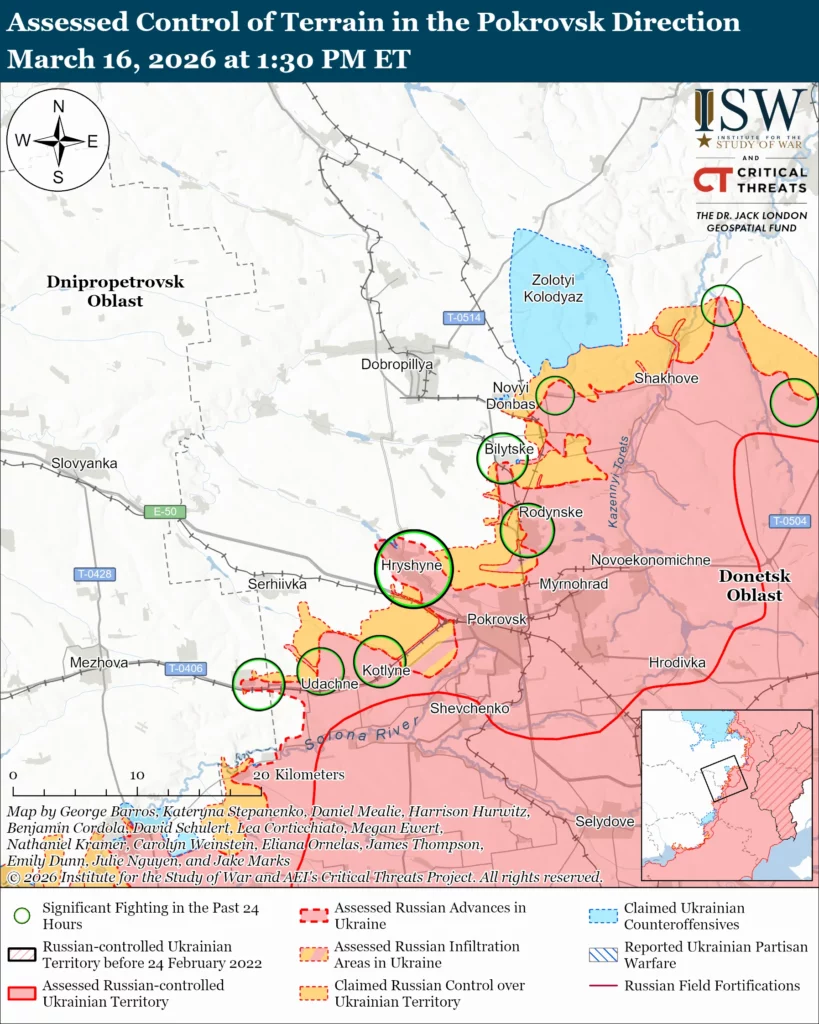
Assessed Ukrainian advances: Geolocated footage published on March 14 shows Ukrainian servicemembers operating in northwestern Hryshyne (northwest of Pokrovsk), indicating that Ukrainian forces recently advanced in the area.[69]
Russian forces attacked near Pokrovsk itself; northwest of Pokrovsk near Hryshyne and toward Shevchenko; north of Pokrovsk near Rodynske and Bilytske; northeast of Pokrovsk near Zatyshok; east of Pokrovsk near Myrnohrad; southwest of Pokrovsk near Molodetske, Udachne, Kotlyne, and Novopidhorodnie; and west of Pokrovsk toward Novooleksandrivka on March 15 and 16.[70]
Ukrainian forces continued their frontline strike campaign near Pokrovsk on March 16. The Ukrainian 7th Rapid Reaction Corps of the Air Assault Forces reported on March 16 that Ukrainian forces struck a Russian manpower concentration in southern Pokrovsk, where Russian forces were using the cover of buildings to train assault groups and accumulate forces.[71] The corps reported that Ukrainian forces also struck a manpower concentration in southeastern Pokrovsk. Geolocated footage published on March 16 confirms the strike against southern Pokrovsk.[72]
The Russian military command is reportedly withdrawing some forces in the Pokrovsk direction for reconstitution while preparing to intensify assaults north of Pokrovsk and Myrnohrad. A Ukrainian brigade operating in the Pokrovsk direction reported on March 15 that the Russian military command withdrew elements of the 2nd Battalion of the Russian 5th Motorized Rifle Brigade (51st CAA, formerly 1st Donetsk People’s Republic [DNR] AC, SMD]) due to heavy losses.[73] The brigade noted that the Russian military command is redeploying elements of an unspecified motorized rifle brigade from the Pokrovsk and Myrnohrad areas to other unspecified nearby settlements likely in preparation for new assault operations north of Pokrovsk and Myrnohrad.
A Kremlin-affiliated Russian milblogger claimed that Russian forces are struggling to consolidate their positions within Hryshyne, most of which is a contested “gray zone.”[74]
Order of Battle: First-person view (FPV) drone operators of the Russian 57th Spetsnaz Company (8th CAA) are reportedly striking Ukrainian equipment near Vasylivka (northwest of Pokrovsk) and Bilytske.[75]
Russian forces continued offensive operations northeast of Novopavlivka near Novomykolaivka and south of Novopavlivka near Filiya on March 15 and 16 but did not advance.[76]
Ukrainian forces recently advanced in the Oleksandrivka direction.
See topline text for assessed Ukrainian and Russian advances in the Oleksandrivka direction.
Russian forces attacked northeast of Oleksandrivka near Zeleny Hai; east of Oleksandrivka near Oleksandrohrad; southeast of Oleksandrivka near Berezove, Ternove, Novomykolaivka, and Kalynivske and toward Verbove; and south of Oleksandrivka near Zlahoda and toward Danylivka on March 15 and 16.[77]
Order of Battle: Drone operators of the Russian Rubikon Center for Advanced Unmanned Technologies continue to strike Ukrainian forces in Vidradne (south of Oleksandrivka).[78] Drone operators of the 14th Spetsnaz Brigade (GRU) are reportedly striking Ukrainian forces near Oleksandrivka.[79]
Ukrainian forces continue their mid-range strike campaign against Russian military assets in occupied Donetsk Oblast. The Ukrainian General Staff reported that Ukrainian forces struck a radar station of a Russian S-300 air defense system near occupied Chervone (one of two settlements either 75 or 117 kilometers from the frontline) and a command and observation point near occupied Stepne (one of multiple settlements between 55 and 129 kilometers from the frontline) on March 15 or overnight on March 15 to 16.[80]
Russian Supporting Effort: Southern Axis
Russian objective: Maintain frontline positions, secure rear areas against Ukrainian strikes, and advance within tube artillery range of Zaporizhzhia City
Ukrainian forces recently advanced in the Hulyaipole direction.
See topline text for assessed Ukrainian advances in the Hulyaipole direction.
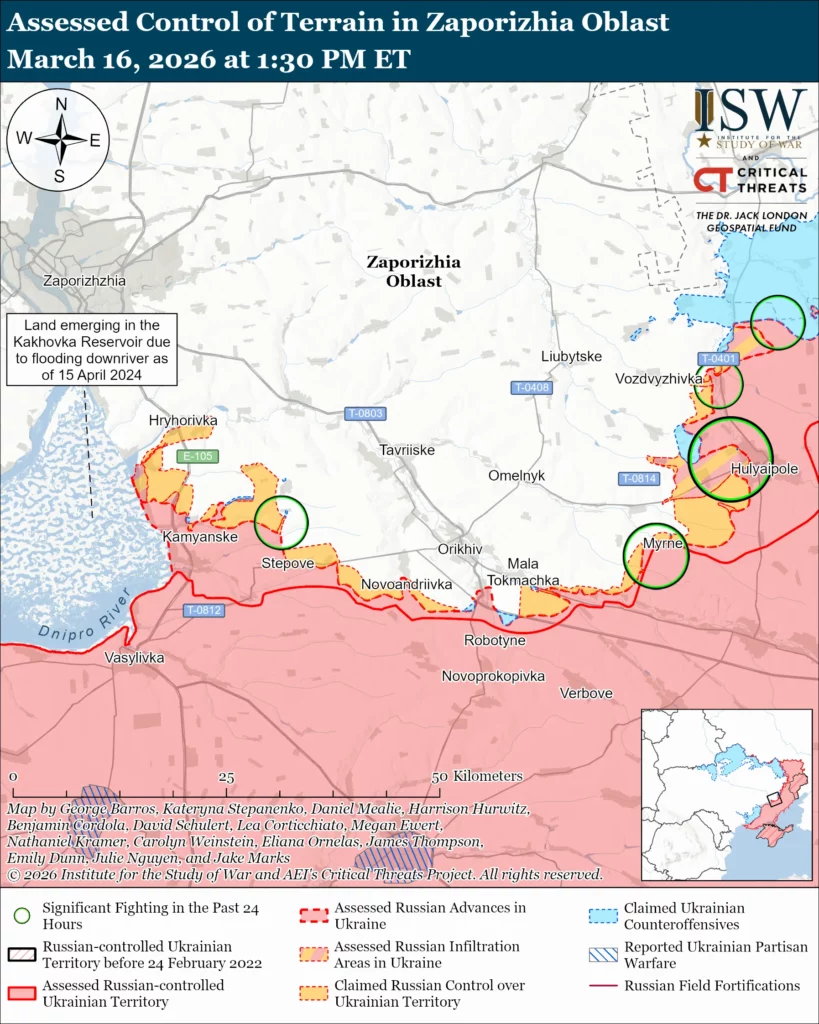
Unconfirmed claims: Russian milbloggers claimed that Russian forces advanced to the eastern outskirts of Verkhnya Tersa (northwest of Hulyaipole) and southwest of Zaliznychne (west of Hulyaipole).[81]
Russian forces attacked near Hulyaipole itself; northwest of Hulyaipole near Zelene, Varvarivka, Svyatopetrivka, and Olenokostyantynivka and toward Verkhnya Tersa, Rizdvyanka, and Vozdvyzhivka; west of Hulyaipole near Zaliznychne; and southwest of Hulyaipole near Myrne and toward Charivne on March 15 and 16.[82]
Order of Battle: Ukrainian military observer Kostyantyn Mashovets reported that elements of the Russian 57th and 60th motorized rifle brigades (both of the 127th Motorized Rifle Division, 5th Combined Arms Army [CAA], Eastern Military District [EMD]) and of the 76th Airborne (VDV) Division are attacking west and northwest of Hulyaipole.[83] Drone operators of the 14th Spetsnaz Brigade (Russian General Staff’s Main Directorate [GRU]) are reportedly striking Ukrainian forces near Vozdvyzhenka and Zirnytsya (northwest of Hulyaipole).[84] Bomber aviation of the 11th Air Force and Air Defense Army (Russian Aerospace Forces [VKS] and EMD) is reportedly striking Ukrainian forces near Lisne (northwest of Hulyaipole) and Novoselivka (west of Hulyaipole).[85]
Russian forces continued offensive operations in western Zaporizhia Oblast on March 16 but did not advance.
Russian forces attacked west of Orikhiv near Pavlivka on March 15 and 16.[86] A Russian milblogger claimed that Ukrainian forces are counterattacking near Stepnohirsk and Prymorske (both west of Orikhiv).[87]
Order of Battle: Drone operators of the Russian 108th VDV Regiment (7th VDV Division) are reportedly intercepting Ukrainian heavy bomber drones and striking Ukrainian forces near Malokaterynivka (northwest of Orikhiv).[88]
Ukrainian forces continued their short- and mid-range strike campaign against Russian military assets in occupied Zaporizhia Oblast. The Ukrainian General Staff reported that Ukrainian forces struck a Russian Tor air defense system missile launcher near occupied Balashivka (about 39 kilometers from the frontline) and a Russian command and observation post near occupied Bahate (southeast of Orikhiv and about two kilometers from the frontline) on the evening of March 15 or overnight on March 15 to 16.[89] The Ukrainian Special Operations Forces (SSO) reported on March 16 that Ukrainian forces struck a Russian armored vehicle repair base in Yakymovka (roughly 85 kilometers from the frontline); a maintenance base and weapons and equipment warehouse in Andriivka (either roughly 62 or 95 kilometers from the frontline); and a logistics center in Berestove (roughly 68 kilometers from the frontline) in the past three days (since March 13).[90] Geolocated footage confirms the Ukrainian strike against the Russian Tor system north of Balashivka.[91]
Neither Ukrainian nor Russian sources reported fighting in the Kherson direction on March 16.
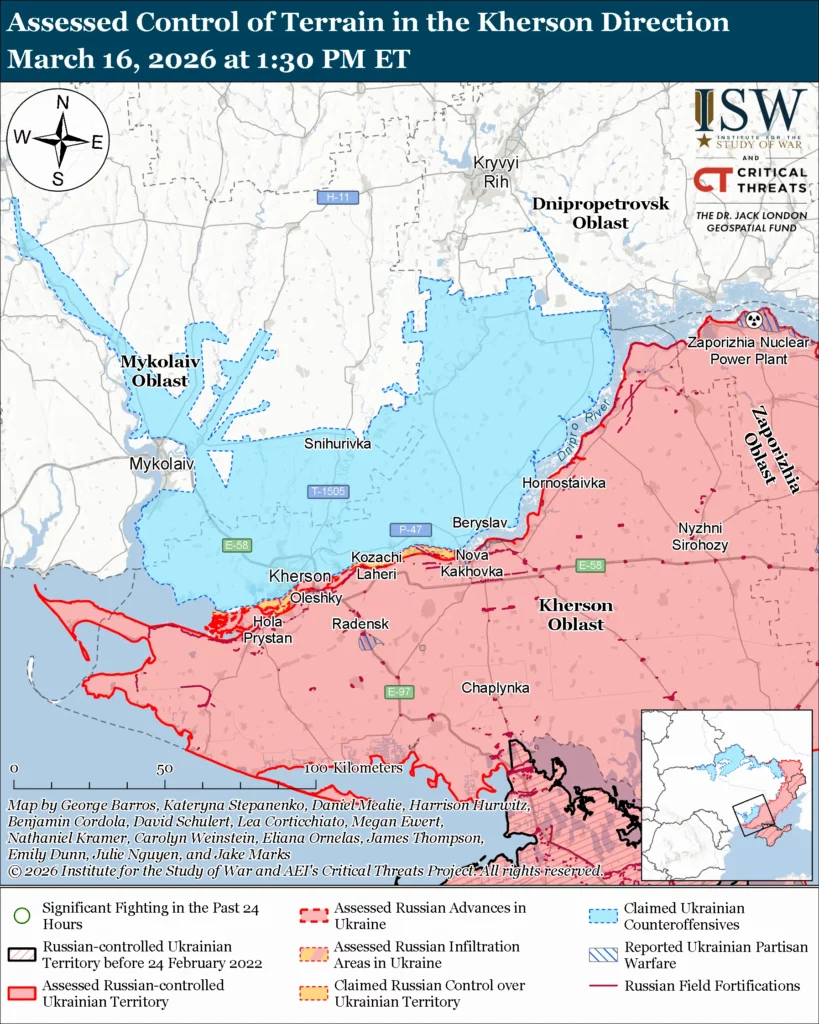
Ukrainian forces continued their long-range strike campaign against Russian military assets in occupied Crimea. Ukraine’s SSO reported on March 16 that Ukrainian forces struck a warehouse and the generator and switching station of an electronic warfare (EW) and electronic reconnaissance station at Khersones Air Base near occupied Sevastopol (roughly 225 kilometers from the frontline) in the past three days (since March 13).[92]
Russian Air, Missile, and Drone Campaign
Russian Objective: Target Ukrainian military and civilian infrastructure in the rear and on the front line
Russian forces conducted a series of drone strikes against Ukraine on the night of March 15 to 16. The Ukrainian Air Force reported that Russian forces launched 211 Shahed-type, Gerbera-type, Italmas-type, and other drones – of which over 100 were Shahed drones – from the directions of Oryol, Kursk, and Bryansk cities; Millerovo, Rostov Oblast; Primorsko-Akhtarsk, Krasnodar Krai; and occupied Hvardiiske, Crimea.[93] The Ukrainian Air Force reported that Ukrainian forces downed 194 drones, that 16 drones struck 10 locations, and that drone debris fell on 11 locations. Ukrainian officials reported that Russian forces struck residential and educational infrastructure in Odesa, Mykolaiv, and Kharkiv oblasts.[94]
Ukrainian Air Force Spokesperson Colonel Yuriy Ihnat stated that Russian forces conducted atypical drone strikes against Kyiv City and Oblast on the morning of March 16.[95] Ihnat stated that Russian forces launched more than 30 drones and that most were strike drones with some reconnaissance drones. Ihnat stated that Russian forces controlled the drones using mesh and other communications networks. (A mesh network is a wireless network that enables a group of drones to maintain a signal amongst themselves, as opposed to individually relying on ground signal systems.) Ihnat stated that Russian forces are constantly modernizing their drones to make them less noticeable and more difficult for Ukrainian electronic warfare (EW) to suppress.Russian forces likely used a Shahed-type mothership drone to extend the range of a modernized Lancet loitering munition to hit central Kyiv City. Ukrainian sources posted footage on March 16 of drone debris near the Independence Monument in central Kyiv City, and Ukrainian military outlet Defense Express, citing sources, reported that the crashed drone was a Lancet loitering munition that likely used artificial intelligence (AI).[96] Defense Express assessed that the drone’s unusual markings suggest Russian forces configured it for drone swarms, autonomous navigation, target acquisition, and unmanned strikes as the markings allow drones in a swarm to stay together. Defense Express assessed that the drone may have used mesh networks or mobile communications. Ukrainian Ministry of Defense (MoD) Advisor Serhii Sternenko similarly stated that the drone was a new version of the Lancet with AI and assessed that a Shahed drone likely delivered the drone to the area – as the Lancet’s range does not extend that far.[97] Ukrainian MoD advisor on defense technology and drone and EW expert Serhiy “Flash” Beskrestnov reported that Russian Lancets cannot reach Kyiv City and that Russian forces instead typically use these drones with small payloads to strike frontline targets.[98] Flash assessed that Russian forces likely dropped Lancet debris from a Shahed drone as part of an information operation, likely in order to create fear in Kyiv City and Ukraine more widely about the reach of Russian drones.
Significant Activity in Belarus
Russian efforts to increase its military presence in Belarus and further integrate Belarus into Russian-favorable frameworks
Belarus continues to cooperate with Russian regions to manufacture dual-use goods, possibly as part of sanctions evasion schemes. Belarusian President Alexander Lukashenko met on March 16 with Ryazan Oblast Governor Pavel Malkov.[99] Lukashenko highlighted trade agreements related to machine tool and passenger and freight vehicle manufacturing.
Note: ISW does not receive any classified material from any source, uses only publicly available information, and draws extensively on Russian, Ukrainian, and Western reporting and social media as well as commercially available satellite imagery and other geospatial data as the basis for these reports. References to all sources used are provided in the endnotes of each update.