 Eurasia Press & News
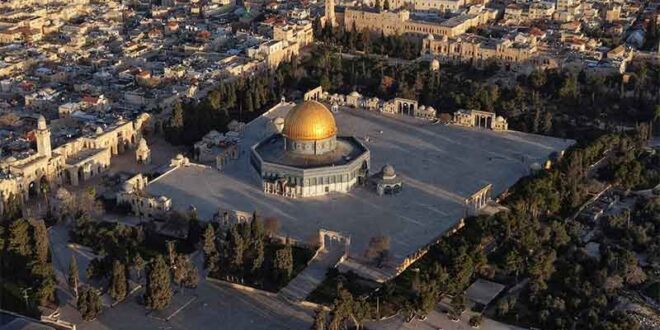
On the morning of 20 March 2026, an elderly Muslim woman knelt on a pavement in Jerusalem to pray on Eid al-Fitr. She was not alone in her humiliation — with her were eight hundred and thirty-nine years of history, three billion Muslims across the earth, and a question that can no longer be silenced: are we witnessing, in slow and brazen motion, the beginning of the execution of the Third Temple project upon the ruins of Islam’s first qibla and third holiest site? What follows is not an opinion piece. It is a documented file — dates, names, figures, architectural blueprints, witnesses — posing to the living human conscience a question that can no longer be avoided.
“Preparing the Temple is no longer a dream. It is a reality in which everyone can take part.”
— Rabbi Yisrael Richman, Director of the Temple Institute, Jerusalem, 2016
“Until the Holy of Holies is under our sovereignty, it means we are still living in exile.”
— Rabbi Shlomo Ra’anan, leading figure of the Israeli messianic movement
A Number That Accuses
Some mornings resemble no other. The morning of 20 March 2026 is one of them.
At dawn on that Friday — the first day of Eid al-Fitr, the feast that crowns the holy month of Ramadan — thousands of Muslim worshippers made their way to the gates of Jerusalem’s Old City to perform the Eid prayer at the Al-Aqsa Mosque. What they found were rows of Israeli soldiers, steel barriers, and tear gas for those who persisted.
Umm Khalil, sixty-two years old, a resident of the Silwan neighbourhood in occupied East Jerusalem, had prepared her grandchildren’s holiday clothes the night before, as she had done every year since childhood, as her mother had done before her, and her mother’s mother before that. She walked through the pre-dawn darkness, leading her two grandsons — aged six and eight — by the hand. At the Damascus Gate, a soldier stopped her and told her, in Hebrew first and then in Arabic: the road is closed. She prayed on the pavement, her knees on the cold asphalt, while the two children wept — not from the gas, but because they could not understand why the mosque was closed on the day of the feast.
This scene — repeated in thousands of variations through every alleyway of the Old City that morning — carries a historical weight that far exceeds any talk of security measures or wartime precautions.
For there is no precedent for what occurred on the morning of 20 March 2026 except by going back eight hundred and thirty-eight years and five months. Or, in the language that history retains: eight hundred and thirty-nine years.
The last time Muslims were prevented from praying at Al-Aqsa on the day of Eid was under the Crusader occupation. And the man who ended that captivity was named Saladin.
Eighty-Eight Years of Silence
This figure — eight hundred and thirty-nine — is not rhetorical approximation. It rests on a chronology documented in the greatest medieval historical sources, both Arab and Latin.
On 15 July 1099 — the year 492 of the Hijri calendar — the armies of the First Crusade breached the walls of Jerusalem. What followed is documented with sinister precision even by the participants themselves. Raymond d’Aguilers, chaplain to Raymond de Saint-Gilles and eyewitness, wrote: “In the Temple of Solomon and its portico, men rode in blood up to their knees and the bridle reins of horses.” Ibn al-Athir, the thirteenth-century Arab historian, records in his Kamil fi al-Tarikh that seventy thousand Muslims perished within hours inside Al-Aqsa alone.¹
The mosque was immediately desecrated. The Crusaders, who called it the Templum Salomonis — the Temple of Solomon — saw in it the literal fulfilment of their eschatological mission. King Baldwin I made it his royal palace. In 1119, the Poor Knights of Christ — the future Knights Templar — took permanent possession of the site, transforming it into a stable, an armoury, and the headquarters of a military-religious order whose stated vocation was the extirpation of Islam from the Holy Land.²
Eighty-eight years. Not a single call to prayer. Not a single Eid takbir. Not a single Friday sermon.
Then came 2 October 1187 — the year 583 of the Hijri calendar — and Saladin entered Jerusalem following his decisive victory at the Battle of Hattin on 4 July of the same year. Imad ad-Din al-Isfahani, Saladin’s secretary and a witness to that historical moment, describes in his Al-Fath al-Qussi fi al-Fath al-Qudsi how the Sultan ordered the Dome of the Rock washed with rosewater after the Crusaders had placed a Christian altar upon it.³ The minbar — the carved pulpit which Nur ad-Din Zengi had commissioned in Aleppo decades earlier in anticipation of this very day — was reinstalled. On the following Friday, the judge Muhyi ad-Din ibn Zaki mounted the minbar and delivered the first Friday sermon after eighty-eight years of silence.⁴
20 March 2026: the sequence resumes.
Forty Years of Silent Preparation
To understand why the closure of Al-Aqsa on Eid al-Fitr 2026 may not be a random historical accident, one must go back to 1984.
That year, Rabbi Yisrael Ariel — a veteran of the paratroopers brigade that seized the esplanade during the Six-Day War — founded the Temple Institute in Jerusalem, known in Hebrew as Machon HaMikdash. Its stated goal, unchanged in four decades: to prepare for the construction of the Third Temple on the esplanade of Al-Aqsa Mosque, at the precise location occupied today by the Dome of the Rock.⁵
What the Institute has accomplished since then does not belong to the realm of spiritual dreaming. It is systematic logistical preparation:
1999: A solid gold Menorah — described by the Institute as “ready for installation as soon as conditions permit.”⁶
2004: Reconstitution of the Sanhedrin after 1,600 years of absence — ruling on Temple construction and priestly lineages.⁷
2011: Full architectural blueprints for the Third Temple — a 1:50 scale model on display in a Jerusalem visitors’ centre since 2025.⁸
2014: Opening of the Nezer HaKodesh Institute for Kohanic Studies — training priests in sacrificial procedures. The stone altar is designed for rapid reassembly on the Temple Mount “when the time comes.”⁹
September 2022: Five red heifers flown from Texas to Israel at a cost of $700,000 — removing the last major practical obstacle to Temple purification under Hebrew law.¹⁰
August 2025: Ben Gvir performs public prayer on the esplanade on Tisha B’Av — the first serving Israeli cabinet minister to do so, in explicit violation of the 1967 status quo.¹¹
According to a Haaretz report dated 7 September 2024, Ben Gvir had prepared a three-stage plan to impose full Israeli sovereignty over Al-Aqsa, culminating in the demolition of the Dome of the Rock “to permit the construction of the Third Temple.” The newspaper notes that Netanyahu “silently approves” of this plan.¹²
Hebron: The Full Dress Rehearsal
It is impossible to grasp what is happening at Al-Aqsa without recalling what happened at the Ibrahimi Mosque in Hebron — for Hebron is the laboratory, and Jerusalem is the final project.
On 25 February 1994, Dr Baruch Goldstein entered the prayer hall of the Ibrahimi Mosque during Ramadan’s dawn prayer and opened fire on worshippers, killing twenty-nine people and wounding one hundred and twenty-five.¹³ The Israeli authorities’ response was to divide the mosque: sixty-three percent allocated to Jewish worshippers, thirty-seven percent to Muslims. A mosque exclusively Islamic since the fourteenth century transformed into a forced shared space by unilateral occupier’s decree.
Security incident → Temporary closure → Partial reopening → Permanent division → Progressive appropriation
Al-Aqsa is today following this same trajectory, at an incomparably greater scale.
When Prophecy Becomes State Policy
Ben Gvir is not a fringe figure. He is the Minister of National Security, commander of the Israeli national police, and the man who controls direct access to the esplanade.
Finance Minister Bezalel Smotrich declared in May 2025: “We now conquer, cleanse, and stay.” This is not the rhetoric of a military strategist. It is the language of territorial purification with eschatological intent.¹⁴
Israeli philosopher Moshe Halbertal warned in Haaretz that the alliance between the religious nationalist right and the Temple movement produces, for the first time in Israeli history, a “coalescence of messianism and state policy” — what my co-author Amir Nour and I have called “Armageddon Politics”: the conduct of state affairs according to an end-times calendar.¹⁵
This grammar is transatlantic. Christians United for Israel (CUFI), which claims ten million members, shares with Temple activists a single interpretive framework: the Third Temple is a necessary precondition for the return of the Messiah. Its construction is not, in this worldview, political violence. It is theological obligation.¹⁶
“The Temple Mount/Al-Aqsa is the most potent messianic and political symbol at the heart of the conflict, capable of morally justifying and sacralising violence.”
— Professor Motti Inbari, University of North Carolina, 2025 ¹⁷
What Already Exists
This is not theory. The preparations for the Third Temple have produced tangible physical objects, functioning institutions, and completed architectural plans that together constitute material evidence of a project in the course of execution:
◈ A solid gold Menorah, permanently displayed in the Jewish Quarter of the Old City, hundreds of metres from Al-Aqsa.
◈ A gold Table of Shewbread. A gold incense altar. A stone sacrificial altar, designed for rapid dismantling and reassembly.
◈ Priestly vestments — linen robes, turbans, embroidered belts — tailored for the entire sacerdotal hierarchy of the future Temple, described as “instruments of service ready for immediate use.”
◈ A 1:50 architectural model of the Third Temple on display in a Jerusalem visitors’ centre inaugurated in 2025.
◈ A priestly school actively training Kohanim in the full rites of Temple service, including animal sacrifice.
◈ A reconstituted Sanhedrin that has already ruled on construction procedures and priestly lineage validation.
◈ Five red heifers imported from Texas — the final practical obstacle to Temple purification removed.
The question is no longer: does a project exist? The question is: at which stage of this project do we now stand?
The Logic of the Stages
Military capture (1967): The Six-Day War places the esplanade under Israeli military control. Dayan leaves the Waqf to administer the site — sovereignty established.
Symbolic infiltration (1984–2004): Temple Institute founded. Objects crafted. First activist incursions. Declared marginality, unceasing growth.
Political normalisation (2004–2022): Sanhedrin reconstituted. Priestly school opened. Temple movement enters the Israeli mainstream.
Entry into government (2022–2025): Ben Gvir and Smotrich join the Netanyahu cabinet. Daily incursions routine, police-escorted, ministerially endorsed. The 1967 status quo is clinically dead.
Total closure (28 February – 20 March 2026): The war against Iran provides security cover. Al-Aqsa closed throughout Ramadan and on Eid — first time since the Crusaders.
Next stage: Unknown. But the logic of the sequence points in only one direction.
Arab Silence: A Diagnosis, Not a Comment
On the morning of 20 March 2026, as Umm Khalil prayed on the pavement of Jerusalem, Arab and Muslim governments were issuing statements. The Arab League “condemned.” The OIC “expressed concern.” Jordan — the official custodian of Jerusalem’s Islamic holy sites under the 1994 Wadi Araba Treaty — “protested.”²⁰ Not one of these statements produced a measurable effect.
This effective silence embodies what Malek Bennabi called colonisability in his enduring masterwork The Vocation of Islam (1954): the condition of a civilisation that has so thoroughly internalised its own impotence that it can no longer distinguish between protest and action. Bennabi wrote: “The colonised is not primarily he whose land is occupied. He is the one rendered incapable of defending himself — not because he lacks physical strength, but because he has lost the sense of what is worth defending.”²¹
Frantz Fanon, in The Wretched of the Earth (1961), warned against the colonised elite that adopts the occupier’s categories to analyse its own situation, treating civilisational emergencies as diplomatic files to be managed rather than ontological wounds to be healed.²² The closure of Al-Aqsa on Eid is not a diplomatic file. It is an ontological wound. To treat it as the former is proof that one suffers from the latter.
The Question That Can No Longer Wait
Does the closure of Al-Aqsa Mosque on Eid al-Fitr, 20 March 2026, represent the beginning of the execution of the Third Temple project?
We do not know with certainty. What we do know is this:
That the project exists. Documented, institutionalised, funded, architecturally planned, ritually prepared, and politically supported at the highest levels of the Israeli government. Not a conspiracy theory — a public programme defended in the Knesset.
That the conditions for an unprecedented opportunity have converged. The war against Iran provides security cover. The most right-wing government in Israel’s history holds power. The Arab world is paralysed. The American evangelical administration will not constitute a brake.
That the logic of the historical sequence points in only one direction. Every stage cleared has made the next more feasible and more probable. Not a single stage has been reversed.
That 839 years without precedent constitute a threshold of incalculable consequence. Whoever crosses it signals to adversaries: the status quo is dead. And to messianic followers: the hour is at hand.
Conclusion: Not Nostalgia. A Demand.
It would be easy — and false — to read this text as a romantic invocation of Saladin, or a call for vengeance. That is not what the history of 1187 teaches us.
Saladin did not liberate Jerusalem because he was divinely inspired. He liberated it because he had read history: he understood the structural weaknesses of the adversary — the internal rivalries among the Crusader kingdoms, the exhaustion of their logistical base, the diplomatic isolation of their project — and patiently built a coalition where his predecessors had produced only palace quarrels. He possessed a strategy, not merely indignation.
Ibn Khaldun observed in the Muqaddima that great historical transformations are never the product of sudden isolated will, but the culmination of accumulated asabiyya — collective solidarity, shared purpose — across generations, until a tipping point is reached.²³ Looking at the four decades separating the founding of the Temple Institute in 1984 from the closure of Al-Aqsa on Eid 2026, one cannot help but ask: are we living through that tipping point now?
The question posed by 20 March 2026 is therefore not: have we returned to the age of the Crusades? The question is: confronted with the real possibility of the execution of the Third Temple project, does the Islamic world and the world of living human conscience possess a strategy — or only statements?
Umm Khalil prayed on the pavement of Jerusalem on the morning of Eid. Her grandchildren wept without understanding. And in eight hundred and thirty-nine years, when a historian asks what happened on that March morning in 2026, they will seek the answer — as we seek the answer to 1099 — in the archives of what the contemporaries said, did, or refused to do.
And who is more unjust than those who prevent the mention of God’s name
in His mosques and strive towards their destruction?
Those — it was not for them to enter them except in fear.
For them in this world is disgrace,
and for them in the Hereafter is a great punishment.
— Quran, Surah Al-Baqarah, 2:114 —
“Strive towards their destruction” — that is the Third Temple project in three words.
“Except in fear” — that is God’s promise to every power that bars His houses from those who seek Him.
“Disgrace in this world” — that is the final historical judgement, which admits no appeal.
The archives are being written now. And the verdict — human or divine — will not wait long.