 Eurasia Press & News
Key Takeaways
US President Donald Trump threatened on March 21 to “obliterate” Iranian power plants if Iran does not “fully open” the Strait of Hormuz within 48 hours. Iran has threatened to attack regional energy infrastructure if the United States attacks power plants in Iran. ISW-CTP has recorded several Iranian attacks on regional energy infrastructure since the war began on February 28, but the new threats could entail an expansion of such attacks.
IRGC Ground Forces Commander Brigadier General Mohammad Karami visited unspecified IRGC Ground Forces units in western and northwestern Iran on March 22. The visit of the IRGC Ground Forces commander to units in northwestern provinces along Iran’s border is notable given the combined force’s efforts to degrade internal security institutions in Iran’s western border region and reports about possible armed Kurdish mobilization along the Iran-Iraq border.
The combined force continued to conduct airstrikes targeting Iranian missile production and storage facilities. The combined force targeted sites that produce short- and medium-range ballistic missiles, including the Fath-360 with a maximum range of 120 kilometers (km), Fateh-110 with a maximum range of 300km, the Zolfaghar with a maximum range of 700km, and the medium-range Haj Qasem ballistic missile with a maximum range of 1,400 km. Iran notably has supplied Russia with Fath-360s for Russia’s offensive campaign in Ukraine.
The IRGC has reportedly restructured Hezbollah under a more decentralized command model following Israeli operations that degraded the group’s leadership in 2024. This decentralized structure aimed to improve operational security and reduce vulnerability to Israeli intelligence penetration.
Toplines
US President Donald Trump threatened on March 21 to “obliterate” Iranian power plants if Iran does not “fully open” the Strait of Hormuz within 48 hours.[1]
Iran has threatened to attack regional energy infrastructure if the United States attacks power plants in Iran. ISW-CTP has recorded several Iranian attacks on regional energy infrastructure since the war began on February 28, but the new threats could entail an expansion of such attacks. Iranian Parliament Speaker Mohammad Bagher Ghalibaf stated on March 22 that Iran would strike critical infrastructure and energy facilities in the region if Iranian power plants are attacked.[2] The Khatam ol Anbia Central Headquarters released a statement on March 22 and similarly threatened to “completely close” the Strait of Hormuz as well as target regional energy infrastructure and regional companies with US shareholders.[3] Iran’s Permanent Representative to the International Maritime Organization reiterated that Iran will not allow US, Israeli, or US-Israeli allied vessels to transit the strait.[4] Iran has attacked energy infrastructure in at least the United Arab Emirates, Saudi Arabia, Bahrain, Oman, and Israel since the war began.
The United Kingdom Maritime Trade Operations (UKMTO) reported on March 21 that an unknown projectile exploded near a vessel 15 nautical miles north of Sharjah, United Arab Emirates.[5] The UKMTO later classified the incident as “suspicious activity,” not an attack, because it could not confirm the intended target.[6] The UKMTO has reported 21 confirmed maritime incidents in the Strait of Hormuz since the war began.[7] The last confirmed Iranian attack on a vessel was on March 11.[8] Iranian officials have repeatedly stated that they will control which vessels transit the strait and that vessels affiliated with the United States, Israel, or their allies cannot pass.[9]
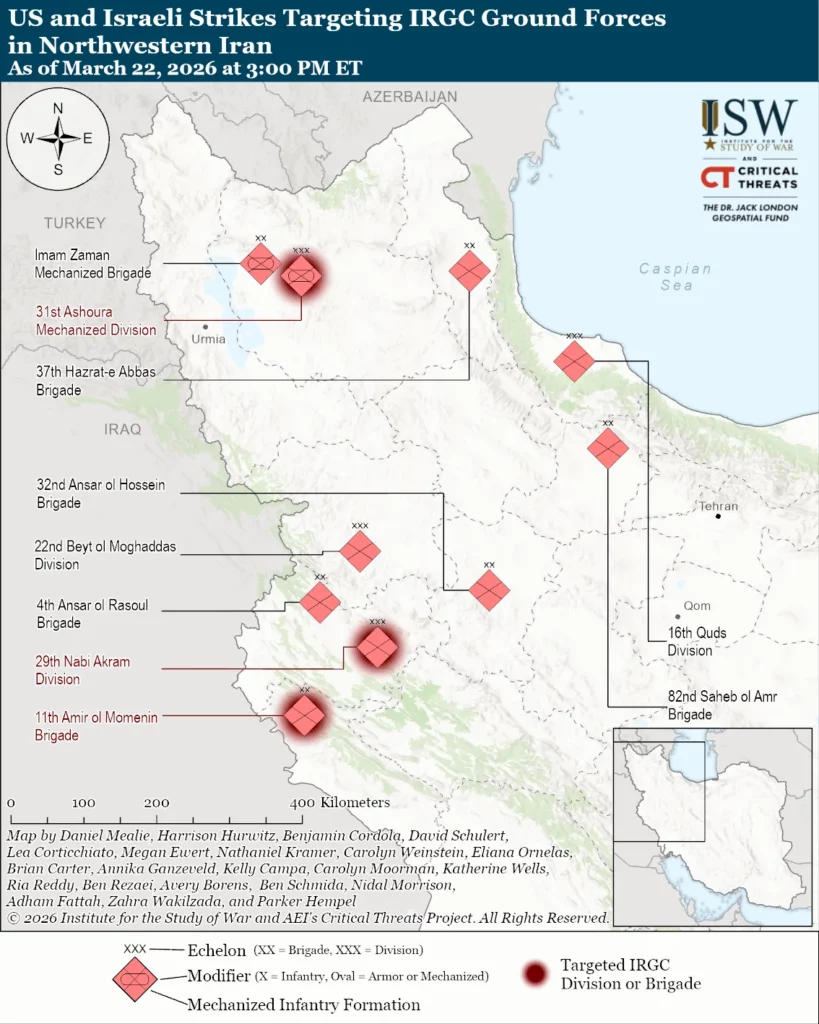
IRGC Ground Forces Commander Brigadier General Mohammad Karami visited unspecified IRGC Ground Forces units in western and northwestern Iran on March 22.[10] The combined force has struck several Ground Forces units in these areas since the beginning of the war. Iranian Armed Forces General Staff (AFGS)-affiliated media reported that Karami warned that Ground Forces units are ready to confront any ”aggressors” on Iran’s borders.[11] The IRGC Ground Forces are structured to confront any invading force while also having units positioned to violently suppress social unrest.[12] The visit of the IRGC Ground Forces commander to units in northwestern provinces along Iran’s border is notable given the combined force’s efforts to degrade internal security institutions in Iran’s western border region and reports about possible armed Kurdish mobilization along the Iran-Iraq border.[13] The combined force has reportedly struck at least two IRGC Ground Forces divisions and one brigade in northwestern and majority Kurdish areas of Iran since February 28 (see map below).[14] The combined force reportedly struck the 31st Ashoura Mechanized Division, which operates in Tabriz, East Azerbaijan Province, on March 4. Commercially available satellite imagery from March 4 and 5 also confirmed damage from combined force strikes to the 11th Amir ol Momenin Brigade base in Soltan Abad, Ilam Province, and the Nabi Akram Operational Division in Kermanshah City, Kermanshah Province.[15]
US and Israeli Air Campaign
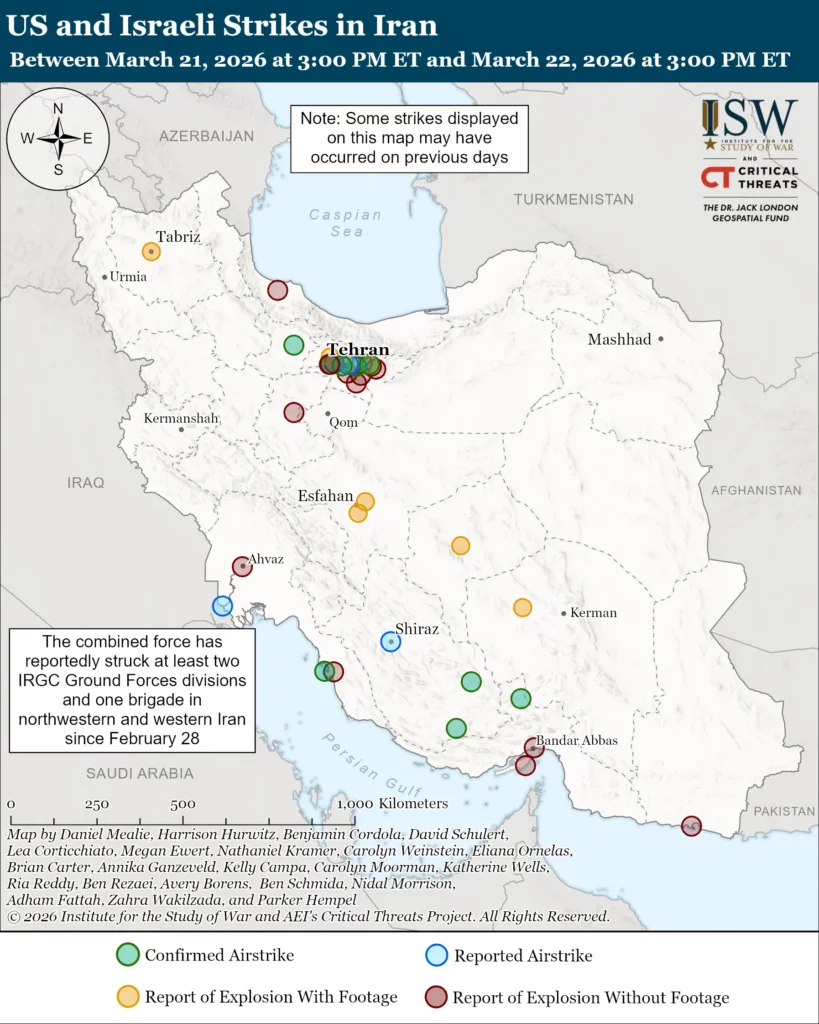
The combined force continued to conduct airstrikes targeting Iranian missile production and storage facilities. US Central Command (CENTCOM) on March 22 published satellite imagery from March 7 showing damage from airstrikes at Iran’s Kuh-e Barjamali short- and medium-range ballistic missile assembly facility.[16] A defense analyst assessed that the site was likely the final site in the production process for solid-propellant missiles on Khojir Aerospace Complex southeast of Tehran City.[17] The analyst noted that the site belonged to Aerospace Industries Organization (AIO), a subsidiary of the Defense and Armed Forces Logistics Ministry.[18] The analyst added that some of the missiles finalized at the site include short-range ballistic missiles, such as the Fath-360 with a maximum range of 120 kilometers (km), Fateh-110 with a maximum range of 300km, the Zolfaghar with a maximum range of 700km, and the medium-range Haj Qasem ballistic missile with a maximum range of 1,400 km.[19] Iran notably has supplied Russia with Fath-360s for Russia’s offensive campaign in Ukraine.[20]
The Israel Defense Forces (IDF) also confirmed on March 22 that it struck a Defense and Armed Forces Logistics Ministry weapons production and storage site east of Tehran City, likely at the Khojir Aerospace Complex.[21] Anti-regime media reported that residents from villages in the vicinity of Damavand town near Khojir Aerospace Complex heard explosions on March 22.[22] Combined force airstrikes have previously struck missile production facilities at Khojir Aerospace Complex.[23] An analyst from the James Martin Center for Non-Proliferation Studies identified extensive damage to planetary mixer and casting sites at the Khojir Aerospace Complex, citing March 4 commercially available satellite imagery.[24]
The IDF also confirmed on March 22 that it struck an Artesh base used for personnel training and a missile storage in southwest Tehran City as well as an Islamic Revolutionary Guards Corps (IRGC) Aerospace Force weapons production facility west of Tehran City.[25] It is unclear where this site is located. Anti-regime media reported several explosions in Karaj, Alborz Province, west of Tehran City on March 22, however.[26]
The combined force continued to strike Iranian underground missile sites in southern Iran. An open-source intelligence (OSINT) account on March 21 identified damage to the exterior of an underground missile base between Gerash and Lar in Fars Province from combined force airstrikes on March 16 and 22.[27] Another OSINT analyst confirmed on March 22 that CENTCOM struck missile launchers and tunnel entrances at two underground missiles bases in Hajjiabad, Hormozgan Province, and Darab, Fars Province on March 20.[28]
The combined force continued to strike the Artesh’s tactical air bases across Iran. An OSINT account on X published footage of a fire reportedly at the 8th Tactical Air Base in Esfahan Province on March 22.[29] The combined force previously struck this air base on March 7 and 8.[30] Another OSINT account on March 22 published satellite imagery showing two craters on the runway at Bushehr Airport, where the 6th Tactical Air Base is located, from airstrikes between March 14 and March 22.[31]
The combined force continues to strike defense industrial sites to degrade Iran’s drone and missile production capabilities. An Israeli OSINT analyst on March 22 identified damage to the roof of a factory belonging to the Advanced Fiber Development Company from previous Israeli airstrikes targeting the Lia Industrial Zone south of Ghazvin City, Ghazvin Province, in northern Iran.[32] The US Treasury sanctioned the company in May 2025 for manufacturing carbon fibers for the IRGC Aerospace Force.[33] An OSINT account on X published footage of a large explosion at an unspecified warehouse in a non-residential area in Rafsanjan City, Kerman Province, in central Iran on March 21.[34]
The IDF continued to strike internal security institutions and personnel in Tehran on March 22. The IDF reported that it struck an “additional headquarters” belonging to Iranian Intelligence and Security Ministry in Tehran.[35] The IDF has pursued other Intelligence and Security Ministry-affiliated targets since the beginning of the war, including headquarters, personnel, and other assets across Iran.[36] The IDF recently killed Intelligence and Security Minister Esmail Khatib in an airstrike on March 18.[37] The IDF also struck an ”emergency command center” for internal security forces in Tehran on March 22.[38] The reference to an ”emergency command center” may refer to improvised facilities necessitated by Israeli strikes on the regular headquarters of the security units. ISW-CTP recently noted that fear and shock have caused some Iranian internal security personnel to abandon established headquarters and bases, set up improvised facilities, and adapt command-and-control structures under pressure.[39]
Geolocated footage posted on March 21 showed damage to the Fars Province LEC Headquarters in Shiraz.[40] The IDF struck the headquarters on March 17.[41] The combined force has struck several internal security targets in Fars Province and Shiraz in particular since the beginning of the war, including the IRGC Ground Forces Fajr Unit Provincial Unit and 33rd Al Mehdi Airborne Brigade.[42] The combined force does not appear to have yet struck internal security institutions or installations at the same scale as it has in Tehran or northwestern Iran, however.
Iranian Retaliation
Two Iranian ballistic missiles impacted in southern Israeli towns and injured nearly 200 people on March 21.[43] The missiles struck Dimona and Arad in the Negev desert.[44] The IDF failed to intercept the two missiles due to “different and unrelated circumstances.“[45] The IDF said that the two missiles that struck Dimona and Arad were likely Ghadr variants.[46] Ghadr missiles are liquid-fuel, medium-range ballistic missiles with a range of 1,950 kilometers, which means that Iran can launch Ghadr missiles from positions in central Iran.[47] Iran is increasingly firing missiles from central Iran due to the IDF‘s destruction of Iranian missile launchers in western Iran, according to the IDF.[48] The Israeli Ministry of Education cancelled in-person classes across Israel on March 22 and 23 following the strikes.[49]
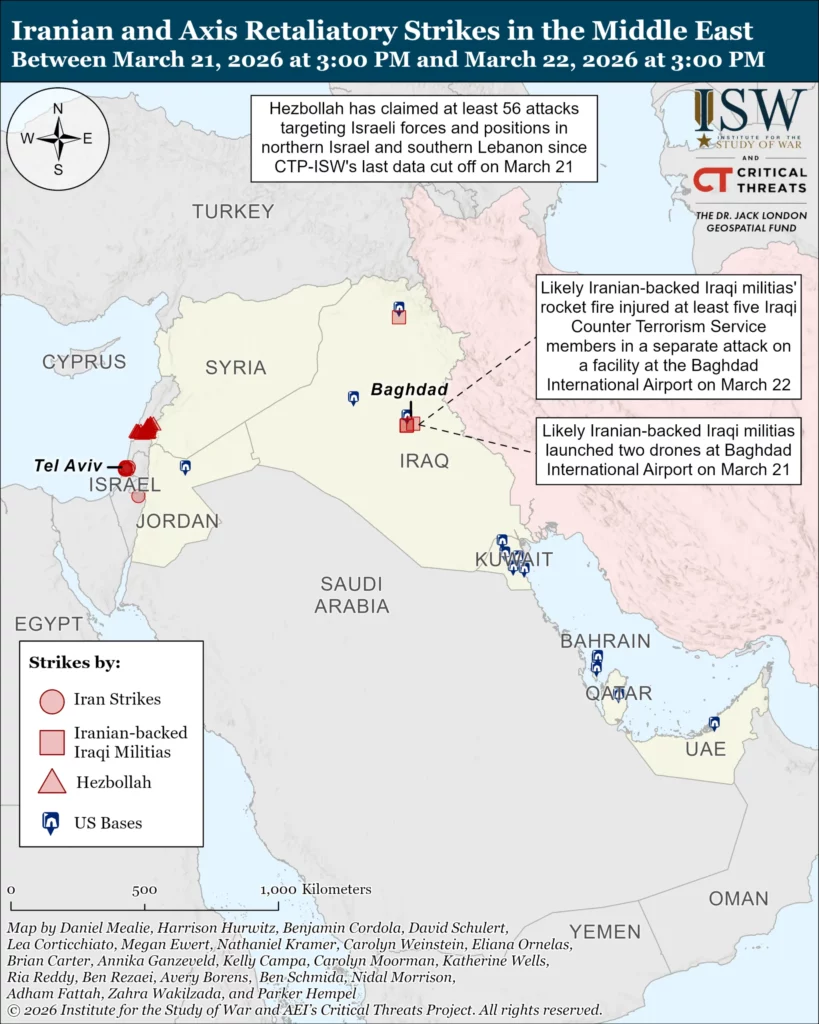
Iran has launched over 400 ballistic missiles targeting Israel since the start of the war, according to an Israeli military correspondent.[50] The IDF has intercepted 92 percent of missiles during the war.[51] This interception rate is close to the Israeli ballistic missile interception rates during Iranian missile attacks on Israel in April and October in 2024 as well as the Israel-Iran War in June 2025.[52] Only five missiles carrying conventional warheads with ”hundreds of kilograms” of explosives have struck populated areas in Israel throughout the war, according to an Israeli military correspondent.[53]
Iran continues to launch missiles carrying cluster munitions targeting populated areas in Israel, likely to maximize destruction and terrorize Israeli civilians. A cluster munition warhead contains submunitions that disperse over a wide area. Cluster munitions are significantly more difficult for Israeli air defenses to intercept once dispersed. Iran launched at least three missiles carrying cluster munitions targeting Israel on March 22 that impacted across the Tel Aviv area, including in Jaffa, Petah Tikva, Bat Yam, and Holon.[54] Iran likely began using cluster warheads to maximize the damage inflicted by its ballistic missiles given their relatively low accuracy when fitted with standard warheads.[55] Around 70 percent of Iranian missile launches at Israel have reportedly carried cluster munitions.[56] An Israeli military correspondent reported that at least two dozen missiles with warheads have released cluster munitions over populated areas throughout the war.[57] The correspondent noted that there have been over 100 separate impact sites from cluster munitions.[58]
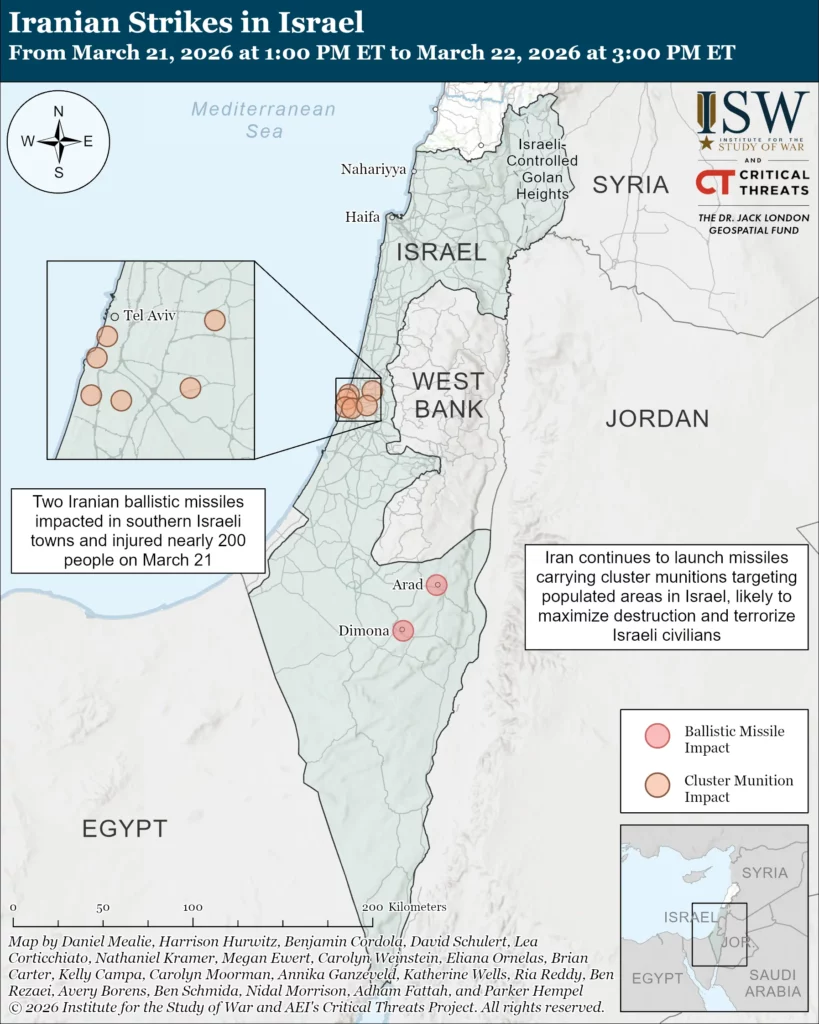
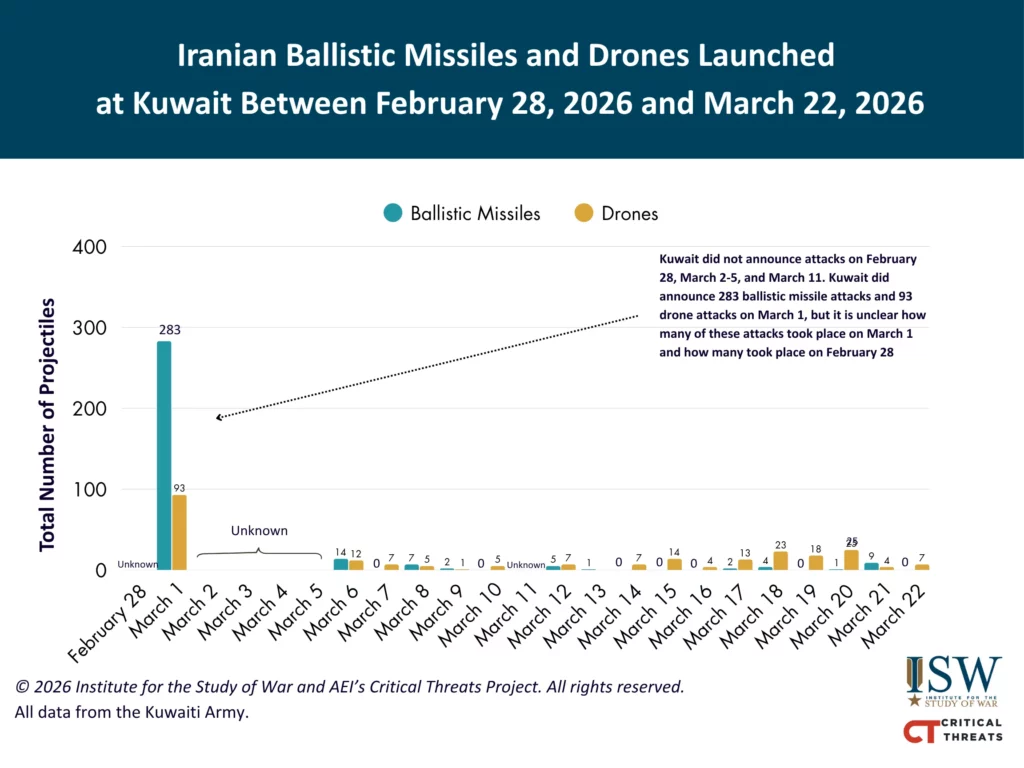
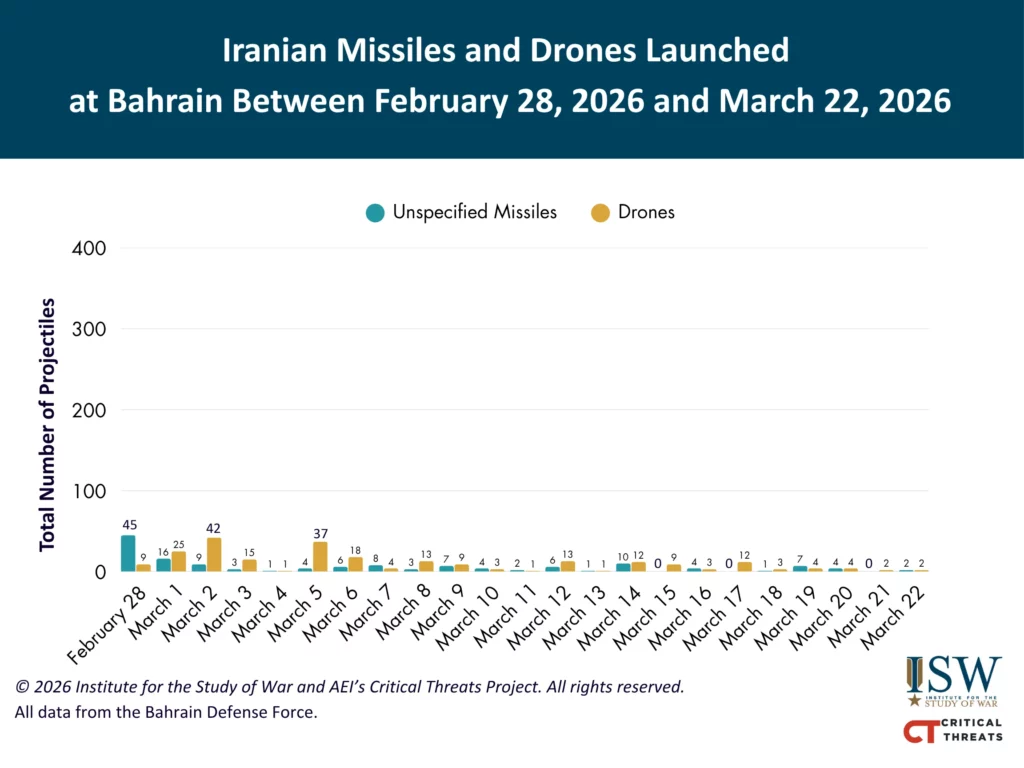
The Gulf states intercepted at least 55 drones and nine missiles from Iran since ISW-CTP’s last data cut off, but ISW-CTP has not observed any recorded impacts on critical Gulf infrastructure or in populated areas as of this writing.[59] Gulf states have reported the following activity:
The Bahrain Defense Force said that it has intercepted two drones and two ballistic missiles since ISW-CTP’s last data cut off.[60] The IRGC claimed to target the US Fifth Fleet base in Manama, Bahrain, on March 22.[61]
Iran has fired at least seven drones targeting Kuwait since ISW-CTP’s last data cut off on March 21.[62] The Kuwaiti Armed Forces intercepted four drones and the other three fell in open spaces.[63]
The Saudi Defense Ministry reported that it has intercepted 21 drones and three ballistic missiles since ISW-CTP’s last data cut off on March 21.[64] Saudi Arabia intercepted one ballistic missile heading towards Riyadh.[65] The IRGC claimed to target the Prince Sultan Air Base near Riyadh.[66]
The UAE reported it that intercepted 25 drones and four ballistic missiles from Iran on March 22.[67]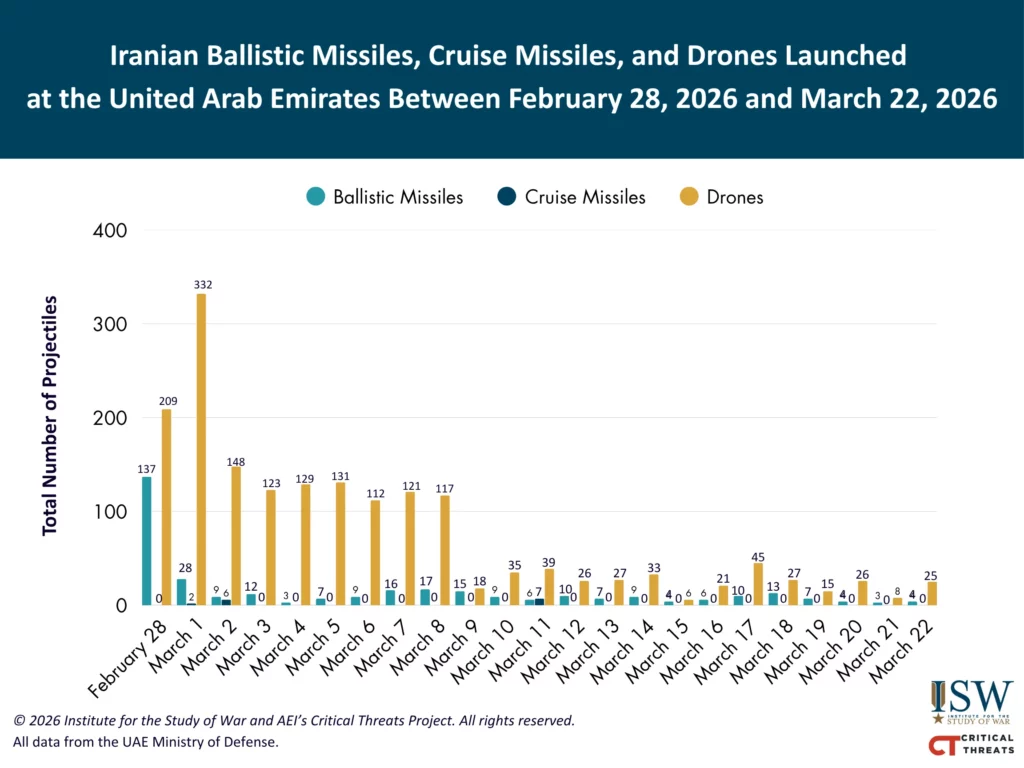
Israeli Campaign Against Hezbollah and Hezbollah Response
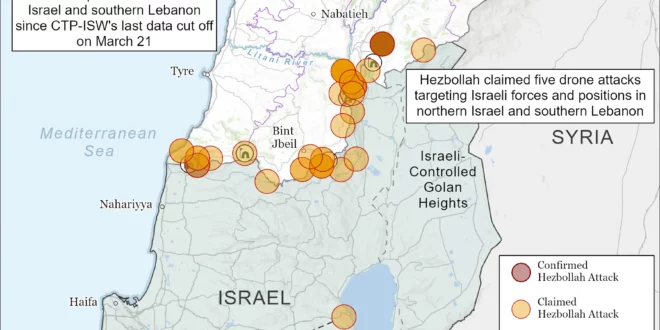
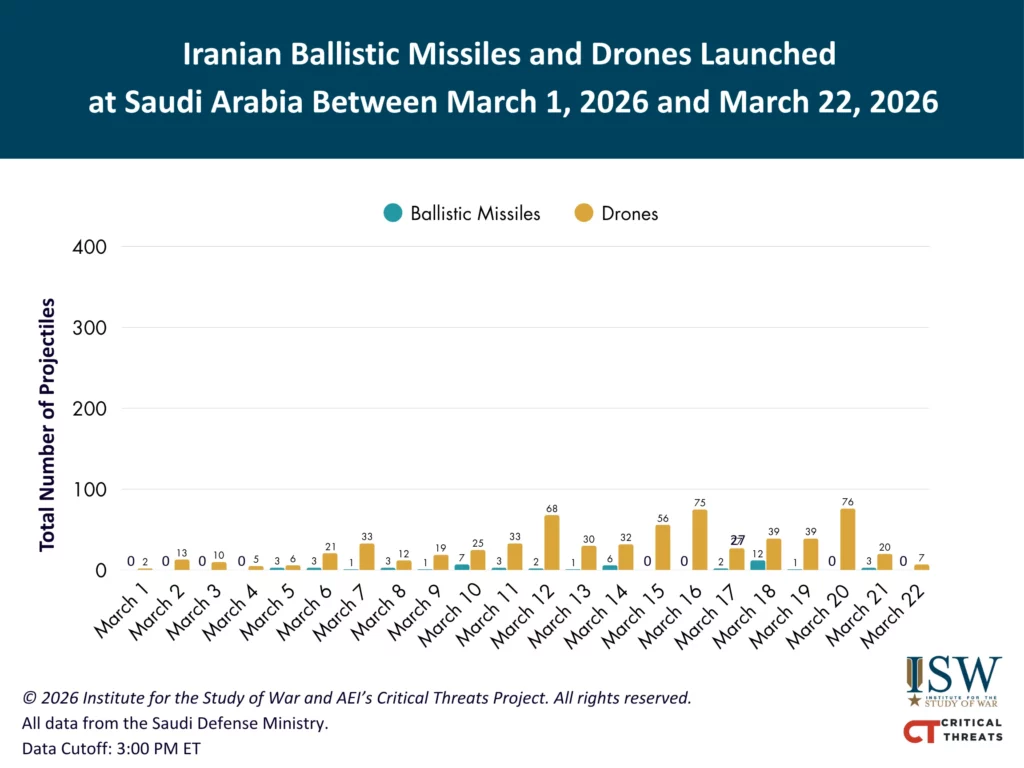
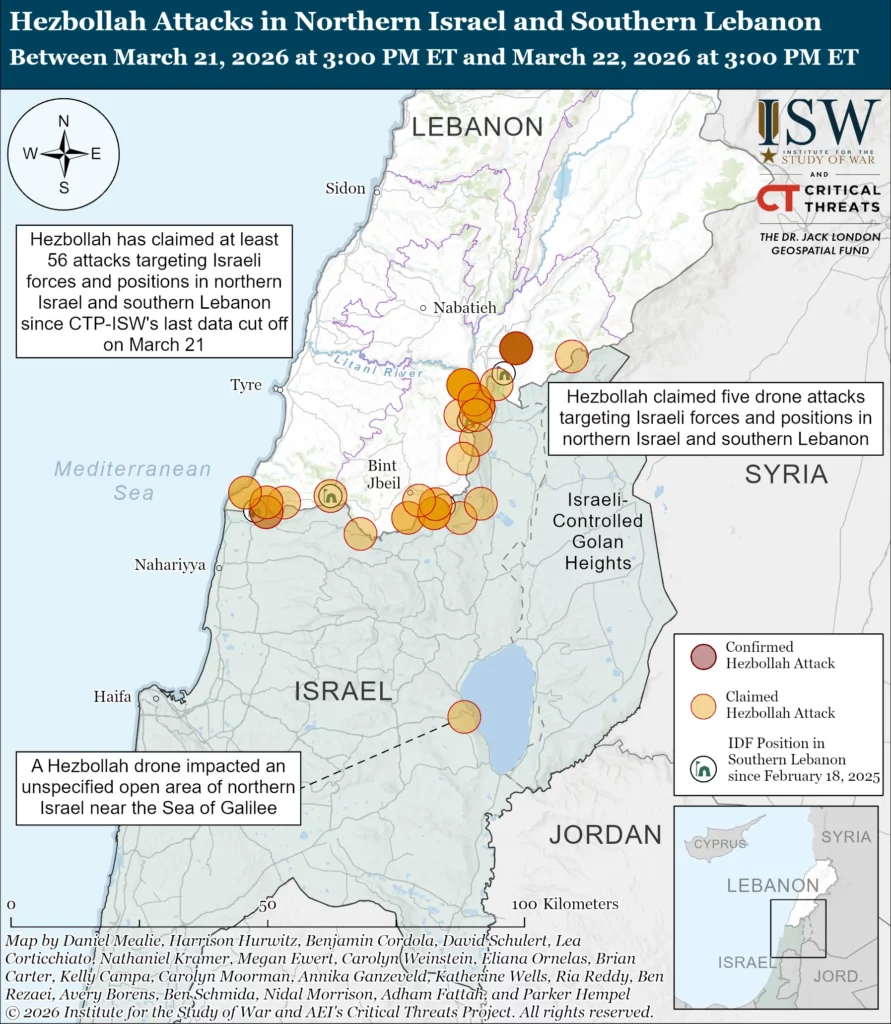
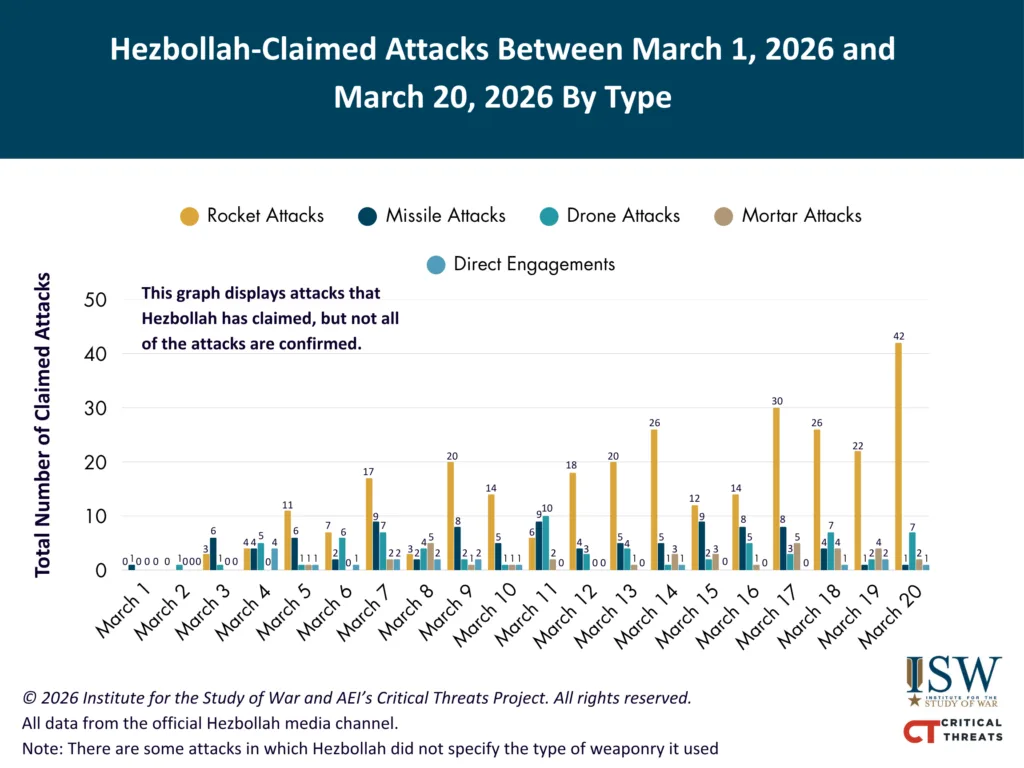
Hezbollah claimed 56 attacks targeting Israeli forces and positions in northern Israel and southern Lebanon, as well as northern Israeli towns, between 3:00 PM ET on March 21 and 3:00 PM ET on March 22.[68] Most of Hezbollah’s claimed attacks targeted Israeli forces and military sites with rockets.[69] Hezbollah claimed six drone attacks targeting Israeli forces and positions in northern Israel and southern Lebanon.[70] Israeli sources reported multiple instances of sirens in northern Israel on March 21 and 22 in response to Hezbollah drone attacks.[71] A Hezbollah drone landed in an open area of northern Israel near the Sea of Galilee on March 22, according to an Israeli correspondent.[72] Hezbollah claimed three rocket attacks targeting northern Israeli towns on March 22.[73] Hezbollah is likely continuing to attempt to displace northern Israeli residents from their homes by targeting northern Israeli towns in order to increase political pressure on the Israeli government to halt its war effort against Iran.
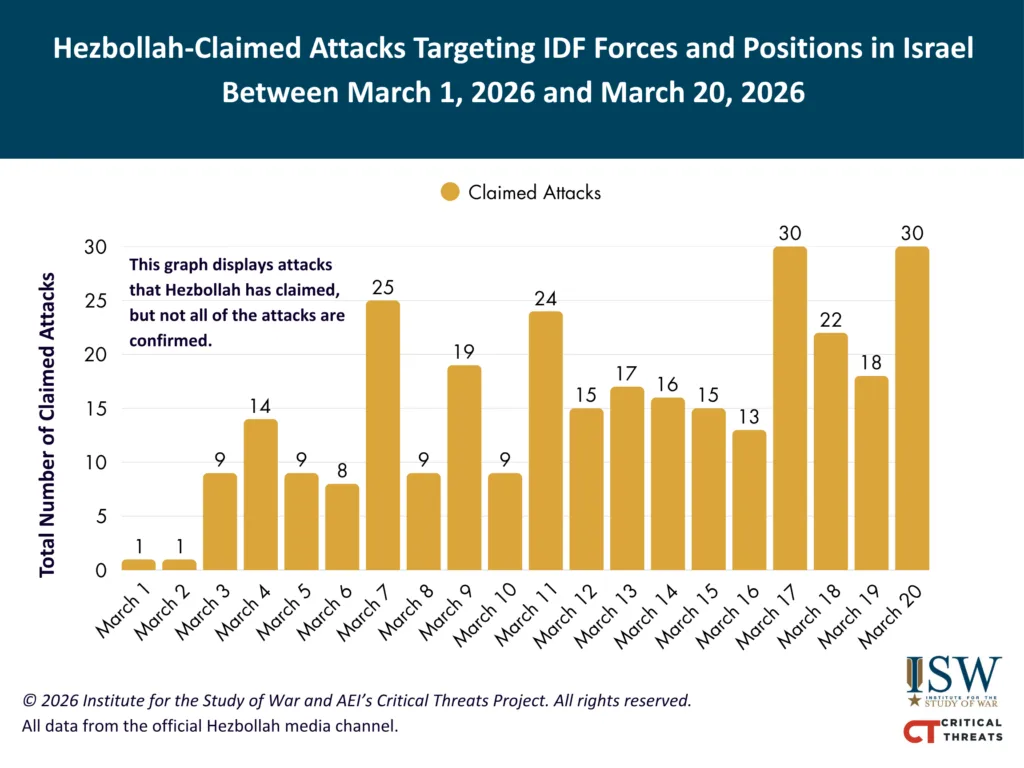
The rate of Hezbollah attacks targeting Israel have varied since the group joined the war on March 1, as illustrated below.
Hezbollah has also employed a variety of weapons in its attacks against Israeli forces and positions in northern Israel and southern Lebanon (see below).
The IDF has continued to conduct airstrikes targeting Hezbollah and Iranian-backed groups across Lebanon. The IDF said it killed Hezbollah ‘Radwan Forces’ commander Abu Khalil Barji in Majdal Selm, Bent Jbeil District, southern Lebanon, on March 21, along with two other fighters.[74] The Radwan Force is Hezbollah’s elite special operations unit that Hezbollah, with Iranian support, built to conduct major ground attacks into Israel.[75] The IDF also said on March 22 it killed a senior Hamas financier, Walid Mohammad Dib, in an unspecified area of Lebanon.[76] The IDF said that Dib was responsible for transferring funds to various Hamas branches in the West Bank, Lebanon, and other countries.[77] The IDF also said that Dib recruited operatives and directed attacks against Israel in Syria and Lebanon.[78] The IDF has killed two Hamas members in Lebanon since February 28.[79] The IDF 91st Division, with Israeli air cover, also killed nine Hezbollah fighters in an unspecified area of southern Lebanon on March 22.[80]
The IDF continued to strike bridges on the Litani River in southern Lebanon to prevent Hezbollah from reinforcing its positions. The IDF struck the Qasmiyeh Bridge on March 22 after issuing an evacuation warning.[81] This is the fifth bridge the IDF has struck on the Litani River since the war began, according to Israeli media.[82] Israeli Defense Minister Israel Katz said on March 22 that he “ordered the army to immediately destroy all bridges over the Litani River” to prevent Hezbollah from reinforcing its positions.[83] Katz added that “we have also ordered the acceleration of the demolition of Lebanese homes in border villages to neutralize threats to Israeli cities, following the model of Beit Hanoun and Rafah in the Gaza Strip.”[84] Lebanese President Joseph Aoun condemned the strikes on bridges over the Litani River in southern Lebanon as “a dangerous escalation” which he said was a prelude to a “Israeli expansion into Lebanese territory.”[85]
The IRGC has reportedly restructured Hezbollah under a more decentralized command model following Israeli operations that degraded the group’s leadership in 2024.[86] Reuters reported on March 21 that the IRGC deployed approximately 100 officers to Lebanon after the November 2024 ceasefire, according to two sources familiar with IRGC activities.[87] These officers retrained Hezbollah fighters, oversaw rearmament, and reorganized Hezbollah into smaller, compartmentalized units with limited operational knowledge.[88] This decentralized structure aimed to improve operational security and reduce vulnerability to Israeli intelligence penetration.[89] The sources added that the IRGC is shaping Hezbollah’s force structure and tempo of operations rather than directing tactical targeting decisions.[90] An academic researcher of Hezbollah told Reuters that the IRGC “has basically reorganized Hezbollah as a far more flat system,” which resembles the group’s organizational structure during the 1980s.[91] He described the strategy as a “mosaic defense” similar to what the IRGC employs in Iran, emphasizing decentralized operations to preserve combat effectiveness under sustained pressure.[92] The Reuters article resembles similar reports from October 2025 saying that Hezbollah has returned to a more decentralized structure.[93]
Other Axis of Resistance Response
Iranian-backed Iraqi militias’ front groups continued to conduct drone and rocket attacks targeting US forces and interests in Iraq and the region. Likely Iranian-backed Iraqi militias launched two drones at Baghdad International Airport on March 21.[94] Iraqi air defenses intercepted the drones.[95] Likely front group Jaysh al Ghadab claimed that it attacked an unspecified US base in northern Iraq with drones.[96] The group’s claim corresponded with reports of air defense activity at Erbil International Airport.[97] Iranian-backed Iraqi militia front group Saraya Awliya al Dam claimed on March 21 that it attacked the former US Victory base with drones.[98] Iranian-backed Iraqi militias have repeatedly claimed attacks targeting the former US Victory base, which is co-located with the Baghdad International Airport, since the start of the war.[99] Saraya Awliya al Dam separately claimed on March 21 that it conducted six “qualitative operations” against US bases in Iraq but provided no evidence of the “operations.”[100] Likely Iranian-backed Iraqi militias’ rocket fire injured at least five Iraqi Counter Terrorism Service members in a separate attack on a facility at the Baghdad International Airport on March 22.[101] Two drones launched by likely Iranian-backed Iraqi militias later impacted near the former US Victory base.[102] The Islamic Resistance in Iraq (IRI), which is a coalition of Iranian-backed Iraqi militias, claimed on March 21 that it had conducted 21 drone and missile operations targeting US bases in Iraq and the region in the past 24 hours.[103] The IRI did not provide evidence for this claim.
The combined force has continued to strike Iranian-backed Iraqi militia positions. Likely combined force strikes targeted unspecified Popular Mobilization Forces (PMF) positions in western Mosul City on March 21, according to Iraqi sources.[104] US airstrikes reportedly targeted the Kataib Hezbollah-associated 13th PMF brigade in Anbar Province, which caused material damage but did not result in casualties, according to Iraqi media.[105] The combined force also conducted three drone strikes on unspecified PMF positions in Jurf al Sakhr, Babil Province, on March 22, according to Iraqi sources.[106]