 Eurasia Press & News
Key Takeaways
Prospects for meaningful US-Iran negotiations remain low as Islamic Revolutionary Guards Corps (IRGC) Commander Major General Ahmad Vahidi and his inner circle continue to dominate Iran’s decision-making and oppose compromise. ISW-CTP assessed that in recent days, the IRGC has sidelined civilian officials and that Iran’s negotiating team lacks the authority to make independent decisions, which helps explain continued inflexibility and the absence of tangible progress.
US President Donald Trump canceled US Special Envoy to the Middle East Steve Witkoff and Jared Kushner’s planned trip to Islamabad, Pakistan, for talks with Iran, due to Iran’s unchanged negotiating positions.
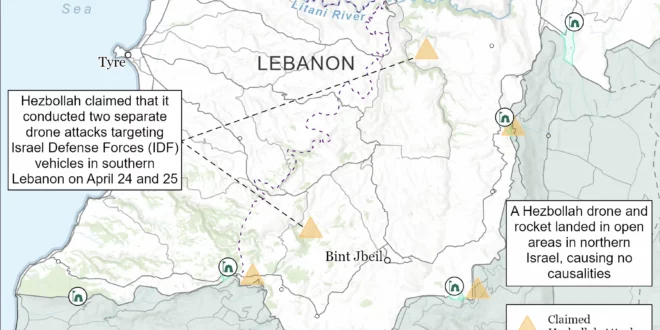
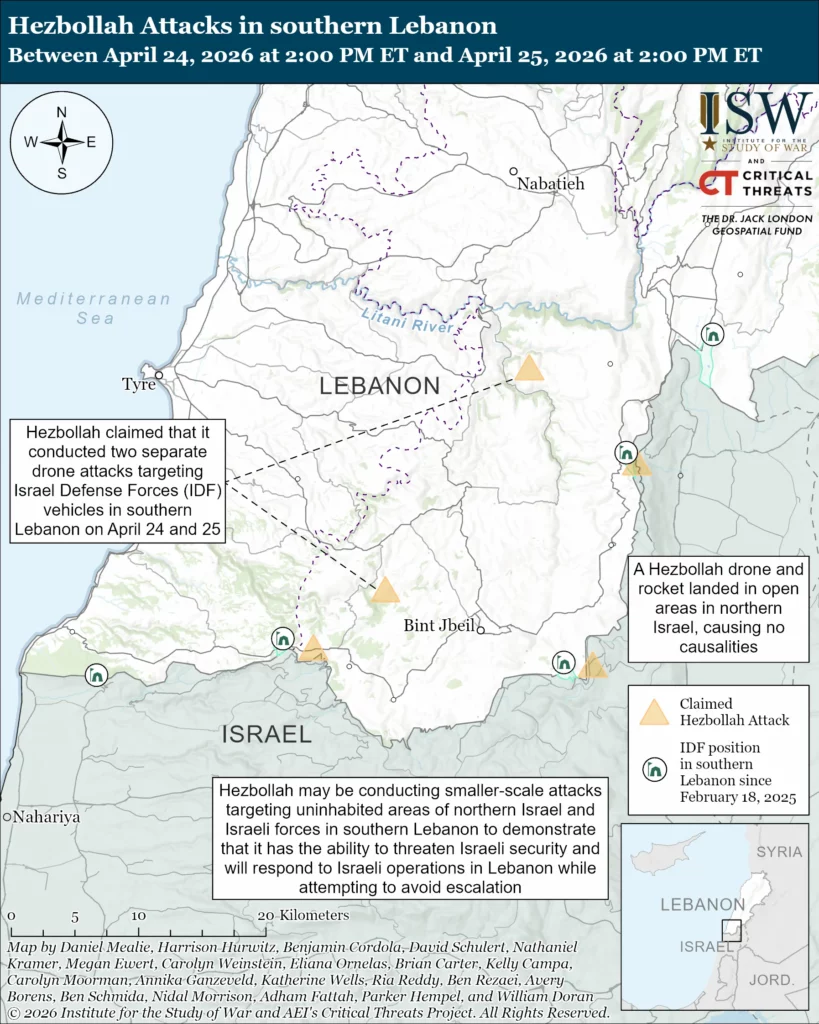
Hezbollah may be conducting smaller-scale attacks targeting uninhabited areas of northern Israel and Israeli forces in southern Lebanon to demonstrate that it has the ability to threaten Israeli security and will respond to Israeli operations in Lebanon. This strategy accepts the risk of a return to war, but is still attempting to keep the attacks below a threshold that would trigger major Israeli attacks.
Toplines
Prospects for meaningful US-Iran negotiations remain low as Islamic Revolutionary Guards Corps (IRGC) Commander Major General Ahmad Vahidi and his inner circle continue to dominate Iran’s decision-making and oppose compromise. Iranian Foreign Affairs Minister Abbas Araghchi met with senior Pakistani officials in Islamabad, Pakistan, on April 25 to convey Iran’s “observations” on ending the war.[1] Araghchi departed Pakistan after his meetings and arrived in Oman on April 25, according to Iranian media.[2] Iranian Foreign Affairs Ministry Spokesperson Esmail Baghaei stated that no meeting between the United States and Iran was scheduled and that Iran would convey its positions to the United States through Pakistan.[3] A Pakistani journalist, citing unspecified sources, reported on April 25 that Iran will not meet the US delegation and that Iran remains unwilling to engage directly and continues to insist that the United States end its blockade as a precondition for negotiations.[4] This pattern reflects a consistent IRGC-driven negotiating line that includes no flexibility, insistence on maximalist demands, and the use of preconditions to delay or constrain talks.[5] Iranian media reinforced this approach by framing Araghchi’s regional tour as part of a broader strategy to prioritize engagement with mediators and strategic partners, such as Pakistan, Oman, and Russia, rather than an effort at direct negotiations with the United States.[6]
ISW-CTP assessed that in recent days, the IRGC has sidelined civilian officials and that Iran’s negotiating team lacks the authority to make independent decisions, which helps explain continued inflexibility and the absence of tangible progress.[7] The Wall Street Journal similarly reported on April 24 that internal regime infighting, driven in part by figures such as Vahidi and other anti-compromise officials, has made compromise difficult.[8] The report noted that Iranian officials became vague when pressed for specifics during earlier talks in Islamabad, which indicates the lack of a clear and unified negotiating position.[9] The IRGC’s consolidation of control over Iranian decision-making indicates that the Iranian political officials do not have the authority to independently determine Iran’s negotiating position.[10]
US President Donald Trump canceled US Special Envoy to the Middle East Steve Witkoff and Jared Kushner’s planned trip to Islamabad, Pakistan, for talks with Iran, due to Iran’s unchanged negotiating positions.[11] Trump posted on social media on April 25 that he canceled Witkoff and Kushner’s trip to Pakistan because the 18-hour flight would waste time and be “too much work” if the Iranians failed to change their negotiating positions.[12] Trump also said that no one knows who is in charge in Iran, including the Iranians, which has resulted in ”tremendous infighting and confusion.”[13] Trump told Fox News and Axios on April 25 that it did not make sense for him to send Witkoff and Kushner to Pakistan “to sit around talking about nothing.”[14] Trump also told Axios that he canceled Witkoff and Kushner’s trip due to Iran’s position on negotiations.[15] Iran appears to be continuing to make maximalist demands (see above). Trump told Axios that his decision not to send Witkoff and Kushner does not mean that he will resume the war with Iran, however.[16] Trump said that if the Iranian leadership wants to talk, then ”all they have to do is call.”[17]
Maritime Developments
The United States has continued to enforce its blockade on Iranian ports. US Central Command (CENTCOM) intercepted a US-sanctioned, Iranian-flagged tanker attempting to transit to an Iranian port on April 24.[18] US Defense Secretary Pete Hegseth reiterated on April 24 that the United States will continue to enforce its blockade on Iranian ports.[19]
US and Israeli Air Campaign
Nothing significant to report.
Iranian Response
Iran is facing escalating economic pressure that will likely worsen its already severe economic crisis. The US Treasury Department sanctioned Chinese company Hengli Petrochemical Refinery Co., one of Iran’s largest crude oil customers, on April 24.[20] The Treasury also targeted 40 shipping firms and vessels involved in transporting illicit Iranian oil.[21] The United States recently froze $344 million USD in cryptocurrency linked to Iran and associated with “unlawful conduct.”[22] These steps to further constrain Iran’s economy come amid an ongoing US naval blockade that restricts Iranian exports, including oil, which is a critical source of revenue for the regime.[23]
Israeli Campaign Against Hezbollah and Hezbollah Response
Hezbollah may be conducting smaller-scale attacks targeting uninhabited areas of northern Israel and Israeli forces in southern Lebanon to demonstrate that it can threaten Israeli security and will respond to Israeli operations in Lebanon. This strategy accepts the risk of a return to war, but is still attempting to keep the attacks below a threshold that would trigger major Israeli attacks. Hezbollah claimed that it conducted two separate drone attacks targeting Israel Defense Forces (IDF) vehicles in southern Lebanon on April 24 and 25.[24] The IDF reported that Hezbollah also fired two rockets and two drones towards northern Israeli towns on April 25.[25] Two of the projectiles landed in open areas of northern Israel, causing no casualties.[26] Hezbollah officials have noted that Hezbollah will continue its attacks against Israeli targets and called the ceasefire agreement ”meaningless” because it allows the IDF to respond to imminent Hezbollah threats.[27] Hezbollah’s attacks during the ceasefire are relatively smaller in scale compared to Hezbollah’s rocket attacks prior to the April 16 ceasefire, which contained approximately 40 rockets.[28] Hezbollah has previously conducted small-scale, symbolic attacks targeting uninhabited areas of northern Israel in order not to provoke a large Israeli response.[29]
Hezbollah has continued to use first-person view (FPV) drones in its attacks targeting IDF vehicles in southern Lebanon since the ceasefire took effect on April 16. Hezbollah claimed that it conducted two separate FPV drone attacks targeting IDF vehicles in southern Lebanon on April 22 and 23.[30] Hezbollah also published footage on April 24 that shows two separate FPV drone attacks targeting IDF vehicles on April 13 and April 15.[31] Israeli media noted that Hezbollah has increasingly used FPV drones in its attacks against Israeli forces in recent weeks.[32]