 Eurasia Press & News
Toplines
Russian forces conducted a massive drone and missile strike consisting of 666 drones and missiles against Ukraine overnight on April 24 into April 25, primarily targeting Dnipro City, Dnipropetrovsk Oblast, killing at least six civilians and injuring at least 47. The Ukrainian Air Force reported that Russian forces launched 47 missiles and 619 drones against Ukraine overnight — the fourth Russian strike of over 500 strike vehicles in April 2026.[1] The Ukrainian Air Force reported that Russian forces launched 12 Iskander-M ballistic missiles/S-300 surface-to-air missiles; 29 Kh-101 cruise missiles; one Iskander-K cruise missile; five Kalibr cruise missiles; and 619 Shahed, Gerbera, Italmas, and other drones — of which roughly 400 were Shaheds. The Ukrainian Air Force reported that Ukrainian air defenses downed 30 missiles and 580 drones, that 13 missiles and 36 drones struck 23 locations, and that downed debris fell on nine locations as of 0800 local time, but noted that the strikes were still ongoing. Ukrainian President Volodymyr Zelensky reported that Russian strikes primarily targeted Dnipro City and also struck Chernihiv, Odesa, and Kharkiv oblasts.[2] Dnipropetrovsk Oblast Military Administration Head Oleksandr Hanzha reported that Russian missile and drone strikes against Dnipro City lasted over 20 hours, purposefully targeted residential areas, and killed at least six civilians and injured at least 47 others.[3] Dnipro City Mayor Borys Filatov stated that Russian forces conducted a double-tap strike against first responders and Ukrainian government officials responding to the impact of Russian strikes against a residential building in Dnipro City.[4]
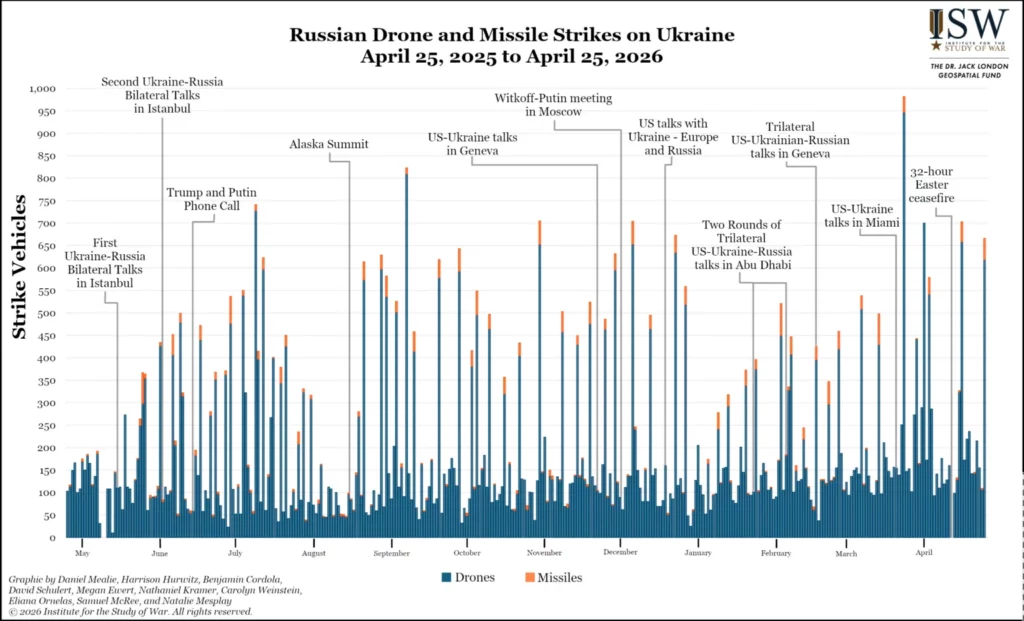
Russian forces have been increasingly leveraging the strike tactic of launching massive strikes in waves to exhaust Ukrainian air defenses with long-range drones and cruise missiles, both of which Ukrainian forces have high interception rates, ahead of ballistic missile strikes, which Ukrainian forces struggle to intercept without Patriot interceptors.[5] Russian forces often launch no or few missiles for multiple days in a row before launching strike packages with a significantly higher quantity of missiles, likely stockpiling missiles between strike series to maximize damage by launching several missiles alongside a large quantity of drones to overwhelm Ukraine’s air defenses.[6] Ukrainian Foreign Minister Andriy Sybiha stated on April 17 that Russia is preparing to conduct large-scale strikes of at least 400 drones and 20 missiles at a frequency of seven times per month.[7] Ukrainian Main Military Intelligence Directorate (GUR) Deputy Head Major General Vadym Skibitskyi recently stated that Russia is increasing the frequency of combined missile and drone strikes to destroy Ukrainian infrastructure and shape the battlefield for the Russian Spring-Summer 2026 offensive.[8]
Ukrainian forces may have conducted drone strikes against Yekaterinburg, Sverdlovsk Oblast and Chelyabinsk City — around 1,600 to 1,700 kilometers from the international border. Geolocated footage published on April 25 shows smoke and damage to an apartment building in Yekaterinburg after a reported Ukrainian drone strike.[9] Kremlin newswire TASS claimed that Ukrainian forces may have used an FP-1 long-range drone launched from Kharkiv Oblast in the strike against Yekaterinburg.[10] Geolocated footage published on April 25 shows a smoke plume near the Chelyabinsk Metallurgical Plant in Chelyabinsk Oblast, and a Ukrainian source reported that locals reported explosions in the area.[11] Chelyabinsk Oblast Governor Alexey Teksler claimed on April 25 that Russian forces repelled a Ukrainian drone strike against unspecified infrastructure in the oblast, causing no damage.[12] Yekaterinburg and Chelyabinsk are each about 1,600-1,700 kilometers from the international border with Ukrainian-held areas, and these reported strikes would mark some of Ukraine’s longest-range drone strikes against Russia thus far in the war. Ukrainian forces have previously struck the oil refinery in Ukhta, Komi Republic (over about 1,780 kilometers from the international border) with drones in August 2025 and with an FP-5 Flamingo missile on February 11 to 12.[13]
Artem Zhoga, the former commander of the 80th Sparta Spetsnaz Battalion (51st Combined Arms Army [CAA], formerly 1st Donetsk People’s Republic Army Corps [DNR AC], Southern Military District [SMD]) and current presidential representative to the Ural Federal Okrug, stated that the Urals have now become vulnerable to Ukrainian drone strikes and that Russians must now be vigilant.[14] A Russian milblogger responded to the reported strike by calling for Russia to increase air defenses near the Urals now and not wait until Ukrainian forces more regularly target Russian defense industrial base (DIB) assets in the area.[15] Russian Security Council Secretary Sergei Shoigu also acknowledged in March 2026 that increasingly effective Ukrainian long-range drone strikes have made the Urals in the “immediate threat zone.”[16] Russian officials and milbloggers have blamed Russian leadership for failing to defend Russian military infrastructure from Ukrainian drone strikes throughout Russia’s full-scale invasion.[17]
A prominent, Kremlin-coopted Russian ultranationalist milblogger has begun socializing the idea that Russians should prepare for possible future limited, rolling reserve call-ups to bolster Russia’s force generation mechanisms. Founder of the Russian Rybar ultranationalist milblogger channel, Mikhail Zvinchuk, gave an interview to Russian Perviy Kanal host Anatoly Kuzichev on April 21 in which Kuzichev asked Zvinchuk about whether Russia will conduct further mobilization.[18] Zvinchuk responded that the Russian military command generally believes that mobilization is necessary not because of manpower shortages but because Russian military units have low cohesion. Zvinchuk claimed that Russia’s recruitment drive is going well, so Russia does not need to recruit greater numbers of personnel but that poor cohesion is contributing to the disorganization that is causing heavy personnel casualties. Zvinchuk claimed that up to 80 percent of Russia’s personnel casualties in 2025 were among first-time volunteer and contract soldiers who operated in small assault groups and were sent on missions “on the fly.” Zvinchuk claimed that Russia can only solve this cohesion problem by creating and fully developing new formations that are interoperable with each other, which Zvinchuk claimed requires the simultaneous one-time recruitment of a large number of people, and that this idea fuels speculation about mobilization in the information space. The Kremlin has been setting conditions to conduct limited, rolling reserve call-ups to make up for its losses in Ukraine, and the Kremlin may be advancing this effort further as Russia’s recruitment rate is falling and casualty rate is rising.[19] Zvinchuk’s statements do not concern rolling call-ups specifically but still likely intend to prepare Russians to accept the need for another form of reserve call-ups following the September 2022 partial mobilization, which generated significant domestic discontent.[20]
Key Takeaways
 Russian forces conducted a massive drone and missile strike consisting of 666 drones and missiles against Ukraine overnight on April 24 into April 25, primarily targeting Dnipro City, Dnipropetrovsk Oblast, killing at least six civilians and injuring at least 47.
Ukrainian forces may have conducted drone strikes against Yekaterinburg, Sverdlovsk Oblast and Chelyabinsk City — around 1,600 to 1,700 kilometers from the international border.
A prominent, Kremlin-coopted Russian ultranationalist milblogger has begun socializing the idea that Russians should prepare for possible future limited, rolling reserve call-ups to bolster Russia’s force generation mechanisms.
Ukrainian forces advanced in the Kostyantynivka-Druzhkivka tactical area and Russian forces advanced in the Pokrovsk direction.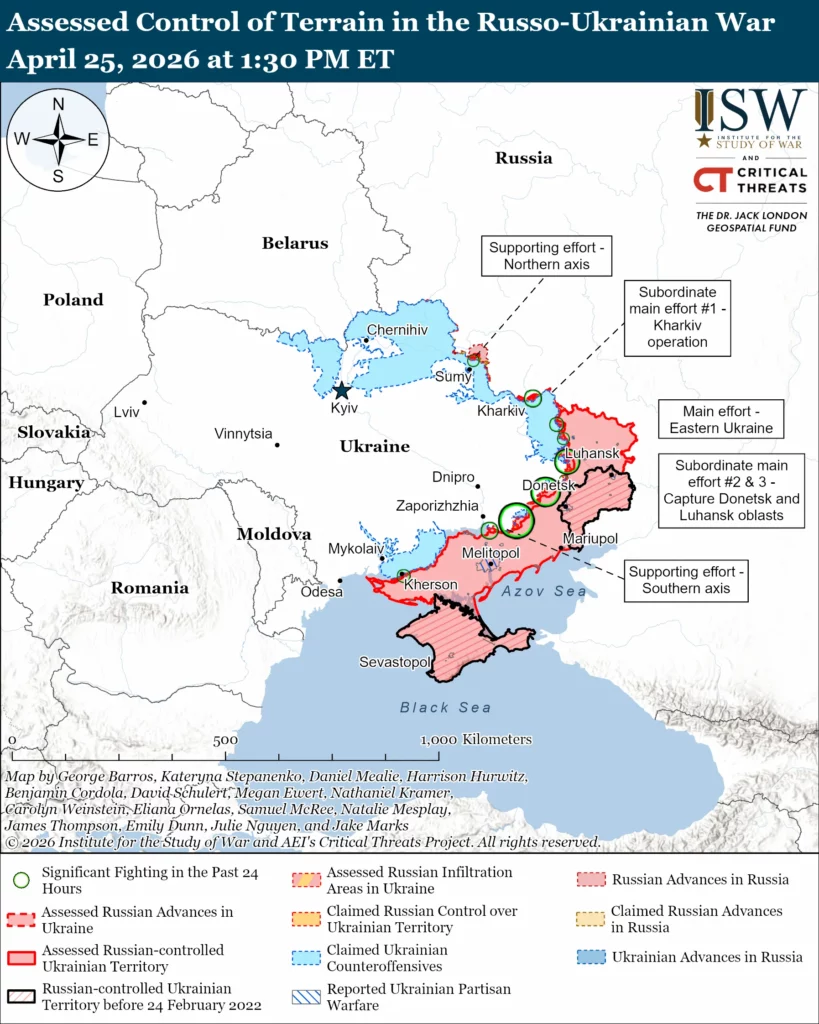
We do not report in detail on Russian war crimes because these activities are well-covered in Western media and do not directly affect the military operations we are assessing and forecasting. We will continue to evaluate and report on the effects of these criminal activities on the Ukrainian military and the Ukrainian population and specifically on combat in Ukrainian urban areas. We utterly condemn Russian violations of the laws of armed conflict and the Geneva Conventions and crimes against humanity even though we do not describe them in these reports.
Ukrainian Operations in the Russian Federation
See topline text.
Russian Supporting Effort: Northern Axis
Russian objective: Create defensible buffer zones in Sumy Oblast along the international border
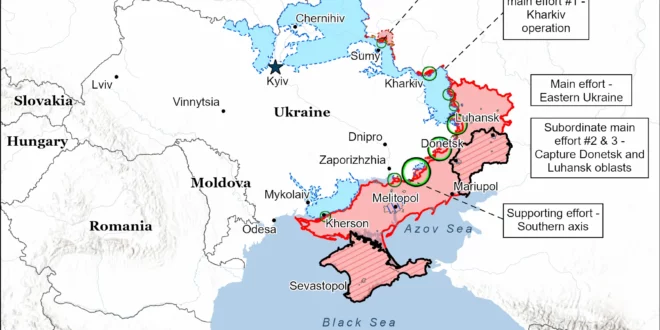
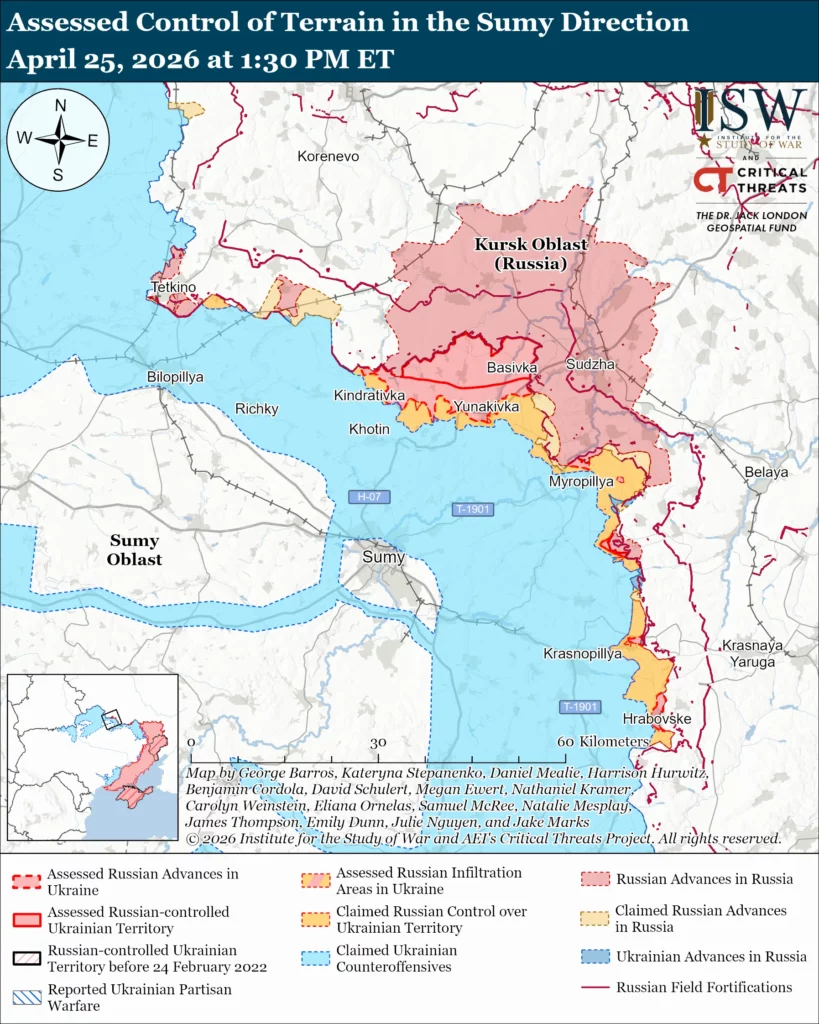
Russian forces continued attacking north, northeast, and southeast of Sumy City on April 25 as Ukrainian forces target Russian military assets along the international border.[21] The Ukrainian General Staff reported, and geolocated footage confirms that Ukrainian forces struck a Russian command and observation post in Tetkino, Kursk Oblast (northwest of Sumy City) with an Armement Air-Sol Modulaire (AASM) Hammer, and Ukrainian forces also struck a Russian manpower concentration near Sopych (northwest of Sumy City).[22]
Russian Main Effort: Eastern Ukraine
Russian Subordinate Main Effort #1 – Kharkiv Oblast
Russian objective: Push Ukrainian forces back from the international border to create a defensible buffer zone with Belgorod Oblast and approach to within tube artillery range of Kharkiv City
Russian forces continued offensive operations north and northeast of Kharkiv City on April 25 but did not make confirmed advances.[23] The Russian Ministry of Defense (MoD) claimed that elements of the Russian 126th Motorized Rifle Regiment (71st Guards Motorized Rifle Division, 14th Army Corps [AC], Leningrad Military District [LMD]) seized Bochkove (northeast of Kharkiv City).[24]
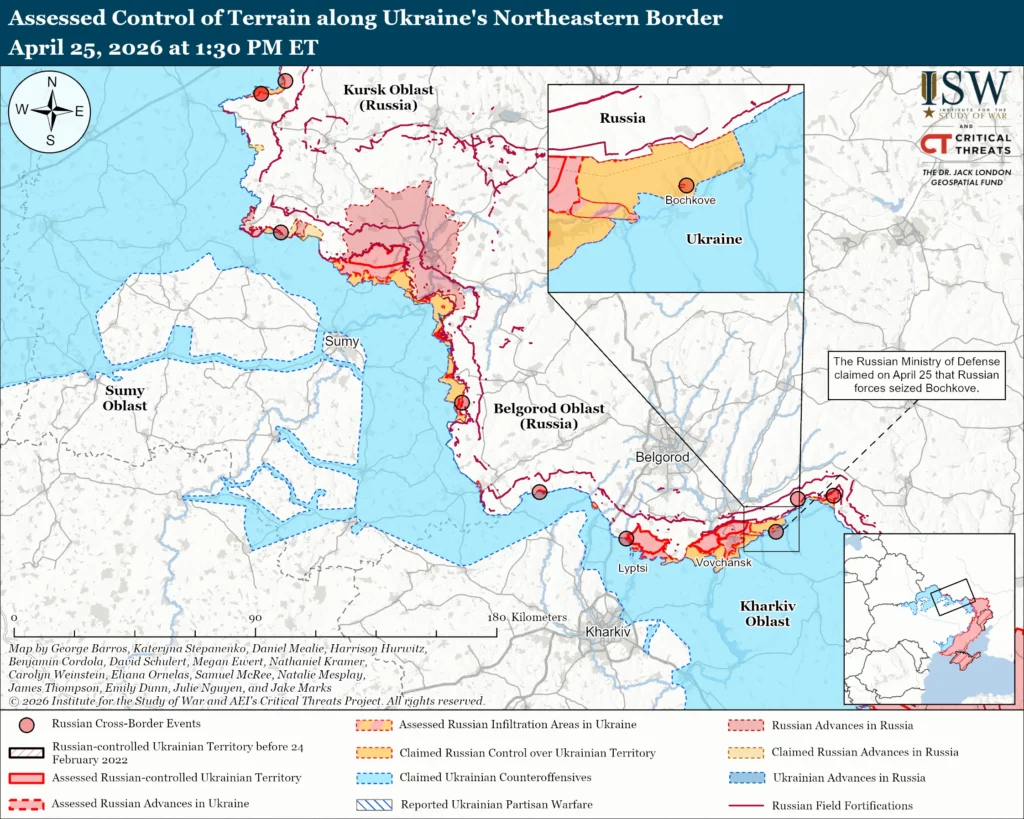
Russian forces appear to be increasingly using motorcycles in assault operations. The Ukrainian 16th Army Corps operating in northern Kharkiv Oblast reported on April 25 that elements of the Russian 127th Motorized Rifle Regiment (71st Guards Motorized Rifle Division) conducted a motorized assault toward Vovchanski Khutory for the first time in a long time, using dried-out roads to attempt to move rapidly through the “kill zone” (an isolated frontline area of elevated drone strike risk).[25] The 16th Army Corps reported that Ukrainian forces repelled the assault. Russian forces have been increasingly conducting motorcycle assaults in other sectors of the theater, including in the Kostyantynivka and Slovyansk directions, as part of the Spring-Summer 2026 offensive.[26]
Neither Ukrainian nor Russian sources reported ground activity in the Velykyi Burluk direction on April 25.
Russian Subordinate Main Effort #2 – Oskil River
Russian objective: Cross the Oskil River in Kharkiv Oblast and push westward into eastern Kharkiv Oblast and northern Donetsk Oblast
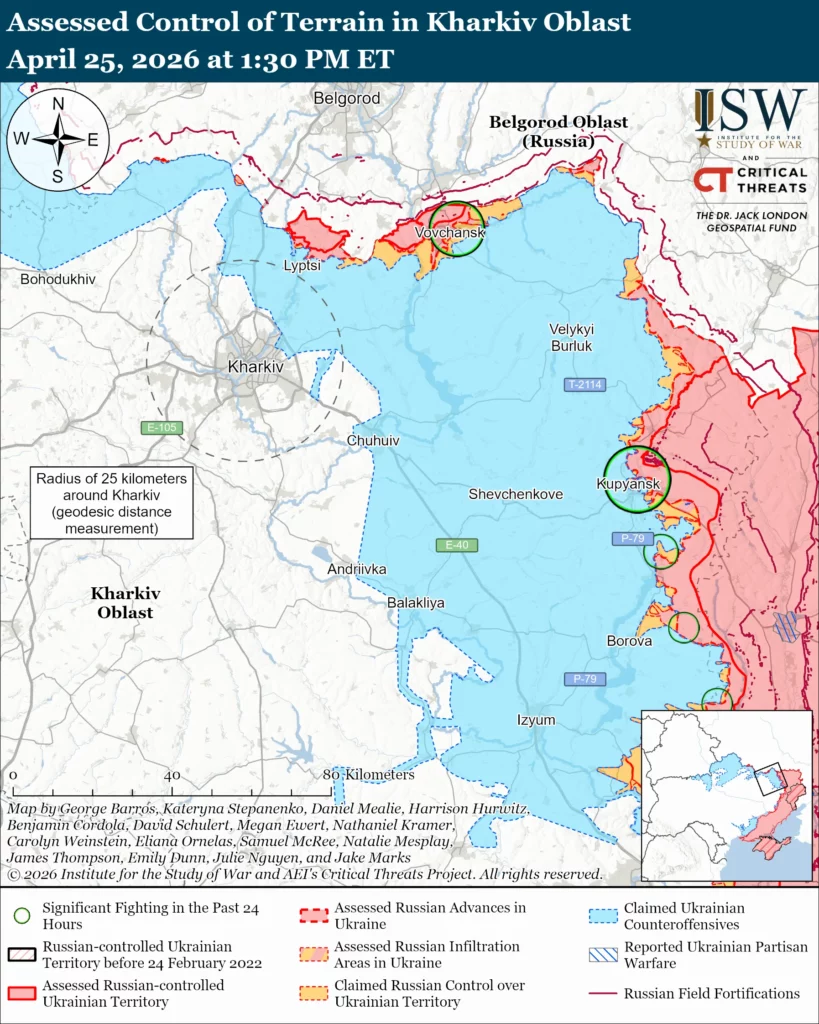
Russian forces intensified infiltration attempts in the Kupyansk direction but did not advance on April 25.[27] Ukrainian Joint Forces Task Forces Spokesperson Colonel Viktor Trehubov reported on April 24 that Russian forces have resumed attempts to infiltrate Kupyansk through Holubivka (north of Kupyansk) and via gas pipes, and are especially active near Kivsharivka (southeast of Kupyansk).[28]
Russian forces continued offensive operations north of Borova on April 25 but did not advance.[29]
Ukrainian forces continued their mid-range strike campaign against Russian military assets in occupied Luhansk Oblast on April 24 and overnight on April 24 to 25. The Ukrainian General Staff reported on April 25 that Ukrainian forces struck a Russian ammunition depot near occupied Bilolutsk (roughly 97 kilometers from the frontline), a command and observation post near occupied Lysychansk (roughly 36 kilometers from the frontline), and a troop concentration area near occupied Solontsy (roughly 28 kilometers from the frontline).[30]
Russian Subordinate Main Effort #3 – Donetsk Oblast
Russian objective: Capture the entirety of Donetsk Oblast, the claimed territory of Russia’s proxies in Donbas, and advance into Dnipropetrovsk Oblast
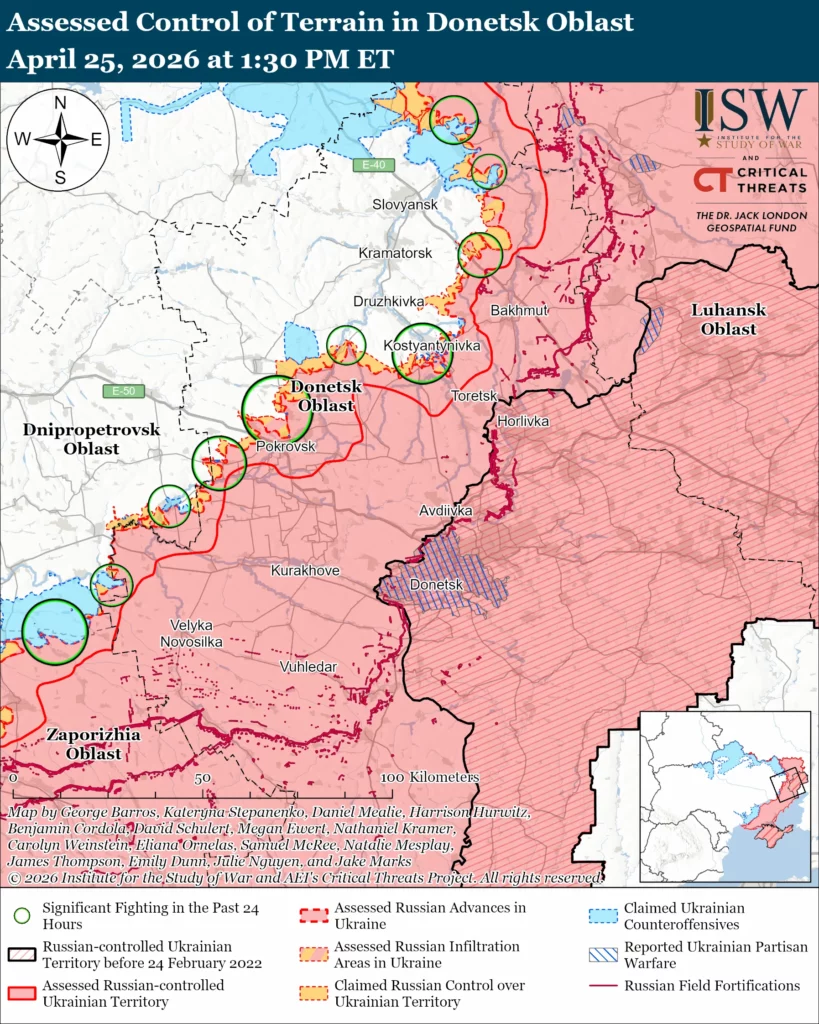
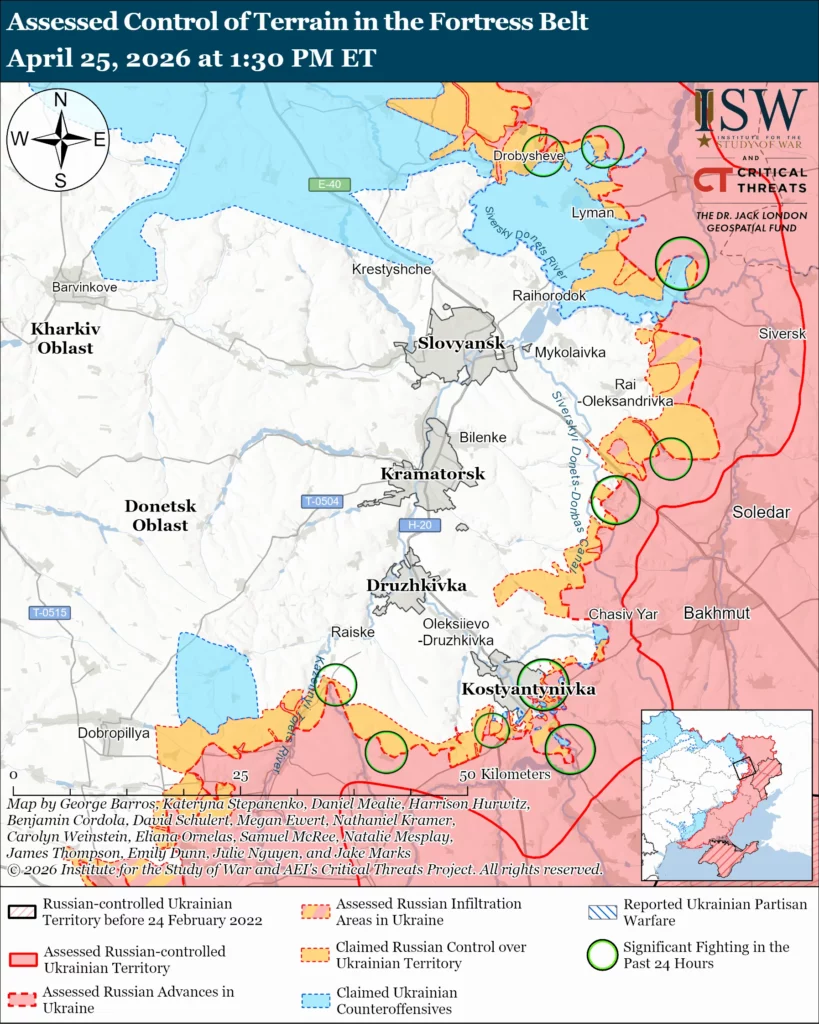
Russian forces continued offensive operations in the Slovyansk direction on April 25 as Ukrainian forces counterattacked in the area.[31]
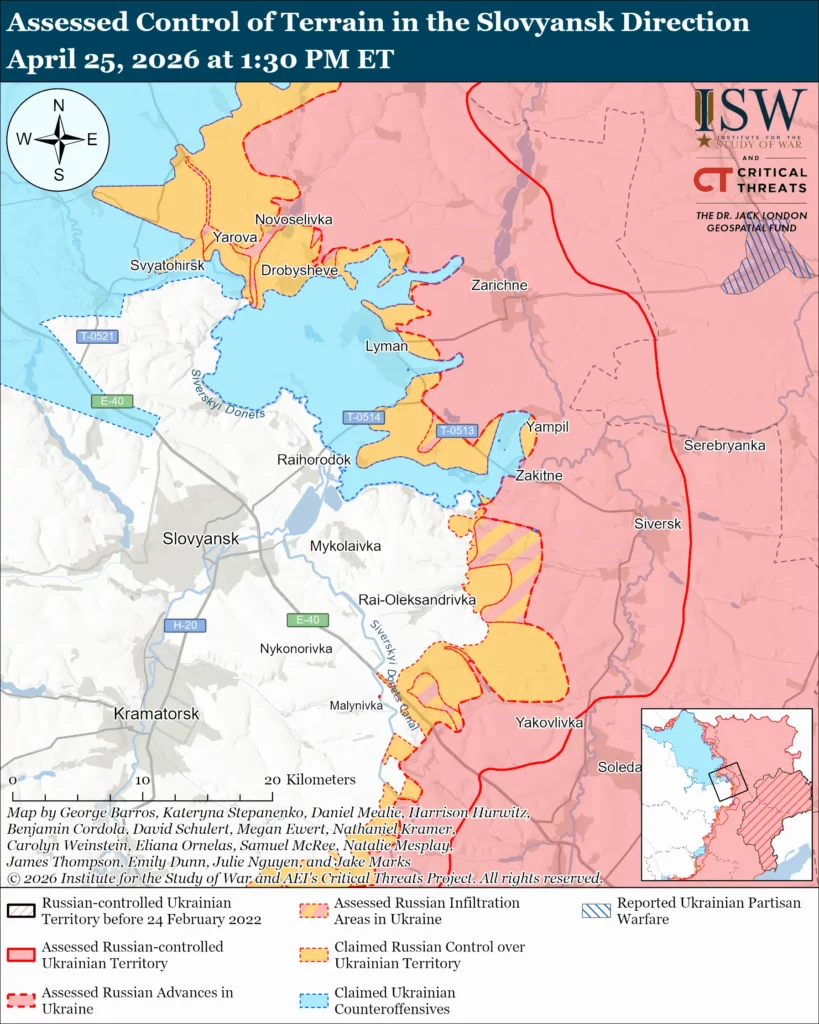
Ukrainian forces recently advanced and counterattacked in the Kostyantynivka-Druzhkivka tactical area as Russian forces continued offensive operations and conducted an infiltration mission.[32] Geolocated footage published on April 24 shows Russian forces striking Ukrainian positions and observing Ukrainian servicemembers operating in southeastern Kostyantynivka, indicating that Ukrainian forces maintain positions in southeastern Kostyantynivka contrary to Russian claims.[33] Geolocated footage published on April 24 shows Ukrainian forces striking a Russian position northeast of Malynivka (northeast of Kostyantynivka) after what ISW assesses was an infiltration mission.[34]
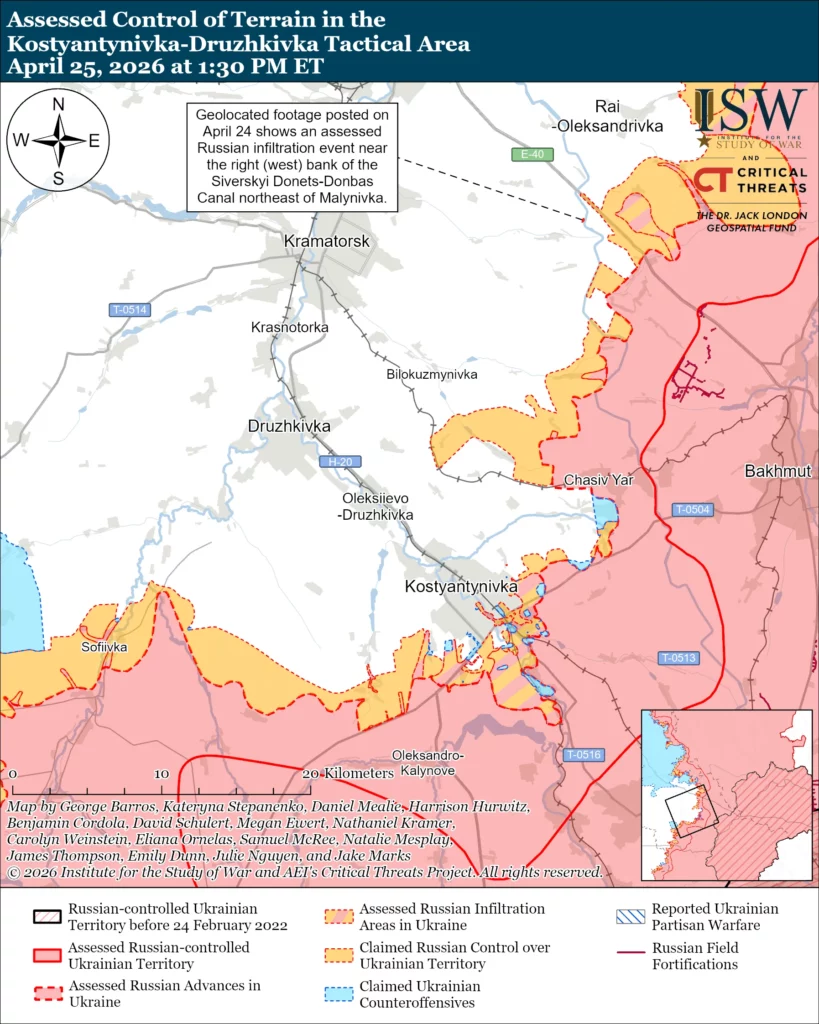
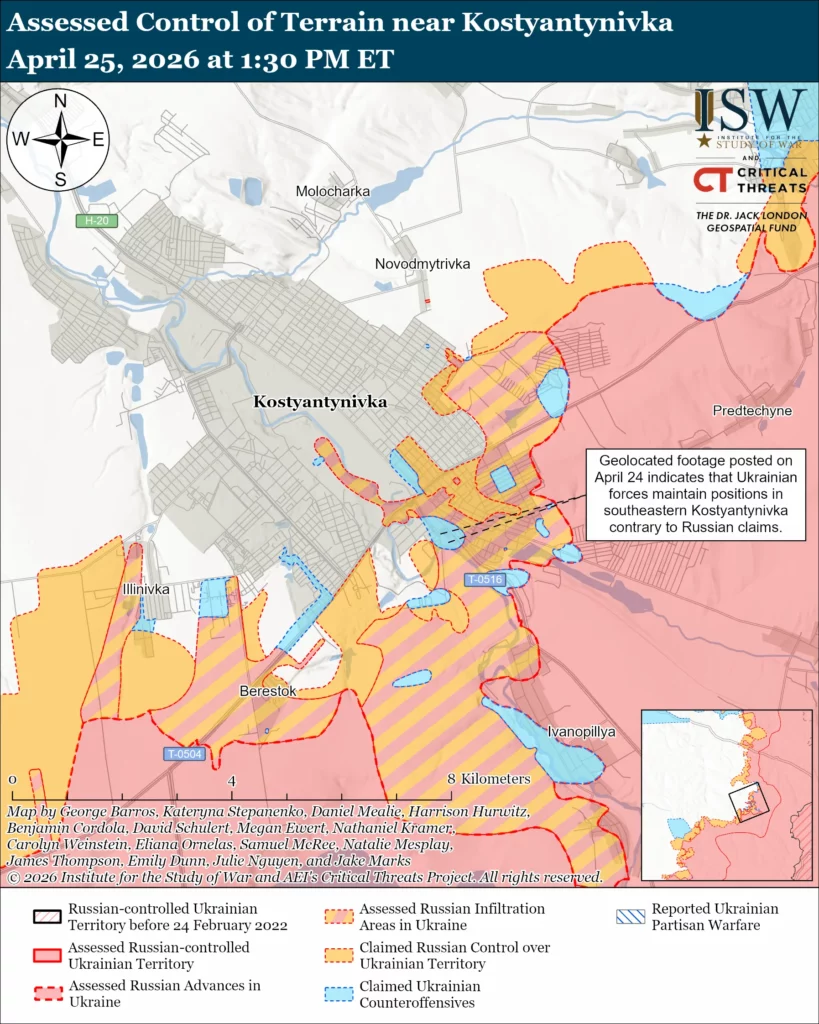
Ukrainian forces continued their short-range strike campaign against the Russian near rear in the Kostyantynivka-Druzhkivka tactical area. The Ukrainian General Staff reported on April 25 that Ukrainian forces struck a Russian manpower concentration area near Kostyantynivka on the night of April 24 to 25.[35]
Russian forces continued offensive operations in the Dobropillya tactical area on April 25 but did not advance.[36]
Russian forces recently advanced in the Pokrovsk direction. Geolocated footage published on April 24 indicates that Russian forces recently advanced northwest of Hryshyne (northwest of Pokrovsk).[37] A Russian milblogger claimed that Russian forces seized Bilytske (north of Pokrovsk) and advanced southwest of the settlement.[38]
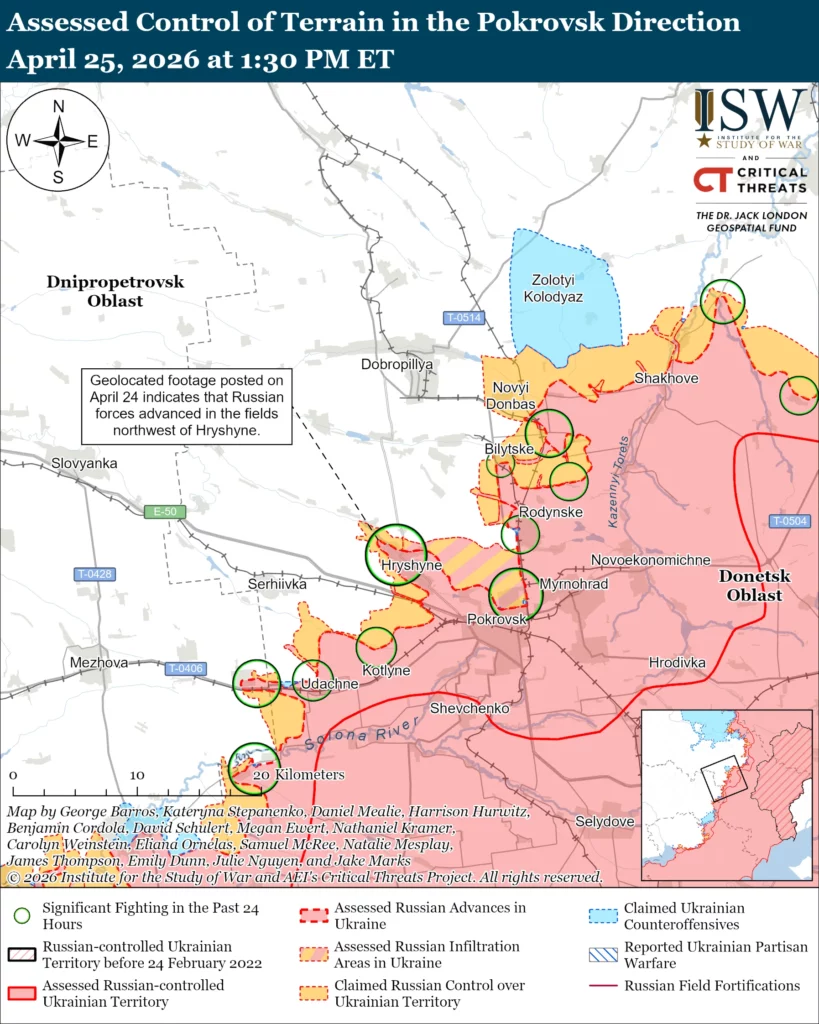
Russian forces are intensifying assault operations in the Pokrovsk direction, exploiting poor weather to increase the size of infiltration groups. The spokesperson of a Ukrainian brigade operating in the Pokrovsk direction reported on April 25 that Russian forces increase the size of their infiltration groups during poor weather conditions.[39] The spokesperson noted that Russian forces largely employ infantry on foot closer to the frontline while using motorcycles and all-terrain vehicles (ATVs) in rear areas.
Ukrainian forces continued their short-range strike campaign against the Russian near rear in the Pokrovsk direction. The Ukrainian General Staff reported on April 25 that Ukrainian forces struck a Russian troop concentration area near Rodynske (north of Pokrovsk) on April 24 or overnight on April 24 to 25.[40]
Russian forces continued limited offensive operations in the Novopavlivka and Oleksandrivka directions on April 25 but did not advance.[41]
Ukrainian forces continued their mid-range strike campaign against Russian military assets in occupied Donetsk Oblast on April 24 and overnight on April 24 to 25. The Ukrainian General Staff reported on April 25 that Ukrainian forces struck an equipment depot near occupied Boykivske (roughly 115 kilometers from the frontline) and a command and observation post near occupied Novopetrykivka (roughly 40 kilometers from the frontline).[42]
Russian Supporting Effort: Southern Axis
Russian objective: Maintain frontline positions, secure rear areas against Ukrainian strikes, and advance within tube artillery range of Zaporizhzhia City
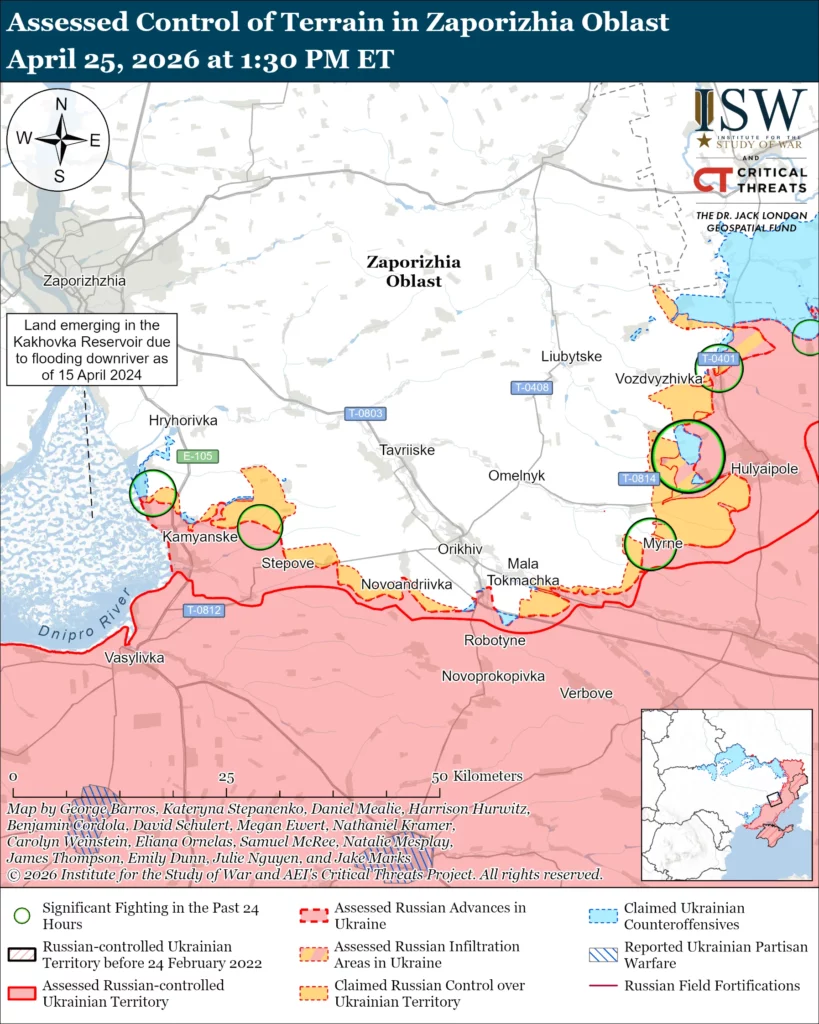
Russian forces conducted an infiltration mission in the Hulyaipole direction. Geolocated footage published on April 25 shows Ukrainian forces striking a Russian servicemember northwest of Myrne (southwest of Hulyaipole) after what ISW assesses was a Russian infiltration mission.[43]
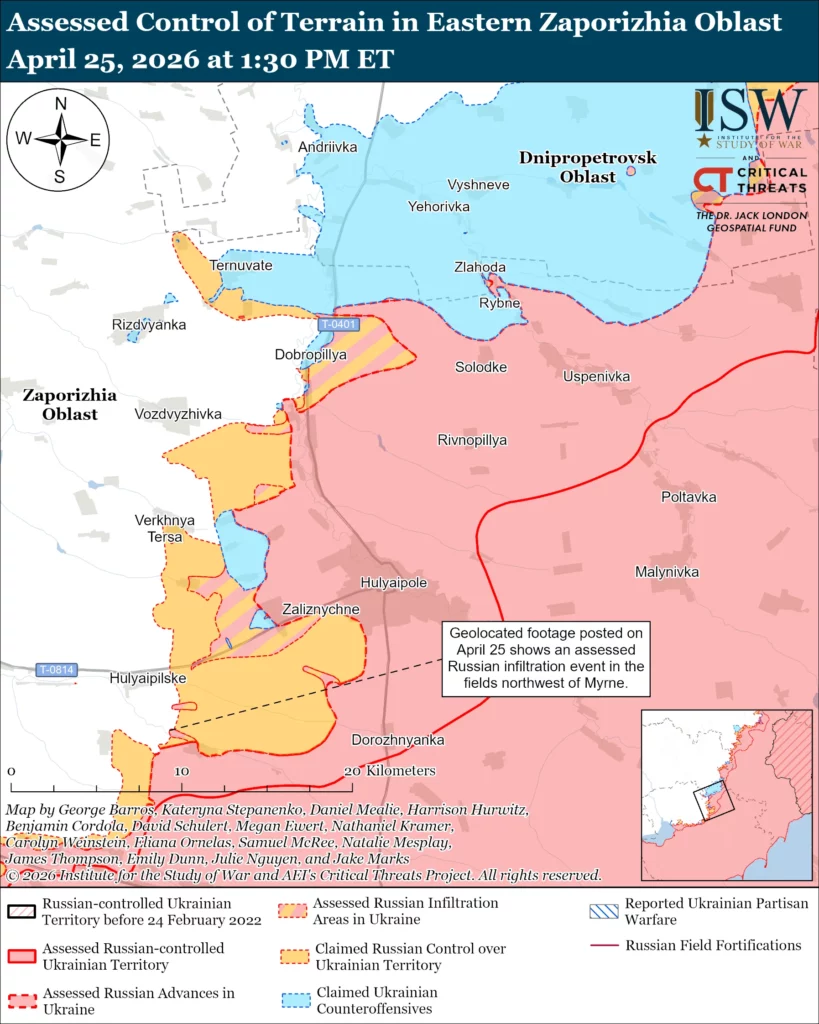
Ukrainian forces continued their short- and mid-range strike campaign against Russian military assets in the Hulyaipole direction and occupied Zaporizhia Oblast on April 24 and overnight on April 24 to 25. The Ukrainian General Staff reported on April 25 that Ukrainian forces struck Russian equipment depots near occupied Novovasylivka (roughly 94 kilometers from the frontline) and Hulyaipole, a command and observation post near occupied Svyatotroitske (roughly 63 kilometers from the frontline), and drone control points near Hulyaipole and Zaliznychne (west of Hulyaipole).[44]
Russian forces continued offensive operations in western Zaporizhia Oblast on April 25 as Ukrainian forces counterattacked in the area.[45]
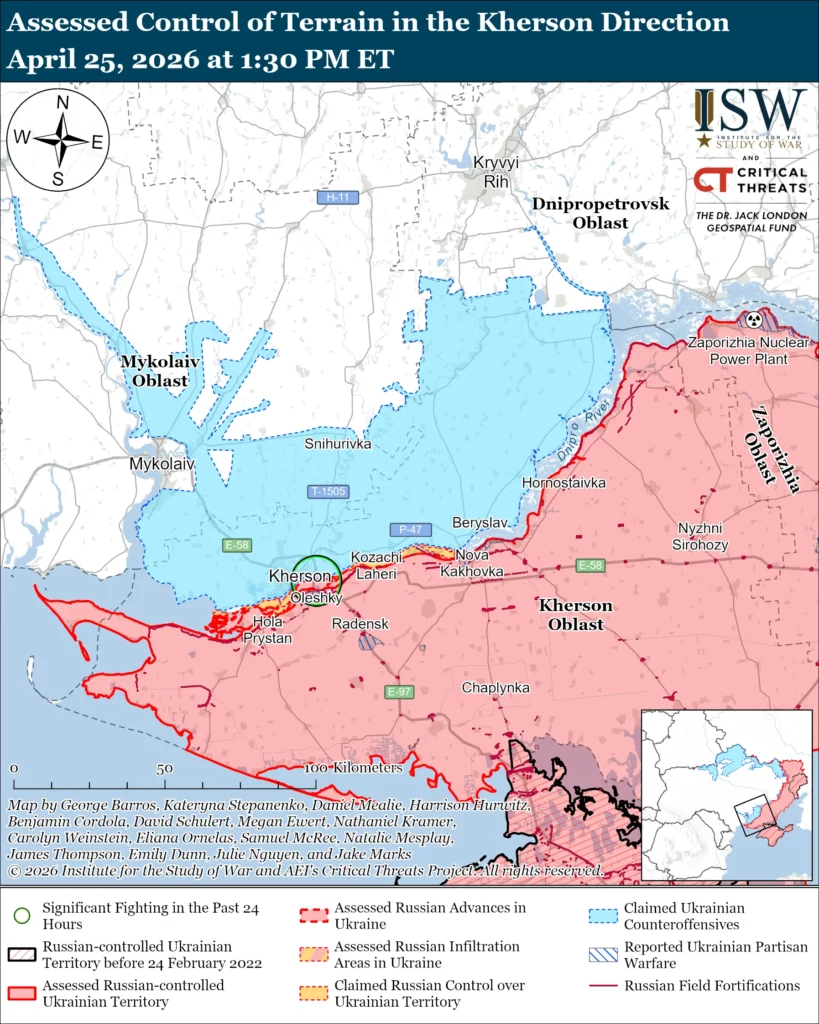
Russian forces continue to conduct limited ground attacks and their “human safari” drone strike campaign targeting civilians in the Kherson direction.[46]
Russian Air, Missile, and Drone Campaign
Russian Objective: Target Ukrainian military and civilian infrastructure in the rear and on the front line
See topline text.
Significant Activity in Belarus
Russian efforts to increase its military presence in Belarus and further integrate Belarus into Russian-favorable frameworks
Nothing Significant To Report.
Note: ISW does not receive any classified material from any source, uses only publicly available information, and draws extensively on Russian, Ukrainian, and Western reporting and social media as well as commercially available satellite imagery and other geospatial data as the basis for these reports. References to all sources used are provided in the endnotes of each update.