Eurasia Press & News
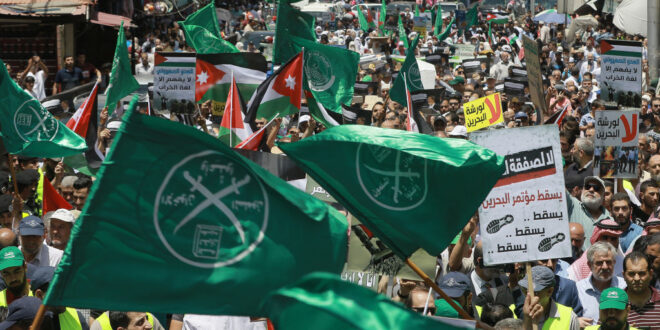
The Jordanian Muslim Brotherhood’s political arm, the Islamic Action Front, is trying out a new name.
Jordan’s Independent Electoral Commission (IEC) ordered the party to change its name under the provisions of the 2022 political parties law, which prohibits party names with religious connotations. On April 26, the party’s Shura Council, its top decision-making body agreed to rebrand as the Ummah Party. While the new name avoids the explicit religious label “Islamic,” the Arabic word “ummah” in this context still denotes the global community of Muslims. On April 29, the IEC confirmed the name change and the new constitution of the party.
The shift followed a sweeping crackdown and the implementation of a ban on the Muslim Brotherhood (MB) after Jordanian security services disrupted a plot “targeting national security, sowing chaos, and sabotage” in April 2025. Officials said individuals affiliated with the Brotherhood had manufactured rockets and drones and stockpiled explosives for potential domestic use.
In January, the United States designated the Jordanian Muslim Brotherhood as a Specially Designated Global Terrorist (SDGT) for providing material support to Hamas. Yet despite these measures, Amman has continued to tolerate the survival of the Brotherhood’s political arm, which remains the largest bloc in parliament with 31 seats. The name change is largely cosmetic and hardly alters the party’s Islamist worldview or its ties to the Brotherhood.
Ummah Party Remains MB’s Political Arm
The head of the party’s general conference, Musa al-Wahsh, said that “opening up to a new name does not mean abandoning its identity.” The party’s new constitution reinforces that point, emphasizing the preservation of Jordan’s Arab-Islamic identity, the promotion of Islamic values and culture, support for an Islamic-oriented economic framework, and mobilization against “colonial projects,” foremost among them Zionism, while also framing the Palestinian cause as a shared Arab and Islamic responsibility.
The party’s cadre also includes individuals directly tied to the banned Jordanian Muslim Brotherhood. For example, Ahmad al-Qatawna, head of the party’s parliamentary bloc, was a member of the executive committee of Jordan’s Brotherhood chapter. Other members of the party’s executive council have likewise held senior positions within the Brotherhood, among them its deputy secretary-general, Jamil Abu Baker.
Meanwhile, Ahmad Zarqan, head of the party’s Shura Council, is the Brotherhood’s deputy comptroller. Jordanian authorities arrested Zarqan in April 2025 in connection with an investigation alleging that funds raised for a Brotherhood-linked humanitarian relief project in Gaza were diverted to support Hamas.
Arab States Have Often Forced Islamists To Camouflage Their Religious Attachment
Amman is forcing the Brotherhood’s political arm to trade its ideological branding for political survival. The party contested elections in 2024 as the Islamic Action Front, but the Jordanian authorities chose at the time to ignore the 2022 law on religiously affiliated party names. Enforcing it now is consistent with the crackdown that began last April, yet opting for cosmetic change suggests the government fears the backlash that would likely follow an actual ban on the party.
This is a familiar regional playbook. In Algeria, after the civil war in the 1990s, authorities imposed similar constraints, forcing the Brotherhood’s affiliate to rebrand from the Movement of Society for Islam to the Movement of Society for Peace and to swap “Islam is the solution” for “peace is the solution” as its slogan. In Tunisia, the state forced the “Islamic Tendency Movement” to rebrand as the Ennahda Movement following legal changes that prohibited political parties based on religion. In Egypt, following the ouster of the MB-aligned Freedom and Justice Party, the state introduced a 2014 constitution banning religious parties, prompting Islamists to rebrand as “civil” political actors.
U.S. Should Target MB Networks and Leadership
Washington’s decision to designate the Jordanian MB was a positive step but insufficient on its own. There has been no parallel action targeting the group’s affiliated individuals and charities.
The U.S. Treasury Department should continue monitoring and targeting any charity — such as the Islamic Charity Center Society — company, or individual that provides material support to the MB, particularly through financing or fundraising. Those acting on the Brotherhood’s behalf, including as representatives, should also be subject to sanctions.