 Eurasia Press & News
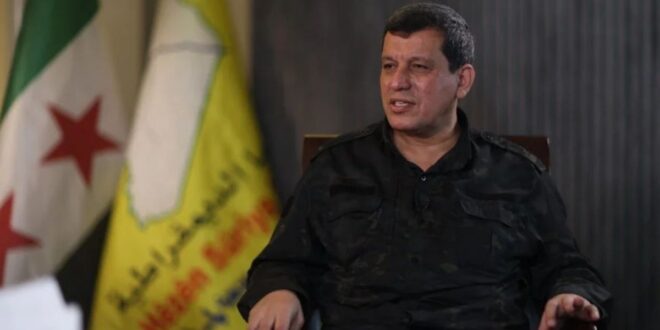
The leader of the Syrian Democratic Forces (SDF), Mazloum Abdi, announced the arrival of new understandings with the Syrian government to address the failure of the judicial file in the province of Hasaka, in light of the continued protests of the supporters of the SDF associated with the Justice Palace and the removal of the Kurdish language from the introductory board of the building, calling on the protesters to give an opportunity for calm and not to disrupt the course of integration between the institutions of the “Autonomous Administration” and the Syrian government.
Abdi’s statement comes at a time when the judicial file is one of the most prominent files that have faced a stumble during the past weeks, within the course of implementation of the January 29 agreement signed between the Syrian government and the Syrian Democratic Forces (SDF), in conjunction with protests in the city of Hasaka, especially in front of the judicial palace, where pro-SDF protesters, including members of the “revolutionary youth”, removed and destroyed more than one identification plate of the building because of its limitation to the Arabic language.
Differences over the merger of “self-administration” judges”
Abdi said, in an interview with (Hawar) agency close to the SDF, that some problems appeared in this file about two weeks ago, and was a direct reason for the disruption of the course of integration for a period of time, explaining that the dispute began as a result of “the absence of a clear mechanism for the accession of the judges of the “Autonomous Administration” to the Syrian government within the course of integration, and the accompanying concerns related to their rights and the nature of the judicial administration in the region.”
He added that “the reaction of the judges and the administration of the judiciary in the region was right,” considering that “the rejection of exclusion is consistent with the essence of integration based on consensus,” and not on the exclusion of one party in favor of another, pointing out that the absence of a consensus agreement from the beginning led to the faltering of the file and reflected on public opinion in the region.
Abdi explained that several meetings have been held during the past period, whether in Damascus or in the northeastern regions of Syria, and at different levels, in order to address the crisis and prevent it from becoming an obstacle to the broader agreements between the two sides.
He pointed out that he held a special meeting with those concerned with the judicial file in order to overcome the differences, stressing that the understandings reached with the Syrian government included the acceptance of the merger of the judges of the “Autonomous Administration” and not to exclude them from the new judicial institutions.
Understandings for the reopening of judicial centres
According to Abdi, the understandings also included the continuation of the work of some judges and former employees within the institutions of the Syrian state, in order to ensure that citizens’ transactions do not stop and the continuation of judicial work, through a joint working formula that brings together the judges of the “self-administration” and the judges previously working.
He added that the lists of the names of the judges of the “Autonomous Administration” were handed over to the concerned authorities, in preparation for subjecting them to government judicial courses and installing them within the official courts, stressing that the two parties agreed to expedite the opening of judicial centers and resume their work, given the association of many official services.
Abdi pointed out that the continued disruption of the judicial palace is not limited to the judicial file only, but is also reflected in other service and administrative files, including elections, procedures for the issuance of passports, and the land registry, in addition to transactions and documents needed by the residents on a daily basis.
He said that “resolving the problem of the judicial palace is an entry point to solve many other files,” referring to the interdependence between the work of the judicial institution and the rest of the state institutions and civil services in the province.
The debate over the Kurdish language continues
With regard to the controversy over the introductory board of the judicial palace in Hasakah, Abdi explained that the Syrian government considers the judicial palace a “sovereign institution” within the province, and believes that the introductory boards should be in Arabic only, adding that the representatives of the region (referring to the SDF) did not want this dispute to turn into a new reason to disrupt the course of integration.
He pointed out that the understandings reached with the government include the adoption of identification plates in Arabic and Kurdish in the cities of Qamishli, Ain al-Arab (Kobani), Malikiya, Amuda and Darbasiyah, adding that dealing with the current plate in Hasakah was accepted for a “specific period of time,” to be reconsidered later.
Abdi considered that the reactions rejecting the removal of the Kurdish language were “right and strong,” especially by the youth group, in light of the sensitivity associated with the issue of the Kurdish language in the region, pointing out that the recent protests and developments prompted a re-discussing of the file with the Syrian government.
Promises to return bilingual paintings
He added that communication with government representatives continued during the past period, and it was agreed on the need to address the issue of language and labels in the judicial palace in Hasaka during the next phase, in line with the mechanism followed in other cities with a Kurdish majority.
He stressed that the Syrian government has made “covenants” to return the painting in Arabic and Kurdish at a later stage, but without specifying a clear timeline for this.
Abdi called on the protesters to give an opportunity for political and administrative understandings to be translated in practice on the ground, and not to disrupt the path of integration or delay the files associated with the judiciary and public services in the region.
Protests continue in front of the Palace of Justice
The city of al-Hasakah has been witnessing repeated tension for weeks against the backdrop of the file of the Palace of Justice, after the removal and re-installation of the introductory panel of the building more than once, amid protests and sit-ins carried out by supporters of the “SDF” and “revolutionary youth”, in protest against the deletion of the Kurdish language from the official plates, at a time when the Syrian government and the SDF are trying to reach broader understandings on the management of institutions and services in northeastern Syria.