 Eurasia Press & News
Future generations will ask, What did you do when the choice became clear between war and development? Did you defend the old order that was failing, or did you join the movement for a new world?
As Europe lay in ruins by the end of World War II, the United States adopted the Marshall Plan, an economic development program that, rather than seeking collective punishment or reparations extraction from defeated countries, was designed to rebuild their war-torn economies.
When nations benefit from each other’s development and share prosperity, war becomes not merely undesirable but economically irrational
The result was transformative: bitter enemies became prosperous partners, and economic interdependency — regardless of long-term eventualities caused by multiple other factors — became the foundation for lasting peace. That lesson, buried by decades of geopolitical warfare, holds the key to understanding why the world is trapped in its current crisis and how to escape it.
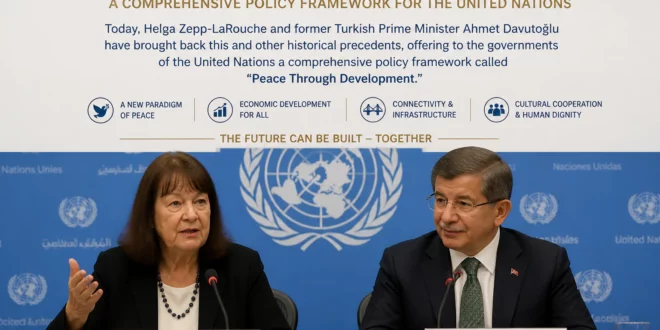
Today, Helga Zepp-LaRouche and former Turkish Prime Minister Ahmet Davutoğlu have brought back this and other historical precedents, offering to the governments of the United Nations a comprehensive policy framework called “Peace Through Development.” An urgent invitation to fundamentally restructure how humanity approaches conflict resolution and international cooperation, their open letter submitted in May 2026 to the UN Security Council is far more than a diplomatic appeal.
The Vision of Lyndon LaRouche: Development as the Foundation of Peace
The intellectual roots of this approach grew from the vision of the late Lyndon LaRouche, enriched by decades of global economics, historical, and statecraft analysis, which cultivated a revolutionary insight:
“Without a shared commitment to economic development, no lasting political agreement is possible between adversaries.”
As LaRouche stated in 1990, “Without a policy of economic development, the Arabs and Israelis have no common basis for political agreement: no common interest.”
This principle was contrary to the prevailing belief that political settlements must come before economic cooperation. Customary diplomacy has always maintained that political disagreements and territorial disputes can be resolved through negotiated security agreements, divorced from economic cooperation.
LaRouche recognized the core flaw in this approach. Without economic cooperation creating tangible mutual benefits, political agreements become meaningless pieces of paper that dissolve the moment they face the pressures of resource scarcity and survival.
History has vindicated LaRouche’s analysis decisively. As the Oslo Accords, the Camp David Summits, the countless peace conferences all fell apart because they tried to solve political problems without solving the economic desperation that feeds the conflict.
Meanwhile, the people of the region were suffering from poverty; they did not have enough water, electricity, or economic opportunity. The moral is inescapable: build economic interdependence first, and peace is not only possible, but inevitable.
The Extended Oasis Plan: Development as Infrastructure for Prosperity
LaRouche’s vision has materialised in the Oasis Plan, initially created in 1975, and continuously developed over the decades by the LaRouche Organization and the Schiller Institute. A plan which imagines transforming Southwest Asia from a dramatic theatre of resource scarcity and perpetual conflict to a region of shared prosperity through massive infrastructure development.
This plan focuses on addressing a very basic need: Access to freshwater. Using China as an example, we will build on its ability to convert deserts in Xinjiang into productive agricultural land through large-scale construction initiatives. The following are proposed as part of the Extended Oasis Plan:
Nuclear desalination facilities producing abundant freshwater for drinking and agriculture, powered by advanced nuclear technology
Regional transport corridors connecting all nations from the Mediterranean to the Gulf, from the Caucasus to India, facilitating trade and commerce
Hydroelectric and water management systems to harness and distribute water resources equitably across the region
Integration with the World Land-Bridge, extending development networks across Asia, Africa, and Europe through rail, road, and telecommunications infrastructure
This is not aid or charity; it is an investment in mutual prosperity. The infrastructure benefits all participating nations simultaneously.
Water projects serve multiple countries. Transport corridors create employment across borders. Energy facilities power regional development. Nations, through both necessity and choice, become economically dependent on each other without relying on any type of conflict or coercion to create such a relationship. The old Silk Road was once a way for the Middle East to be a center of trade between countries around the world, creating wealth through commerce and sharing of cultures; the Oasis Plan attempts to recreate this historical function for today’s world.
When nations benefit from each other’s development and share prosperity, war becomes not merely undesirable but economically irrational.
The 2026 Convergence: When Strategy Meets Opportunity
There is a rare chance for new regional cooperation through former Prime Minister Davutoğlu’s outline of a four-point regional framework that includes the Strait of Hormuz, nuclear issues, security architecture, and the establishment of an independent state of Palestine. This was recognized by Helga Zepp-LaRouche as the ideal time to produce a complete policy synthesis.
On May 15 at the EIR Roundtable, “The Iran War and the ‘Controlled Disintegration’ of the World Economy,” Zepp-LaRouche and Davutoğlu presented their proposals together as one overarching vision.
When asked whether the Oasis Plan’s development approach could complement his diplomatic framework, Davutoğlu responded with profound clarity:
“The best way to peace is economic interdependency. There is no other way. You can sign peace plans, and you can make many declarations, but the best way to peace is economic interdependency. Whenever you have economic interdependency, nobody will be starting a war.”The Open Letter to the UN: A Challenge to Failed Institutions
On May 17, 2026, through a letter by Zepp-LaRouche to all governments meeting at the UN Security Council, with China as chair in rotation, the combined proposal was formally submitted to the UN governments, citing the grim fact that due to institutional paralysis, the United Nations as it is currently structured today is unable to prevent wars or solve regional problems, and that its reform is urgent and necessary.
The open letter suggested that the May 26 UN session adopt a radically different approach, based on shared development rather than military deterrence or geopolitical competition, and provides an alternative to what the UN has failed to deliver: a real way forward, with the Extended Oasis Plan, combined with Davutoğlu’s multilayered regional framework.
What Makes This Different: Addressing Root Causes
The international system of today, administered by the same institutions that have brought us to the edge of a nuclear disaster, is built upon unsound and bankrupt assumptions about peace. The approach to establishing peace through military balance, territorial compromise, or political negotiations that ignores the economic aspect is inherently flawed.
It prioritizes geopolitical “stability” over human development. Successive failures, from the Middle East to Ukraine, from Afghanistan to the unfolding global economic collapse, reveal the complete bankruptcy of this approach. The architects of this failed system benefit from the status quo of conflict.
Military contractors make money from war, financial speculators make money from instability and debt, and extractive industries make money when regions remain underdeveloped and unable to assert sovereignty over their resources. This narrative sustains the system: that conflict is natural, that some nations are meant to dominate and others to be dominated, that development must wait for political agreement, that peace comes through military deterrence rather than mutual prosperity.
The Peace through Development movement provides an alternative lens for thinking about how to end conflict by addressing its causes. Education and healthcare must be accessible, infrastructure must support the community to connect to each other and conduct business with one another, and mutual prosperity creates a need to sustain stability. Development will decrease the despair that breeds extremism, the scarcity that leads to conflict, and the destitution that makes a person prefer destruction.
When nations co-invest in water systems, power plants, or transport networks, their populations become stakeholders in peace, defenders of stability, and protectors of infrastructure, rather than recruits for conflict.
Development doesn’t merely resolve conflicts; it makes conflict irrational at the popular level.
The Global Dimension: A New Economic and Financial System
This framework extends well beyond Southwest Asia. In essence, the proposal calls for a new global financial architecture, rooted in the principles that gave birth to the Marshall Plan, which mobilized capital for productive investment in rebuilding economies and creating prosperity, over the punitive logic of the Treaty of Versailles, which it rejected in favour of the creative logic of mutual development.
The current global financial system, which is driven by speculative finance and austerity policies enforced by international financial institutions, actively inhibits the massive capital mobilization necessary for real development.
Developing countries that try to invest in infrastructure are crippled by debt and conditionality from the World Bank and the IMF, and when they try to invest in nuclear power, water systems, or transportation networks, external forces stifle them with sanctions and political pressure.
A system designed to perpetuate underdevelopment and dependence, not to enable the development that would lead to peace. Zepp-LaRouche envisions a completely new international credit system based on the original Bretton Woods principles, but reformed so that the World Bank, the IMF, and the entire architecture of international finance are reoriented from extraction to development, through institutional reform of the World Bank and IMF, new development banks with lending policies that maximize productive investment and economic growth, not debt service payments to creditors, and a shift from the current system where financial institutions impose austerity and privatization, to one where nations can mobilize capital for the massive infrastructure projects that will transform entire regions.
This is not radical or utopian; it is practical statecraft. China, with the Belt and Road Initiative, has illustrated this principle by moving billions of dollars in capital for development projects in Asia, Africa, and Latin America, while the BRICS New Development Bank has demonstrated that alternative financial institutions can fund development without the extractive conditionality of Western institutions.
The proof of concept is there; the political will is needed to move from the current failed system to one that actually serves human development and peace.
The Urgency of Now: A Historical Turning Point
At this moment, as historical forces converge to open doors that seemed forever shut, global conflicts spread in the Middle East, Ukraine, and across the Global South; nuclear weapons threaten the extinction of civilization; and the current financial system nears systemic collapse, and the current institutional order, the security arrangements of the post-Cold War era, has proven incapable of preventing catastrophe, but also cooperation between the great powers of the world has become possible in a way it was not even years ago.
The development corridors that BRICS nations have started and the Belt and Road Initiative of China, have demonstrated that the concept works and have provided alternative models to Western financial domination.
The developing countries of the Global South have started to assert their entitlement to development and prosperity, not to be condemned to imposed poverty. A true multipolar world, one in which the nations of the world cooperate.
The forces of the old order will resist this transformation fiercely, for it threatens their power and profit. Yet the forces for change are mobilizing.
The choice before humanity is stark and urgent. An Invitation to Join the Movement for Peace and Development. Helga Zepp-LaRouche’s open letter functions as more than a policy proposal presented to diplomats; it is a moral and practical invitation to all people of conscience and vision. To national leaders considering whether to support this framework: the choice between perpetual war and genuine development is ultimately simple, and development serves your nation’s true interests.
To intellectuals and professionals in academia, engineering, economics, and science: your expertise is required to develop and implement these plans. To citizens concerned with humanity’s future: your voice and mobilization can overcome the resistance of entrenched interests.
The framework exists. The plans are detailed and viable. The method is proven by history and by contemporary examples. The resources required are available if channelled toward development rather than military spending.
What is needed above all is the political will to leave behind failed orthodoxy and embrace the only true solution to humanity’s gravest crises. Generations are judged by their decisions at defining moments. Future generations will ask, What did you do when the choice became clear between war and development? Did you defend the old order that was failing, or did you join the movement for a new world?
When humans decide to build prosperity for all rather than to compete for scarcity, and to invest in abundance rather than manage shortage, the better world becomes inescapable, and the choice is for those who see and are willing to act: the time is now, the invitation is open.