 Eurasia Press & News
The US/Israeli war with Iran not only altered the military balance in the Middle East. It also opened a deeper crisis: that of the power model upon which the Gulf Cooperation Council (GCC) countries built their rise over the past few decades.
The US/Israeli war with Iran not only altered the military balance in the Middle East. It also triggered a deeper crisis: the power model upon which the Gulf Cooperation Council (GCC) countries had built their rise over the past few decades. Saudi Arabia, the United Arab Emirates, Qatar, Kuwait, Bahrain, and Oman had managed to combine three crucial assets: security largely provided by the US, logistical centrality in energy flows (exports and distribution corridors), and extraordinary global investment capacity through their sovereign wealth funds. This war has jeopardized all three simultaneously.
Public debate tends to focus on the most visible aspects: missiles, drones, damaged refineries, the closure of the Strait of Hormuz, and the escalation between Washington and Tehran. But the real geopolitical shift is more structural. The reconfiguration of the GCC now depends on its ability to address three simultaneous vulnerabilities: the absence of a truly integrated regional defense; the construction of alternative corridors around major maritime bottlenecks, with the strategic question of whether China will be included in their design; and the preservation of its external financial power, particularly the flow of its sovereign wealth funds to the United States, in a context of war, falling revenues, and the need to redirect capital toward domestic priorities.
The war accelerates this discussion because it simultaneously impacts the Gulf’s security, energy, tourism, logistics, and capacity to continue exporting capital. Rebecca Patterson astutely articulated this in a recent article for the Council on Foreign Relations: “There is a far less discussed risk to the United States than the price of oil or the disruption of critical raw materials. That risk is the reduction in the supply of dollars from the Gulf, especially to U.S. technology companies in need of financing, artificial intelligence projects, and their financial intermediaries.” This is not a minor detail. It is one of the least discussed nerves of the new regional balance.
The Gulf Cooperation Council’s (GCC) primary problem is military, though its true nature is political. The six Gulf states have spent years discussing defense coordination, interoperability, early warning systems, and a common architecture for combating missiles and drones. Agreements, joint exercises, working groups, and even recurring rhetoric of “indivisible security” exist. However, the war demonstrated that this integration was more formal than effective.
The main barrier is not technological. It is political. The Gulf States do not share the same strategic worldview. The UAE and Bahrain have deepened ties with Israel; Qatar maintains a close partnership with Turkey; Oman protects its role as mediator and maintains channels with Iran; Saudi Arabia alternates between containment, negotiation, and the pursuit of autonomy. They are allies on paper, but not identical in their priorities, their perceived threats, or their room for maneuver.
For years, Washington helped manage this fragmentation without resolving it. It sold missile defense systems, radars, aircraft, and air defense batteries to its Gulf partners. It promoted joint military exercises. It fostered interoperability between local forces and the U.S. military apparatus. In May 2024, following the Iranian attack on Israel, a Pentagon official presented the incident as proof of the value of integrated air and missile defense, arguing that it had given new urgency to regional cooperation.
The problem is that interoperability with the United States does not equate to defensive integration among the GCC countries. Washington built an architecture of bilateral ties—each monarchy connected to the protecting power—rather than a true intra-Gulf collective defense. This model was profitable for the US military industry and functional in preserving Washington’s centrality as an indispensable supplier. But it left the essential element unresolved: that the GCC countries themselves could share information, allocate resources, coordinate responses, and protect themselves as a bloc, not just as clients of an external umbrella.
The war with Iran exposed the cost of that difference. The attacks made little distinction between the degrees of alignment of each capital. Ports, energy facilities, airports, and critical infrastructure in the Gulf became part of the theater of operations. Reuters reported the unease of regional sources who expressed a brutal paradox: the United States ignited the war, but the Arab Gulf states are absorbing a substantial portion of the economic and strategic damage.
The question, then, is no longer whether the GCC needs more defense. That is obvious. The question is what kind of defense it wants to build. If the answer is to buy more domestic systems, the result will be a more expensive version of its current vulnerability. If the answer is a true regional architecture—shared early warning, coordinated air defense, joint command, and local production of certain critical inputs—then the GCC could transform the crisis into an opportunity for strategic autonomy.
But this alternative requires something that has not yet happened: that the Gulf monarchies accept that sovereignty is not preserved through isolation, but through integrating capabilities. This is the first dilemma of regional reconfiguration.
The second axis is logistical and geoeconomic. The closure of the Strait of Hormuz was not simply a disruption of energy trade. It demonstrated that the Gulf’s main bottleneck can be transformed into an instrument of strategic coercion.
Before the war, the Strait of Hormuz was a constant threat, but one often treated as unlikely in its extreme consequences. Even when the risk was acknowledged, much of Western economic analysis categorized it as a scenario of partial tension, not massive and sustained disruption. The scale of the conflict explains why the Strait of Hormuz ceased to be a mere maritime passage. In 2025, nearly 15 million barrels of crude oil per day passed through the strait, roughly a third of the world’s oil trade. Furthermore, a crucial portion of global LNG trade depends on this route, particularly Qatari gas.
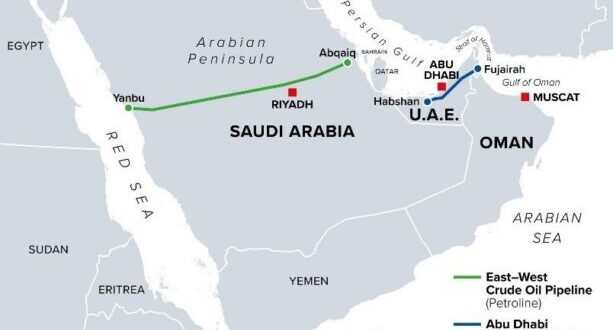
The crisis showed that there are ways to alleviate the situation, but not complete solutions. Saudi Arabia was able to increase shipments through the east-west pipeline to Yanbu, on the Red Sea. The UAE used the Habshan-Fujairah route to transport some of its crude oil, avoiding the strait. These infrastructures helped mitigate the loss of exports and marginally increase tanker traffic at Saudi Red Sea ports.
But its scope shouldn’t be exaggerated. Energy bypasses don’t cover everyone equally. Kuwait, Qatar, and Iraq have much greater restrictions. The alternatives are primarily for oil, not necessarily for liquefied natural gas. And no single pipeline can resolve the vulnerability of essential imports, food supply chains, industrial goods, fertilizers, or general trade flows. That’s why the corridor ceases to be merely “infrastructure” and becomes a national and regional strategy.
The new question for the Gulf is how to build routes that will allow it to survive an intermittent, conditional, or politically contested Strait of Hormuz. This discussion includes pipelines, ports, railways, strategic depots, digital networks, submarine cables, and logistics platforms. The GCC had already approved progress on regional rail connectivity, but the war gives it a different meaning; it is no longer just about diversifying trade, but about reducing existential vulnerabilities.
However, the real debate is not technical. It is political: can the GCC design alternative corridors without China? The realistic answer is that it probably doesn’t want to. China is not a minor external actor for the Gulf. It is a key energy buyer, a critical trading partner, and a provider of financing and infrastructure. In May 2025, the ASEAN-China-GCC Joint Declaration explicitly included the promotion of high-quality cooperation under the Belt and Road Initiative and the development of logistics corridors and digital platforms.
This fact changes the whole picture. If the Middle East-India-Europe (IMEC) corridor was conceived in Washington/Israel as part of a geoeconomic strategy to contain the advance of China’s Silk Road, the Gulf countries seem less interested in choosing between one architecture or the other than in overlapping them. They want Western corridors, yes, but they also want to maintain access to Chinese capital, demand, and infrastructure. This ambivalence infuriates the United States because it reduces the strategic value of its connectivity projects: a corridor meant to anchor the Gulf to the West could become, in the hands of the GCC, a platform for multipolarity.
If China plays a decisive role in shaping the Gulf corridors, the United States loses its monopoly. If it remains outside the system, the GCC’s room for maneuver vis-à-vis its main Asian trading partner is reduced. Neither option is neutral. The war with Iran makes this decision even more urgent because it demonstrates that infrastructure is, in reality, politics incarnate. The Strait of Hormuz was not simply a strait. It was a promise of continuity. That promise has been broken.
The third axis is the most underestimated and, perhaps, the most important for the United States. For decades, there was talk of “petrodollar recycling.” Energy-exporting countries accumulated surpluses, and a substantial portion returned to Western markets in the form of deposits, bonds, stocks, and portfolio investments. This logic did not disappear, but it changed radically in scale and sophistication.
Gulf sovereign wealth funds have transformed into instruments of industrial policy, economic diplomacy, and strategic power. According to estimates cited by CFR, the region manages between $4 trillion and $7 trillion in sovereign assets. The US captured $132 billion in 2025, 48% of the total, driven largely by investments in digital infrastructure, data centers, and artificial intelligence companies. This is a crucial point: Gulf capital is no longer just a financial cushion for monarchies. It is part of the metabolism of American capitalism, especially its most ambitious and costly sectors.
If the war persists, the GCC countries will need more resources for defense, infrastructure repairs, fiscal stabilization, and domestic support. This could reduce or postpone capital placements abroad. Reuters reported in March that three Gulf states began reviewing how to deploy their sovereign wealth funds, including possible reversals of commitments, divestments, and reassessments of global sponsorships.
This is not an improvised shift. The international retrenchment had already begun before the war. In April 2026, the governor of the Saudi Public Investment Fund stated that the fund would seek to allocate 80% of its investments to the local economy and reduce the international proportion to 20%, from peaks of nearly 30%. The shift responds both to the pressure of deficits and lower oil revenues and to the renewed urgency imposed by the war. In other words, the war does not create the reorientation of Gulf capital from scratch; it accelerates it.
This is why the Washington-GCC relationship is experiencing a profound contradiction. The United States wants the Gulf countries to remain strategic partners, purchase American weaponry, finance priority sectors of its economy, and support pro-Western corridors. But the very war that Washington helped unleash is eroding the Gulf’s capacity to fulfill all these roles simultaneously. If the conflict drags on, the GCC will have to prioritize. And it is reasonable to assume that it will prioritize its domestic stability over the financial comfort of Silicon Valley.
The major lesson of this war is that the Gulf can no longer be understood as a passive, wealthy, and dependent region whose function is to export energy, buy weapons, and recycle surpluses. It is emerging as an actor that must simultaneously manage security, connectivity, and capital.
If the GCC succeeds in building an effective regional defense, it will reduce its dependence on the US umbrella. If it manages to develop alternative corridors with sufficient autonomy, it will limit the coercive power of the Strait of Hormuz and gain leverage against Iran. If it preserves its sovereign wealth funds without being caught between war and domestic emergencies, it will maintain its global influence. But if it fails on any of these fronts, its position will weaken.
The United States also faces a choice. It can continue treating the Gulf as an extension of its security architecture, assuming that the monarchies will absorb the costs of a regional strategy designed in Washington. Or it can accept that the GCC is entering a more autonomous, transactional stage, less disciplined by Western logic.
This autonomy will include talks with China, including on strategic corridors. It will include greater caution in capital outflows. It will include more concrete security demands in exchange for cooperation. And it will likely also include a critical review of the old tacit exchange: US protection in exchange for stable energy, investment, and geopolitical alignment.
The future of the Gulf will not be decided solely on battlefields or at the negotiating table between Washington and Tehran. It will also be decided in data centers seeking financing, in ports connecting Asia and Europe, in pipelines that bypass the Strait of Hormuz, in discreet meetings of sovereign wealth funds, and in the still-pending ability of six wealthy states to become a true strategic community.
The reconfiguration of the Middle East is at stake here. And so is a significant part of American power in the 21st century.