 Eurasia Press & News
The power of the neoliberal ideological apparatus, its omnipresent intrusiveness, capable of permeating the entirety of the era’s general imaginary and, therefore, subsuming both the Right and Left quadrants under its umbrella, is clearly revealed by its performative capacity to legitimize itself in any context by delegitimizing any truly existing or ideally possible alternative experience. The one-sided use of historical memory, as well as the application of the category of totalitarianism, are brilliant examples of this.
Alongside and connected to these two expressive functions is the omitted demonization, by the neoliberal discourse, of the dropping of the two atomic bombs on Hiroshima and Nagasaki, the final act of World War II and, simultaneously, the first of the Cold War. The lack of remorse and collective prosecution of the crime committed—which has not even been defined as a “crime,” but rather as a legitimate act of war or, from a different perspective, as a “necessary evil” (against an already defeated and powerless Japan)—is emblematic of what has already been pointed out: for the American-centric neoliberal order, genocide and violence, bombings and totalitarianism are always, by definition, those things not directly connected to the work of the neoliberal order itself.
The origin of the modern foundation of Atlanticist imperialism lies, in the realm of world history, in the absolution of the bombings of Hiroshima and Nagasaki: and, therefore, in that imbalance of guilt, by virtue of which the just condemnation of the concentration camps and the gulags was not followed by a similar condemnation of the two atomic bombs and, with them, of the practice of “bombing for good.” The result of this evaluative asymmetry is well known: as a “necessary evil,” legalized bombing has been able to be practiced again, as evidenced by, among others, the events in Vietnam (1965), Yugoslavia (1999), Iraq (1991 and 2003), Libya (2011), and Iran (2026).
While the right has historically maintained a well-established relationship with imperialism, and indeed has been its fundamental space for propulsion and legitimation, the noteworthy novelty seems to be the recent reconversion of the New Left to the “justifications” of ethical bombardment , humanitarian interventionism , and therapeutic embargoes : in short, to the reasons for the ” universal evil ” of US imperialism, which de facto coincides with the ” armed wing ” of market globalization. Furthermore, it is proof that the neoliberal order does not employ violence where the persuasive power of manipulation and the intellectual power of domestication suffice, and yet it resorts to it again, ” dripping —to use Marx’s words — blood and filth from head to toe ,” wherever it encounters resistance and opposition.
American imperialism is based on a “syllogism of war” (Domenico Losurdo), which states: given the existence of universal values, of which the Atlanticist-leaning West is the sole interpreter and custodian, it follows geometrically that the West itself has the right to export such universal values, even resorting to a sovereignly declared “preventive” war; a war which, under these premises, will in any case be, by definition —regardless of the more or less catastrophic consequences—a just war, in the name of human rights and universal freedom . And, because ex falso sequitur quodlibet (anything follows from a falsehood), torture and violent deaths will not have the same meaning if carried out by a non-globalized terrorist or a proponent of global free trade under the Atlanticist umbrella.
The right-wing economic structure (the imposition of the market and the interests of dominant groups) now also finds its complement in the left-wing cultural superstructure (the interventionist ideology of human rights). Indeed, the imperialism of the Leviathan of the Star-Spangled Banner always proceeds, in its justifications, with a dual approach: the cynical one of the right and the “beautiful soul” of the left. The cynic openly supports the imperialist invasion without pretense, in the name of “the advantage of the strongest”—according to Thrasymachus‘s theorem —and the naked economic and geopolitical interests of the dominant power. The “beautiful soul” inclined to the left, on the other hand, seeks to justify the imperialist invasion with the bombastic rhetoric of human rights or even by pretending to adopt the perspective of the weakest, whom the imperialist operation itself supposedly defends.
It is only from this perspective that the positioning of the main forces of the Western “imperial left” within the framework of the “Fourth World War,” as interpreted and defined by Costanzo Preve , can be fully explained . This conflict coincides with the global war that the dollar civilization , victor of the Third World War (the Cold War), declared in 1989 against all the governments of the planet that had not yet aligned themselves with the Washington Consensus or integrated into the fortified spaces of the disordered order of American-centric neoliberal globalization.
The primary objective of the Fourth World War and its technical tests for the end of humanity consists of maintaining a unipolar world under Atlanticist leadership (global governance), destroying by force the forces that still resist it, preventing the emergence of competitors (especially Russia and China), devaluing international law, and globalizing a deterritorialized, depoliticized, and desovereign market economy. This is the price of the war—or rather, the just war —that the neo-Leviathan monarchy of the dollar (after the end of the Soviet bloc and its never sufficiently praised role in curbing Atlanticist imperialism) wages: a) to subjugate the entire world, orphaned of the protective bipolarity of the pre-1989 era ( New World Order ); and b) to guarantee its own global security , preventing any possible resistance or dissent, which is immediately demonized and, consequently, treated as ” terrorist .”
Among the many episodes of the Fourth World War aimed at the Americanization of the globe, it suffices to recall once again the case of Serbia in 1999. Because it was not aligned with Washington’s will and remained firmly committed to defending the Serbian state, the socialist Milošević was degraded by Atlanticist rhetoric to the rank of ” new Hitler .” This was done so that, secondarily, the manipulated public opinion would accept the resulting treatment reserved for him and celebrate the preordained imperialist occupation of the Balkans as a “liberation” from Milošević ‘s new “Nazism.” Incidentally, this occupation, abstractly carried out in the name of human rights , resulted in the creation, in the Yugoslav province of Kosovo, of “Camp Bondsteel,” the largest US base built abroad since the Vietnam War. And it thus revealed the true purpose of the aggression against Serbia as a key moment in the Fourth World War . This coincided primarily with the comprehensive Americanization of a part of the Balkans traditionally untouched by Atlanticist influence and culturally and ideologically closer to Moscow than to Washington. Indeed, even the Chinese embassy was bombed by the dollar monarchy , which justified it as unwanted “collateral damage“—the official term for major crimes committed by Washington—which, not without good reason, might be better interpreted as a clear warning to China, one of the main—if not the main, tout court —obstacles to the Atlanticization of the world in the post-1989 context.
In that instance as well, the neoliberal left was firmly aligned—as in all other episodes of the Fourth World War , and sometimes even more fervently than the right wing —with US imperialism. Moreover, it played a crucial role in justifying this imperialism to the public. It did so by employing the politically correct discourse of human rights fundamentalism exported via missiles and the moral imperative to overthrow the “new Hitlers” and the new totalitarian regimes scattered throughout the world. The war in Ukraine, which erupted in 2022, would confirm these trends, with a new left increasingly aligned in defense of the interests of US imperialism (in the process of occupying post-Soviet spaces) and even at the forefront of arms shipments for anti-Russian purposes.
The emancipatory universalism of the struggle against imperialism and in defense of the patriotism of national liberation struggles has been rapidly replaced by the “bad universalism” of human rights and takeaway democracy —that is, by the ideology that, with Chomsky, we will label the umbrella of US power. The comprehensive post-1989 rehabilitation of imperialism and colonialism could be considered complete: “Colonialism’s Back” was the unequivocal title proposed by the New York Times on April 18, 1993. This rehabilitation is carried out by redefining, in perfect Newspeak style, Atlanticist imperialism with the reassuring but treacherous names of peacekeeping and the export of rights and democracy. And it always comes—in Serbia, as in Iraq or Libya—with a timely erasure of the unequivocally totalitarian exterminations carried out by the armed wing of the Stars and Stripes of capitalist globalization, with its humanitarian bombings with unconventional weapons, with its liberal ethical concentration camps (from Guantanamo to Abu Ghraib), with its preventive wars for the greater good , with its therapeutic genocidal embargoes (from Cuba to Iraq), with its destabilization of legitimate governments replaced by nefarious dictatorships.
Within the framework of this political economy of human rights , the reductio ad Hitlerum , as conceptually theorized by Leo Strauss , plays a crucial role in legitimizing the New World Order. As demonstrated in Il futuro è nostro , the ideological reduction of non-aligned governments to the category of “new Hitlers” and “new red and black totalitarianisms” effectively enables the automatic activation of the “Hiroshima model“—that is, ethical bombing presented as a “necessary evil ” (or “collateral damage“)—with devastating consequences, but justified nonetheless in the name of overthrowing the abominable dictator.
For this reason, the liberal-Atlanticist discourse transformed Gaddafi and Saddam, as well as Assad and Milošević, into new Hitlers — and, in general, all those who, condemned a priori for being on the wrong side of history , dared to oppose the imperialist Americanization of the world. In 2022, Putin himself, the former leader of that Soviet Communist Party that had fought against Nazism in Europe, was brazenly presented to the public as a “new Hitler,” in the height of manipulation and hypocrisy; and this, moreover, was thanks to a dollar-driven civilization that did not hesitate to support, in Ukraine, the real-life Nazis of the “Azov Battalion” and all the Russophobic forces openly Nazi in their ideas and symbols.
The lesson to be learned is inflexible. Against the new Hitlers, not only are negotiation and dialogue by definition impossible, but any military operation is justified, beyond the limits and regulations of jus in bello and jus ad bellum: the imperialist attack, smuggled in as the “liberation” of oppressed peoples, can be carried to its extreme consequences, thus beyond any supposed jus in bello. Market deregulation is accompanied by military deregulation and the converging idea of total war, which the heralds of the Empire —self-proclaimed “forces of Good“—declare themselves called to wage, by any means and beyond all limits, against the demonic forces of Evil: Operation Infinite War was, in fact, the global war project launched by President Bush in 2002.
The “Fourth World War ” (Preve) differs from its predecessors, which unfolded within the framework of dialectical capitalism, in this respect as well. It is equally supported by the imperial right and left , both colonized by the ideology—constitutive of the self-awareness of Western false consciousness—with which the imperialist capitalist world manages to establish itself as the only free world .
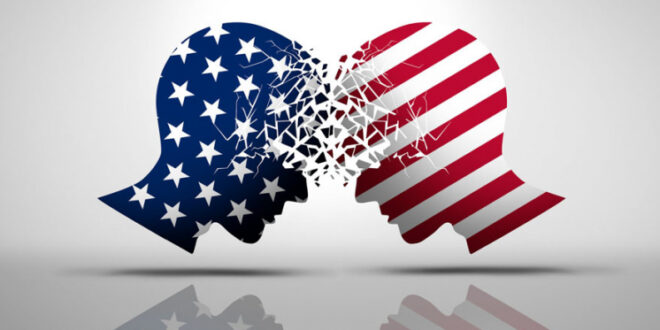
The blue-colored Right and the fuchsia-colored Left of neoliberalism thus appear as the two gendarmes in the service of US imperialism: that is to say, of the violence with which market globalization, as a political, economic, social and cultural phenomenon, imposes itself in the areas of the world still resistant to accepting the “magnificent and progressive destinies” of the “freedom” of capital.