 Eurasia Press & News
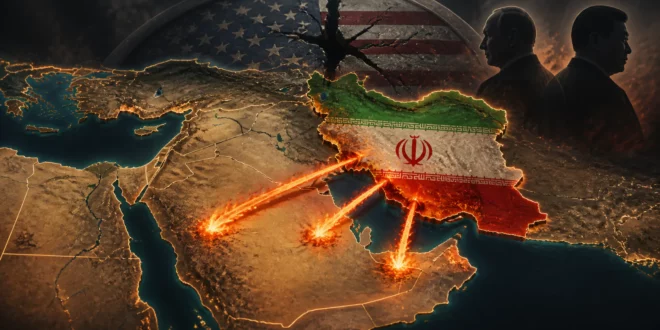
The Iran war has reshaped global geopolitics by weakening U.S. credibility and the liberal world order, intensifying regional instability in the Middle East, disrupting energy markets and economies, and accelerating the shift of global power toward emerging alliances led by Russia and China.
Global Disruption and the Shifting World Order
The US-Israeli attack on Iran emerged as one of the global issues that has completely altered the global dynamics and world order. The implications of this war have been felt around the world. From the energy crisis to unemployment and inflation, this war has affected the world in numerous ways. The US-Israel-Iran war also affected the aggressors in various ways, as well as the broader Middle Eastern region. One of the major impacts of this war is that it significantly altered the global views of US credibility both as an ally and as a negotiator. Moreover, it has pushed the US competitors and rivals closer than ever.
Regional Security Breakdown and the Gulf Response
This war has created a global perception that nuclear capabilities remain the sole guarantee of security against any foreign military or political intervention
Among all of the implications of this war, the most significant one is the Iranian retaliatory attacks on the Gulf nations housing US military bases, especially the UAE, Qatar, Bahrain, Saudi Arabia, and Kuwait, which also hit the energy and civilian infrastructures in some cases. This Iranian strategy shattered the perception of the US military’s strong capabilities. It also undermined the efficacy of the US security umbrella, coercing these nations to explore alternate options, including Russia, China, Pakistan, and India, to enhance their defenses and ensure their sovereignty. In this quest, some of these nations, like the United Arab Emirates (UAE), have enhanced collaboration with Israel. The latter deployed the Iron Dome air defense system and sent several troops to operate it in the UAE. Israel thwarted numerous Iranian drones and missiles through its Iron Dome in the UAE. This development weakened US credibility in the region while strengthening Israel’s regional influence.
Energy Security, Economic Shock, and Gulf Vulnerabilities
The Iranian attacks on these nations and the closure of the Strait of Hormuz by the Iranian Revolutionary Guards (IRGC) also forced a recalibration among these countries on energy production, storage alternatives, and transportation methods to protect these resources from further regional conflicts. This war also deepened the historic Arab-Iranian divide among the Muslim community, which will further strengthen the Wahabi-Shia (often misinterpreted as Sunni-Shia) competition in the Middle Eastern states like Bahrain, Pakistan, and Iraq. This rivalry between the two sects and Iran and the Saudi-Gulf will continue to exacerbate, even if the US-Israel-Iran war issue is resolved through negotiations.
Another major implication of this war is that it busted the Dubai dream. Before this war, the UAE was seen as a safe haven for tourism, trade, investment, and entertainment – attracting the global elite and businessmen. The UAE was considered a refugee camp for tax evaders and corrupt politicians. However, the recent Iranian attacks on the UAE severely damaged the global image of the city-state. It would take years to restore the investment environment and global perception of the UAE. This also has negative implications for South Asia’s marginal economies, as the South Asian labor in the UAE has been severely affected by this war.
The Iranian attacks on the UAE and Gulf countries have significantly damaged the energy production and economies of these countries. Qatar produces over 20 percent of global LNG. Its economy is highly reliant on oil and LNG exports. Around 60 percent of Doha’s revenue was generated through petroleum exports. These energy exports made the country the richest in the world per capita, with around $600 billion in its sovereign wealth funds. However, the Iranian attacks on Qatar’s energy facilities and the closure of the Strait of Hormuz have damaged its economy and energy exports. The Arab countries could now think of creating storage for their gas and crude oil outside the conflict zone. This war would also force many other countries to build greater energy storage facilities to cope with uncertainties.
Decline of the US-Led Order and the Rise of New Alliances
The United States, through its attack on Iran and trade tariffs on its rivals, has further pushed its adversaries closer. Through his interventionist and unilateralist policies, US President Donald Trump has further solidified the China-Russia alliance, as evidenced by the recent Xi-Putin summit. These policies are increasingly isolating the United States and accelerating its decline as a global hegemon, creating a power vacuum on the global stage that Russia and China are rapidly filling through their inclusive policies. This war has also increased strategic, military, technological, and economic cooperation between Beijing, Moscow, and Tehran.
The US and Israeli attack on Iran, amidst ongoing negotiations, has also undermined the global perception of international rules and norms. Moreover, this attack showcases the inefficacy and helplessness of the liberal international institutions. It has strengthened the global perception that the US-led world order is designed to serve Western interests. Through this attack, the United States has weakened the US-led unilateral world order and pushed the Global South towards the Eastern bloc, led by Russia and China. Moreover, this war has created a global perception that nuclear capabilities remain the sole guarantee of security against any foreign military or political intervention.