 Eurasia Press & News
Key Takeaways
Iran is taking steps to establish a joint mechanism with Oman to try to exercise long-term authority over the Strait of Hormuz. Such a mechanism would enable Iran to regulate transit through the strait and decide to restrict passage at its discretion. Recent increased vessel traffic through the strait does not eliminate the threats that Iranian control over the strait poses to US interests and global commerce.
Iranian regime officials have continued to deny that the United States could control how the regime spends any funds it obtains from the US-Iran memorandum of understanding (MoU). Any economic relief that the regime obtains could support Iranian efforts to reconstitute its military capabilities and the Axis of Resistance.
Iranian Supreme Leader Mojtaba Khamenei’s Telegram channel reiterated the primary objectives that Iran seeks to achieve in the current conflict. These objectives include ending US military operations against Iran, making the United States lift its naval blockade on Iranian ports, consolidating Iranian sovereignty over the Strait of Hormuz, receiving US compensation for Iranian reconstruction, the lifting of all sanctions, “the resolution of nuclear issues,” and Iranian access to frozen assets.
Recent Iranian reporting suggests that Major General Ali Abadi Abdollahi may now serve as the Armed Forces General Staff (AFGS) deputy chief and Khatam ol Anbia Central Headquarters commander simultaneously. Iranian media reports identifying Abdollahi as the AFGS deputy chief follow unconfirmed reports from December 2025 that Iranian leaders were considering merging the AFGS and Khatam ol Anbia Central Headquarters.
United States Central Command’s (CENTCOM) proposed deconfliction initiative in Lebanon would operate at a disadvantage compared to Iran because the IRGC’s on-the-ground presence in Lebanon likely enables Iran to identify and report alleged ceasefire violations to the newly established “deconfliction cell” faster than the United States. Israeli political leaders have expressed concern over the “deconfliction cell” due to Iran’s role in the cell and Israel’s exclusion from the mechanism.
Toplines
Iran is taking steps to establish a joint mechanism with Oman to try to exercise long-term authority over the Strait of Hormuz. Such a mechanism would enable Iran to regulate transit through the strait and decide to restrict passage at its discretion. Iranian Parliament Speaker Mohammad Bagher Ghalibaf met with Omani officials in Muscat on June 23 to discuss joint Iranian-Omani management of the strait.[1] Iranian and Omani officials released a joint statement following the talks that emphasized their commitment to clause 5 of the US-Iran memorandum of understanding (MoU). This clause states that Iran will work with Oman to “define the future administration and maritime services in the Strait of Hormuz” in consultation with other Persian Gulf littoral states.[2] Islamic Revolutionary Guards Corps (IRGC)-affiliated Fars News Agency reported that both delegations agreed to continue discussions on the management of the strait, including maritime services and associated costs.[3] These discussions will almost certainly involve Iranian efforts to establish a toll system in which vessels must pay “service fees” to Iran and Oman to transit through the strait. Omani Foreign Affairs Minister Badr Albusaidi stated after the meeting that Oman supports “toll-free safe passage” through the strait.[4] Iran, however, has consistently differentiated between “tolls” and other charges, such as “service fees” and “insurance” to protect vessels against attacks. Iran continues to be the only threat against commercial shipping in the strait. Any imposition of fees would violate international law. The Strait of Hormuz is an international waterway, not territorial waters, and Article 26 of the UN Convention on the Law of the Sea — which permits fees in territorial waters — therefore does not apply to the strait.[5] A reality in which Iran is able to manage traffic through the strait and collect related fees would constitute a significant strategic victory for Iran and give Iran substantial leverage over global commerce.
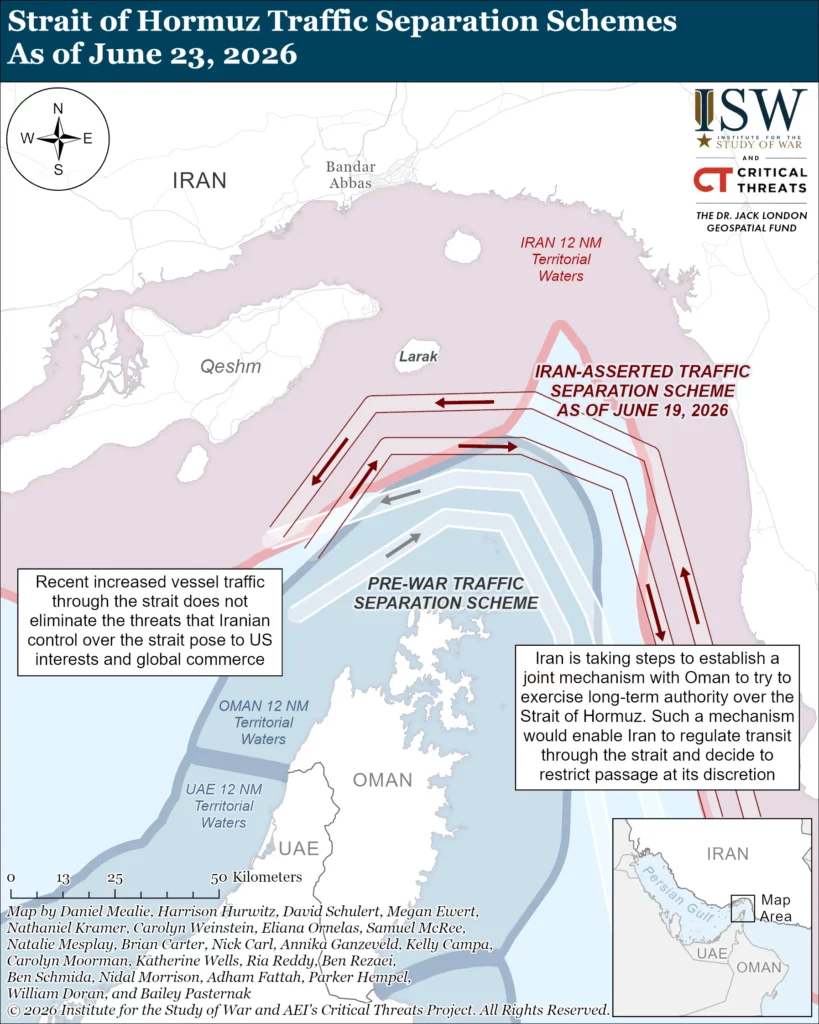
Recent increased vessel traffic through the strait does not eliminate the threats that Iranian control over the strait poses to US interests and global commerce. Western media reporting and commercially available maritime data indicate that vessel traffic through the strait has increased in recent days.[6] Iran continues to claim that the IRGC Navy is “allowing” vessels to pass through the strait, however.[7] This framing implies that Iran has the authority to deny vessels passage whenever it chooses, which significantly undermines US interests and global commerce. Iran has already used its claimed control over traffic in the strait as a lever to try to extract concessions during negotiations with the United States. ISW-CTP previously assessed that Iran’s recent announcement of the “closure” of the strait likely aimed to increase economic pressure on the United States to compel Israel to halt operations against Hezbollah and withdraw from Lebanon, for example.[8] Iran’s continued efforts to establish joint control over the strait would enable Iran to retain its ability to use the strait as a tool of coercion.
Iranian regime officials have continued to deny that the United States could control how the regime spends any funds it obtains from the US-Iran memorandum of understanding (MoU). Any economic relief that the regime obtains could support Iranian efforts to reconstitute its military capabilities and the Axis of Resistance. Iranian Ambassador to the United Nations Ali Bahreini rejected on June 23 any US involvement in deciding how Iran could use unfrozen assets it gains access to from the MoU.[9] Iran’s Central Bank Governor, Abdolnaser Hemmati, told regime media on June 23 that Iran has “no obligation” to buy US agricultural products under the terms of the MoU.[10] US Vice President JD Vance told reporters on June 22 that, if the United States unfroze Iranian assets, Iran would have to use the assets to purchase US agricultural products.[11] Regime officials have previously indicated that the regime could use any economic relief from the MoU to reconstitute Iran’s military capabilities. Arab mediators told the Wall Street Journal on June 13 that IRGC Commander Major General Ahmad Vahidi, whom ISW-CTP continues to assess is leading regime decision-making, has insisted that Iran’s frozen assets should not be “barred from military spending,” for example.[12] Iranian Foreign Affairs Ministry Spokesperson Esmail Baghaei similarly stated in May that Iran would use assets released under an agreement with the United States to advance its defense and military sectors, including Iran’s missile and drone programs.[13]
Iranian Supreme Leader Mojtaba Khamenei’s Telegram channel reiterated the primary objectives that Iran seeks to achieve in the current conflict.[14] The objectives include:
Ending US military operations against Iran;
Making the United States lift its naval blockade on Iranian ports;
Consolidating Iranian sovereignty over the Strait of Hormuz;
US compensation for Iranian reconstruction;
The lifting of all sanctions;
“The resolution of nuclear issues,” likely referring to maintaining the Iranian nuclear program; and
Iranian access to frozen assets.
Recent Iranian reporting suggests that Major General Ali Abadi Abdollahi may now serve as the Armed Forces General Staff (AFGS) deputy chief and Khatam ol Anbia Central Headquarters commander simultaneously. The Iranian media has not publicly announced a replacement for the AFGS deputy chief position since the current IRGC Commander Major General Ahmad Vahidi, who previously served as the AFGS deputy chief, was appointed as the IRGC deputy commander in December 2025.[15] Vahidi was appointed as IRGC Commander in March 2026.[16] Iranian media, including an AFGS-affiliated outlet, identified Abdollahi as the AFGS deputy chief in May and June 2026 while reporting that he had appointed new officials to positions within the Passive Defense Organization (PDO).[17] The PDO operates under the AFGS and develops and coordinates policies to protect Iranian civilian, military, and nuclear infrastructure from attacks.[18] Abdollahi’s reported role as AFGS deputy chief in making these appointments is notable because the AFGS chief, rather than the deputy chief, has historically appointed senior PDO officials.[19] The Iranian media has not announced a new AFGS chief since Israeli strikes killed former AFGS Chief Major General Abdol Rahim Mousavi in February 2026.[20] Iranian media have simultaneously continued to identify Abdollahi as the commander of the Khatam ol Anbia Central Headquarters, a position to which he was appointed in September 2025, which suggests that Abdollahi may hold both positions concurrently.[21] Iranian media reports identifying Abdollahi as the AFGS deputy chief follow unconfirmed reports from December 2025 that Iranian leaders were considering merging the AFGS and Khatam ol Anbia Central Headquarters.[22] A single commander previously served as both the Khatam ol Anbia commander and AFGS chief before the regime separated the two organizations in 2016.[23] The regime may have decided to merge the AFGS and Khatam ol Anbia Central Headquarters as part of a broader effort to restructure the military establishment after the 12-day Israel-Iran War, which highlighted Iran’s command-and-control issues.[24] Such a move would likely aim to increase coordination and reduce redundancies at the highest level of Iran’s military establishment.
United States Central Command’s (CENTCOM) proposed deconfliction initiative in Lebanon would operate at a disadvantage compared to Iran because the IRGC’s on-the-ground presence in Lebanon likely enables Iran to identify and report alleged ceasefire violations to the newly established “deconfliction cell” faster than the United States.[25] CENTCOM Spokesperson Captain Tim Hawkins told US media on June 23 that CENTCOM is monitoring kinetic activity in Lebanon for tactical deconfliction.[26] US media reported that CENTCOM’s monitoring mechanism is part of the newly established “deconfliction cell” to oversee the ceasefire in Lebanon.[27] The “deconfliction cell” includes both US and Iranian representatives, but no Israeli representation.[28] The United States does not have an on-the-ground presence in southern Lebanon, and its tactical monitoring efforts will thus presumably rely on the Israel Defense Forces (IDF). This reliance on the IDF for information would likely delay US awareness about ceasefire violations because IDF soldiers would need to report Hezbollah ceasefire violations to their superiors, who would in turn also need to notify their superiors until the report reaches a senior command echelon. The senior command echelon would presumably notify CENTCOM, which in turn would inform US officials in the “deconfliction cell.” Iran, however, has deployed IRGC Quds Force officers to southern Lebanon in the current conflict, which would likely reduce the time and complexity needed for IRGC officers to report incidents to Iranian officials involved in the “deconfliction cell.”[29] Iran may face some challenges with reporting incidents despite its overall advantage, however, because Hezbollah’s combat units are decentralized and maintain limited communication with other units and higher command echelons.[30] Being able to notify the “deconfliction cell” about incidents faster would enable Iran to provide its interpretation of incidents and thereby influence the narrative over incidents in the “deconfliction cell.”
Israeli political leaders have expressed concern over the “deconfliction cell” due to Iran’s role in the cell and Israel’s exclusion from the mechanism.[31] Israeli Ambassador to the United States Yechiel Leiter warned Lebanese and US officials at the start of US-brokered negotiations in Washington, DC, on June 23 that negotiations are failing to expel Iranian influence from Lebanon and risk offering Hezbollah a “new lease on life.”[32]
US-Iran Negotiations
Nothing significant to report.
Maritime Activity in the Strait of Hormuz and Persian Gulf
See topline section.
US and Israeli Air Campaign
Nothing significant to report.
Iranian Domestic Affairs
See topline section.
Iran’s Axis of Resistance
Lebanese Hezbollah and the Israeli Campaign in Lebanon
Israeli and Lebanese officials met in Washington, DC, for the latest round of US-brokered negotiations on June 23.[33] International media reported that the talks will likely continue through June 25 and that Israeli, Lebanese, and US officials will discuss ceasefire measures, including plans to replace the IDF with the Lebanese Armed Forces (LAF) in “pilot zones” in southern Lebanon.[34] Israeli media reported on June 23 that the IDF will likely withdraw from limited specific areas in southern Lebanon and transfer control of these areas to the LAF.[35] The IDF first transferred control of Dibbine, Marjaayoun District, to the LAF and the United Nations Interim Force in Lebanon (UNIFIL) after withdrawing from the town on June 4.[36] Hezbollah Secretary General Naim Qassem said in a speech on June 23 that Hezbollah is cooperating “to the fullest extent” with the LAF and urged the Lebanese government to “take advantage” of Hezbollah as a partner force in Lebanon.[37] Qassem has previously claimed that Hezbollah would work with Lebanese authorities and urged the Lebanese government to align with the group, although Qassem has also frequently criticized the Lebanese government for pursuing Hezbollah’s disarmament.[38]
The Israel Defense Forces (IDF) reported that it engaged two groups of Hezbollah fighters near Ali al Taher, Nabatieh District, on June 23. The IDF reported that its forces killed a group of Hezbollah fighters that advanced toward IDF positions near Ali al Taher.[39] The IDF also reported that it conducted a drone strike targeting four Hezbollah fighters in vehicles near IDF positions in Ali al Taher.[40] The IDF reported that this group of Hezbollah fighters “operated under civilian cover.”[41] Hezbollah claimed that Israeli forces targeted civilians as they cleared roads and recovered bodies.[42] Hezbollah accused the IDF of violating the June 19 Israel-Lebanon ceasefire.[43] Israeli forces and Hezbollah last engaged each other on June 20.[44] Israeli Prime Minister Benjamin Netanyahu and the IDF warned on June 20 that Israel is committed to the ceasefire but will continue to “forcefully” strike Hezbollah if the group launches further attacks against Israeli forces.[45]
Other Axis of Resistance Activity
Iranian Ambassador to Iraq Mohammad Kazem Sadegh downplayed Iran’s opposition to Iranian-backed Iraqi militia disarmament in an interview with Iraqi state media on June 22.[46] Sadegh claimed that Iran would respect any Iraqi government decision regarding militia disarmament and called the issue an “internal Iraqi matter,” which contradicts previous reporting about Iran’s position on the issue.[47] Unspecified political and informed security sources previously told US-funded, Arabic-language media on June 10 that Iran views Iraqi militias’ possible disarmament as an issue related to the Axis of Resistance rather than merely an internal Iraqi matter.[48] The IRGC also reportedly told Iraqi militia leaders not to surrender their weapons and vowed that Iran would do “everything in its power” to keep the militias armed.[49] Sadegh’s interview comes as the Iraqi federal government has recently taken initial steps to disarm Iranian-backed Iraqi militias, including forming a disarmament committee, amid increased US pressure on the Iraqi government to dismantle the militias.[50] ISW-CTP continues to assess that any Iraqi federal government attempt to disarm the militias and integrate them into the Iraqi security establishment that does not address the militias’ networks and allegiance to Iran would likely further embed Iranian influence within the Iraqi state.[51]
Sadegh also attempted to deflect Iranian responsibility for Iranian-backed Iraqi militia attacks during the recent conflict.[52] He falsely claimed during the interview that Iran “did not ask any party to intervene” on its behalf during the war.[53] Eight Iraqi sources told Western media on June 19, however, that the IRGC formed multiple Iraqi militia cells that directly report to the IRGC, instead of pre-existing Iranian-backed Iraqi militias, to conduct attacks on US forces in Gulf countries.[54] Unspecified Iraqi sources also told Saudi media in April that IRGC Quds Force officers “constantly” supervised militia attacks, helped militias develop ammunition for drones, and provided militias with technical expertise regarding missiles.[55]