 Eurasia Press & News
Key Takeaways
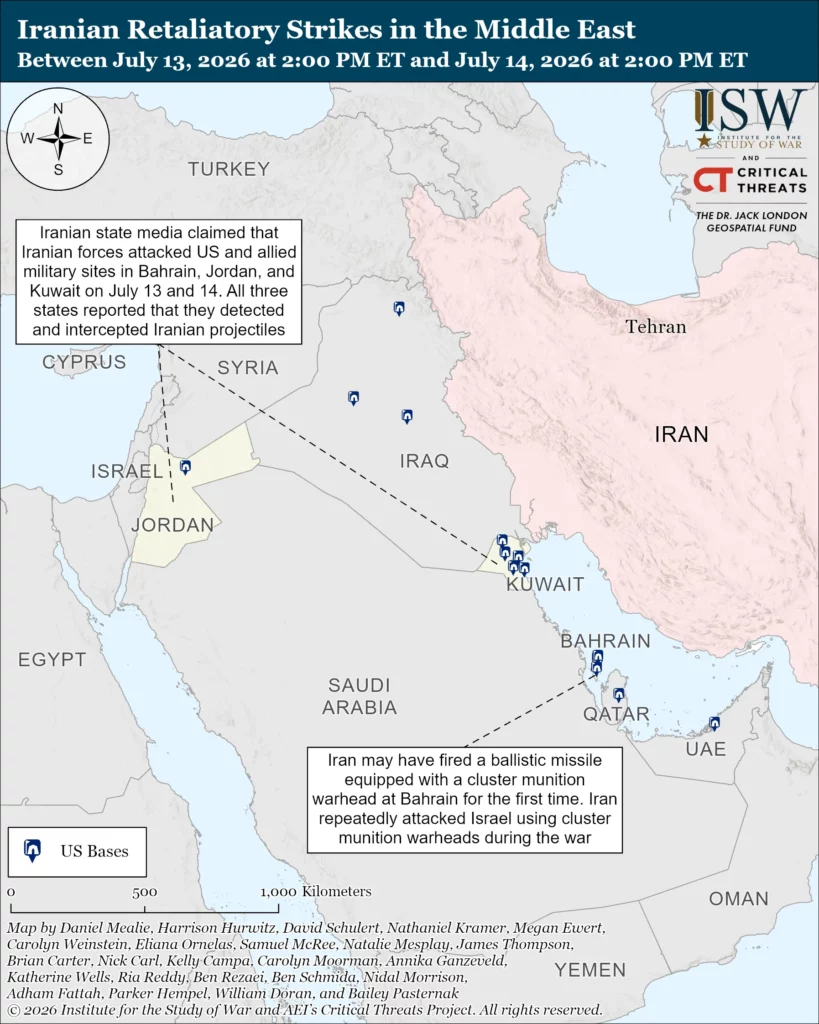
Iran has attacked at least three commercial vessels in the Strait of Hormuz in the past 24 hours, which indicates that Iran retains the ability and willingness to attack commercial shipping despite recent US strikes on Iran. US Central Command (CENTCOM) announced on July 13 that it conducted another wave of strikes against Iranian military targets that Iran used to threaten shipping in the strait. Iran responded to the US strikes by attacking US military bases across Kuwait, Bahrain, and Jordan on July 14.
Hezbollah appears to be conducting an information campaign to delay the Lebanese government’s disarmament efforts by attempting to convince the Lebanese government that the group will cooperate with the Lebanese Armed Forces (LAF) and that the Lebanese government must prioritize securing a complete Israeli withdrawal from Lebanon before disarmament efforts can begin.
Two US officials stated on July 14 that the United States backed Saudi Arabia’s July 13 airstrikes on Houthi-controlled Sanaa International Airport in Yemen. The Houthis also warned commercial airlines on July 14 against using Saudi airspace.
Toplines
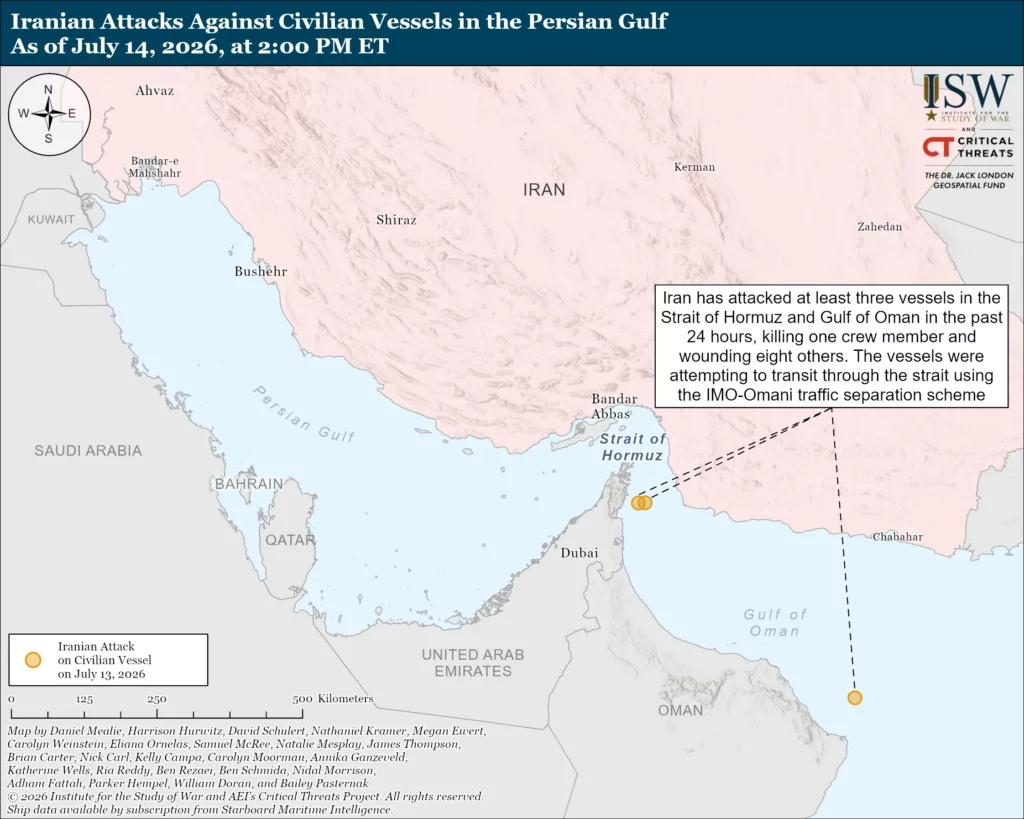
Iran has attacked at least three commercial vessels in the Strait of Hormuz in the past 24 hours, which indicates that Iran retains the ability and willingness to attack commercial shipping despite recent US strikes on Iran. Iran struck at least three vessels, including two Emirati tankers, on July 13 that were attempting to transit through the strait via the southern route along Oman’s coast.[1] The Iranian attacks killed one crew member and wounded eight others.[2] Iran has repeatedly used force to try to deter vessels from using the alternative traffic separation scheme along Oman’s coast because traffic through this route undermines Iranian efforts to assert full control over traffic in the strait. US Central Command (CENTCOM) announced on July 13 that it conducted another wave of strikes against Iranian military targets that Iran used to threaten shipping in the strait.[3] US officials, including US President Donald Trump, have stated that the current US campaign to degrade Iran’s ability to threaten shipping could last several weeks. It is therefore premature to assess the effects of this campaign. The threshold for Iran to be able to disrupt shipping in the strait remains low, however, given that even individual drone and missile attacks can deter vessels from passing through the strait. Maritime traffic through the strait is dependent on the risk calculations of ship captains and shipping companies, which are generally risk averse.
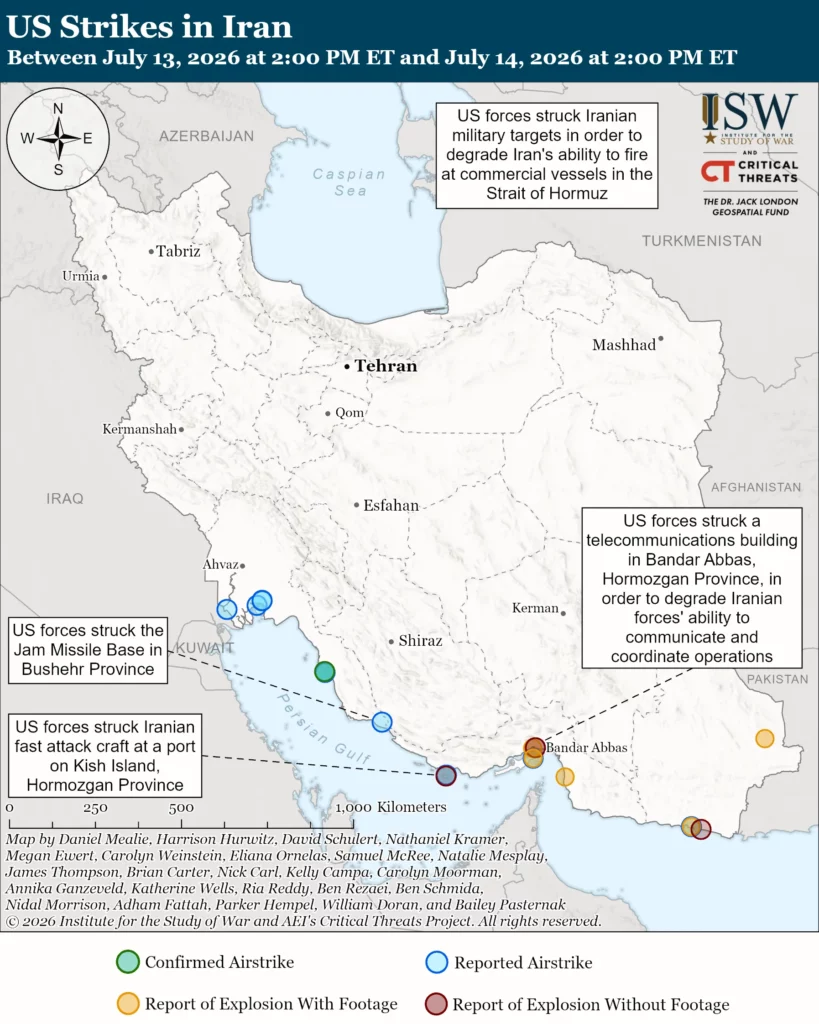
Iran responded to the US strikes by attacking US military bases across Kuwait, Bahrain, and Jordan on July 14.[4] Iran reportedly used a cluster munition warhead in an attack on Bahrain for the first time. ISW-CTP cannot verify this report, but if the report is accurate, Iran’s use of a cluster munition warhead to attack Bahrain would represent a notable inflection in Iranian tactics given that Iran has previously only used cluster munition warheads in attacks against Israel.[5] Cluster munition warheads contain submunitions that disperse over a wide area and are intended to maximize damage.
US-Iran Negotiations
Nothing significant to report.
Maritime Activity in the Strait of Hormuz and Persian Gulf
See toplines.
US and Israeli Air Campaign
See toplines.
Iranian Domestic Affairs
The Iranian Parliament held its first open session since the start of the US-Israel-Iran War and discussed proposed legislation on Iranian management of the Strait of Hormuz.[6] Parliamentarians reviewed the “Strategic Action Plan for Ensuring the Security and Sustainable Development of the Strait of Hormuz and the Persian Gulf,” which Parliament first proposed in April, among other matters, at the July 13 session.[7] Parliament did not approve the bill or publish its text. The bill is likely intended to formalize Iran’s control over the Strait of Hormuz and likely will not fundamentally alter the steps Iran is currently taking to secure its control over the strait. One hundred and eighty parliamentarians also signed a letter on July 14 calling for an oversight committee to ensure the government implements the bill.[8]
Iranian Parliament Speaker Mohammad Bagher Ghalibaf notably did not preside over the session, and Deputy Parliament Speaker Hamidreza Haji Babaei led the session in his absence.[9] It is unclear why Ghalibaf did not lead the session, but his absence comes after several parliamentarians have criticized Ghalibaf in recent weeks for failing to convene Parliament.[10]
Iran may be deploying forces to the Iran-Iraq border due to concerns about Kurdish opposition groups conducting anti-regime activity amid heightened tensions between the United States and Iran. Anti-regime Kurdish groups based in Iraqi Kurdistan told Iraqi media on July 14 that the Islamic Revolutionary Guards Corps (IRGC) deployed 3,000 “special forces” from the IRGC Aerospace Force and IRGC Ground Forces, as well as drones, artillery, and tanks, to the Iran-Iraq border in recent weeks.[11] The groups’ leaders claimed that the IRGC is deploying these forces to prepare for a possible confrontation against them.[12] No other sources have reported this large troop deployment at the time of this writing, however. Iran has periodically launched drone and missile attacks at these groups’ bases during the US-Israel-Iran War, including during the US-Iran ceasefire.[13] ISW-CTP has observed an uptick in these groups’ attacks on Iranian security forces and Iranian security operations in Kurdish-populated areas in recent weeks.[14] Iranian Armed Forces General Staff-run outlet Defa Press also reported in June that the regime is closely monitoring fighters in Kurdish-populated provinces and has replaced “purely defensive reactions” with an “active deterrence” doctrine against these fighters.[15] The Iranian regime has historically accused Kurdish opposition groups of cooperating with Israel and the United States to conduct operations against the regime and destabilize Iran.
Iran’s Axis of Resistance
Lebanese Hezbollah and the Israeli Campaign in Lebanon
Hezbollah appears to be conducting an information campaign to delay the Lebanese government’s disarmament efforts by attempting to convince the Lebanese government that the group will cooperate with the Lebanese Armed Forces (LAF) and that the Lebanese government must prioritize securing a complete Israeli withdrawal from Lebanon before disarmament efforts can begin. Hezbollah is attempting to portray itself as a willing partner to the Lebanese government that also seeks to preserve internal Lebanese stability, which is a key Lebanese government objective.[16] Senior Hezbollah officials, including Hezbollah Secretary General Naim Qassem, have repeatedly stated in recent weeks that Hezbollah seeks to maintain Lebanese national unity and supports the LAF’s deployment to southern Lebanon.[17] Unspecified sources told Lebanese media on July 13 that Hezbollah agreed to withdraw from southern Lebanon and “cooperate” with the LAF.[18] Hezbollah previously agreed to withdraw its forces north of the Litani River during the Lebanese government’s previous disarmament efforts following the November 2024 ceasefire agreement.[19] Hezbollah has consistently stated that it will remain armed, even if the group withdraws from southern Lebanon, however.[20] Hezbollah-affiliated media also claimed on July 14 that Hezbollah has informed all “relevant parties” that the LAF is permitted to deploy “wherever it wishes,” so long as the LAF does not “approach” Hezbollah positions and the Lebanese government prioritizes securing an Israeli withdrawal before any Hezbollah-Lebanese government discussions about disarmament take place.[21]
Hezbollah and Hezbollah allies are simultaneously claiming that the pilot zone plan in the Trilateral Framework Agreement is intended to cause “internal conflict” between the LAF and Hezbollah.[22] Lebanese Parliament Speaker and Hezbollah ally Nabih Berri has continued to criticize the framework agreement and claimed that the initiative may be an Israeli “trap” to force the LAF into an internal conflict with Hezbollah.[23] Hezbollah parliamentarians have similarly claimed in recent weeks that the United States and Israel seek to provoke conflict between the LAF and Hezbollah by pressuring the LAF to disarm Hezbollah under the framework agreement.[24] Hezbollah officials have consistently threatened that any Lebanese disarmament efforts could result in “civil war.”[25]
Hezbollah’s information campaign is likely capitalizing on the Lebanese government’s cautious approach toward Hezbollah’s disarmament.[26] The Lebanese government has sought to balance Hezbollah’s disarmament with the group’s continued threat to Lebanese stability despite the group’s unprecedented weakness.[27] Lebanese President Joseph Aoun stated on July 10 that the Lebanese government must “cooperate with Hezbollah” in order to disarm the group, for example.[28] Any disarmament plan that relies on cooperating with Hezbollah and its supporting foreign cadres, including the IRGC, will almost certainly fail, because none of these actors will acquiesce to disarming Hezbollah.[29]
Hezbollah’s information campaign also coincides with US-mediated Israel-Lebanon talks in Rome, which began on July 14 and have reportedly focused on the pilot zone plan.[30] Israeli Foreign Minister Gideon Saar told international media on July 14 that the IDF is ready to move forward with implementing the two recently announced pilot zones.[31] The Israeli and Lebanese delegations reportedly continue to disagree over the timeframe for the IDF’s withdrawal and the LAF’s backfill of the pilot zones, the geographic scope of the LAF’s deployment, and how the United States and Israel will monitor the LAF’s efforts to disarm Hezbollah within the pilot zones, however.[32]
Other Axis of Resistance Activity
Unspecified Iranian-backed Iraqi militias are reportedly demanding guarantees before they disarm, including Iraqi federal government protection from future US or Israeli strikes and an end to the US military presence in Iraq.[33] Unspecified sources told Iraqi media on July 14 that the militias are concerned that surrendering their weapons to the government would leave them “vulnerable” given current regional tensions.[34] Three Shia Coordination Framework sources told Iraqi media on July 14 that the militias that refuse to disarm do not seek confrontation with the Iraqi federal government, but view existing, unspecified “guarantees” as insufficient.[35] One of the framework sources specifically noted the lack of guarantees regarding the safety of militia leaders and said that the militias seek guarantees that they will not face “political and security prosecution” in the future.[36] The US-Israeli combined force conducted numerous strikes targeting Iranian-backed Iraqi militia positions during the war to degrade the ability of the militias to attack the United States, Israel, and the Gulf states.[37] Multiple militias, including those within the Islamic Resistance in Iraq, have repeatedly refused to disarm and often cite the continued presence of US-led international coalition forces in Iraq as a reason to remain armed.[38] The Islamic Resistance in Iraq is a coalition of Iranian-backed Iraqi militias.[39]
Iranian-backed Iraqi militia Kataib Hezbollah threatened on July 14 that Iranian-backed Iraqi militias would participate in a renewed war between Iran and the United States and Israel.[40] It is not clear how Kataib Hezbollah is defining “war,” however. Iran and the United States have exchanged more frequent and intense fire in the Persian Gulf in recent days, though below pre-ceasefire levels.[41] Iraqi militias, especially Kataib Hezbollah, frequently attacked US and foreign targets in Iraq and the region during the war in March and April.[42] Iranian-backed Iraqi militias also likely conducted several attacks targeting the Gulf states between the start of the ceasefire and mid-May.[43]
Recent Iranian-backed Iraqi militia statements reflect ongoing divisions among the militias over the Iraqi federal government’s ongoing anti-corruption campaign. Kataib Sayyid al Shuhada Spokesperson Kazem al Fartousi rejected the anti-corruption campaign in an interview with Iraqi media on July 13 and said that the militia opposes the government “selectively” fighting corruption.[44] Fartousi added that the worst forms of corruption, which he implied the government should prioritize, are the quota system and nepotism in state institutions.[45] Kataib Hezbollah separately said on July 14 that it supports the anti-corruption campaign but warned the government against using the campaign to “settle scores and eliminate opponents.”[46] Iraqi authorities have primarily arrested Sunnis and allies of former Prime Minister Mohammad Shia al Sudani.[47] Kataib Hezbollah added that the campaign must focus on all governing institutions. Kataib Sayyid al Shuhada and Kataib Hezbollah are both members of the Islamic Resistance in Iraq, which released a statement on July 12 expressing support for the anti-corruption campaign.[48] Fartousi’s opposition to the campaign may reflect disagreements in the Islamic Resistance in Iraq about the campaign. Fartousi’s comments may also indicate internal divisions within Kataib Sayyid al Shuhada regarding the campaign.
Asaib Ahl al Haq Spokesperson Ahmed Adnan expressed support on July 14 for US investment in Iraq in contrast to the Islamic Resistance in Iraq’s July 12 statement that implored the Iraqi federal government to “liberate” the Iraqi economy from “American hegemony.”[49] Iraqi Prime Minister Ali al Zaydi’s visit to Washington, DC, began on July 13 and is expected to focus on expanding US-Iraq economic relations.[50] Asaib Ahl al Haq is not a member of the Islamic Resistance in Iraq and Adnan’s comments reflect the group’s differing strategic priorities compared to those of the militias in the Islamic Resistance in Iraq.[51] Asaib Ahl al Haq’s leadership, including its leader Qais al Khazali, has focused more on politics than kinetic activity in recent years, including during the October 7 War.[52] The US-Israeli combined force struck multiple Asaib Ahl al Haq positions during the recent war and the US Treasury Department noted in April 2026 that the group conducted drone attacks targeting US and coalition forces in northern Iraq in March 2026, however.[53]
Iraqi Armed Forces Spokesperson Major General Sabah al Numan announced on July 14 that Iraq will establish a new security cooperation framework with the United States after the US-led coalition withdraws from Iraq in September 2026.[54] Numan stated that the framework will include enhanced military and intelligence cooperation with the United States.[55] Numan also stated that Iraqi Prime Minister Ali al Zaydi will sign agreements with the United States to support training and capacity building for the Iraqi Security Forces (ISF) during his visit to Washington, DC, on July 14.[56] The United States has not resumed its funding for some counterterrorism and training programs for the Iraqi Security Forces since suspending funding for these programs in April 2026 due to concerns about Iranian-backed Iraqi militia attacks during the war.[57] US-led international coalition forces are currently based in Iraqi Kurdistan following their withdrawal from federal Iraq in January 2026.[58]
Two US officials stated on July 14 that the United States backed Saudi Arabia’s July 13 airstrikes on Houthi-controlled Sanaa International Airport in Yemen.[59] Axios reported on July 14 that Saudi officials expressed concern to the United States last week about the resumption of IRGC-affiliated Mahan Air flights between Sanaa and Tehran. The flights resumed on July 3, marking the first direct flights between the two cities in over 10 years.[60] Axios reported that Saudi Arabia is concerned that Iran will use the direct air route to transfer weapons and military advisers to the Houthis.[61] Saudi Crown Prince Mohammad bin Salman spoke with US President Donald Trump on July 10, during which Salman reportedly requested and received Trump’s approval for “military action” against the Houthis, according to a US official.[62] Saudi forces struck Sanaa International Airport on July 13, which the Houthis responded to by launching an unspecified number of ballistic missiles and drones targeting Abha International Airport in Saudi Arabia.[63] The Houthi Political Bureau claimed on July 13 that Saudi Arabia struck Sanaa International Airport to prevent a Mahan Air passenger jet from landing at the airport.[64] The Mahan Air flight was reportedly carrying a Houthi delegation returning from former Iranian Supreme Leader Ali Khamenei’s funeral in Tehran but returned to Iran following the strikes.[65] The Houthis also warned commercial airlines on July 14 against using Saudi airspace.[66]