 Eurasia Press & News
Toplines
Russian Ministry of Defense (MoD) recruitment programs are reportedly failing to compensate for the rising Russian casualty rate amid costly advances in Ukraine. The Ukrainian Foreign Intelligence Service (SZRU) reported on July 12 that the Russian MoD recruited about 195,000 personnel contract soldiers as of early July 2026 — less than 50 percent of Russia’s annual contract recruitment goal of 409,000.[1] SZRU reported that Russia’s daily recruitment rate fell from about 1,200 people per day in 2024 to 1090 recruits per day in mid-2026 and noted that Russia’s recruitment rate is insufficient to accomplish Russia’s annual goal. SZRU noted that growing battlefield losses have forced the Russian MoD to relax its medical and other administrative standards for recruiting candidates and intensify efforts to recruit students, foreigners, and residents in Russian-occupied Ukraine. Ukrainian Commander-in-Chief General Oleksandr Syrskyi reported on July 14 that Russian forces currently suffer over 400 casualties per each square kilometer that Russian forces seize in Donetsk Oblast.[2] ISW previously assessed that Russian forces suffered around 1,298 casualties per square kilometer they seized or infiltrated in June 2026 compared to an average of 68 casualties per kilometer seized in June 2025 at the theater level.[3] ISW’s calculations differ from those in Syrskyi’s statement due to a number of methodological factors. ISW’s assessment accounts for theater-wide casualties while Syrskyi’s figures specifically refer to the Donetsk Oblast. ISW is unable to independently estimate Russian casualty levels within individual Ukrainian oblasts. It is also unclear how Syrskyi’s statistics account for the areas in which Russian forces conduct infiltration missions, suffer casualties, but do not successfully seize. Ukrainian forces also recently liberated areas near Lyman, and it remains unclear how territorial control changes resulting from newly Ukrainian liberated-territories factor into the Russian casualty rate when calculating the quantity of square kilometers that Russian forces seized. Syrskyi’s figures all the same provide a helpful metric for quantifying the overarching trend in how Russian forces pay very steep prices for meager tactical gains, regardless of the specific methods used to quantify such figures. Russia’s high casualty rates, regardless of calculation method, reflect Ukraine’s ability to undermine Russian battlefield operations and inflict significant personnel losses.[4] Russia’s casualty rate overtook its recruitment rate in March 2026, and Russian forces will likely continue struggling to generate replacements amid the rising casualty rate without compulsory mobilization.[5]
The Coalition of the Willing reaffirmed the necessity that Ukraine receive binding security guarantees as part of a larger peace plan and reiterated the members’ commitment to participate in peace negotiations. The Coalition of the Willing met in Paris on July 13 and issued a joint statement reaffirming its support for Ukraine, calling for an “immediate and complete ceasefire” in Ukraine and direct peace negotiations between Russia and Ukraine with the participation of the United States and Europe.[6] The coalition reiterated that there can be no meaningful peace agreements surrounding Ukrainian and European interests and security without Ukrainian and European participation. The coalition supported US President Donald Trump’s July 7 statement at the NATO Summit in Ankara in support of providing security guarantees to Ukraine. The coalition emphasized that politically and legally binding security guarantees for Ukraine are essential for a durable peace following a ceasefire to deter future Russian aggression and to European stability and security.
The Kremlin continues to reject security guarantees for Ukraine and seeks to deny European participation in peace negotiations on Ukraine. Russian Foreign Minister Sergei Lavrov claimed on July 14 that unspecified “Europeans” are attempting to undermine unspecified “existing agreements” between Russia and the United States, possibly referencing the supposed agreements that the Kremlin claims the US and Russia reached at the August 2025 Alaska Summit, but that in fact were never reached.[7] Lavrov reiterated Russian President Vladimir Putin‘s June 2024 speech emphasizing Russia‘s maximalist war aims, including Ukraine’s complete withdrawal from Ukrainian-controlled territory in Luhansk, Donetsk, Zaporizhia, and Kherson oblasts and the abandonment of Ukraine’s NATO accession aspirations before Russia would agree to a ceasefire and start peace negotiations.[8] Lavrov reiterated that US President Donald Trump and Putin “concluded” an agreement during the August 2025 Alaska Summit in Anchorage but acknowledged that the US and Russia did not sign any documents formalizing any agreement.[9] US Secretary of State Marco Rubio recently confirmed on June 25 that Russia and the United States did not reach any agreement to end Russia’s war in Ukraine during the August 2025 Alaska Summit.[10] Kremlin Spokesperson Dmitry Peskov stated on July 14 that Russia opposes European participation in peace negotiations and added that Russia will not agree to any security guarantees for Ukraine without Russia’s participation, rejecting US President Donald Trump’s and the Coalition of the Wiling’s efforts to facilitate a lasting peace in Ukraine.[11] The Kremlin has routinely tried to exclude European leaders from being involved in the peace negotiations to end the war in Ukraine, including rejecting proposals for European peacekeepers and security guarantees and portraying the United States and Russia as the only relevant negotiating actors.[12] The Kremlin’s repeated rejection of any meaningful Western security guarantees for Ukraine further demonstrates Russia’s unwillingness to accept any agreement that falls short of Ukraine’s full capitulation.[13]
Ukraine’s Western partners continue efforts to boost Ukraine’s air defense umbrella, particularly to combat Russian ballistic missiles. Denmark, France, Germany, Italy, the Netherlands, Norway, Spain, Sweden, the United Kingdom, and Ukraine signed a joint declaration at the Coalition of the Willing meeting on July 13 in Paris to create the Integrated Anti-Ballistic Missile Coalition to accelerate the production of anti-ballistic air defense systems.[14] Ukrainian President Volodymyr Zelensky stated that he hopes Ukraine’s Freyja anti-ballistic missile interceptor will be in operation within the next 12 months (by mid-July 2027). Zelensky added that Ukraine will be the first to receive the new Franco-Italian Sol-Air Moyenne-Portée/Terrestre New Generation (SAMP/T NG) air defense systems and that France will provide Ukraine with two SAMP/T systems in 2026.[15] Ukrainian forces downed five of the eight ballistic missiles Russian forces launched on the night of July 13 to 14 — a notably higher interception rate compared to the past five Russian strike packages that included ballistic missiles, in which Ukrainian forces downed none of the missiles.[16] Russian forces have been taking advantage of Ukraine’s depleted stocks of Patriot missile interceptors in recent weeks to maximize the destructive potential of their strike packages.[17] European efforts to boost Ukraine’s anti-ballistic air defense umbrella will complement US efforts to grant Ukraine a license to produce an unspecified type of interceptor missile for Patriot air defense systems, which are critical for Ukraine’s ability to defend against Russian ballistic missiles.[18]
France and Italy granted Ukraine licenses to produce Franco-Italian glide bombs and French SCALP missiles in Ukraine, as Ukraine’s partners continue efforts to boost Ukraine’s own defense industrial base (DIB). Ukrainian President Volodymyr Zelensky and French President Emmanuel Macron announced on July 14 that France granted Ukraine the licenses to produce Armement Air-Sol Modulaire (AASM) precision-guided glide bombs and SCALP cruise missiles in Ukraine.[19] France and Italy also granted Ukraine the licenses to produce Aster 30 surface-to-air missiles in Ukraine until the end of 2026. The joint declaration also announced Ukraine’s initial order of 16 French Rafale fighter jets from the total 100 that Ukraine stated it would buy in November 2025. France will transfer the first four Rafale fighter jets after Ukrainian personnel complete training for pilots and mechanics, which could begin in France in 2026. The joint declaration added that France will deliver air-to-ground and air-to-air missiles, including laser-guided anti-drone missiles, Missile d’Interception de Combat et d’Auto-defense (MICA) missiles, and beyond-visual-range air-to-air METEOR missiles. Ukraine’s growing fleet of Rafale jets could enable Ukraine to launch more SCALP/Storm Shadow missiles to augment and sustain its intermediate-range strike campaign.
Ukrainian forces struck the Salavat Oil Refinery on the night of July 13 to 14, the only major Russian refinery that Ukrainian forces had not previously struck in 2026. The Ukrainian General Staff and Ukrainian Special Operations Forces (SSO) reported that Ukrainian forces struck the Gazprom Neftokhim Salavat Oil Refinery in Salavat, Republic of Bashkortostan (roughly 1,300 kilometers from the international border), resulting in a fire and damaging the AVT-6 primary oil distillation unit and other production facilities.[20] A Ukrainian open-source intelligence (OSINT) channel reported that satellite imagery collected on July 14 indicates that the Ukrainian strikes struck both the AVT-6 and AVT-4 primary processing units.[21] The Ukrainian General Staff reported that the Salavat refinery is one of the largest in Russia and has a processing capacity of about 10 million tons of oil per year.[22] The Ukrainian SSO reported that the refinery was the last major Russian gasoline production facility that Ukrainian forces had not struck thus far in 2026 and that Ukrainian drones traveled roughly 1,500 kilometers from their launch point to the refinery.[23] Geolocated footage published on July 14 shows fire and smoke coming from the Salavat Oil Refinery.[24] Republic of Bashkortostan Head Radiy Khabirov acknowledged that Ukrainian drones targeted an industrial area in Salavat.[25] Russian officials appear to have been unable to provide sufficient air defense protections for the refinery, despite the established pattern that Ukraine has been targeting major refineries since Spring 2026.
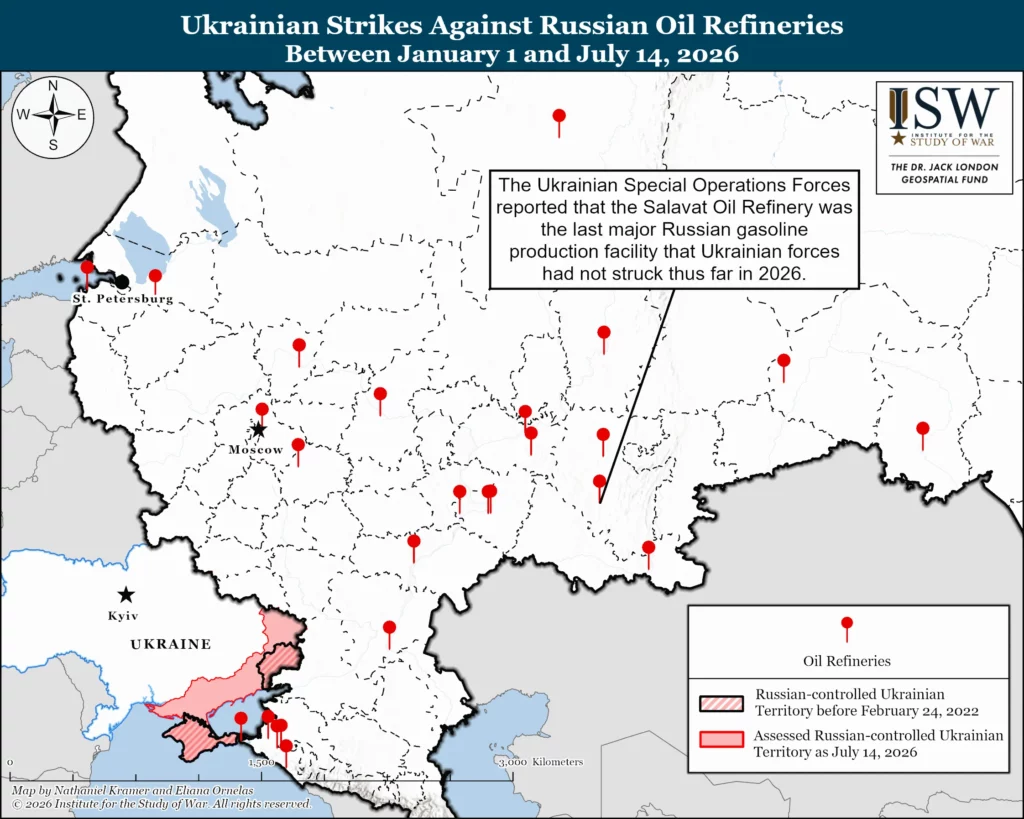
The Ukrainian General Staff also reported that Ukrainian forces struck the Afipsky Oil Refinery in Afipsky, Krasnodar Krai (roughly 375 kilometers from the frontline) and a transshipment area near Gelendzhik, Krasnodar Krai (roughly 370 kilometers from the frontline) overnight.[26] The Ukrainian General Staff reported that the Afipsky Oil Refinery is one of the key oil enterprises in southern Russia with a production capacity of about 6.25 million tons per year. The Ukrainian General Staff reported that Russian forces use the transshipment infrastructure near Gelendzhik to ship oil and support Russian military and naval logistics. Imagery published on July 14 reportedly shows a fire at Afipsky Oil Refinery.[27] On July 14, the Krasnodar Krai Operational Headquarters acknowledged a fire at the refinery.[28]
Key Takeaways
Russian Ministry of Defense (MoD) recruitment programs are reportedly failing to compensate for the rising Russian casualty rate amid costly advances in Ukraine.
The Coalition of the Willing reaffirmed the necessity that Ukraine receive binding security guarantees as part of a larger peace plan and reiterated the members’ commitment to participate in peace negotiations.
The Kremlin continues to reject security guarantees for Ukraine and seeks to deny European participation in peace negotiations on Ukraine.
Ukraine’s Western partners continue efforts to boost Ukraine’s air defense umbrella, particularly to combat Russian ballistic missiles.
France and Italy granted Ukraine licenses to produce Franco-Italian glide bombs and French SCALP missiles in Ukraine, as Ukraine’s partners continue efforts to boost Ukraine’s own defense industrial base (DIB).
Ukrainian forces struck the Salavat Oil Refinery on the night of July 13 to 14, the only major Russian refinery that Ukrainian forces had not previously struck in 2026.
Russian forces recently advanced in Sumy Oblast and in the Kostyantynivka-Druzhkivka tactical area.
Russian forces launched eight Iskander-M/S-400 ballistic missiles, two Kh-59/69 guided cruise missiles, and 135 drones against Ukraine overnight.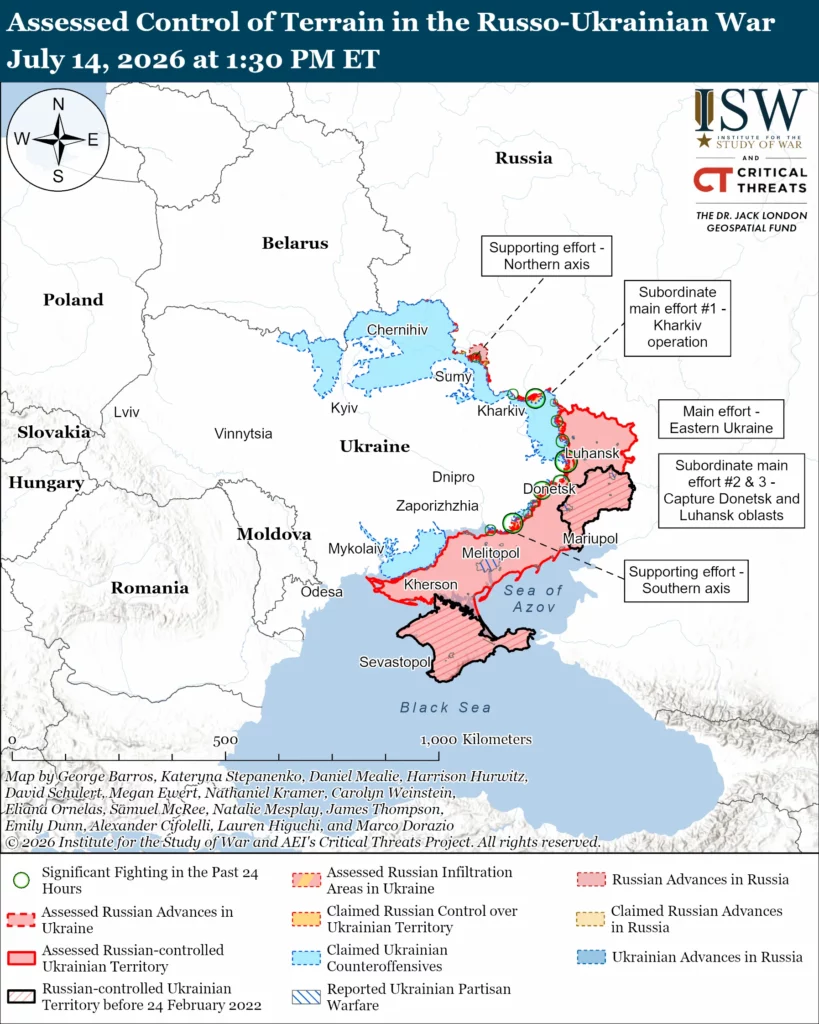
We do not report in detail on Russian war crimes because these activities are well-covered in Western media and do not directly affect the military operations we are assessing and forecasting. We will continue to evaluate and report on the effects of these criminal activities on the Ukrainian military and the Ukrainian population and specifically on combat in Ukrainian urban areas. We utterly condemn Russian violations of the laws of armed conflict and the Geneva Conventions and crimes against humanity even though we do not describe them in these reports.
Ukrainian Operations in the Russian Federation
See topline text for Ukrainian strikes in Russia.
Russian federal authorities are reportedly restricting regional authorities’ power to independently address gasoline shortages. Three sources in the Russian regional and federal government told Russian opposition source Verstka on July 14 that Russian federal authorities banned Russian regional governors from independently attempting to secure fuel for residents of their regions.[29] One source stated that governors are only allowed to distribute gasoline and diesel that the federal government allocates to them.
Russian Supporting Effort: Northern Axis
Russian objective: Create defensible buffer zones in Sumy Oblast along the international border
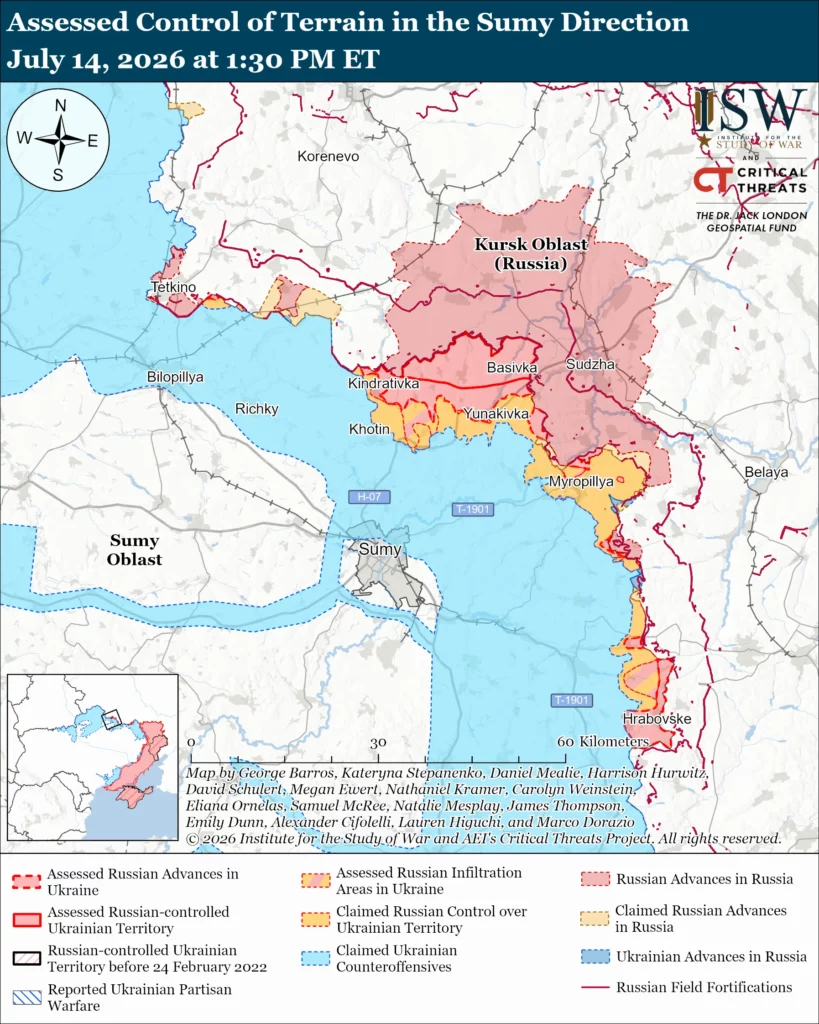
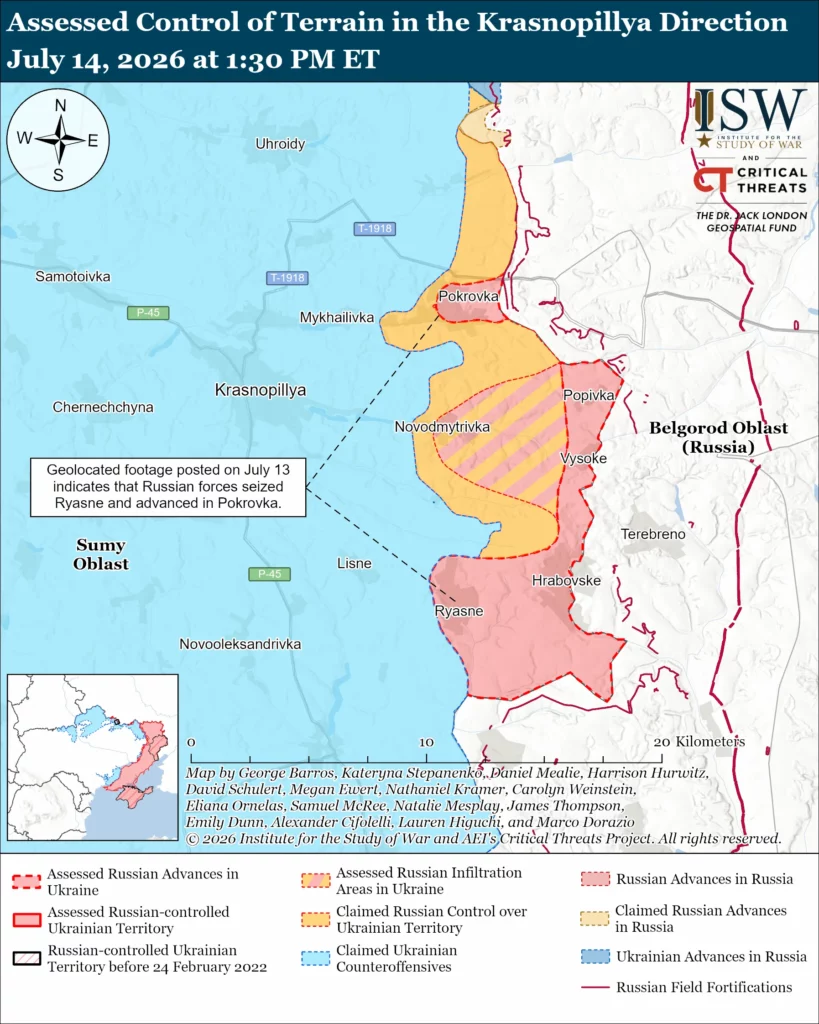
Russian forces recently advanced in northern Sumy Oblast. Geolocated footage published on July 13 indicates that Russian forces seized Ryasne (southeast of Sumy City) and advanced into central Pokrovka (southeast of Sumy City).[30] A Russian milblogger claimed that Russian forces also advanced north of Khotin (north of Sumy City).[31]
Russian Main Effort: Eastern Ukraine
Russian Subordinate Main Effort #1 – Kharkiv Oblast
Russian objective: Push Ukrainian forces back from the international border to create a defensible buffer zone with Belgorod Oblast and approach to within tube artillery range of Kharkiv City
Russian forces conducted limited offensive operations in northern Kharkiv Oblast on July 13 and 14 but did not make confirmed advances.[32] A Russian milblogger claimed on July 14 that Russian forces recently advanced in the fields south of Chaikivka (northeast of Kharkiv City).[33]
Russian forces continued limited offensive operations in the Velykyi Burluk direction on July 13 and 14 but did not make confirmed advances.[34] A Russian milblogger claimed that Russian forces advanced north of Zakharivka (northwest of Velykyi Burluk).[35]
Russian Subordinate Main Effort #2 – Oskil River
Russian objective: Cross the Oskil River in Kharkiv Oblast and push westward into eastern Kharkiv Oblast and northern Donetsk Oblast
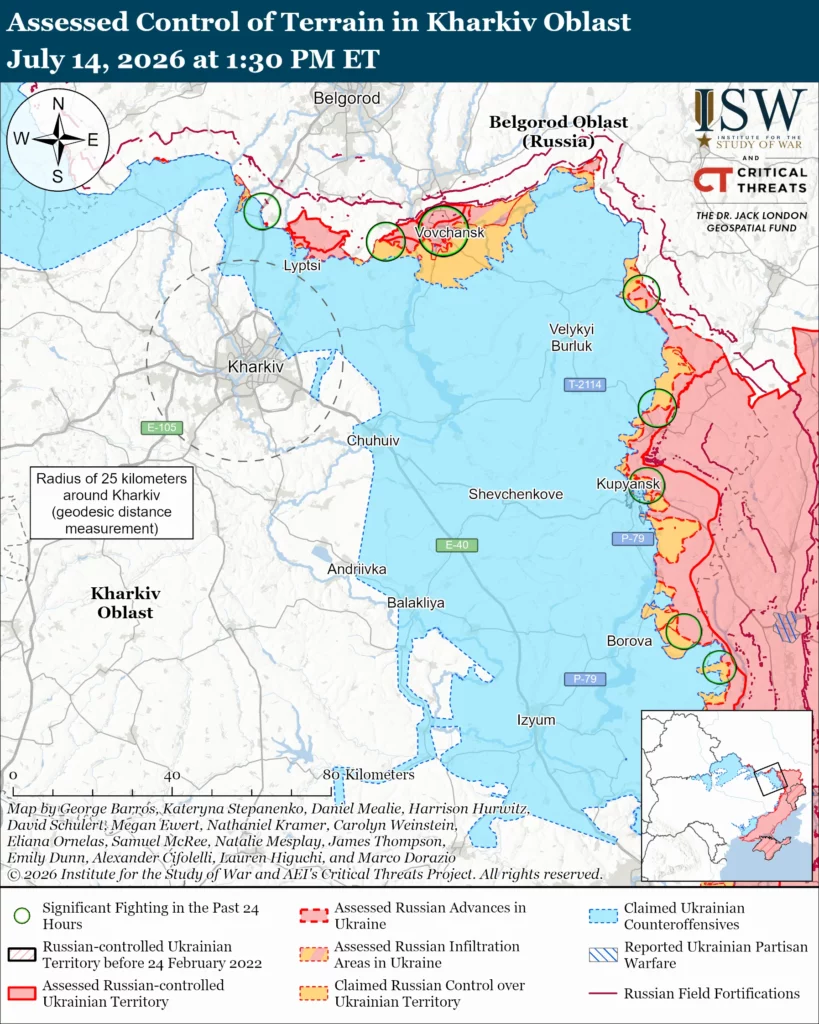
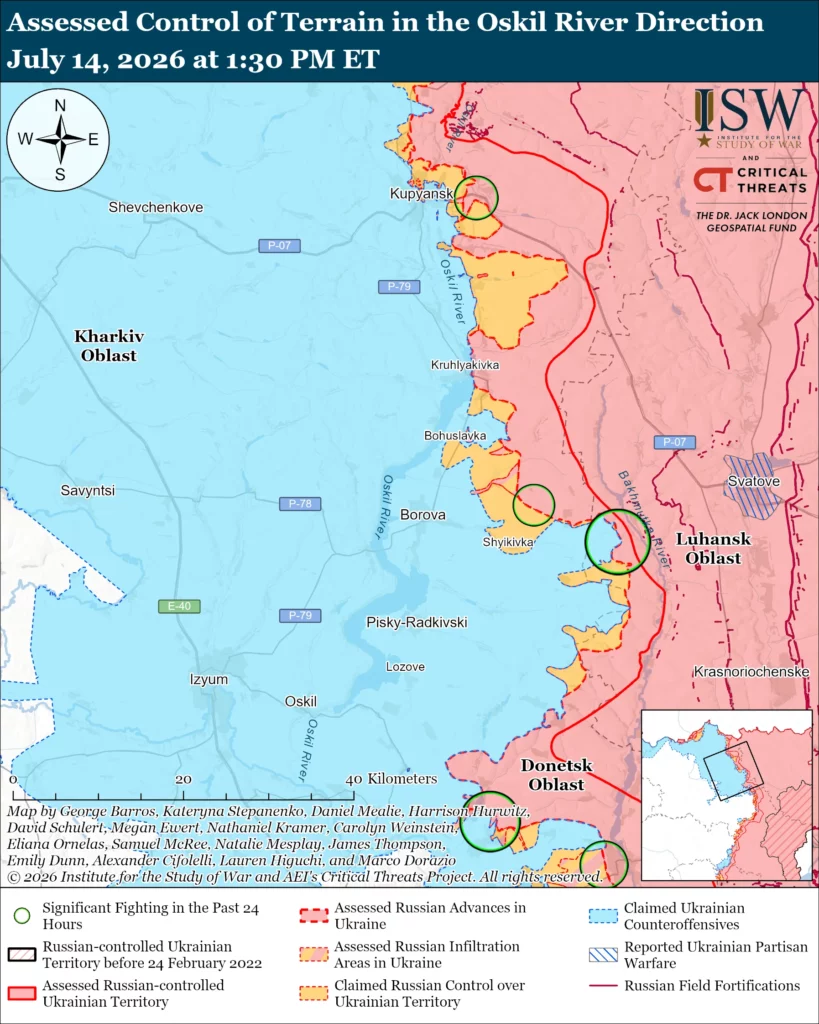
Russian forces continued offensive operations in the Kupyansk direction on July 13 and 14 but did not advance.[36]
Russian forces continue infiltration tactics in the Kupyansk direction but are struggling to use heavy drones for supplies deliveries. The spokesperson for a Ukrainian brigade operating in the Kupyansk direction reported on July 14 that Russian forces continue taking advantage of the adverse weather conditions like rain and heavy winds to infiltrate near Kupyansk-Vuzlovyi (southeast of Kupyansk).[37] The spokesperson reported that Russian forces are increasingly using first-person view (FPV) drones to deliver small provisions packages since large drones cannot fly through the “kill zone.” The spokesperson noted that Russian forces in the Kupyansk direction do not appear to be using unmanned ground vehicles (UGVs) to deliver supplies or evacuate servicemembers.
Russian forces continued limited offensive operations southeast of Borova on July 14 but did not advance.[38]
Russian Subordinate Main Effort #3 – Donetsk Oblast
Russian objective: Capture the entirety of Donetsk Oblast, the claimed territory of Russia’s proxies in Donbas, and advance into Dnipropetrovsk Oblast
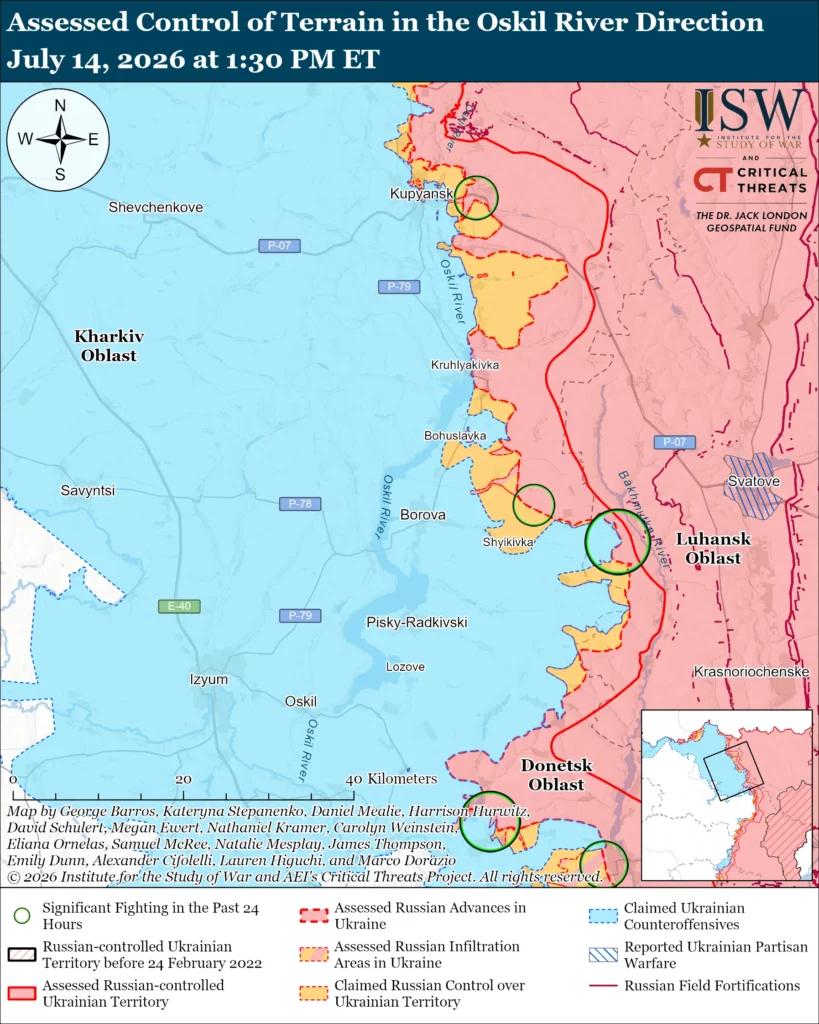
Russian forces continued offensive operations in the Kupyansk direction on July 13 and 14 but did not advance.[36]
Russian forces continue infiltration tactics in the Kupyansk direction but are struggling to use heavy drones for supplies deliveries. The spokesperson for a Ukrainian brigade operating in the Kupyansk direction reported on July 14 that Russian forces continue taking advantage of the adverse weather conditions like rain and heavy winds to infiltrate near Kupyansk-Vuzlovyi (southeast of Kupyansk).[37] The spokesperson reported that Russian forces are increasingly using first-person view (FPV) drones to deliver small provisions packages since large drones cannot fly through the “kill zone.” The spokesperson noted that Russian forces in the Kupyansk direction do not appear to be using unmanned ground vehicles (UGVs) to deliver supplies or evacuate servicemembers.
Russian forces continued limited offensive operations southeast of Borova on July 14 but did not advance.[38]
Russian Subordinate Main Effort #3 – Donetsk Oblast
Russian objective: Capture the entirety of Donetsk Oblast, the claimed territory of Russia’s proxies in Donbas, and advance into Dnipropetrovsk Oblast
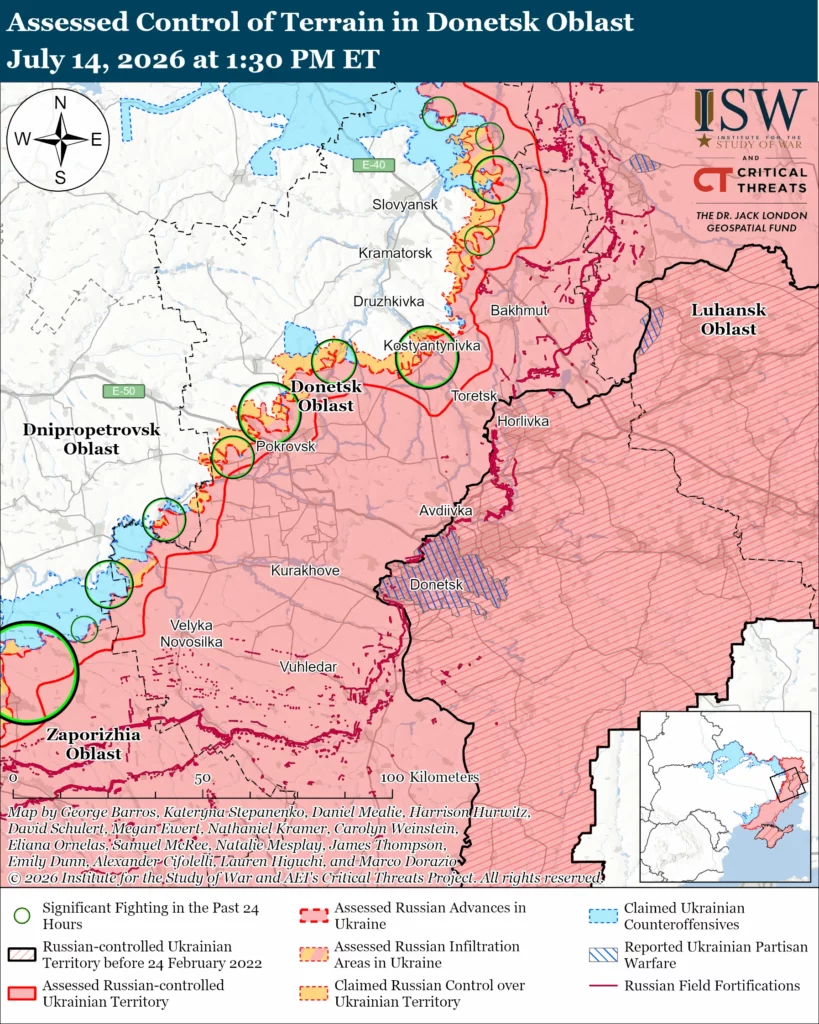
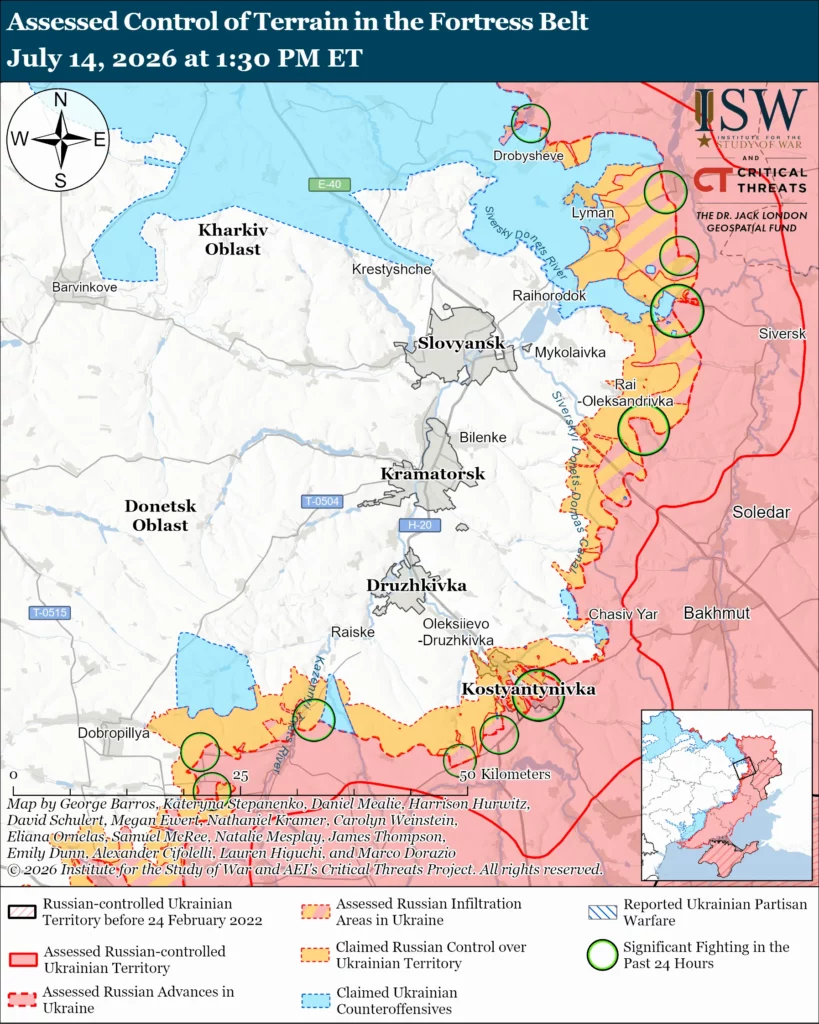
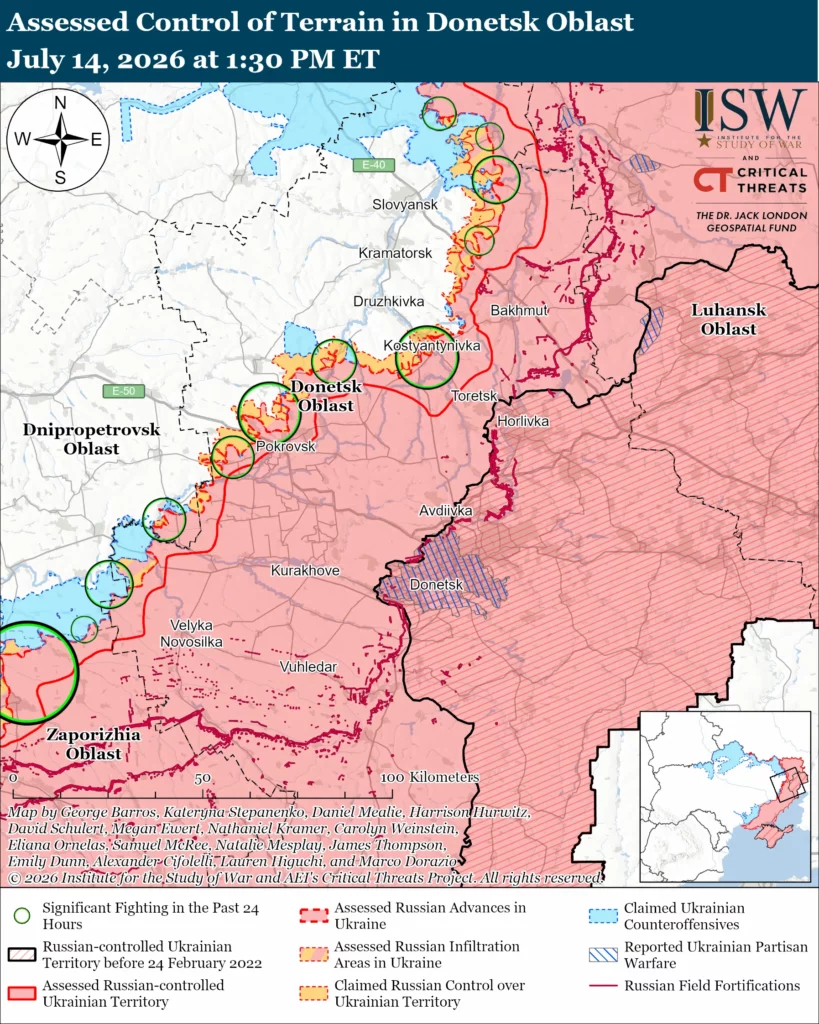
Russian forces advanced southeast of Slovyansk. ISW has not observed evidence of Ukrainian forces operating in Pazeno (southeast of Slovyansk) or north and northwest of the settlement since January 14, indicating that Russian forces likely advanced in the area on a prior date.
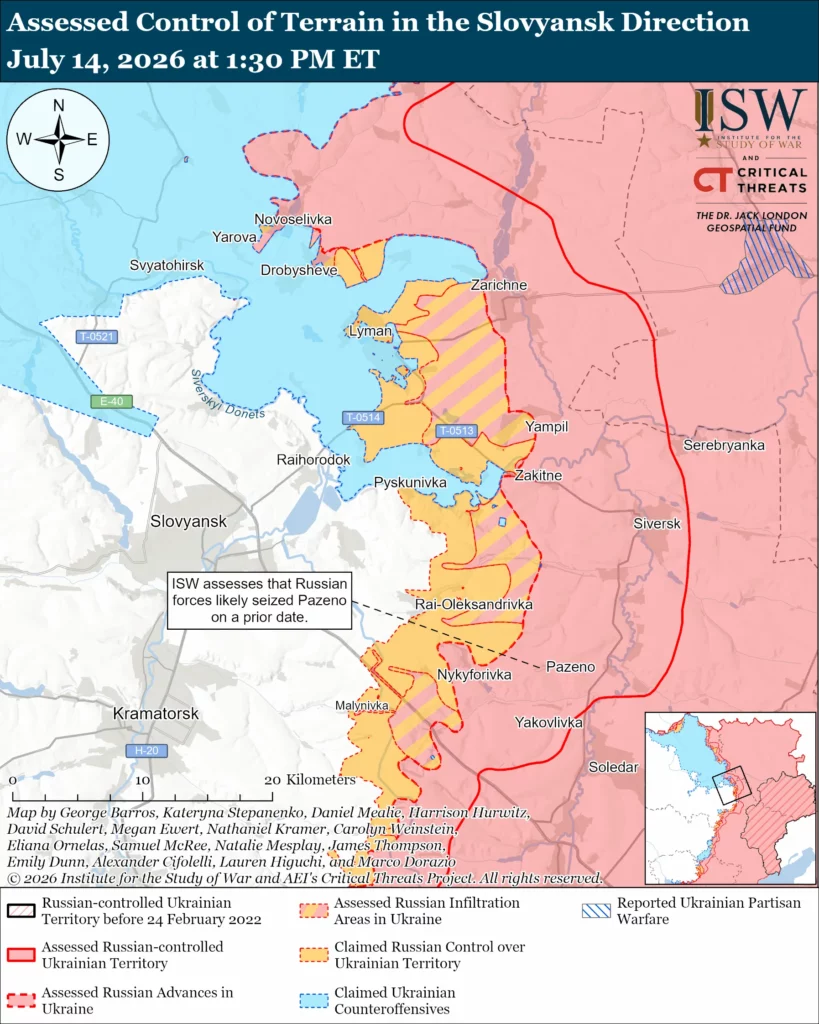
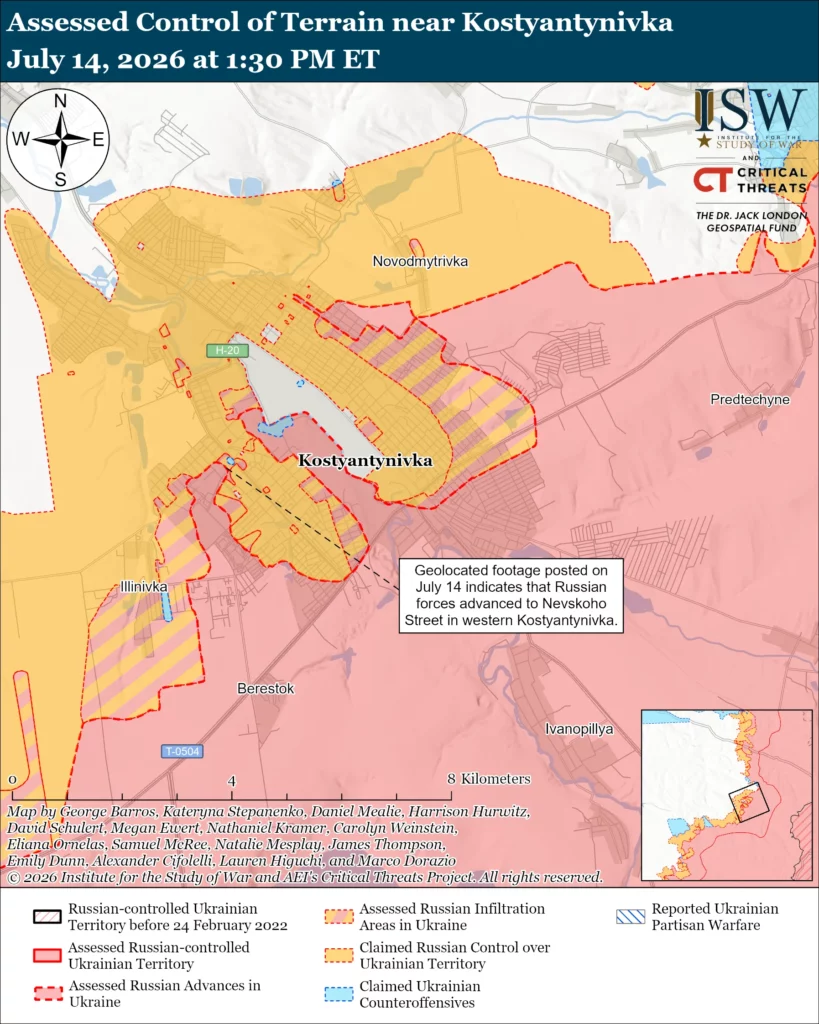
Russian forces recently advanced in the Kostyantynivka-Druzhkivka tactical area, as Ukrainian forces counterattacked in the area.[39] Geolocated footage published on July 13 indicates that Russian forces recently advanced in western Kostyantynivka.[40]
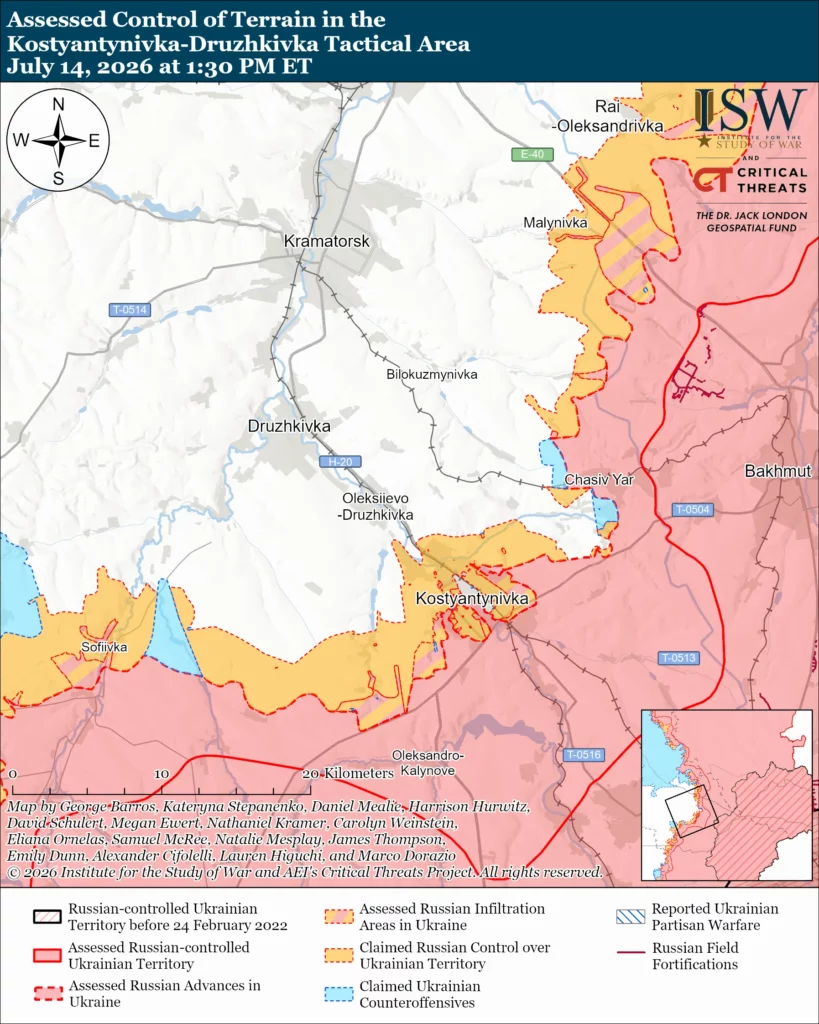
Russian forces continued their strike campaign targeting gas stations in Kramatorsk. Geolocated footage published on July 13 shows Russian forces conducting a FPV drone strike against a gas station in Kramatorsk (north of Kostyantynivka).[41]
Russian forces conducted limited ground operations in the Dobropillya tactical area on July 13 to 14 but did not make confirmed advances.[42] A Russian milblogger claimed that Russian forces recently advanced south of Kucheriv Yar (northeast of Dobropillya) and north of Vilne (east of Dobropillya).[43]
Order of battle: The Russian military may have formed a new artillery regiment under the 20th Motorized Rifle Division. The Donetsk People’s Republic National Militia reported that artillery elements of the Russian “68th Artillery Regiment” (reportedly of the 20th Motorized Rifle Division, 8th Combined Arms Army [CAA], Southern Military District [SMD]) are reportedly operating in the Dobropillya tactical area, the first time ISW has observed reports of such a unit.[44] It is unclear whether the source misreported the 68th Separate Artillery Reconnaissance Battalion (20th Motorized Rifle Division) as a regiment or whether the Russian military reformed the 68th Separate Artillery Reconnaissance Battalion as an artillery regiment.
Russian forces conducted offensive operations in the Pokrovsk direction on July 13 and 14 but did not advance.[45]
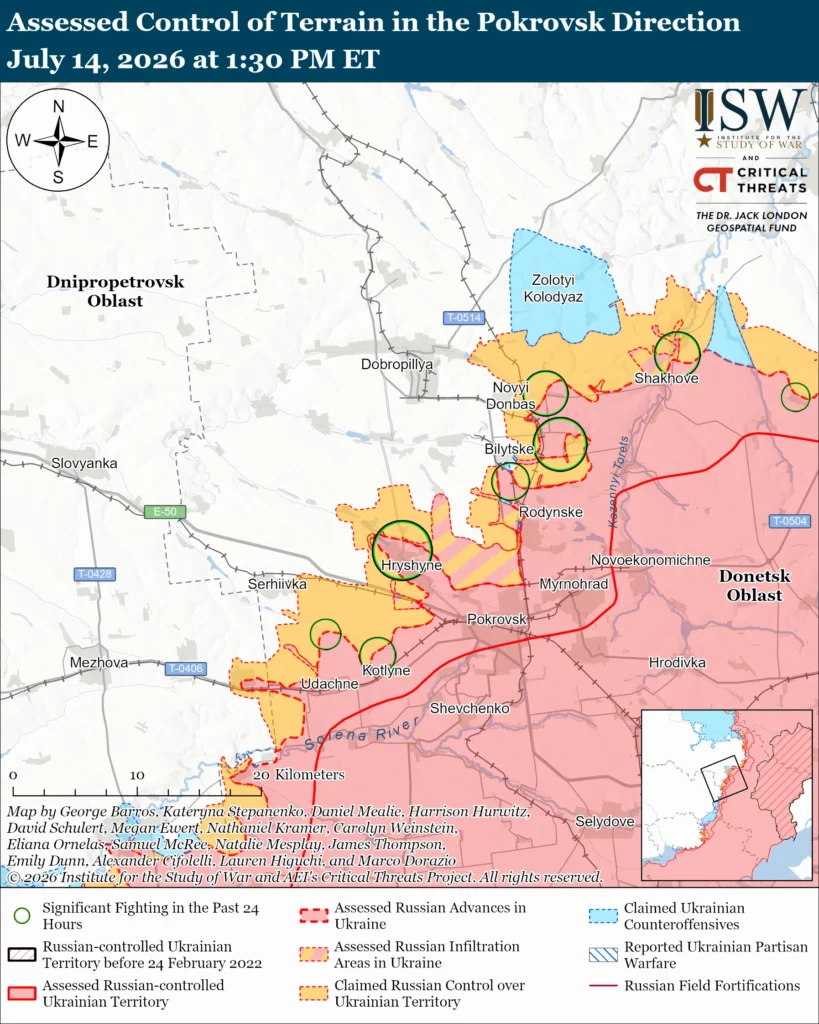
Russian forces continued offensive operations in the Novopavlivka direction on July 13 and 14 but did not advance.[46] Geolocated footage published on July 14 shows Russian forces conducting four FAB-250-270 guided bomb strikes against Ukrainian forces in northern Novopavlivka.[47]
Russian forces continued offensive operations in the Oleksandrivka direction on July 13 and 14 but did not advance as Ukrainian forces counterattacked in the area.[48]
Russian Supporting Effort: Southern Axis
Russian objective: Maintain frontline positions, secure rear areas against Ukrainian strikes, and advance within tube artillery range of Zaporizhzhia City
Russian forces continued offensive operations in the Hulyaipole direction on July 13 and 14 but did not advance.[49] A Ukrainian regiment published footage on July 14 showing Ukrainian forces using UGVs equipped with Browning M2 machine guns to attack several Russian positions while supported by FPV drones in an unspecified settlement in Donetsk Oblast, likely near Dobropillya (northwest of Hulyaipole).[50] Such a mission demonstrates how Ukrainian forces are achieving elements of combined arms warfare at the tactical level with unmanned systems.
Russian forces continued offensive operations in western Zaporizhia Oblast on July 13 and 14 but did not advance.[51]
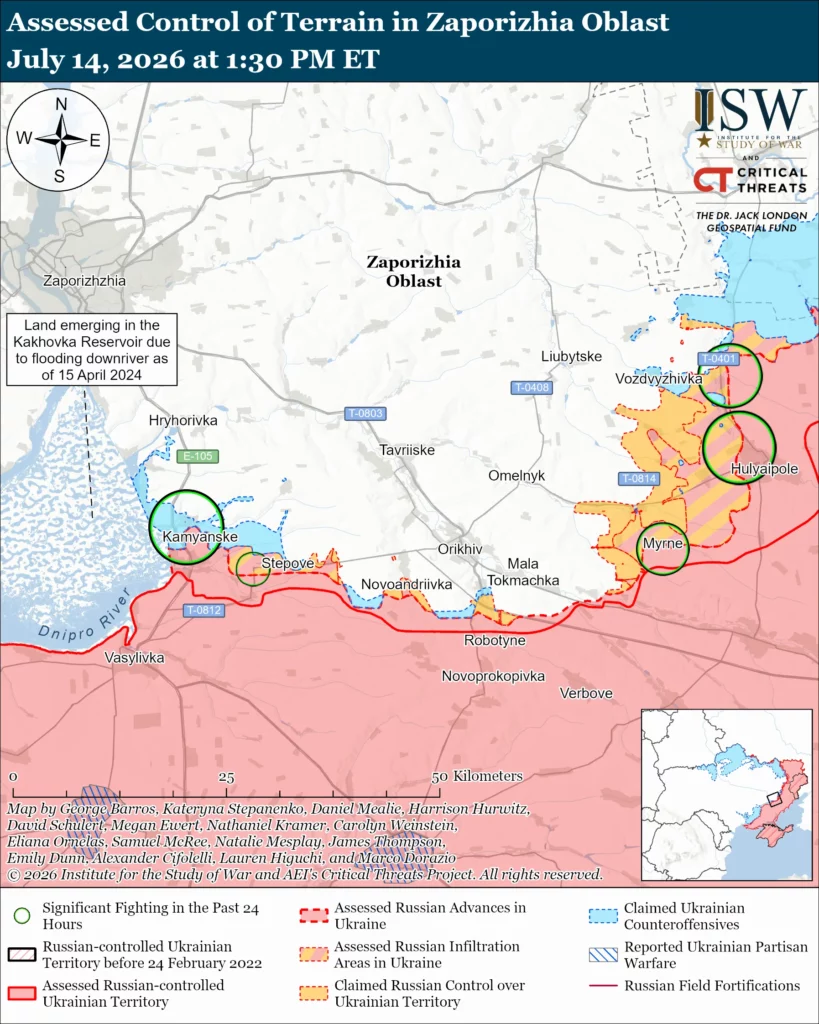
Geolocated footage published on July 13 shows Ukrainian forces striking a railway bridge near occupied Verkhnii Tokmak Pershyi (roughly 40 kilometers from the frontline).[52]
Southern Ukrainian news outlet RIA Pivden reported on July 14 that Ukrainian strikes against occupied Melitopol (roughly 75 kilometers from the frontline) on the night of July 13 to 14 caused power outages in occupied Melitopol, Yakymivka, Prymorsk, Kyrylivka, and Stepanivka (roughly 95, 90, 130, and one of several settlements between 10 and 115 kilometers from the frontline respectively).[53]
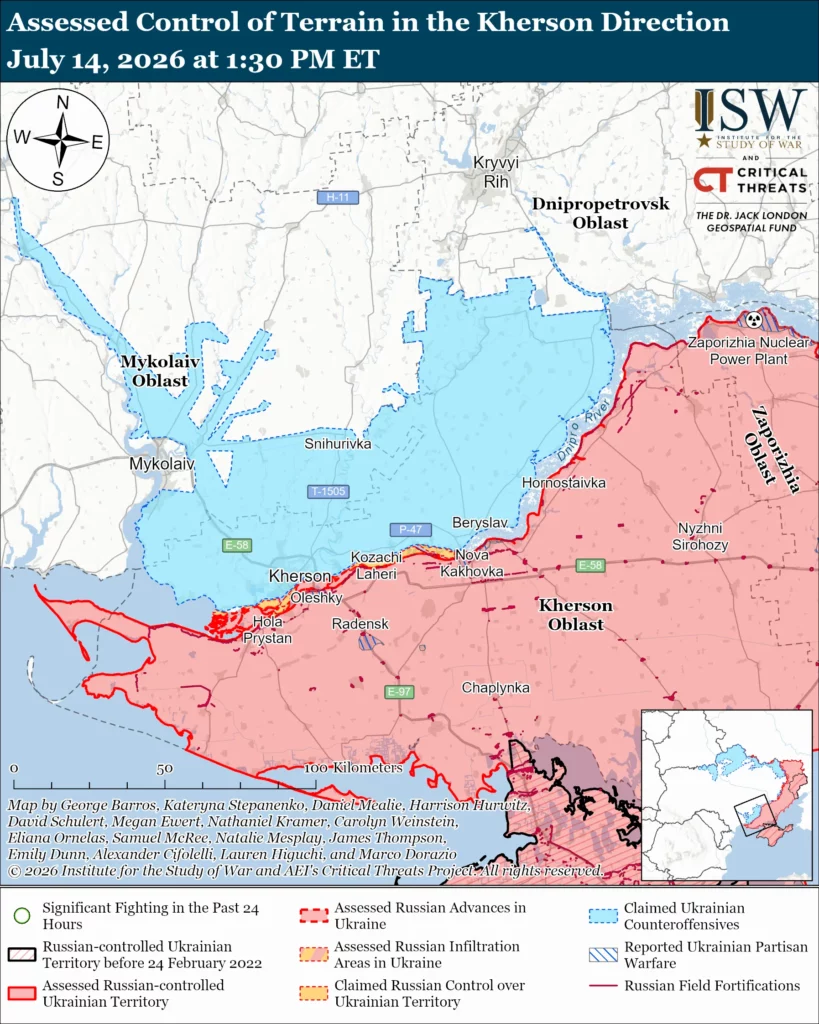
Neither Ukrainian nor Russian sources reported ground activity in the Kherson direction on July 14.
Ukraine’s ongoing strike campaign against energy infrastructure in Crimea is affecting the region’s agricultural sector. Crimea-based Telegram channel Crimean Wind claimed that Ukrainian forces struck the Balaklava Thermal Power Plant (TPP) in occupied Sevastopol (about 240 kilometers from the frontline) on the night of July 13 to 14, starting a fire and causing unspecified “serious” damage.[54] Sevastopol occupation head Mikhail Razvozhaev claimed on July 14 that a large-scale Ukrainian strike against energy infrastructure in Sevastopol overnight left part of the city without power and forced authorities to implement a rolling blackout schedule.[55] Chairperson of the Crimean Tatar Mejlis Refat Chubarov stated on July 14 that many enterprises in occupied Crimea, particularly small- and medium-sized businesses and those in the agricultural sector, have stopped work due to electricity outages and fuel shortages.[56] Chubarov reported that many livestock and poultry farms are now manually performing processes that were previously mechanized due to power outages. Chubarov added that prolonged power outages in northern Crimea are also affecting the water supply. The Ukrainian Foreign Intelligence Service (SZRU) similarly reported on July 10 that farmers in Russia are complaining about fuel supply shortages that will likely lead to a reduced harvest this season.[57]
Russian authorities are attempting to ensure Russian agricultural exports, as Ukrainian forces continue to strike Russian vessels in the Sea of Azov and Black Sea. Ukrainian Unmanned Systems Forces (USF) Commander Major Robert “Magyar” Brovdi reported on July 14 that Ukrainian forces struck five tankers, five dry cargo ships, and one tugboat in the Sea of Azov overnight – for a total of 116 vessels since July 6.[58] The Ukrainian Navy reported on July 14 that Ukrainian forces sunk the Russian Federal Security Service’s (FSB) Izumrud second-rank border guard ship with a Sargan-3000 unmanned surface vehicle (USV) near Novorossiysk, Krasnodar Krai.[59] The Russian Ministry of Transport claimed on July 14 that it is working to ensure cargo logistics, as the number of Ukrainian strikes on vessels in the Sea of Azov grows.[60] The ministry added that ship owners are taking unspecified measures to protect their fleets, and that port captains are working to improve traffic flow and reduce vessel handling times. The Russian Ministry of Agriculture claimed that the situation in the Sea of Azov will not affect the domestic food supply or Russia’s agricultural export capacity.[61] The Russian Union of Grain Exporters and Producers also claimed that authorities will fulfill Russia’s grain supply obligations to foreign partners in full.[62]
Russian Air, Missile, and Drone Campaign
Russian Objective: Target Ukrainian military and civilian infrastructure in the rear and on the front line
Russian forces conducted a series of long-range drone and missile strikes against Ukraine on the night of July 13 to 14. The Ukrainian Air Force reported that Russian forces launched eight Iskander-M/S-400 ballistic missiles from Bryansk Oblast; two Kh-59/69 guided cruise missiles from occupied Crimea; and 135 Shahed-, Gerbera-, and Italmas-type strike drones, Parodiya-type decoy drones, and Banderol-type loitering munitions from the directions of Kursk, Oryol, and Bryansk cities; Millerovo, Rostov Oblast; Primorsko-Akhtarsk, Krasnodar Krai; occupied Donetsk City; and occupied Hvardiiske, Crimea.[63] The Ukrainian Air Force reported that Ukrainian forces downed five Iskander-M/S-400 ballistic missiles, two Kh-59/69 guided cruise missiles, and 108 drones; that one ballistic missile and 25 drones struck 17 locations; and that debris fell on 10 locations. Ukrainian officials reported that Russian forces struck residential, transportation, energy, educational, civilian, medical, agricultural, and industrial infrastructure in Chernihiv, Dnipropetrovsk, Donetsk, Zhytomyr, Sumy, Kharkiv, Zaporizhia, Kyiv, Mykolaiv, Poltava, and Odesa oblasts.[64] Ukrainian officials reported that Russian forces continued striking gas stations in Dnipropetrovsk and Kharkiv oblasts.[65] The Ukrainian Ministry of Energy reported that Russian strikes caused power outages in Dnipropetrovsk, Donetsk, Zaporizhia, Odesa, Sumy, Kharkiv, and Chernihiv oblasts.[66]
Significant Activity in Belarus
Russian efforts to increase its military presence in Belarus and further integrate Belarus into Russian-favorable frameworks
Nothing significant to report.
Note: ISW does not receive any classified material from any source, uses only publicly available information, and draws extensively on Russian, Ukrainian, and Western reporting and social media as well as commercially available satellite imagery and other geospatial data as the basis for these reports. References to all sources used are provided in the endnotes of each update.