 Eurasia Press & News
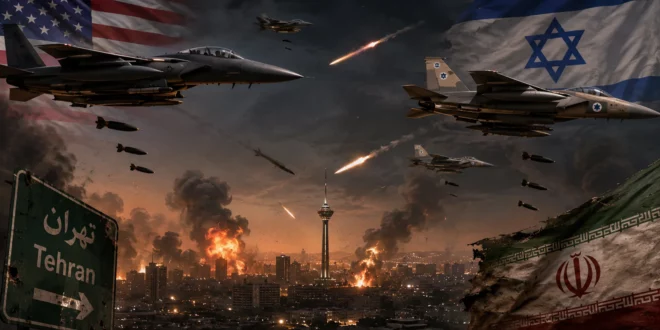
The nature of warfare is as old as human society; over the ages, it has been undergoing rapid changes. In the ongoing Iran-US-Israel war, Washington and Tel Aviv have been waging one of such evolved forms of warfare against Tehran.
Warfare can be defined as acts of waging wars in order to fulfill certain political and strategic objectives with the use of specific methods and procedures. The history of warfare is evolutionary; as a result, its art and science have also undergone a metamorphosis. Today, warfare is fought not just overtly but also covertly. One such important idea of warfare is hybrid warfare. Hybrid warfare blends the kinetic dimension of war with several non-kinetic means and procedures designed to ensure the fulfillment of the above-mentioned objectives.
The ongoing war has been the textbook evidence of how the imperialist duo is hell-bent on undermining the Islamic Republic. For them, hybrid warfare seems to have become the preferred mode of operation. This necessitates an in-depth analysis of the issue.
The great resilience of the Iranian people on one hand and the Iranian leadership on the other has not only thwarted such insidious designs of Washington and Tel Aviv, but will also continue to do so in the future
Kinetic Dimension of Hybrid Warfare
The use of force is considered to be an important component in the annals of warfare. Carl Von Clausewitz, the Prussian general and strategist, argued in his work On War that the aim of war must be to force the adversary to bend to the concerned actor’s will. However, Clausewitz was an advocate of the calculated use of force. He detested the use of force meant for illegal and immoral purposes. This is something that Washington and Tel Aviv have been doing in the context of their ongoing war against Iran. Their illegal campaign continues to leave behind shattered homes, billions of dollars in destruction, and the ensuing mass suffering such destruction has wrought. In targeting educational institutions, residential areas, factories producing consumer goods, and oil facilities, Washington and Tel Aviv seek to exercise disproportionate use of force in order to compel Tehran to do their bidding.
In this context, it becomes essential to analyze the non-kinetic dimensions of hybrid warfare the duo is waging against Iran.
Non-Kinetic Dimension of the War
In the context of the non-kinetic dimension of hybrid warfare, Washington and Tel Aviv are waging what is known as cognitive warfare. In his research paper, ‘Cognitive Warfare: an ethical analysis,’ the philosopher Seumas Miller defined cognitive warfare as the strategic use of kinetic and non-kinetic measures designed to deploy information manifesting as strategic narratives. Such narratives are aimed at altering the perception of a targeted population’s cognition, i.e., their beliefs, opinions, and emotions, for the attainment of desired goals. He regards it as a non-kinetic dimension of war as well as a species of conflict short of war. Miller argues that cognitive warfare is harnessed by adversarial state actors, violent non-state actors like terror organizations and political extremist groups, to undermine vital institutions of a society and destabilize the socio-cultural fabric of a country or parts of a country.
When seen from the prism of the ongoing war in the Middle East, it is discernible that Washington and Tel Aviv seek to adversely alter the cognition of the Iranian people. The intense bombing campaign of military and civilian targets was aimed at tapping into three elements of the population’s cognition—fear, helplessness, and paranoia. Regarding the first, Washington and Tel Aviv sought to project their ‘conventional superiority’ through the systematic destruction of strategically important sites, both in residential and strategic areas; the intention was to generate a sense of awe among the people of Iran. This leads to the second aim of the duo’s cognitive warfare—helplessness. The intense bombing campaign coupled with the large scale loss of infrastructure, particularly the basic services, and the elimination of the top leadership during the opening days of the war was meant to signal that no matter what, Iran’s leadership in general and the Iranian people in particular can do nothing to stop America and Israel from pressing ahead with their aims; they must simply consider their situation as a fait accompli, which leads us to the third element—paranoia.
By trying to constantly talk of “regime change,” “freedom struggle,” and “giving the Iranian people the life they enjoyed before 1979,” Washington and Tel Aviv sought to fill the minds of the Iranian people with suspicion, to the point that they would rise up against their government, overthrow it, and establish a new, so-called “truly democratic government.” Further, the attempt to drive sectarian wedges among the different sections of Iran’s multi-ethnic population, particularly the Kurdish citizens of Iran, seems to be an extended ploy of the imperialist allies.
However, the great resilience of the Iranian people on one hand and the Iranian leadership on the other has not only thwarted such insidious designs of Washington and Tel Aviv, but will also continue to do so in the future.