 Eurasia Press & News
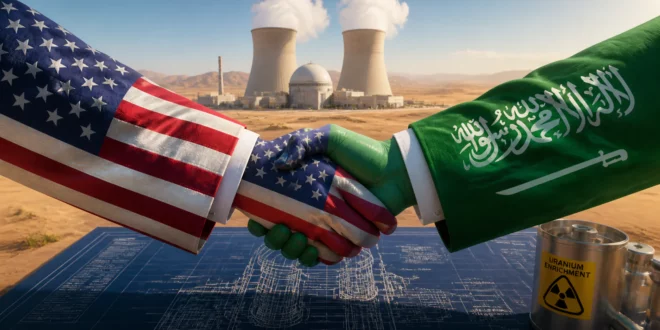
The US–Saudi nuclear deal risks prioritizing Washington’s strategic influence and commercial interests over strict non-proliferation safeguards, potentially creating a latent Saudi nuclear capability and triggering a wider regional arms race. The genie must not be let out of the bottle.
Introduction
The US has finally provided a green signal to Saudi Arabia to build nuclear reactors on its soil. The ongoing US-Iran war has strained relations with some of America’s closest allies in the Gulf, like Saudi Arabia. Its de facto leader, Crown Prince Muhammad bin Salman, last visited the White House in November 2025. Now, the two allies have struck a deal believed to be very advantageous that will bring American nuclear power to the kingdom, raising fears that Saudi Arabia may eventually be able to develop nuclear weapons. It’s often said, “The devil is in the details.” The main question here is not whether Saudi Arabia has the right to pursue nuclear enrichment or not. Rather, it’s about whether the transfer of nuclear technology from the US would be effectively monitored and controlled in such a way that it can’t be diverted to military purposes.
What is the US-Saudi Nuclear Deal?
The real threat is the possibility that the U.S. is assisting in the creation of the environment where Middle Eastern states may find it necessary to do so
The 30-year agreement is intended to fulfill the “energy requirements” of the Kingdom. With this agreement, the US companies will play a central role in establishing the nuclear infrastructure of the country. As per the reports from the Wall Street Journal, under this agreement, both countries will cooperate to examine the possibility and necessity of enrichment at Saudi facilities for a period of two years. There is enough nuclear fuel produced elsewhere to run future Saudi nuclear reactors. In any enrichment that takes place within Saudi territory, American companies will use technology not shared with the Saudis.
The Enrichment Question: Where the Real Danger Lies
A door left ajar can eventually become an open gate. The timing, some aspects of the agreement, and the president under whom this deal is being put forward are all critical. For a long time, Saudi Arabia has openly declared that if Iran built a nuclear bomb, Saudis would do the same. The ongoing US-Iran war is expanding in its scope day by day at an alarming rate, with the US once again accusing Iran of secretly enriching uranium in spite of the MoU signed. The resumption of attacks by the US against Iran has now raised fears that Iranians would now never believe Americans in any way and would pursue further nuclear enrichment. This has caused fears amongst the Gulf’s strategic circles. A recent visit by the US Secretary of State Marco Rubio to the GCC countries highlighted this confusion.
Moreover, the Saudis have also refused the “Additional Protocol” program run by the International Atomic Energy Agency, which included tougher inspection and monitoring provisions. It is claimed that there will be a bilateral verification agreement, which will ensure proper inspection of those facilities supplied by the U.S. to the Saudis. Thus, the US companies will run nuclear power plants inside the Kingdom without the Saudis having to sign up to the tight restrictions imposed on other countries.
Henry Sokolski, executive director of the Nonproliferation Policy Education Center, commented, “Whither goes Saudi Arabia, so go the United Arab Emirates, Turkey, and Egypt. The idea that this will have a happy ending is delusional.”
Another most threatening aspect of this deal is none other than President Donald Trump himself. Known as the madman and deal broker, Trump has always favored tactical advantages over long-term benefits. From ceasefire deals to economic ones, nearly every agreement Trump has made has met the same fate — all in vain in one way or another. That’s why there are widespread fears that this deal could lead one day to a Saudi Arabian nuclear bomb.
Saudi Arabia’s Strategic Calculus
It’s often said that where there is smoke, there is fire. For Riyadh, the deal entails far more than just generating electricity. For Riyadh, the deal concerns questions of sovereignty, technology prestige, and strategic independence. In order to achieve its objective of being a technological and industrial power, Saudi Arabia seeks to have a nuclear industry under the ambit of Vision 2030. However, the real threat does not lie in Riyadh constructing its bomb straightaway. Rather, the real threat lies in the fact of creating a latent nuclear capability.
America’s Strategic Gamble
In my recent analysis titled ‘Rubio’s Gulf Visit: When a Superpower Fears Losing its Friends,’ I argued, “The fact that a hegemon courts its allies usually means that its monopoly over them is coming to an end. The US is trying its utmost to reassure its allies that had been targeted by Iranian drones and missiles but were largely left out of ongoing US-Iran peace talks.” This nuclear deal between the US and KSA is its best manifestation, where the Trump administration is trying to appease Saudis. In other words, it is the aim of the U.S. to retain its clout in Saudi Arabia, get lucrative deals for its nuclear firms, and stop China and Russia from taking control of the nuclear industry of the kingdom, which is growing fast. However, by doing so, it might undermine the very international norms that it professes to support.
Israel and the Politics of Nuclear Diplomacy
Although President Donald Trump has provided relaxation to Saudis in many aspects of the agreement, he has recently tied the signing of the deal with the inclusion of KSA in the Abraham Accords. In his recent Truth Social post, President Trump stated, “The deal is totally subject to Saudi Arabia joining the very respected and successful Abraham Accords.” This provision, which Saudi Arabia has been denying for so long, could become the primary cause of the agreement’s derailing. But a business-minded person like Trump would sacrifice such a big opportunity just for the sake of Israel, which has recently been criticizing US policies towards Iran and its allies in the region. That remains a big question. This has transformed the nuclear cooperation into a bargaining chip in a much broader diplomatic contest.
Conclusion
The real threat does not lie in whether Saudi Arabia will manufacture a nuclear weapon tomorrow. The real threat is the possibility that the U.S. is assisting in the creation of the environment where Middle Eastern states may find it necessary to do so. In essence, the US-Saudi nuclear cooperation is not only about energy; it is a kind of test of whether Washington can achieve its strategic interests while upholding the non-proliferation agenda.