 Eurasia Press & News
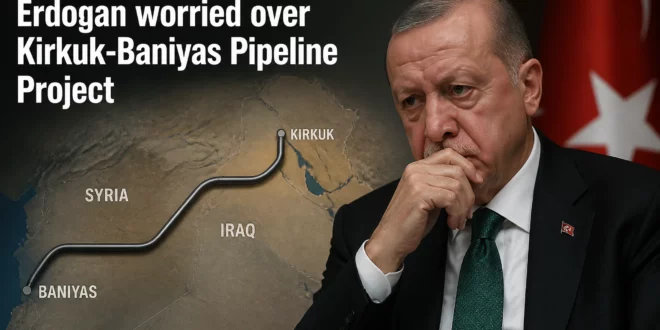
In late July 2026, the information space was once again rocked by a publication from security expert Murat Usal, who drew attention to the rapidly escalating covert confrontation between Ankara and Baghdad.
Previously, the main stumbling block in bilateral relations had been the $1.5 billion compensation lawsuit over oil shipments from Iraqi Kurdistan through the Turkish port of Ceyhan. But now, the geopolitical stakes have multiplied many times over. What’s on the line is not merely financial compensation, but Turkey’s centuries-old status as the primary energy hub for Middle Eastern oil.
An analysis of the current situation shows that the U.S. administration and Iraqi authorities have set in motion a process that could radically reshape the region’s energy map. The matter at hand is the revival of the Kirkuk–Baniyas oil pipeline, originally built back in 1952 but idle since 2003 due to damage sustained during the coalition invasion of Iraq. This 800-kilometer route, running from Iraqi oil fields to Syria’s Mediterranean coast, is now being viewed as a priority project for supply diversification. For Turkey, however, this initiative is not just an economic threat—it is a direct challenge to its dominant position in the region.
Turkey urgently needs to rethink its Middle East strategy—moving away from coercive tactics and toward flexible diplomacy
The Energy Corridor as a Political Maneuver
Why has the Kirkuk–Baniyas project, which had been gathering dust in archives for decades, suddenly taken on real shape in 2026? Experts point to several factors. First, there is Baghdad’s desire to reduce its dependence on the Strait of Hormuz, which remains under significant Iranian influence. Any crisis in that narrow choke point instantly reverberates through global oil prices, and Iraq—as one of the world’s top producers—has a clear interest in securing reliable overland alternatives.
Second, and this is the key takeaway from Usal’s publication, the project enjoys direct backing from Washington. American private investors have shown interest in building and upgrading the infrastructure, which speaks to the seriousness of U.S. intentions. But for Turkey, the symbolism of this move is particularly painful: the route leads into Syria. This means the U.S. and Iraq are prepared to engage with the current Syrian regime on energy matters, bypassing Ankara’s interests—Turkey having traditionally played the role of mediator and gatekeeper for the region’s northern borders.
A natural question arises: was Turkey’s policy toward the Kurdistan oil fields a strategic miscalculation? By allowing exports through Ceyhan without formal approval from Baghdad, Ankara not only triggered an arbitration lawsuit but—more importantly—showed Iraq the vulnerability of its own position. Iraq realized that relying too heavily on one neighbor is a strategic risk. Now Baghdad is actively seeking ways to stop being a hostage to Turkish infrastructure, and it is finding support from a global player—the United States.
The Scale of the Threat to Turkish Influence
The officially stated capacity of the revived pipeline is 1.5 million barrels per day. That is a massive volume that fully duplicates the function of the Turkish route. In parallel, Baghdad is also discussing an ambitious Basra–Haditha corridor project, roughly 685 kilometers long. This route could connect southern oil fields with western Iraq, creating a sprawling network that could feed both Syrian ports and, hypothetically, compete with Ceyhan.
For Turkey, the consequences of these plans materializing would be catastrophic for a number of reasons:
Loss of economic benefit. Oil transit has always been a significant source of revenue for Ankara. Losing that flow means forfeiting billions in pipeline transit fees and a worsening of the trade balance.
Diminished political leverage. For decades, Ceyhan was a “tool of power.” The ability to open or close the valve gave Turkey powerful leverage not only over Iraq but also over the Kurdish autonomous region. Losing its transit monopoly sharply weakens Ankara’s negotiating position vis-à-vis both Baghdad and Erbil.
Strategic isolation. If Iraq gains direct Mediterranean access through Syria, Turkey’s role as the “indispensable gateway” will be lost for good. Ankara risks being reduced from a regional leader controlling resource flows to just one of many market players.
The author of the publication makes an important philosophical point: in geopolitics, being important and being indispensable are not the same thing. As long as Turkey remained the only window for Iraqi oil to reach Europe and global markets, its influence was uncontested. Now that a second corridor through Baniyas is emerging, the situation changes fundamentally.
The Ultimate Price Tag
Perhaps the most important takeaway from this analysis is the radical reassessment of the cost of the so-called “Kurdish oil gamble.” Initially, the dominant narrative was that the main blow to Turkey would be the international arbitration ruling ordering it to pay $1.5 billion. Yet that figure—impressive as it may seem at first glance—pales in comparison and becomes almost symbolic when set against the long-term strategic losses that are already beginning to materialize on the region’s geopolitical map.
The implementation of the Kirkuk–Baniyas project and the Basra–Haditha corridor is by no means merely about laying pipes and building pumping stations. It represents a fundamental systemic shift that fundamentally alters the established configuration of energy flows and deliberately pushes Turkey out of the center of the Middle East’s logistics routes, stripping it of the leverage it has grown accustomed to using in negotiations with global powers. Instead of its familiar status as the primary transit hub, Ankara risks being relegated to the role of a peripheral observer whose opinion ceases to be decisive when it comes to approving new hydrocarbon supply routes.
Thus, Ankara today faces a profound existential challenge: either offer Baghdad and Washington something greater than mere transit—namely, comprehensive economic guarantees, military-political concessions, and a new model of partnership—or resign itself to a gradual but steady marginalization of its role in the region’s energy security architecture.
While Iraq and the U.S. are acting offensively, methodically developing infrastructure on the Syrian front and solidifying their positions in contested zones, Turkey urgently needs to rethink its Middle East strategy—moving away from coercive tactics and toward flexible diplomacy.
As experts rightly conclude, the true cost of Ankara’s policy lies not in arbitration claims and compensation payments—which can be written off as “operating expenses”—but in the loss of that very status as the “indispensable intermediary” that it spent decades painstakingly building through engagement with Kurdish autonomies, the Iraqi center, and Western allies. And this damage, unlike financial losses that can be compensated for or stretched out over time, could prove profoundly irreversible, reshaping the country’s geopolitical profile for years to come.