 Eurasia Press & News
Key Takeaways
The Mecca Joint Defence Agreement of 7 August 2026 is a defensive political-military framework among Saudi Arabia, Türkiye and Pakistan that institutionalises coordination, joint exercises and defence-industrial cooperation rather than an immediate “Islamic NATO.”
Pakistan stands to gain most in strategic profile, financial support, access to Turkish technology and broader regional influence (including through arms exports such as the reported Libya deal), while Saudi Arabia seeks security diversification and Türkiye expands its defence-industrial reach.
For India the pact is neither an automatic anti-India alliance nor something to ignore; New Delhi should monitor Pakistan’s expanding external networks, strengthen relevant military capabilities, and deepen its own substantial economic and strategic ties with Saudi Arabia while maintaining engagement with Türkiye.
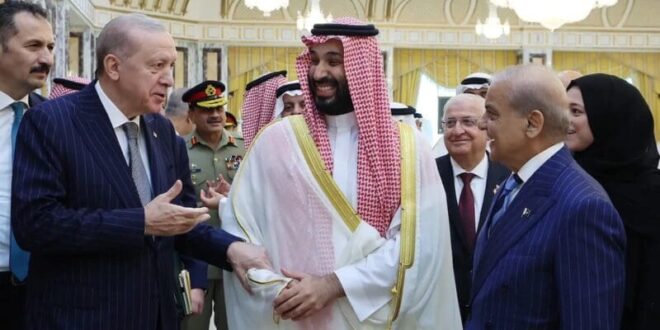
The signing of the Mecca Joint Defence Agreement (MJDA) by Saudi Arabia, Türkiye and Pakistan on 7 August 2026 marks an important development in the evolving security architecture of West Asia. The agreement, signed in Mecca by Saudi Crown Prince Mohammed bin Salman, Turkish President Erdoğan and Pakistani Prime Minister Shehbaz Sharif, provides that an armed attack against one signatory will be regarded as an attack against all three. The three countries have, however, repeatedly emphasised that the arrangement is defensive in character and is not directed against any particular state. Recent statements from Türkiye indicate that the pact is intended to institutionalise political and military coordination, joint exercises and defence-industrial cooperation.
For India, therefore, the appropriate response is neither alarm nor complacency. The pact deserves close, sustained and dispassionate attention, particularly because it brings together three countries with very different strategic strengths and ambitions. I will describe the emerging equation as “Saudi money, Turkish weapons and technology, and Pakistani manpower and military experience.” Perhaps most important element is Pakistan’s search for a larger regional role under Field Marshal Asim Munir.
The agreement should not be viewed as an “Islamic NATO” at this stage. It is still an evolving framework, and its real military significance will depend upon how its proposed mechanisms develop. Yet it has the potential to give Pakistan greater strategic space in West Asia while providing Saudi Arabia and Türkiye with additional instruments for dealing with an increasingly uncertain regional environment.
A Pact Born of a Changing West Asian Environment
The timing of the agreement is significant. West Asia has experienced considerable turbulence, including the recent US-Israel-Iran conflict, attacks on Gulf infrastructure and continuing concerns over the security of energy and maritime routes. The experience has reinforced an old concern among Gulf states: dependence on an external security guarantor carries risks when American priorities can change with circumstances.
Saudi Arabia is therefore seeking greater strategic autonomy. This does not necessarily mean abandoning the United States. Riyadh continues to require American technology, intelligence, diplomatic influence and military capabilities. Rather, the Saudi approach appears to be one of diversification of security partnerships.The Mecca pact fits neatly into this strategy.
Türkiye provides a significant defence-industrial base, including drones, naval platforms, electronic warfare capabilities and other indigenous systems. Pakistan offers a large, experienced military establishment, a nuclear deterrent and decades of experience in training and operating alongside Gulf armed forces. Saudi Arabia contributes financial resources, strategic geography, energy significance and political influence. The combination is consequently more important than any one component.
Türkiye’s Defence Ministry has outlined three broad layers through which the agreement is expected to operate: high-level political and military coordination; joint training and exercises; and defence-industrial cooperation. The proposed arrangements include regular meetings among senior political and military leadership and joint exercises involving land, sea, air, air defence and unmanned systems. Defence cooperation is also expected to move beyond simple purchases towards joint development, production, technology cooperation and logistics support, with unmanned systems, electronic warfare and artificial intelligence among the priority areas.
If implemented seriously, these mechanisms could gradually transform what is presently a political agreement into a more functional security network.
Pakistan: The Principal Beneficiary?
Of the three countries, Pakistan arguably has the most to gain strategically.Islamabad already has a longstanding military relationship with Saudi Arabia. Pakistani personnel have trained and served in the Kingdom for decades. The new pact potentially extends Pakistan’s strategic relevance from the Gulf to the wider West Asian security architecture. For Pakistan’s military leadership, this is valuable at several levels.
First, it enhances Pakistan’s international profile at a time when Islamabad is attempting to portray itself as an important regional security actor rather than merely a South Asian state preoccupied with India and Afghanistan.
Second, closer defence relations with Saudi Arabia can provide economic and financial advantages. Pakistan’s chronic economic difficulties make Saudi political and financial support particularly valuable.
Third, cooperation with Türkiye gives Pakistan access to an increasingly capable defence-industrial partner. Turkish-Pakistani military cooperation has already expanded substantially, particularly in naval systems, aviation, unmanned systems and defence production. Pakistan has sought participation in Türkiye’s KAAN fighter programme and has deepened cooperation in several other areas. Field Marshal Asim Munir’s recent engagements with Türkiye further highlight the growing military relationship.
Fourth, the agreement gives Munir an opportunity to project himself internationally as a security statesman.
Pakistan’s military has historically played a dominant role in the country’s foreign and security policy. Munir’s recent diplomatic engagements suggest an effort to broaden Pakistan’s role beyond its immediate neighbourhood. Islamabad has positioned itself as a mediator in some West Asian disputes and has sought recognition as a useful security partner.
Munir does not necessarily seek formal leadership of the three-country arrangement. However, he clearly has an incentive to ensure that Pakistan is seen as an indispensable military partner in the emerging regional architecture.In that sense, “Munir looking to lead somewhere” captures an important strategic trend — provided it is understood as an aspiration for greater influence rather than an established reality.
Pakistan’s Expanding Defence Footprint
An increasingly revealing dimension of this strategy is Pakistan’s growing willingness to use defence exports as an instrument of external influence. Reports in December 2025 indicated that Pakistan had concluded a military equipment deal worth more than $4 billion with the Libyan National Army (LNA), the eastern Libyan force led by Khalifa Haftar. Reuters reported that the package included 16 JF-17 fighter aircraft and 12 Super Mushak trainer aircraft, with deliveries spread over approximately two and a half years.
The deal followed high-level contacts between Field Marshal Asim Munir and members of the Haftar family. It is particularly significant because Libya remains politically divided and subject to a UN arms embargo, making any major military agreement with the eastern-based LNA a matter of international scrutiny.
The Libya episode is important not merely because of the size of the contract. It illustrates how Pakistani military capabilities could increasingly be leveraged through Gulf financial resources to acquire influence in theatres well beyond South Asia. If this pattern expands, Pakistan could emerge as a useful security and arms partner for states seeking military capabilities while Gulf powers provide the financial means.
The emerging equation could therefore become Saudi financial resources, Turkish defence technology and Pakistani military expertise operating across a much wider geographical space. For Munir, this offers an opportunity to establish Pakistan as a regional security actor rather than a power whose strategic relevance is confined to India and Afghanistan.
Türkiye: Technology and Strategic Ambition
Türkiye is the other major pillar of the arrangement.Over the past decade, Ankara has developed a much more autonomous defence-industrial capability. Turkish drones have acquired international prominence, while its defence industry is expanding into naval platforms, missiles, electronic warfare, unmanned systems and combat aircraft.
For Ankara, this serves two objectives: strengthening its political influence in the Muslim world and expanding the market for its defence industry.The Mecca agreement provides Türkiye with another platform through which its defence-industrial capabilities can be integrated with Saudi financial resources and Pakistan’s military experience. The emphasis on joint development, production, technology transfer, unmanned systems, electronic warfare and artificial intelligence could become particularly significant if the agreement progresses beyond political declarations.
Türkiye, however, has interests extending far beyond Pakistan or Saudi Arabia. It remains a NATO member and continues to maintain relations with the United States, Europe, Russia, China and other regional powers. Ankara is therefore unlikely to allow the new arrangement to completely determine its wider foreign policy.
For India, Türkiye’s increasingly close military relationship with Pakistan remains a concern, particularly given Ankara’s political positions on Kashmir. Yet New Delhi should distinguish between Turkish-Pakistani strategic cooperation and Türkiye’s broader national interests.
Saudi Arabia: The Pragmatic Centre of Gravity
Saudi Arabia is perhaps the most consequential member of the arrangement because it provides the strategic and financial centre of gravity.Riyadh’s motivation is understandable. The Kingdom has invested enormously in economic transformation under Vision 2030. Protection of energy infrastructure, maritime routes, investment centres and critical infrastructure is consequently a national priority.
The Saudi leadership is unlikely to want a new military bloc that automatically drags it into every regional conflict. Its foreign policy in recent years has demonstrated considerable pragmatism: maintaining relationships with Washington while simultaneously improving ties with China, India, Türkiye and other powers.
India’s relationship with Saudi Arabia has developed substantially over the past decade. The two countries now cooperate across energy, investment, security and defence. Their Strategic Partnership Council has institutionalised the relationship, and bilateral defence cooperation has expanded. Saudi Arabia is also an important energy supplier to India.
Reuters has described the emerging Saudi approach as an effort to build regional defensive arrangements while avoiding unnecessary entanglement in wider conflicts. India should therefore be cautious about interpreting the agreement as an anti-India alignment at this stage.
India’s Concerns
The principal Indian concern should not be that Saudi Arabia, Türkiye and Pakistan have suddenly formed a military coalition against India.The more realistic concern is that Pakistan is gradually embedding itself in multiple external security networks. Its relationships with China, Türkiye, Saudi Arabia and other countries give Islamabad a broader diplomatic and military ecosystem than it possessed previously.
Türkiye’s relationship with Pakistan has certainly complicated India-Türkiye relations. Ankara’s political positions on Kashmir and its defence cooperation with Islamabad have generated considerable concern in New Delhi. This could affect India in several ways: Firstly, Pakistan could acquire greater access to advanced defence technologies, training and operational experience. Secondly, Islamabad may become more confident in its ability to mobilise diplomatic support following a crisis with India. Thirdly, Pakistani military influence could extend further into West Asian security affairs, making India-Pakistan disputes more internationalised. Fourthly, Pakistan’s growing defence-export ambitions could give its military establishment new relationships with states outside its traditional strategic environment. The Libya deal is particularly instructive in this regard.
The question that deserves particular attention is therefore not whether Saudi Arabia or Türkiye would automatically fight India on Pakistan’s behalf. That is unlikely to be the default outcome. The more important question is how these countries would respond politically, diplomatically and militarily to a future India-Pakistan crisis.
India’s Opportunity
There is, however, an equally important positive side for India.New Delhi should resist the temptation to view every Pakistani diplomatic gain as an Indian strategic setback.
India’s relationship with Saudi Arabia is too substantial to be reduced by Pakistan at the moment. India’s economic relationship with the Gulf is deep and expanding. Millions of Indians live and work in the Gulf, while energy, investment, trade, logistics and technology increasingly connect India with Saudi Arabia and the wider region.
At the military level, India should concentrate on intelligence, surveillance and reconnaissance, counter-drone capabilities, electronic warfare, air defence and maritime awareness. These are sensible requirements regardless of the Mecca pact and should form part of India’s broader military modernisation.
The Larger Strategic Picture Overlapping Partnerships
The emerging West Asian order is likely to be characterised less by rigid alliances and more by overlapping partnerships.Saudi Arabia will continue to work with the United States while expanding relations with China, India and Türkiye. Türkiye will remain within NATO while developing autonomous regional relationships. Pakistan will continue balancing among China, the United States, Türkiye and the Gulf.
This makes the Mecca agreement important — but not necessarily revolutionary. Its significance will ultimately depend on implementation. Will the three militaries develop genuinely integrated command arrangements? Will intelligence-sharing become institutionalised? Will joint exercises produce interoperability? Will defence-industrial cooperation result in actual joint production rather than announcements?
For India, the appropriate response is preparedness, engagement, and strategic patience without complacency. New Delhi should closely monitor Pakistan’s expanding defence partnerships and arms exports while strengthening intelligence, air defence, counter-drone and maritime capabilities. At the same time, India must deepen its strategic relationship with Saudi Arabia and maintain channels with Türkiye. The objective should be to contain risks, expand partnerships and build sufficient economic, diplomatic and military strength to ensure that Pakistan’s widening external relationships do not become a strategic disadvantage for India. The emerging equation of Saudi money, Turkish weapons and Pakistani manpower is certainly worth watching days ahead.