 Eurasia Press & News
Toplines
The Russian Ministry of Defense (MoD) and Russian milbloggers continue exaggerating Russian advances in the Oleksandrivka and Hulyaipole directions as part of the systematic Russian cognitive warfare effort to propagate claims of expansive Russian gains for informational effects. Russian Defense Minister Andrey Belousov publicly inspected the Russian Eastern Grouping of Forces (GoF) on August 15, and the Russian MoD claimed that the GoF seized Rybalske (southwest of Oleksandrivka) and 19 settlements as part of the grouping’s summer campaign.[1] A Russian milblogger that frequently publishes footage from the area of responsibility (AoR) of the Russian Eastern Grouping of Forces, Voin DV, published a large quantity of footage on August 14 and 15, which Voin DV claimed were filmed between August 12 and 14, showing Russian servicemembers waving flags reportedly in Yehorivka, Berezove, Kalynivske, Maliivka, Stepove, Novoheorhiivka, Novomykolaivka, Ternove, Verbove, Oleksiivka, Zlahoda, and east of Velykomykhailivka (all southeast of Oleksandrivka in Dnipropetrovsk Oblast); Voskresenka, Oleksandrohrad, Zeleny Hai, Myrne, Tovste, Novokhaste, Piddubne, Yalta, and Zaporizhzhia (all east and northeast of Oleksandrivka in Donetsk Oblast); Rybalske, Pryvilne, Rybne, Krasnohirske, and Novohryhorivka (all southeast of Oleksandrivka in Zaporizhia Oblast), Novoselivka, Luhivske, and Charivne (all southwest of Hulyaipole in Zaporizhia Oblast).[2] Voin DV claimed that the published footage is in response to recent Ukrainian flag-raising footage, likely referring to Ukraine’s August 12 announcement that Ukraine’s January — August 2026 counteroffensive in the Oleksandrivka direction liberated 26 villages.[3] ISW has reason to assess that much of the footage posted by Voin DV is not credible, as some pieces of footage are likely AI-generated or AI-altered, while other footage features older footage falsely presented as recent.[4] Voin DV claimed on August 15 that Russian forces seized Ukrainian positions west of the Oleksandrivka-Khrystoforivka line (southwest of Oleksandrivka), penetrated Ukrainian defenses west of Rivne and Kopany toward Shyroky and Chervonyi Yar (all north and northeast of Oleksandrivka), and advanced west of Novoselivka.[5] Another Russian milblogger claimed on August 15 that Russian forces advanced near Novoselivka, Dolynka (northwest of Hulyaipole), and Lyibytske and in the direction of Velykomykhailivka.[6] The Russian MoD’s and Russian milbloggers’ reporting patterns are consistent with the Kremlin’s systematic cognitive warfare effort to fabricate claims of Russian tactical successes in areas where Russian forces do not maintain enduring positions to falsely portray the frontline as collapsing, contrary to available evidence.[7]
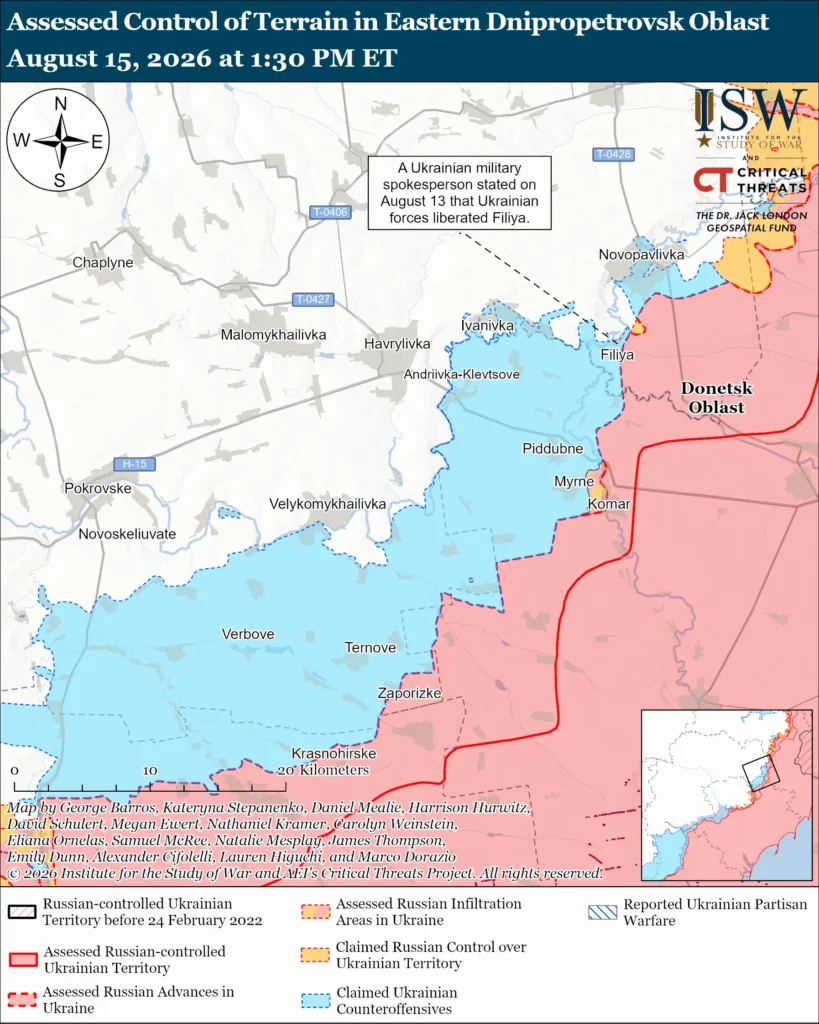
Ukrainian forces used combined arms approaches to leverage drones in support of infantry forces and achieved elements of mechanized maneuver at the tactical level during the Ukrainian 2026 Oleksandrivka counteroffensive. The spokespersons of two Ukrainian brigades that participated in Ukraine’s 2026 counteroffensive operation in the Oleksandrivka direction reported on August 13 that Ukrainian brigades and drone units supported Ukrainian assault groups – likely mechanized infantry – to overcome active Russian resistance throughout the operation.[8] One spokesperson added that effective command and control contributed to Ukraine’s ability to advance in the Oleksandrivka direction, and a Ukrainian source with access to Ukrainian military sources reported that Ukrainian forces outright seized 19 of the 26 settlements that were entirely Russian-occupied (as opposed to being contested, or with Russian forces present on the settlement’s or the settlements’ outskirts. A Kremlin-affiliated Russian milblogger claimed on March 12 that Ukrainian forces in the Oleksandrivka direction were advancing both with dismounted infantry and with armored fighting vehicles (AFVs).[9] These reports suggest that Ukrainian forces managed to employ elements of mechanized maneuver at the tactical level to retake several settlements. The spokespersons additionally reported that Ukrainian forces liberated Filiya (northeast of Oleksandrivka) as part of the counteroffensive operation on a prior unspecified date. The other spokesperson noted that Ukrainian forces have full control over the liberated settlements and have cleared approaches to them.
Ukrainian forces conducted an FP-5 Flamingo cruise missile strike against an enterprise critical to Russia’s efforts to develop domestic satellite communications for the battlefield in Ukraine overnight on August 14 to 15. The Ukrainian General Staff reported on August 15 that Ukrainian forces struck the Progress Space Rocket Center in Samara City, Samara Oblast (roughly 1,488 kilometers from the Russian-Ukrainian border), causing a fire.[10] The Ukrainian General Staff noted that the Progress Space Rocket Center is one of Russia’s rocket and space industry’s key enterprises and produces Soyuz-type launch vehicles, including the Soyuz-2.1b three-stage carrier rocket involved in the deployment of Russia‘s Rassvet satellite constellation — the Russian analogue of Starlink. Ukrainian defense manufacturer Fire Point confirmed on August 15 that Ukrainian forces used FP-5 Flamingo cruise missiles to strike the Progress Space Rocket Center.[11] Geolocated footage published on August 15 shows smoke rising over the Progress Space Rocket Center.[12] Samara Oblast Governor Vyacheslav Fedorishchev acknowledged that Ukrainian forces struck an unspecified industrial facility in Samara City.[13] Russia reportedly began deploying Rassvet communications satellites into low orbit in late March 2026 after SpaceX cut off Russia’s access to Starlink terminals on February 1, 2026, and Russian forces reportedly already leverage the Rassvet satellites for precise drone strikes in Ukraine.[14]
RAND engineer Michael Bohnert amplified reporting on August 15 that two of five Ukrainian Flamingo cruise missiles struck the Progress Space Rocket Center despite Russia reportedly deploying four A-50U Airborne Warning and Control System (AWACS) aircraft to assist in intercepting Ukraine’s Flamingo cruise missiles.[15] Ukrainian and Russian sources recently reported Russia’s increased use of A-50U AWACS aircraft to identify and help intercept Ukrainian cruise missiles, including in Samara Oblast.[16] Russian forces reportedly have fewer than ten operational A-50 AWACS aircraft and four or five of the modernized A-50U variant as of June 1, 2025.[17]
Ukrainian forces appear to be targeting Russian ballistic missile launch infrastructure amidst Ukraine’s ongoing anti-ballistic missile interceptor shortage. Ukrainian officials reported on August 15 that Ukrainian forces struck the Savasleyka Air Base in Nizhny Novgorod Oblast (roughly 680 kilometers from the Russian-Ukrainian border), causing a fire.[18] The air base houses a branch of the Russian Ministry of Defense’s 4th State Center for Aviation Personnel Training and Military Tests as well as Russian MiG-31K fighter jets that Russia uses to launch Kinzhal aeroballistic missiles against Ukraine.[19] A source that reports on successful Ukrainian strikes published footage on August 15 reportedly showing a fire at the air base.[20] Ukraine last struck the Savasleyka Air Base in August 2024 and April and June 2025.[21]
Key Takeaways
The Russian Ministry of Defense (MoD) and Russian milbloggers continue exaggerating Russian advances in the Oleksandrivka and Hulyaipole directions as part of the systematic Russian cognitive warfare effort to propagate claims of expansive Russian gains for informational effects.
Ukrainian forces used combined arms approaches to leverage drones in support of infantry forces and achieved elements of mechanized maneuver at the tactical level during the Ukrainian 2026 Oleksandrivka counteroffensive.
Ukrainian forces conducted an FP-5 Flamingo cruise missile strike against an enterprise critical to Russia’s efforts to develop domestic satellite communications for the battlefield in Ukraine overnight on August 14 to 15.
Ukrainian forces appear to be targeting Russian ballistic missile launch infrastructure amidst Ukraine’s ongoing anti-ballistic missile interceptor shortage.
Ukrainian forces recently advanced in the Oleksandrivka direction.
Russian forces launched 152 long-range drones at Ukraine overnight on August 14 to 15.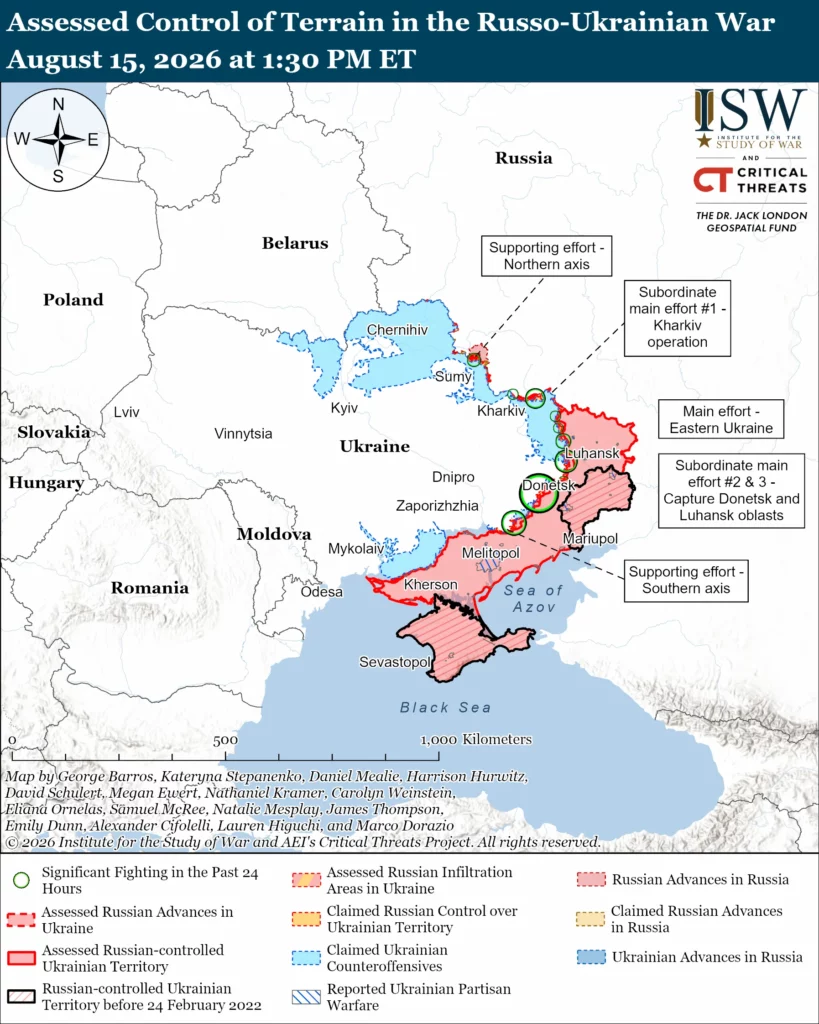
We do not report in detail on Russian war crimes because these activities are well-covered in Western media and do not directly affect the military operations we are assessing and forecasting. We will continue to evaluate and report on the effects of these criminal activities on the Ukrainian military and the Ukrainian population and specifically on combat in Ukrainian urban areas. We utterly condemn Russian violations of the laws of armed conflict and the Geneva Conventions and crimes against humanity even though we do not describe them in these reports.
Ukrainian Operations in the Russian Federation
See topline text for more reports about Ukrainian operations in Russia.
Recent Ukrainian strikes against Novorossiysk, Krasnodar Krai, are disrupting Russian energy and other cargo exports from the Black Sea port. Reuters reported on August 14, citing three familiar sources, that Russian authorities suspended crude oil exports from and stopped accepting oil into the Sheshkaris terminal in Novorossiysk, Krasnodar Krai after a recent Ukrainian drone strike.[22] The sources added that the terminal’s storage tanks had reached capacity. Ukrainian forces struck Novorossiysk, including the Sheshkaris oil terminal, on August 11 to 12.[23] Russian Railways announced on August 13 that it imposed restrictions on loading cargo at Novorossiysk from August 13 to 22 – likely due to the recent Ukrainian strikes in the area.[24]
Ukrainian forces recently conducted a cyberattack against Wildberries to complement Ukraine’s ongoing strike campaign against the company’s warehouses in Russia. Ukraine’s Main Military Intelligence Directorate (GUR) reported that Ukrainian forces conducted a cyberattack against the digital infrastructure of Wildberries on August 10 to 11.[25] The GUR reported that the cyberattack caused large-scale failures, disrupting the main remote customer service channel, partially destabilizing the payment infrastructure, and adding additional load on contact centers.
Russian Supporting Effort: Northern Axis
Russian objective: Create defensible buffer zones in Sumy Oblast along the international border
Russian forces continued limited offensive operations in northern Sumy Oblast on August 14 and 15 but did not advance.[26]
Russian forces reportedly struck Ukrainian energy and drone infrastructure in northern Chernihiv Oblast. The Russian Ministry of Defense (MoD) claimed on August 15 that Russian Geran-type drones, including Geran-4 jet-powered Seeker drones, struck a gas distribution station in Radomka, an electrical substation in Horodnya, a drone storage and launch site in Pekurivka, and a drone warehouse in Chernihiv City.[27]
Russian Main Effort: Eastern Ukraine
Russian Subordinate Main Effort #1 – Kharkiv Oblast
Russian objective: Push Ukrainian forces back from the international border to create a defensible buffer zone with Belgorod Oblast and approach to within tube artillery range of Kharkiv City
Russian forces continued offensive operations in northern Kharkiv Oblast on August 14 and 15 but did not make confirmed advances.[28] A Russian milblogger claimed on August 15 that Russian forces seized Kudiivka (north of Kharkiv City) and advanced west of the settlement.[29]
Russian forces continued offensive operations in the Velykyi Burluk direction on August 14 and 15 but did not advance.[30] A source reporting on the Russian Northern Grouping of Forces claimed that Ukrainian forces counterattacked near Ivashkyne (northeast of Velykyi Burluk).[31]
Russian Subordinate Main Effort #2 – Oskil River
Russian objective: Cross the Oskil River in Kharkiv Oblast and push westward into eastern Kharkiv Oblast and northern Donetsk Oblast
Russian forces continued offensive operations in the Kupyansk direction on August 14 and 15 but did not advance.[32] A Russian milblogger claimed that Russian forces control northern Kupyansk, and another milblogger claimed that Russian forces control Kupyansk barring parts in the south and west.[33] A source reporting on the Russian Western Grouping of Forces claimed that Ukrainian forces maintain positions in central, southern, and southwestern Kupyansk.[34]
Russian forces continued offensive operations in the Borova direction on August 14 and 15 but did not advance.[35] A source reporting on the Russian Western Grouping of Forces and a source affiliated with the Russian 144th Motorized Rifle Division (20th Combined Arms Army, Moscow Military District) claimed that Ukrainian forces are counterattacking near Ridkodub and Nove (both southeast of Borova).[36]
Russian sources continue to use likely AI-altered footage to allege further Russian advances in the Borova direction. Russian sources published footage on August 14 of Russian forces raising a flag in Oskil (southwest of Borova).[37] ISW assessed the footage to be likely AI-altered. ISW has only observed evidence to assess that Russian forces have advanced or infiltrated as close as 17 kilometers of Oskil.
Ukrainian forces continued their intermediate-range strike campaign against Russian military assets in occupied Luhansk Oblast. The Ukrainian General Staff reported that Ukrainian forces struck a Russian Strela-10 air defense system in Kreminna (roughly 20 kilometers from the frontline) and a material and technical equipment depot in Lysychansk (roughly 35 kilometers from the frontline) on August 14 or the night of August 14 to 15.[38]
Russian Subordinate Main Effort #3 – Donetsk Oblast
Russian objective: Capture the entirety of Donetsk Oblast, the claimed territory of Russia’s proxies in Donbas, and advance into Dnipropetrovsk Oblast
Ukrainian forces recently advanced in the Slovyansk direction. Geolocated footage published on August 14 shows Russian forces shelling a Ukrainian position in Ozerne (east of Slovyansk), indicating that Ukrainian forces recently advanced in the area and contrary to previous Russian sources’ claims that Russian forces maintained positions west of Ozerne.[39]
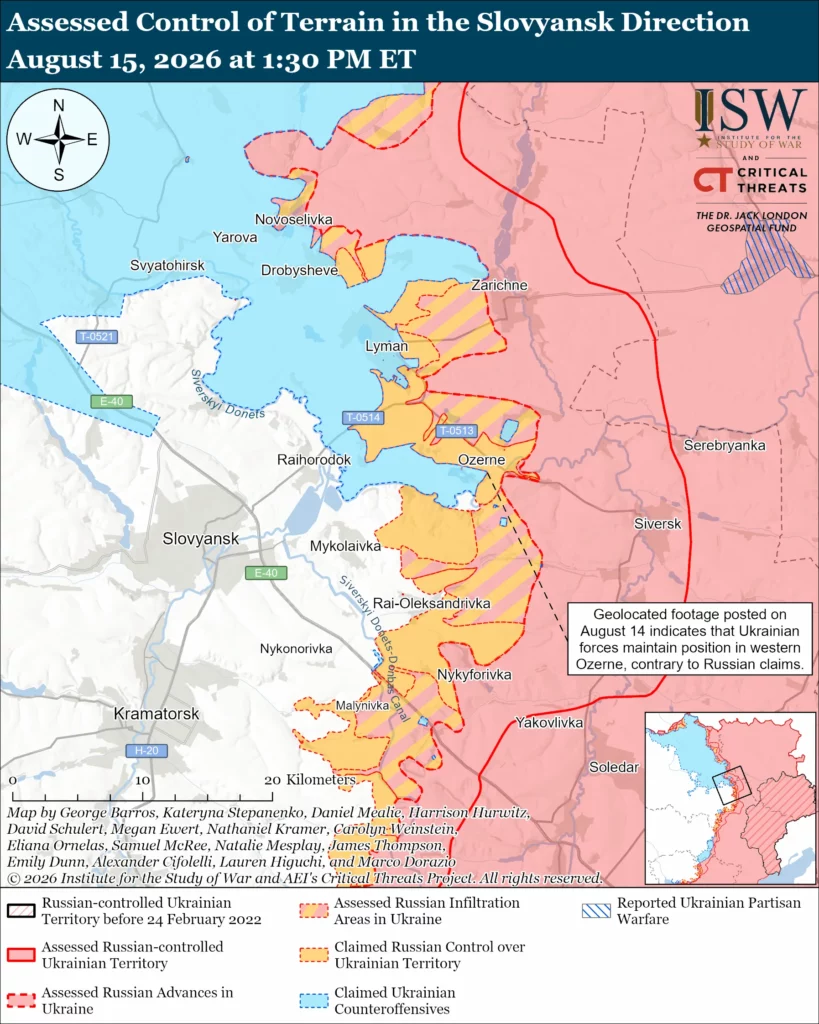
Russian forces continue to rely on glide bombs and drone strikes to disrupt Ukrainian logistics in Slovyansk. A Russian milblogger claimed on August 15 that Russian forces conducted several guided glide bomb strikes against a pedestrian bridge over the Kazennyi Torets River in Slovyansk, collapsing one span of the bridge.[40] Russian forces have recently struck other bridges over the Kazennyi Torets River in Slovyansk, likely as part of Russian efforts to generate battlefield air interdiction (BAI) effects to facilitate future Russian offensive operations against Ukraine’s Fortress Belt.[41] A Ukrainian brigade operating in the Lyman direction reported that Russian forces are heavily using sleeper drones on the sides of roads, field paths, and other routes along which Ukrainian infantry and equipment move.[42] Ukrainian military observer Yuriy Butusov reported on August 15 that Russian forces are attacking dominant heights on the eastern outskirts of Slovyansk in an attempt to seize and establish drone crews on them.[43]
Russian forces are attempting to outflank Ukrainian forces west of Kostyantynivka and degrade Ukrainian logistics in the Kostyantynivka direction. A non-commissioned officer (NCO) of a Ukrainian brigade operating in the Kostyantynivka direction reported that Russian forces are attacking along the brigade’s left flank near Illinivka (west of Kostyantynivka) and right flank near Krasnyi Kut (northwest of Illinivka), searching for vulnerabilities to exploit along the seams between Ukrainian units.[44] The Ukrainian NCO reported that Russian forces are also fielding sleeper drones that can transmit sound as well as footage back to Russian drone operators, allowing Russian sleeper drone operators an additional means by which to detect vehicles driving along Ukrainian ground lines of communication (GLOCs).
A Kremlin-affiliated Russian milblogger refused on August 15 the Russian Ministry of Defense (MoD)’s August 14 claim of having seized Novomykhailivka (northwest of Kostyantynivka).[45]
Russian forces continued limited offensive operations in the Dobropillya tactical area on August 15 but did not advance.[46] The Kremlin-affiliated Russian milblogger stated that Russian forces have not established positions within Dobropillya itself, contrary to official Russian claims of having entered Dobropillya.[47]
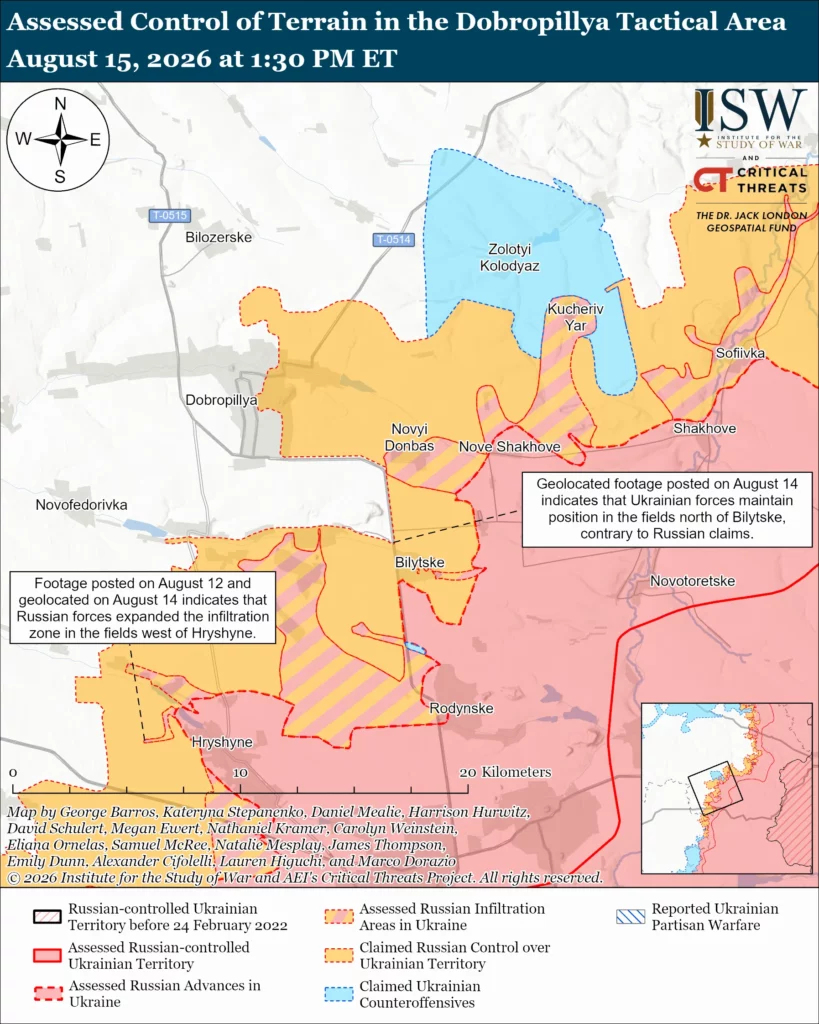
Ukrainian forces recently advanced or maintained positions in the Pokrovsk direction as Russian forces continue infiltration missions in the area. Geolocated footage published on August 14 shows a Ukrainian position northwest of Bilytske (north of Pokrovsk) in an area where Russian sources previously claimed Russian forces had advanced.[48] Additional geolocated footage published on August 12 shows Ukrainian forces striking a Russian servicemember west of Hryshyne (northwest of Pokrovsk) during a likely infiltration mission.[49]
Neither Russian nor Ukrainian sources reported ground activity in the Novopavlivka direction on August 15.
Russian forces continued offensive operations in the Oleksandrivka direction on August 14 and 15 but did not make confirmed advances.[50] See topline text for information about the Ukrainian counteroffensive operation and aggrandized claims of Russian advances in the Oleksandrivka direction.
Ukrainian forces continued their intermediate-range strike campaign against Russian military assets in occupied Donetsk Oblast on August 14 and overnight on August 14 to 15. The Ukrainian General Staff reported that Ukrainian forces struck a Russian drone depot in occupied Vuhledar (about 46 kilometers from the frontline) and a control point in occupied Selydove (about 24 kilometers from the frontline).[51]
Russian Supporting Effort: Southern Axis
Russian objective: Maintain frontline positions, secure rear areas against Ukrainian strikes, and advance within tube artillery range of Zaporizhzhia City
Russian forces continued offensive operations northwest to southwest of Hulyaipole on August 14 and 15 but did not make confirmed advances.[52] See topline text for information about aggrandized claims of Russian advances in the Hulyaipole direction.
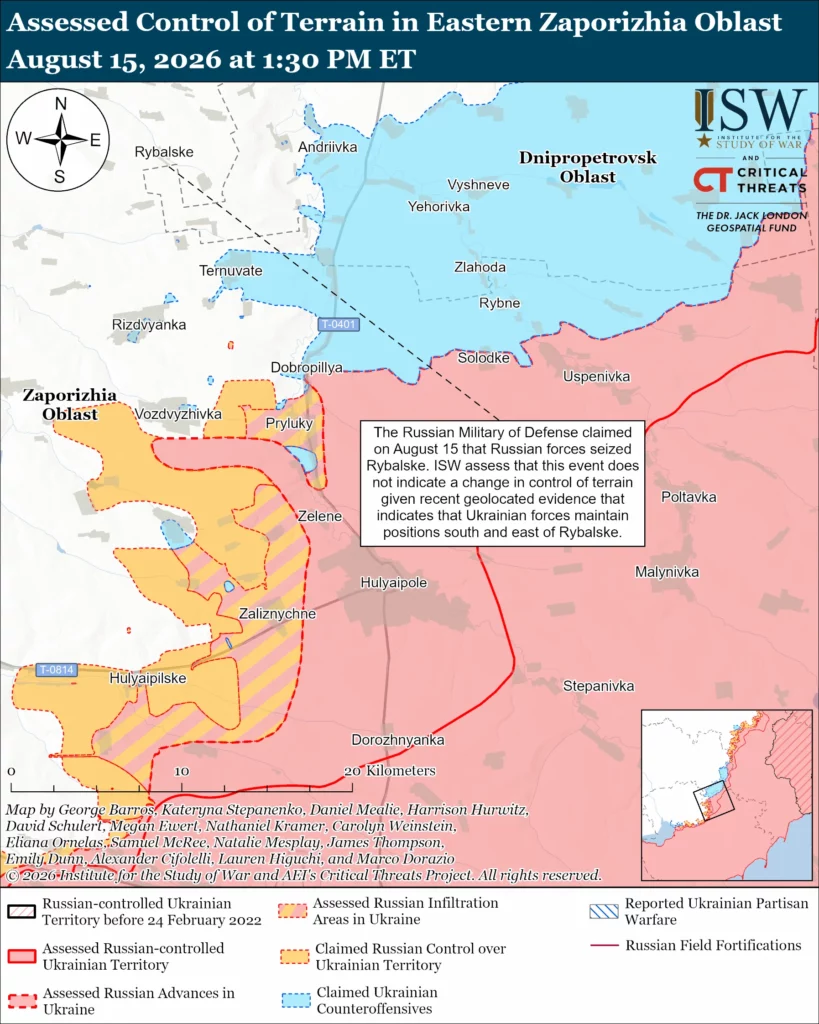
Russian forces continued limited offensive operations west and northwest of Orikhiv in western Zaporizhia Oblast on August 14 and 15 but did not advance.[53]
Ukrainian intermediate-range strikes continue degrading Russian logistics and military assets in occupied southern Ukraine. The Ukrainian General Staff reported that Ukrainian forces struck a Russian control point near occupied Mykhailivka (about 33 kilometers from the frontline).[54] Satellite imagery collected on July 30 and August 13 indicates that there is likely damage to a railway bridge near Svitlodolynske (about 48 kilometers from the frontline) following a Ukrainian strike against the bridge on August 4.[55]
Neither Russian nor Ukrainian sources reported ground activity in the Kherson direction on August 15.
Ukrainian forces continue striking Russian military assets and energy infrastructure in occupied Crimea. Geolocated footage published on August 14 shows a Ukrainian Zozulya drone strike against a Russian rocket and artillery depot south of Solone Ozero (about 128 kilometers from the frontline) on August 13.[56] Data from the NASA Fire Information for Resource Management System (FIRMS) indicates several fires near Solone Ozero on August 13.[57] A local Crimea-based source reported that there were three explosions and a fire at the Balaklava Thermal Power Plant (TPP) overnight on August 14 to 15 and reported that Ukraine may have struck the plant.[58] The source claimed that local authorities ceased operating the Balaklava TPP as of August 14 following recent Ukrainian strikes.[59]
Russian Air, Missile, and Drone Campaign
Russian Objective: Target Ukrainian military and civilian infrastructure in the rear and on the front line
Note: The Ukrainian military ceased reporting the numbers of Russian missiles fired and the number of missiles intercepted as of August 11.[60]
Russian forces conducted a series of long-range drone strikes against Ukraine overnight on August 14 to 15. The Ukrainian Air Force reported that Russian forces launched 152 Shahed- and Gerbera-type strike drones (including jet-powered Shahed-type drones), Banderol loitering munitions, and Parodiya-type decoy drones from the directions of Kursk and Oryol cities; Millerovo, Rostov Oblast; Primorsko-Akhtarsk, Krasnodar Krai; and occupied Donetsk City overnight.[61] The Ukrainian Air Force reported that Ukrainian forces downed 124 Shahed-type, Gerbera-type, and other drones and three Banderol loitering munitions; that Russian aerial munitions struck 16 locations; and that debris hit one location. Ukrainian officials reported that Russian forces struck civilian infrastructure in Dnipropetrovsk Oblast; a gas station and administrative and agricultural buildings in Mykolaiv Oblast; and industrial enterprises and a shopping center in Poltava, Odesa, and Zaporizhia oblasts overnight.[62] Dnipropetrovsk Oblast officials reported that a Russian strike against Marhanets killed an infant and injured at least 11 other civilians.[63] Ukrainian authorities recently stopped reporting out the number of missiles Russia is launching but are continuing to mention the types of missiles launched, such that no mention of missiles in the Ukrainian Air Forces’ report implies that Russian forces did not launch any.
Russian forces are innovating their intermediate-range strike drones with jet engines to evade Ukrainian interceptor drones as part of the ongoing offense-defense technological race. Ukrainian Presidential Advisor on Defense Technologies Serhiy “Flash” Beskrestnov reported on August 15 that Russian forces equipped their cheaper Italmas-type (or BM-35) strike drones, which Russian forces use for intermediate-range strikes, with jet engines and warned that Russia is adding these engines to other unspecified intermediate-range drones.[64] Yevhen Yevtushenko, the head of the military administration of Nikopol Raion in Dnipropetrovsk Oblast, also warned that Russian forces are fielding Shahed-type and Italmas-type jet-powered drones against Nikopol Raion (immediately across the Kakhovka Reservoir from occupied Enerhodar, Zaporizhia Oblast).[65] Russia is reportedly prioritizing the production of jet-powered drones, such as Geran-4 and Geran-5 drones, likely as Ukrainian forces currently lack sufficient countermeasures to intercept the faster drones at a high rate.[66]
Significant Activity in Belarus
Russian efforts to increase its military presence in Belarus and further integrate Belarus into Russian-favorable frameworks
Nothing significant to report.
Note: ISW does not receive any classified material from any source, uses only publicly available information, and draws extensively on Russian, Ukrainian, and Western reporting and social media as well as commercially available satellite imagery and other geospatial data as the basis for these reports. References to all sources used are provided in the endnotes of each update.