 Eurasia Press & News
Key Takeaways:
The author rejects “why Arabs can never be democratic” as Orientalist essentialism (Said). Ask instead which institutions, rents, and power balances have so far blocked transitions—without treating 22 unlike states as one culture. Bellin and Sadiki are used to put discourse and coercive institutions ahead of an “Arab mind.”
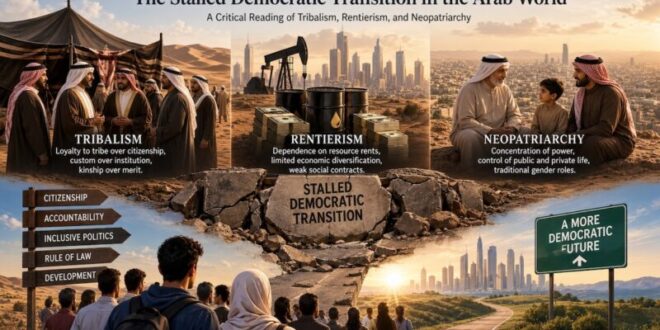
Proposed mix, not one cause: Khaldunian asabiyyah recast as modern clientelism (Morocco’s “bak sahbi”); oil and aid rents that buy compliance without taxation-for-representation (Ross); Sharabi’s neopatriarchy; colonial security states plus Cold War and counterterror backing; cohesive armies that fear opening. Culture is not the independent variable.
Tunisia after 2011 is the counterexample: an Arab-Muslim society ran competitive politics, then reversed—proof of possibility and fragility, not destiny. Youth and digital protest can punch holes in narrative control but not replace parties and unions. Democracy, following Sen, is treated as a universal value whose fate is the distribution of power, which can change.
Introduction
Challenging the Essentialist Premise The question of why democracy has struggled to take root across much of the Arab world has often been posed in a deceptively simple form: why have Arab societies apparently failed to embrace democratic values and institutions? In its most categorical formulation, however, the question contains a problematic assumption—the existence of an enduring structural or cultural incapacity that prevents Arab societies from adopting universal democratic principles. Such a formulation requires critical deconstruction before any attempt is made to identify its supposed causes. Asking why Arabs “can never” become democratic risks transforming a historically contingent political condition into a supposedly permanent civilizational characteristic. It reproduces, in a different vocabulary, precisely the kind of intellectual reductionism that Edward Said criticized in Orientalism: the reduction of historically diverse and geographically heterogeneous societies to a single, static cultural essence (Said, 1978).
Contemporary scholarship in comparative political sociology has similarly warned against what has sometimes been called “Middle Eastern exceptionalism”—the tendency to treat the Arab Middle East as an isolated case governed by cultural laws fundamentally different from those operating elsewhere. Eva Bellin, for example, demonstrated that the resilience of authoritarianism in the Middle East could be explained through identifiable institutional and political variables rather than through an immutable cultural disposition toward authoritarian rule (Bellin, 2004). Likewise, Larbi Sadiki has shown that democratic discourse in the Arab world has never been absent; rather, it has been plural, contested, historically changing, and articulated through competing Islamic, secular, liberal, nationalist, and popular vocabularies (Sadiki, 2004). The question, therefore, is not whether Arabs possess democratic values, but under what institutional, economic, social, and historical conditions democratic aspirations are translated—or prevented from being translated—into effective political institutions.
The more appropriate formulation is consequently the following: what structural, historical, political, and cultural factors have so far impeded, though not permanently prevented, democratic transitions in most Arab countries? This formulation shifts the analytical focus away from cultural essence and toward political structures, distributions of power, institutional incentives, and historically produced relationships between state and society. It also makes comparison possible. The Arab world is not a homogeneous political unit. It encompasses constitutional monarchies and republics, oil-rich and resource-poor economies, highly urbanized societies and predominantly rural ones, relatively strong states and fragmented states, countries with powerful militaries and countries where armed forces have traditionally remained politically peripheral. Treating these twenty-two states as a single political case obscures more than it explains.
This essay therefore adopts a comparative perspective derived from the literature on democratization, political sociology, and authoritarian resilience. It treats tribal solidarity, economic rent, neopatriarchal social structures, colonial legacies, and coercive institutional strength as interacting variables rather than as independent or sufficient explanations. It also introduces counterexamples from within the Arab world itself. Tunisia, in particular, demonstrates that democratic experimentation was possible within an Arab and Muslim social environment and that subsequent democratic reversal does not invalidate this possibility. On the contrary, Tunisia illustrates the fragility of democratic institutions and the importance of institutional balances, intermediary organizations, economic structures, and political coalitions.
The central argument is therefore neither that Arab societies are culturally incompatible with democracy nor that democratization is inevitable. Rather, democratic stagnation in much of the Arab world is best understood as the product of a historically constructed equilibrium in which different forms of solidarity, economic dependency, social hierarchy, state-building, geopolitical intervention, and coercive capacity reinforce one another. These structures are durable, but they are not eternal. Their durability should not be confused with immutability.
Tribal Solidarity between the Khaldunian Legacy and Contemporary Reproduction
The concept of asabiyyah, formulated by Ibn Khaldun in his celebrated Muqaddimah, remains one of the earliest and most influential frameworks for understanding political authority in Arab and Amazigh societies. Ibn Khaldun connected the rise and decline of dynasties to the strength and eventual erosion of group solidarity. Political power, in his analysis, initially rests upon a cohesive social group whose solidarity enables it to conquer and establish political authority. Once power becomes consolidated, however, luxury, individualization, and the separation of rulers from their original social base gradually weaken that solidarity (Ibn Khaldun, 2005).
Yet it would be analytically misleading to transform Ibn Khaldun’s historical concept into a timeless explanation of contemporary Arab political behavior. Asabiyyah was not proposed as a biological or cultural essence possessed permanently by Arabs. It was an analytical concept designed to explain the dynamics of premodern political formations. Modern states have profoundly transformed the mechanisms through which solidarity is organized and political loyalty is produced. Direct tribal allegiance has often been supplemented, displaced, or transformed into networks of patronage, clientelism, kinship, regionalism, sectarianism, and economic dependency.
The persistence of solidarity networks in modern political systems should therefore not be interpreted as evidence that traditional society simply survived unchanged beneath the surface of modern institutions. Rather, traditional forms of solidarity have frequently been rearticulated through modern institutions. Political parties, parliaments, bureaucracies, municipalities, professional associations, and electoral campaigns can become vehicles through which familial, tribal, regional, or personal loyalties are reorganized. Modern institutional language may consequently coexist with traditional patterns of political recruitment and political obligation.
This phenomenon corresponds closely with Hisham Sharabi’s concept of neopatriarchy, which describes the survival and transformation of traditional authoritarian relationships within apparently modern institutional structures. The result is what might be described as a modern state in institutional form but traditional in important aspects of political substance (Sharabi, 1988). Institutions formally designed to aggregate interests and represent citizens may instead become mechanisms for reproducing pre-existing hierarchies. The parliamentary representative may function less as an independent political actor than as a broker between local networks and the state; the party may become less an ideological organization than an electoral vehicle; and political office may become a means of distributing access to employment, contracts, services, and influence.
The Moroccan case offers a particularly revealing example of this transformation. Tribal solidarity has not simply disappeared; rather, it has been transformed into forms of neo-tribalism and clientelism operating within modern political and administrative structures. Personal networks, family connections, regional loyalties, and the logic commonly expressed through the phrase “bak sahbi”—roughly, “your father is my friend,” or more broadly, the advantage conferred by personal connections—may sometimes compete with competence, merit, and programmatic political commitments. In such circumstances, the problem is not tribalism in its traditional form but the transformation of traditional solidarity into modern patronage networks (Chtatou, 2021, 2025).
This distinction is essential because tribal configurations do not automatically generate identical political outcomes. Some tribal societies have developed forms of electoral competition, negotiated representation, and political incorporation. Others have become deeply integrated into authoritarian patronage systems. The political consequences of tribal or familial solidarity depend upon the institutions surrounding them: the nature of the state, the distribution of economic resources, electoral rules, the degree of political competition, and the ability of institutions to convert social loyalties into broader forms of citizenship.
The analytical error, therefore, lies in assuming that tribal solidarity is itself the cause of democratic failure. More accurately, certain forms of solidarity become obstacles to democratic representation when they are embedded within systems that reward personal loyalty over institutional accountability. Tribalism becomes politically problematic when it is converted into clientelism, when access to state resources is mediated through personal networks, and when political competition becomes a struggle among competing patronage blocs rather than a contest among alternative programs.
The contemporary transformation of asabiyyah thus demonstrates that political modernization does not necessarily eliminate traditional forms of solidarity. It can instead modernize them. The challenge for democratization is consequently not to abolish social identities but to construct institutions capable of preventing those identities from becoming exclusive mechanisms for distributing political power.
Rentier Economies and the Purchase of Political Compliance
Among the most influential structural explanations of authoritarian resilience in the Arab world is the theory of the rentier state. This approach is particularly relevant to oil-producing countries but also offers broader insights into states that rely heavily on external rents, foreign assistance, remittances, strategic subsidies, or other revenues that reduce their dependence on domestic taxation.
Michael Ross’s seminal analysis demonstrated that oil wealth can hinder democratization through several interconnected mechanisms. First, the rentier effect allows governments to maintain low levels of taxation while distributing benefits and privileges, weakening the classical political principle that taxation generates demands for representation. Second, the repression effect allows governments to finance large security apparatuses capable of suppressing political opposition. Third, the modernization effect suggests that oil wealth can slow the emergence of the independent middle classes and occupational diversification that often accompany modernization and generate demands for political participation (Ross, 2001).
The political consequences are particularly visible in several Gulf monarchies, where substantial material welfare has historically been combined with restricted political competition. The implicit social contract can become one in which the state provides employment, subsidies, housing, healthcare, education, and other forms of material security while citizens accept significant limitations on political participation. Citizenship is consequently organized less around taxation, representation, and accountability than around a redistributive relationship between ruler and ruled.
Yet rentier theory cannot by itself explain authoritarian persistence across the entire Arab world. Countries such as Egypt and pre-2011 Tunisia did not possess the enormous petroleum revenues of the Gulf. Their political systems nonetheless developed durable authoritarian institutions. This observation encouraged scholars to broaden the concept of rentierism toward forms of quasi-rentierism, in which governments rely on foreign aid, remittances, strategic assistance, tourism, or geopolitical rents. In such contexts, external resources can perform functions analogous to oil revenues by helping governments finance social stability and political control without creating strong domestic pressures for accountability.
This broader understanding of rentierism is particularly important because it reveals that the political issue is not simply oil. The deeper issue is the relationship between the state’s financial resources and its dependence upon society. Where governments can finance themselves without relying extensively upon citizens, the incentives for reciprocal political accountability may be weakened. Conversely, where governments depend more directly upon broad-based taxation, citizens may possess greater leverage to demand transparency, representation, and public services.
The popular language of “selfishness” sometimes used to describe authoritarian elites consequently requires reformulation. What appears as individual selfishness may actually constitute a rational incentive structure. Political elites, bureaucratic actors, military officers, and economic beneficiaries may have strong material reasons to preserve the existing order. Democratic opening introduces uncertainty: political office can change hands, economic privileges can be scrutinized, patronage networks can be disrupted, and previous beneficiaries may face demands for accountability.
From the perspective of narrow rational choice, therefore, authoritarian elites may behave rationally even when their behavior is socially destructive. They have more to lose than to gain from an uncontrolled transition. This helps explain why political reform can remain limited even when rulers publicly recognize the need for modernization.
Samuel Huntington’s concept of the “king’s dilemma” offers a complementary perspective. Authoritarian regimes seeking modernization confront two opposing dangers: insufficient modernization leaves society increasingly dissatisfied and unable to meet rising expectations, while rapid modernization can generate an educated and socially differentiated middle class that demands political participation (Huntington, 1968). Rentierism can provide an escape from this dilemma. States may finance extensive economic and social modernization without undertaking an equivalent political transformation.
This produces a central paradox of contemporary Arab politics: economic modernization does not necessarily generate political modernization. Modern universities, sophisticated infrastructure, globalized businesses, digital economies, and advanced cities can coexist with highly centralized political authority. The development of physical and economic modernity therefore cannot automatically be treated as evidence of democratization.
The rentier model is consequently best understood as an incentive structure rather than a cultural explanation. It does not suggest that citizens of rentier states inherently prefer authoritarianism. Rather, it explains how certain forms of state finance can reduce the bargaining power of society and increase the resources available to governments seeking to maintain political control.
Neopatriarchy and the Gendered Structure of Political Authority
Hisham Sharabi’s concept of neopatriarchy adds an important social dimension to the analysis. For Sharabi, the Arab political crisis is not simply an institutional crisis. It is also rooted in social structures that have not fully transitioned from traditional patriarchal authority toward modern notions of individual autonomy and equal citizenship. The result is a hybrid system in which patriarchal relationships are reproduced through modern institutions (Sharabi, 1988).
At the level of political symbolism, the ruler may become analogous to a father of the nation, while the citizen is positioned as a dependent subject rather than as an autonomous political actor. Authority is imagined vertically. Loyalty flows upward, while protection, resources, and recognition flow downward. Political participation therefore becomes conditional upon obedience.
This structure can be reproduced at multiple levels: the family, school, religious institution, workplace, political party, and state. Children learn hierarchical obedience within the family; educational systems may emphasize memorization and respect for authority rather than critical inquiry; political organizations may reproduce internal hierarchies; and citizens may encounter public administration as a vertical structure rather than as a service institution accountable to them.
The gender dimension is particularly important. Patriarchal authority in the family can be reproduced as masculine authority in the public sphere. Women’s exclusion from political decision-making may therefore reflect not an immutable cultural or religious principle but historically specific institutions and policies.
Nicola Pratt’s analysis is useful here because it demonstrates how authoritarian modernization projects have sometimes appropriated women’s emancipation as a symbol of state modernity while limiting women’s independent political agency (Pratt, 2007). Women may become objects of state reform without necessarily becoming autonomous political subjects. The state presents itself as the liberator of women while simultaneously controlling the terms of their emancipation.
This distinction between state-sponsored emancipation and autonomous citizenship is crucial. Legal reforms, educational expansion, and increased female employment can dramatically alter women’s social position, but democratic transformation requires more than symbolic inclusion. It requires access to political decision-making, independent civil society, equal citizenship, and institutional mechanisms capable of holding political authorities accountable.
At the same time, the Arab world should not be treated as uniformly patriarchal in political outcomes. Differences among Arab countries in women’s parliamentary representation, participation in government, education, employment, and civil society demonstrate that patriarchal structures are variable and politically mediated. Where political institutions create incentives for inclusion, representation can expand. Where authoritarian systems instrumentalize gender reforms without opening political space, modernization may remain selective.
The important conclusion is therefore that neopatriarchy should be understood as a historically produced structure rather than as an unchanging cultural essence. It is capable of transformation under the influence of education, urbanization, demographic change, economic restructuring, women’s movements, globalization, and digital communication.
Colonial Legacies and the Engineering of the Authoritarian State
Any serious analysis of authoritarianism in the Arab world must also examine the colonial construction of the modern state. Nicola Pratt emphasizes that contemporary authoritarianism cannot simply be understood as the survival of premodern political structures. Colonial administrations established centralized bureaucratic and security institutions whose primary purpose was often control rather than democratic representation (Pratt, 2007).
French and British colonial administrations developed administrative systems designed to monitor populations, collect information, maintain order, control territory, and suppress resistance. At independence, many national elites inherited these institutions. The new states frequently retained centralized bureaucracies, powerful security services, and highly concentrated executive authority.
The problem was intensified by the circumstances of decolonization. Newly independent governments faced real challenges: territorial fragmentation, separatist movements, foreign intervention, weak administrative capacity, economic underdevelopment, and sometimes sectarian or ethnic tensions. State consolidation was therefore presented as an existential necessity. Political pluralism could be portrayed as a luxury that threatened national unity.
Thus, the emergency logic of the colonial period was frequently transformed into the permanent security logic of the postcolonial state. What had initially been justified as temporary centralization became normalized as a mode of government.
This process may be understood as the normalization of authoritarianism. Political regimes justified restrictions on opposition in the name of development, modernization, national unity, anti-imperialism, and later counterterrorism. The legitimacy of liberation movements was gradually transformed into the legitimacy of ruling parties, military establishments, or presidential systems.
Pratt’s formulation of the transition from “liberation legitimacy” to authoritarian legitimacy is particularly important in this regard (Pratt, 2007). Anti-colonial movements initially derive legitimacy from representing national independence. After independence, however, the same political forces may claim that because they liberated the country, they possess a special right to govern it.
The geopolitical environment reinforced this pattern. During the Cold War, Western powers frequently tolerated or supported authoritarian Arab governments because of strategic interests involving energy supplies, military alliances, regional stability, and containment of communist influence. After the Cold War, security partnerships continued, increasingly justified through the language of combating terrorism and containing political Islam.
Eva Bellin therefore correctly emphasizes that the absence of democratic transition in the Arab world cannot be explained solely through domestic culture. International support for authoritarian institutions contributed to their durability (Bellin, 2004). External actors frequently preferred predictable authoritarian stability to uncertain democratic transitions whose outcomes could not be guaranteed.
The result was a political equilibrium in which domestic elites and international actors could share an interest in maintaining the status quo. Authoritarianism was not simply imposed from outside, nor was it purely internally generated. It became embedded in an international political economy of security, energy, strategic alliances, and regional order.
The Resilience of Authoritarianism: Elite Cohesion and Coercive Institutions
Among the strongest explanations for authoritarian resilience is the institutional strength of coercive apparatuses. Eva Bellin’s influential argument emphasizes that authoritarian regimes in the Middle East have often survived because their security institutions remain cohesive, well financed, and willing to repress opposition when necessary (Bellin, 2004).
This contrasts with experiences in parts of Latin America and Eastern Europe, where military institutions sometimes fragmented or refused to repress populations during decisive political crises. In many Arab states, by contrast, security institutions maintained organizational cohesion and remained closely connected to ruling elites.
Several mechanisms reinforce this cohesion. They include rent revenues and foreign assistance, professional and material benefits provided to security institutions, weak traditions of military political neutrality, limited expectations of international intervention against domestic repression, and recruitment patterns based on family, sectarian, regional, or personal loyalty.
The result is a coercive apparatus whose interests are closely connected to regime survival. Security institutions therefore do not necessarily perceive political liberalization as a neutral institutional development. They may see it as a direct threat to their economic privileges, political influence, and organizational survival.
Again, the language of selfishness is insufficient. The behavior of these institutions can be understood as a collective calculation. Senior officers, security officials, businessmen connected to the state, and senior bureaucrats may all have accumulated privileges within the existing system. A genuine democratic opening could expose corruption, redistribute economic assets, and weaken their political positions.
This explains an important distinction between reform from above and transformation from below. Authoritarian regimes may introduce constitutional amendments, elections, decentralization, or new institutions without fundamentally changing the distribution of strategic power. Such reforms can be meaningful, but their transformative capacity depends on whether they alter the underlying relationship between executive authority, security institutions, political parties, and citizens.
The experience of Morocco after the 2011 Constitution illustrates this complexity. The political system combined significant institutional concessions with the continuing centrality of royal decision-making, creating a form of gradual or incremental democratization in which elected institutions and local governance could expand while strategic decision-making remained strongly concentrated within the monarchy (Chtatou, 2026). This is neither equivalent to complete authoritarian closure nor to liberal democracy. It is better understood as a negotiated and incremental political order.
Monarchies have, in some circumstances, possessed greater flexibility than republican authoritarian regimes in absorbing political crises. Traditional, religious, and historical legitimacy can provide monarchies with additional symbolic resources that facilitate controlled reform without necessarily requiring a complete redistribution of power.
The Arab Spring demonstrated this difference. Republican regimes in Egypt, Libya, Syria, and elsewhere faced acute legitimacy crises because presidential succession had often become hereditary or quasi-hereditary. Sadiki observed that the transfer of authority from father to son effectively transformed some republics into undeclared monarchies, undermining the representative meaning of republican institutions (Sadiki, 2009).
The central point is that authoritarian durability is institutional rather than psychological. Citizens do not necessarily “like” authoritarianism. Rather, institutions may make collective resistance difficult and make elite cooperation with authoritarian structures materially rational.
The Culturalist Debate: Islam, Orientalism, and the Universality of Democracy
One of the most persistent explanations for democratic stagnation in the Arab world is culturalist. According to its strongest version, Islam or “the Arab mind” is supposedly incompatible with democracy. Such arguments reproduce a conceptual distinction between supposedly democratic Western societies and supposedly authoritarian Arab or Muslim societies.
Edward Said’s critique of Orientalism remains indispensable here. Orientalist discourse, in his analysis, often constructed the East as the cultural opposite of the West: irrational rather than rational, traditional rather than modern, despotic rather than democratic, and static rather than historical (Said, 1978). Applying such a binary to contemporary political analysis risks confusing political outcomes with cultural essence.
Abdullahi Ahmed An-Na’im offers an important alternative. He distinguishes between Sharia as a moral and religious reference and the modern state as a civil political institution that must accommodate citizens holding different interpretations of religion. In this framework, a secular state need not be understood as anti-Islamic. Rather, institutional neutrality can protect the freedom of Muslims themselves to interpret and practice their religion in different ways (An-Na’im, 2008).
This perspective destabilizes the simplistic opposition between Islam and democracy. The relevant question becomes not whether Islam is democratic but how Islamic ethical and political traditions can interact with constitutionalism, citizenship, pluralism, and individual rights.
Amartya Sen similarly rejects the idea that democracy is an exclusively Western cultural invention. Public deliberation, consultation, debate, disagreement, and political participation can be found in multiple historical civilizations. Democracy should therefore be understood as a universal political value rather than as a cultural possession belonging exclusively to Europe or North America (Sen, 1999).
Larbi Sadiki’s work reinforces this point from within the Arab context. Arab societies have generated multiple indigenous discourses on democracy—Islamist, secular, liberal, nationalist, socialist, and popular. These discourses disagree profoundly about what democracy should mean, but their very existence demonstrates that the Arab world is not devoid of democratic thought (Sadiki, 2004).
This distinction is fundamental. The central conflict is often not between democracy and an allegedly unified Arab culture, but among competing political actors over the meaning, limits, institutions, and distributional consequences of democracy.
Political Islam itself provides evidence against cultural essentialism. Many Islamist movements have participated in elections, accepted political pluralism, formed parties, negotiated coalitions, and debated the relationship between religious reference and democratic representation. Their positions have varied enormously, but this diversity demonstrates that there is no single “Islamic political mind.”
Indeed, the history of Islamist participation suggests that political actors adapt their ideological commitments to institutional environments. Where elections are meaningful, political movements may develop programmatic strategies; where institutions are authoritarian, opposition movements may become more clandestine or radicalized. Political behavior is therefore shaped not only by ideas but also by incentives and institutional structures.
The culturalist thesis consequently mistakes political history for cultural destiny. If authoritarianism is strong in a particular society, that does not establish that its culture caused authoritarianism. One must still ask who benefits from authoritarianism, how institutions distribute resources, how security services operate, how political parties are regulated, and how international actors reinforce the existing order.
The Limits of Determinism: Tunisia and the Empirical Challenge
The strongest challenge to deterministic explanations comes from empirical counterexamples. Tunisia is particularly important because it shares many of the broad cultural, linguistic, religious, and historical characteristics often invoked to explain Arab exceptionalism. Yet following the 2011 revolution, Tunisia succeeded for several years in constructing a competitive political system, negotiating a new constitution, organizing pluralist elections, and developing a comparatively vibrant civil society.
If Arab culture were inherently incompatible with democracy, Tunisia’s post-2011 experience would be difficult to explain. Its subsequent democratic reversal is equally revealing. The Tunisian case suggests not that democracy is guaranteed but that democratic institutions are possible—and fragile.
Bellin’s framework helps explain Tunisia’s relative opening. The country’s military establishment was comparatively less politically embedded than those of several other Arab republics. Tunisia also possessed a strong and independent labor movement, represented by the Tunisian General Labour Union, while the absence of major oil wealth limited the state’s ability to purchase social compliance through rent distribution (Bellin, 2004; Ross, 2001).
The Tunisian experience thus confirms the importance of institutional and economic variables over cultural determinism.
Its subsequent reversal reinforces the same conclusion. Democracy is not a political condition that, once established, becomes irreversible. It is a continuing process dependent upon institutional balances, intermediary organizations, constitutional norms, economic performance, political trust, and the willingness of political elites to accept uncertainty.
The Tunisian case consequently teaches two lessons. First, Arab societies are demonstrably capable of democratic experimentation. Second, democratization requires institutional consolidation and cannot survive indefinitely if executive power becomes excessively concentrated or if intermediary institutions lose their capacity to constrain political authority.
Sadiki’s concept of “elections without democracy” captures a broader regional problem: elections can exist without generating genuine democratic accountability (Sadiki, 2009). Voting procedures alone do not guarantee democracy. The decisive issue is whether citizens possess meaningful choices, whether elected officials can influence public policy, whether institutions constrain executive authority, and whether political competition can produce alternation in power.
Democratization is therefore best understood as a continuum rather than a binary condition. A country may liberalize electoral competition without establishing judicial independence; expand parliamentary representation without limiting executive power; decentralize administration without transferring genuine resources; or reform constitutional texts without changing political practice. This is why the distinction between democratic form and democratic substance is so important.
Demographic Transformation and the Digital Public Sphere
Classical theories of tribalism, rentierism, and neopatriarchy were developed primarily before the extraordinary demographic and technological transformations that have reshaped Arab societies. The rise of a predominantly young population and the expansion of digital communication introduce variables that earlier theoretical frameworks could not fully anticipate.
In many Arab countries, a substantial proportion of the population is under thirty. This creates political pressures that differ from those faced by older generations. Young citizens confront unemployment, underemployment, housing difficulties, educational inequalities, migration pressures, and frustrations concerning access to political decision-making. They are also more deeply integrated into transnational digital cultures.
The Arab Spring demonstrated the political potential of digital networks. Social media enabled young activists to bypass traditional media structures and create horizontal forms of mobilization that were difficult for governments to control through conventional censorship. Larbi Sadiki’s analysis of the Arab Spring highlights the importance of these new forms of political organization (Sadiki, 2015).
Yet digital mobilization has limits. Online networks can mobilize citizens rapidly, but they do not automatically create durable political organizations. The Egyptian, Libyan, and Syrian experiences demonstrated that the weakening of traditional mechanisms of information control does not necessarily weaken the coercive state itself. Digital activism can challenge narratives, expose corruption, and coordinate protests, but it cannot by itself replace political parties, trade unions, professional organizations, constitutional institutions, or effective governance.
Morocco’s February 20 Movement offers an instructive example. Cyber activism helped expose corruption, clientelism, neopatriarchal structures, and forms of traditional governance while demanding a more meaningful constitutional monarchy and gradual democratization (Chtatou, 2018). The movement nevertheless lost momentum as the regional Arab Spring receded and institutional reforms partially absorbed political pressure.
More recently, the emergence of the GENZ212 movement illustrates the transformation of political dissatisfaction among younger generations. Its digital activism has focused attention on clientelism, public services, corruption, and the perceived persistence of neo-tribal networks within public institutions (Chtatou, 2025).
These developments reveal an important transformation in the political sociology of the Arab world. Younger citizens may be less willing to accept traditional patronage arrangements, but their rejection of established politics does not automatically translate into participation in formal democratic institutions. Indeed, disappointment with parties can produce political disengagement and abstention as easily as mobilization.
The digital public sphere therefore represents both an opportunity and a challenge. It weakens traditional monopolies over information and enables new forms of political expression, but it can also fragment public debate, accelerate polarization, and encourage episodic rather than organizational forms of participation.
The interaction between demographic youthfulness, digital connectivity, economic frustration, and institutional rigidity may become one of the defining political dynamics of the coming decades. The question is whether Arab political systems will be able to transform youthful energy into institutional participation or whether continued exclusion will deepen political alienation.
Toward a Pluralist, Non-Essentialist Explanation
The preceding analysis suggests that democratic stagnation in the Arab world cannot be explained by a single factor. Tribal solidarity, rentierism, neopatriarchy, colonial legacies, geopolitical intervention, and coercive institutional strength interact in complex ways.
Tribalism can provide social networks that facilitate patronage. Rentierism can provide governments with the financial resources necessary to sustain patronage and repression. Neopatriarchy can legitimize hierarchical authority at the social level. Colonial state structures can provide centralized bureaucratic and coercive institutions. International geopolitical interests can protect authoritarian regimes from external pressure. Security institutions can then preserve the entire configuration through coercion and surveillance.
These factors reinforce one another, producing what may be called an authoritarian equilibrium.
Yet the equilibrium is neither uniform nor permanent. The variation among Arab states demonstrates that different combinations of these variables produce different outcomes. Oil-rich monarchies differ from resource-poor republics. Constitutional monarchies differ from presidential republics. Countries with strong labor organizations differ from countries where civil society remains weak. States with highly institutionalized militaries differ from those where security institutions are personalized around families or sectarian groups.
The proper unit of analysis is therefore not “Arab culture” but the concrete configuration of political institutions and social forces within each country.
This approach also allows us to distinguish between obstacles and determinants. An obstacle can be overcome; a determinant implies a much stronger form of causality. Rentierism may impede democratization without making it impossible. Patriarchy may constrain participation without preventing women’s political mobilization. Tribal networks may reproduce clientelism without eliminating electoral competition. Strong security institutions may repress opposition without permanently preventing institutional reform.
This distinction is not merely semantic. It changes the political implications of research. If authoritarianism is culturally predetermined, political reform becomes almost meaningless. If authoritarianism is institutionally reproduced, however, reform becomes a question of changing incentives, institutions, and distributions of power.
The task of political analysis is consequently to identify where resistance to change is concentrated. Is it located in economic rents? In security institutions? In political parties? In administrative bureaucracies? In social networks? In external geopolitical alliances? Or in the interaction among all of these? The answer will vary from one Arab country to another.
Conclusion
From Cultural Excuse to Political Explanation The democratic stagnation experienced by much of the Arab world is a complex historical phenomenon. It cannot responsibly be described as evidence of an inherent Arab inability to embrace democracy. Such a conclusion confuses political history with cultural essence and risks reproducing the very Orientalist assumptions that modern comparative scholarship has sought to overcome.
The more convincing explanation is plural and institutional. The persistence of authoritarianism reflects the interaction of transformed forms of tribal solidarity, rentier or quasi-rentier economies, neopatriarchal social structures, colonial and postcolonial state-building, geopolitical support, and cohesive coercive institutions (Bellin, 2004; Pratt, 2007; Ross, 2001; Sharabi, 1988).
Tribalism should not be treated as a timeless obstacle. Contemporary asabiyyah is often expressed through clientelism, patronage, family networks, regional loyalties, and political brokerage. As the Moroccan case demonstrates, traditional solidarity can be reproduced inside modern institutions and can therefore undermine meritocratic and programmatic politics without necessarily eliminating elections or formal political pluralism (Chtatou, 2021, 2025).
Rentierism likewise explains not a cultural preference for authoritarianism but a particular political economy. Where governments possess substantial independent sources of revenue, they can reduce their dependence on taxation and therefore weaken one of the traditional foundations of representative government. They can finance welfare, patronage, and security institutions without conceding equivalent political power (Ross, 2001).
Neopatriarchy explains another dimension: the reproduction of hierarchical relationships between ruler and citizen, family and individual, male and female, institution and subject. Yet even here, the structure is historical rather than immutable. Education, urbanization, women’s political participation, demographic change, and digital communication are transforming the social foundations upon which patriarchal authority once rested (Sharabi, 1988; Pratt, 2007).
Colonialism and postcolonial state-building further demonstrate why political history matters. Centralized bureaucratic and coercive institutions were not simply inherited passively from the past; they were actively reproduced by national governments in the name of modernization, national unity, development, and security. External powers frequently reinforced these arrangements because authoritarian stability was perceived as strategically preferable to uncertain political transition (Bellin, 2004; Pratt, 2007).
The decisive variable may nevertheless be the resilience of coercive institutions. Where security establishments remain cohesive and perceive political opening as an existential threat, authoritarian regimes possess considerable capacity to survive crises. Democratic movements may mobilize millions, but without institutional allies and organized political structures they can struggle to translate mobilization into durable political change.
The culturalist explanation therefore fails because it reverses the direction of causality. It sees authoritarian outcomes and attributes them to culture, when the more productive approach is to examine the institutions and power relations that produce those outcomes.
Tunisia provides perhaps the clearest empirical demonstration. Its post-2011 democratic experiment proved that Arab and Muslim societies are not structurally incapable of democratic politics. Its subsequent democratic reversal demonstrated something equally important: democracy is fragile everywhere. It requires institutions, intermediary organizations, political compromise, economic inclusion, and mechanisms capable of constraining executive power.
The emerging digital generation adds a new dimension to this historical process. Young Arabs increasingly inhabit political spaces that cannot be completely controlled through traditional mechanisms. Digital activism has weakened the state’s monopoly over information and enabled horizontal forms of political organization. Yet digital mobilization alone cannot substitute for durable political institutions. The challenge is therefore to connect the energy of digital citizenship with the institutional infrastructure of democratic citizenship.
The responsible answer to the question of democratic stagnation in the Arab world is thus neither an unconditional declaration of possibility nor a fatalistic assertion of impossibility. It is a map of political resistance. That resistance is concentrated in rentier structures that reward loyalty; in coercive institutions that fear political uncertainty; in clientelist networks that convert public resources into private influence; in patriarchal structures that privilege hierarchy over autonomy; and in historical state formations that have concentrated authority at the center. None of these structures is eternal.
The central analytical task is therefore not to search for a cultural excuse for authoritarianism but to identify, dismantle, and transform the concrete mechanisms through which authoritarian power is reproduced. Democracy in the Arab world should be understood as an open historical possibility whose success depends upon political choices, institutional reform, social mobilization, economic restructuring, and changing balances of power.
Amartya Sen’s conception of democracy as a universal value provides an appropriate point of departure. Democracy is not the exclusive property of one civilization, nor is authoritarianism the natural expression of another. Political systems emerge from historical struggles and institutional configurations (Sen, 1999). The Arab world is therefore neither condemned to authoritarianism nor guaranteed a democratic future. Its political trajectory remains contested.
The most important question is consequently not whether Arabs are “ready” for democracy. That formulation places the burden of explanation on societies and cultures rather than on institutions and political elites. The more meaningful question is: what institutional arrangements prevent citizens from exercising political power, and what historical conditions would allow those arrangements to change?
Once the question is posed in this way, the possibility of democratic transformation becomes analytically visible. The problem is no longer an allegedly defective culture. It is the distribution of power. And distributions of power, unlike cultural essences, can change.