 Eurasia Press & News
As Syria struggles to rebuild, Israel is using the chaos to entrench military dominance and prevent any new regional order from restraining its power
It has been nearly a year since the fall of Bashar Al-Assad’s government in Syria. For the past nearly 12 months, Israel has continued its aggression, expanding its territorial ambitions by illegally occupying more Syrian land and exploiting the war-torn country’s fragile political transition.
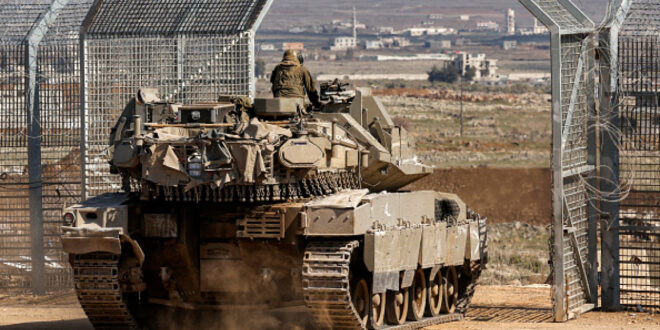
In the months following the collapse, Israel violated the 1974 disengagement agreement and advanced into Syrian territory, seizing additional land, including Mount Hermon, under the pretext of creating a “buffer zone” while destroying much of the Syrian military’s weaponry.
Since then, Israel has continued to strike Syrian targets at will, subjecting the country to repeated humiliation at a moment when it lacks both the leverage and the capacity to deter Tel Aviv’s ongoing incursions.
On 19 November, Israeli Prime Minister Benjamin Netanyahu paid a visit to his country’s troops in occupied southern Syria. When addressing the Israeli military personnel, Netanyahu stressed the “importance to our capability here, both defensive and offensive, safeguarding our Druze allies, and especially safeguarding the State of Israel and its northern border opposite the Golan Heights”.
Israeli objectives in Syria need to be understood within the wider context of Tel Aviv’s quest to take advantage of the devastating blows which Iran’s “Axis of Resistance” suffered in 2024 and consolidate its status as the regional hegemon. Put simply, Israel wants neighbouring Syria and Lebanon to be weak, fragmented, and unable to wage any form of armed resistance.
“Netanyahu’s goal is to ensure that Syria does not rise from the ashes,” said Dr Nader Hashemi, director of Georgetown University’s Prince Alwaleed bin Talal Center for Muslim-Christian Understanding, in an interview with The New Arab.
“The working model is that of a mafia don that seeks to exert total control over a piece of turf without any rivals to challenge his control,” he added.
Noting that Israel has been “extraordinarily successful in destroying the old order in the region,” Dr Joshua Landis, director of the Center for Middle East Studies at the University of Oklahoma, told TNA that “today, Syria lies in pieces at Israel’s feet”.
As he explained, Tel Aviv’s main objective is to “prevent a new order that constrains Israel’s freedom of movement from emerging. This means keeping Turkey from picking up the pieces”.
Dr Nabeel Khoury, former deputy chief of mission at the US Embassy in Yemen, spoke about the reality of Israel’s long-term strategy remaining fundamentally unchanged.
This is a project of “colonial expansion” carried out with “total disregard for the people it kills or displaces in the process”, he said. In practical terms, Israel extends its control beyond its recognised borders under the pretext of establishing ‘buffer zones’ for security.
Once that territory is absorbed or annexed, the newly expanded border is treated as vulnerable as well – prompting yet another push outward to create a buffer for what was itself originally a buffer, he told TNA.
“The Golan Heights were acquired in 1967 in order to protect ‘Israel-Proper’. Then, the Golan Heights were officially annexed by the Knesset. Now the Golan is Israel, and lo and behold, it needs a buffer zone to protect it. Hence, the ongoing acquisition of southern Syria,” observed the former American diplomat.
The new Syria has few cards left to play
Unfortunately for Al-Sharaa and the rest of Syria, Damascus does not have the cards to defend itself from Israeli aggression, with the country unable to shift the balance in its favour.
Years of conflict and economic and humanitarian crises have further depleted its capacity to respond effectively to its far more powerful neighbour, Israel. Each Israeli act of aggression against Syria only underscores how few viable options remain for the leadership in Damascus. This weakness leaves Syria vulnerable and humiliated.
“The current leadership in Damascus has no leverage against Israel. Put simply, Sharaa has no military capable of confronting Israel, and no Arab army is coming in to help, not even Arab diplomacy is interested. He has been left out in the prairie for the wolves to eat his, well, Syria’s, flesh,” Dr Khoury explained to TNA.
“Iran and Hezbollah, for better or worse, were in charge of keeping Syria together, fighting off all enemies, foreign and domestic. They have now been removed. Israel has a buffer, Syria does not,” he added.
“Syria, broadly, seems to have international politics on its side, as it tries to press for Israel to withdraw from newly occupied territory and return to the two countries’ 1974 disengagement agreement. None of that, however, seems to have yielded meaningful pressure on Israel,” noted Sam Heller, a fellow at The Century Foundation, in a TNA interview.
“The Syrian government can try appealing to the United States, Arab Gulf states, and Russia to try to influence Israel’s position on Syria, but so far none of them have seemed willing or able to prevail on the Israelis,” he added.
Netanyahu’s calculated display of power
An unmistakable message accompanied the Israeli prime minister’s visit to occupied southern Syria earlier this month. The symbolism was difficult to miss. Additionally, given that Netanyahu’s appearance came shortly after Al-Sharaa’s landmark trip to Washington, the timing seemed anything but incidental.
With Al-Sharaa’s visit to the White House further “legitimising” the post-Assad government in Washington’s eyes, particularly following the announcement of Syria’s entry into the Global Coalition to Defeat ISIS, he returned to Damascus with a significant foreign-policy victory.
His success in positioning the “New Syria” favourably before the Trump administration was due in no small measure to the support of several Gulf Cooperation Council (GCC) states, which worked diligently to persuade Trump to lift sanctions and to regard Al-Sharaa not as an irredeemable figure tied to his militant past, but as a leader with whom the United States could credibly partner.
As Dr Landis put it, Netanyahu’s tour of southern Syria was intended to “pop Sharaa’s balloon” in the aftermath of that watershed White House visit.
In an interview with TNA, Caroline Rose, director of Military and National Security Priorities at New Lines Institute, explained, “Netanyahu is seeking to send the message of ‘we are not going anywhere,’ to Damascus, despite warming US-Syria ties”.
What lies ahead for Damascus and Tel Aviv
Although US officials have attempted to pull post-Assad Syria into the framework of the Abraham Accords, Al-Sharaa made it clear on 10 November that his government has no intention, at least for now, of entering direct talks to normalise relations with Israel, despite Washington’s renewed pressure.
He emphasised that Syria’s political landscape and security challenges are far more intricate than those faced by the Arab states that joined the accords in 2020, arguing that the US-led drive to expand the circle of Israeli normalisation cannot be applied uniformly across such a diverse and volatile region.
Given Syria’s multitude of internal challenges after years of devastating civil war, coupled with its shared border with Israel and the deeply entrenched anti-Israeli sentiment within Syrian society, it is unrealistic to expect Damascus to move swiftly toward normalisation under the present circumstances.
Yet the central obstacle remains the status of the Israeli-occupied territories in southern Syria. For Syrians, the Golan Heights and other areas under Israeli control are not merely questions of sovereignty. They are matters fundamental to both national identity and security.
Ultimately, it is probably safe to conclude that without the issue of Israel’s occupation of Syrian land, the possibility of Damascus entering the Abraham Accords is off the table because the Syrian government will not be ready for any such talks with Tel Aviv.
“I expect Israel and Syria will remain in their present stalemate. Israel has laid out conditions for any agreement that would compromise Syria’s sovereignty and territorial integrity, and that are, for Syria’s new leadership, a non-starter; and Israel doesn’t seem to need an agreement so urgently that it might compromise and moderate its demands,” explained Heller in a TNA interview.
However, while Al-Sharaa insisted that direct talks are not on the table at present, he hinted that the Trump administration might, in time, help cultivate conditions more favourable to a future dialogue between Damascus and Tel Aviv.
“Maybe the United States administration with President Trump will help us reach this kind of negotiation,” Al-Sharaa added, signalling that, despite deep mistrust, Syria’s post-Assad government is not fully closing the door on future diplomatic efforts.
This brings us to the question of where Washington will ultimately position itself, and how the United States will choose to navigate the region’s deeply lopsided balance of power.
Despite the White House’s generally positive relationship with Al-Sharaa, there is little reason to expect the Trump administration to exert meaningful pressure on Netanyahu’s government to respect Syria’s sovereignty or its legitimate security concerns.
Moreover, other regional developments – ranging from the precarious ceasefire in Gaza to ongoing diplomatic and economic dealings with Saudi Arabia and other GCC members – are likely to command far greater attention from Trump and his team.
Nonetheless, if greater peace and stability in the Middle East truly rank among Trump’s objectives, his administration would be well served by adopting a more realistic approach towards Israel and other actors in the region.
“Henry Kissinger is widely cited as telling Prime Minister Golda Meir after the 1973 War that her demand for ‘absolute security’ for Israel meant ‘absolute insecurity’ for everyone else. As a realist, he believed that a stable international system comes when there is a balance of power in which every nation assumes some risk, not when one nation is in a position of overwhelming military dominance,” Dr Landis told TNA.
“If Syrians are forced to remain in absolute insecurity, they will look to Russia and other possible allies to counterbalance Israel. This is a moment of opportunity for the United States to lock in an agreement that will build a new order in the region that is stable and offers security to all,” the University of Oklahoma professor concluded.