 Eurasia Press & News
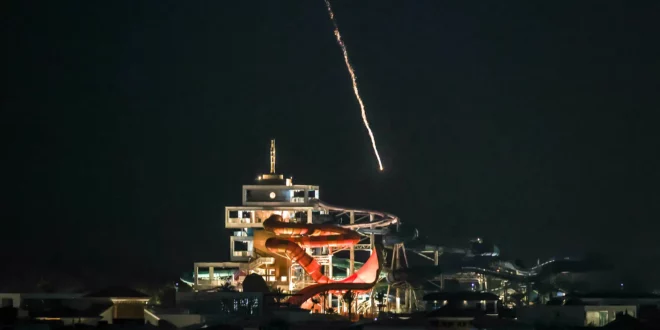
Shots of belching flames at the world’s first seven-star hotel aren’t the images Dubai wants Instagram influencers to share after decades spent cultivating the glittering city’s brand as a unique global hub of peace and prosperity.
Nor will the shots of fallen missile debris do anything for the reputation of the United Arab Emirates’ capital Abu Dhabi, ranked the world’s safest city for the 10th year in a row in 2026. Saudi Arabia, Qatar, Bahrain, Kuwait, Jordan and now Oman have also all come under Iranian attack after the U.S. and Israeli strikes against the Islamic Republic—despite having refused to be used as springboards for a war on Iran.
The attacks on civilian targets as well as U.S. bases are straining defense systems and forcing tough choices on the oil and gas rich Gulf Arab countries, which had built strong ties to U.S. President Donald Trump, but had also sought greater rapprochement with a weakened Iran despite traditional Sunni-Shiite rivalry.
The attacks have brought the Gulf countries together in a show of unity. They now face choices between whether to lobby Trump for a quick end to the conflict, whether to ride out the attacks and hope U.S. forces severely degrade a now-evident Iranian threat or whether they allow themselves to be drawn fully into the conflict and make even plainer their alignment with and reliance on U.S. power. The implications are important not only for the Middle East, but for relationships with China, India, Russia and beyond as geopolitics is reshaped under Trump.
“These are states that have spent years diversifying their economies, expanding their service sectors, and positioning themselves as stable investment hubs in an otherwise volatile region. Sustained attacks put that narrative at risk,” Elham Fakhro, a Research Fellow of the Middle East Initiative at the Harvard Kennedy School told Newsweek.
“The economic and reputational damage will depend heavily on duration: short-lived escalation can be absorbed, but prolonged instability is a harder story to manage with investors and markets,” she said.
Recognizing the strategic danger in attacking the neighbors, influential Iranian politician Ali Larijani, a possible successor to Supreme Leader Ayatollah Ali Khamenei after his death in the air strikes, told the neighbors the attacks were only because of the U.S. bases on their soil. But strikes on Dubai hotels and luxury apartments in Bahrain made clear that wasn’t the case.
Iranian Foreign Minister Seyed Abbas Araghchi appeared to blame Iranian forces acting independently for the attacks on Oman, a mediator between Iran and the United States.
Those attacks on Oman at the weekend prompted a new outpouring of coordinated responses from states of the Gulf Cooperation Council (GCC) with regional powerhouse Saudi Arabia offering Oman help for “any measures it may undertake” although Oman itself continued to push for dialogue.
Gulf Countries Unified
“These attacks have created the strongest near-term unifying impulse the Gulf has seen in years, because they cut across the region’s basic shared vulnerability: airspace, ports, energy infrastructure, and reliance on uninterrupted trade flows. I would describe the emerging unity as operational rather than political,” said Andreas Krieg, a Lecturer at King’s College London.
“It does not automatically translate into a unified offensive posture, and for the moment most Gulf actors look set to remain in a defensive stance while trying to shape Washington’s decision-making.”
The continued waves of attacks put pressure on civilians in the monarchies as well as military forces, with it being unclear how long stocks of interceptor missiles can hold out. The United Arab Emirates said it had downed 152 of 165 ballistic missiles, 506 out of 541 drones and both cruise missiles fired its way by late on Sunday. Kuwait said it had intercepted 97 Iranian ballistic missiles and 283 drones.
There is no sign of suing for peace yet, however. Having borne the brunt of the attacks and with three foreign workers killed and the world’s busiest international airport forced to close, the United Arab Emirates in fact raised the diplomatic ante: shutting its embassy in Iran.
In a message to Iran, senior Emirati politician Anwar Gargash said: “Through this escalation, you confirm the narrative of those who see Iran as the region’s primary source of danger, and its missile program as a perpetual title for instability… Return to your senses, to your surroundings, and deal with your neighbors with reason and responsibility before the circle of isolation and escalation widens.”
Standing With Trump
The closer alignment that the attacks have brought with Washington was evident from a joint statement on Sunday that said they and the United States “stand united in defense”.
“Iran’s willingness to strike repeatedly and at scale has changed the Gulf’s tolerance for a return to the old equilibrium where deterrence rests on assumptions of restraint,” said Krieg, adding that while some in the Gulf would welcome the degradation of the Iranian threat, they don’t want to be the battlefield where that happens.
“The most plausible Gulf preference is a short, controlled campaign that allows Washington to claim it has reduced the missile threat and then pivot back to a mediated off-ramp, rather than an open-ended war or regime-change logic.”
The Gulf countries are still not at the point of confronting Iran directly and while there is internal discussion of what that could mean there is opposition too.
“The Gulf states have spent the past several years moving deliberately toward de-escalation with Iran, precisely to avoid becoming caught in a broader confrontation,” said Fakhro.
“Saudi Arabia, in particular, has invested heavily in its economic transformation agenda and has little appetite for a conflict that would put that at risk. That posture could come under pressure if the current attacks persist. Even so, their incentives continue to favor rapid de-escalation over a prolonged campaign aimed at neutralizing Iran.”
Qatar’s former prime minister, Hamad bin Jassim bin Jaber Al Thani, warned of the danger of confrontation, and also of the other risk that Israel emerges as a greater force in the Middle East after the conflict—highlighting one of the fundamental divisions in the region that temporary unity over the Iranian attacks will not paper over for long.
“A reduced Iranian threat might improve the Gulf’s overall security environment, but it would also remove one of the key drivers of cohesion,” said Krieg.