 Eurasia Press & News
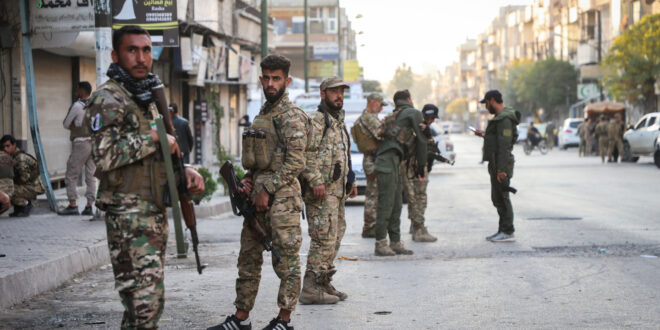
Violence in Homs raises questions over whether Syria’s new authorities can enforce the rule of law, or if the country risks reproducing patterns of warlordism
In late November and early December, the Syrian central city of Homs descended into a cycle of revenge killings and sectarian-coded attacks that exposed deep fractures in Syria’s nascent post-Bashar Al-Assad governance.
What began as “isolated criminal cases” spiralled into armed retaliation, the mass displacement of Alawite communities, and fears of broader destabilisation, revealing not merely security failures, but systemic questions about whether Syria’s transitional authorities can enforce the rule of law or if the country risks reproducing patterns of localised warlordism.
In the span of just days, Homs, Syria’s largest governorate by area, spanning 43,630 square kilometres or 23 percent of the country’s total territory and third by population, witnessed a cascade of violence that reanimated the trauma of civil war for residents who believed those years had passed.
Two young Alawite men were found dead in the backyard of Al Waer hospital after being kidnapped while on their way to work in the mostly Alawite Zahra neighbourhood. A few days before, an Alawite woman was shot dead outside her home in Akrama neighbourhood as she left with her husband.
Also, in the southern Homs town of Zaidel, a Bani Khalid tribal member and his wife were found murdered in their home, with the body of the wife burned and sectarian slogans scrawled on the walls.
Syrian Interior Ministry officials insisted that criminal investigations had established a crucial detail: the sectarian framing was fabricated.
The primary case, the Zaidel killings, stemmed from drug addiction and robbery, not sectarian motivation, according to the ministry’s statement.
The suspect, identified as Mohammad al-Hamid bin Khalifa, born in 1999 and a nephew of one of the victims, had written the sectarian slogans to misdirect investigators. He was an addict of crystal methamphetamine.
The Interior Ministry’s official spokesman Nour al-Din al-Baba told The New Arab that the perpetrator had confessed to all details of the murders, and the ministry condemned the use of crime to stir sectarian strife.
“The killer has no sectarian affiliation linked to the victims,” al-Baba said.
What officials say vs. what happened
Yet the reality on the ground told a different story.
Between 1-3 December, armed elements from the Bani Khalid tribe carried out retaliatory attacks across predominantly Alawite neighbourhoods, al-Muhajirin, al-Bassel, the Armenian quarter, and Zahra.
Witnesses documented torched shops and vehicles, random gunfire that killed and wounded civilians, and security forces firing into the air to disperse armed groups. The violence forced families to flee their homes or barricade themselves inside, an experience that has become dangerously too familiar.
The contradiction between official narratives and lived experience was instructive.
Officials insisted the violence was criminal in origin, deliberately framed in sectarian language. Yet the sectarian pattern of targeting, systematised attacks on Alawite neighbourhoods by armed tribal members, and the collective displacement it triggered suggested something more complex.
Whether rooted in sectarian animus or manipulated through sectarian language, the effect was undeniably sectarian. The distinction mattered for any criminal investigation but offered limited comfort to residents who fled their homes.
“This is a natural result of the de facto authorities failing in their duty to protect Syrians’ rights, especially the Alawites’ right to security and safety,” Ramia Jadaoun, a prominent activist from the National Bloc party, which was founded in September 2025 by figures from the former Syrian opposition and civil activists, told The New Arab.
“A series of violations, crimes, and the absence of serious investigations and real accountability led to armed, uncontrolled groups feeling emboldened to target this sect. This reflects continuing security chaos since the regime fell,” Jadaoun said.
The Alawite question and systemic failure
The question of state capacity has become an urgent one for Syria’s legal establishment as well.
Lawyer Muhammad Shannani, a member of the Homs Bar Association, emphasised the core problem: “We must establish awareness that accountability is the judiciary’s and the state’s responsibility. No party has the right to take revenge themselves.”
He warned that repeated assaults on civil peace undermine efforts to consolidate security.
“These events renewed demands to control and consolidate weapons in state hands, because individual and random revenge threatens civil peace and undermines efforts to establish security and stability,” Shannani told TNA.
Rights lawyer Samer al-Duaiyi, executive director of the Free Lawyers Association, offered a more pessimistic reading of what Homs’s chaos revealed.
“Homs is not a stable city,” he said. “It suffers from accumulated tribal, political, and social tensions over the years. There’s a defect in security management in Homs; neighbourhoods are divided along lines of local loyalty, which hinders police response and rapid resolution, leaving space for weapons proliferation and chaos.”
Al-Duaiyi identified what may be the most dangerous development: the blurring of lines between crime and political statements, as “some official and tribal actions are treating the events as if they constitute a political position taken by an armed group”.
He stressed that “only the state security forces must hold weapons and declare escalation or de-escalation. Otherwise, we reproduce the model of local protection committees like in Suweida”.
That reference to Suweida governorate, where local Druze armed forces have been operating with significant autonomy from central authority following sectarian clashes and massacres a few months ago, underscored a genuine fear, according to Al Duaiyi, that Homs could become another arena where state authority remains nominal while tribal and sectarian power brokers determine security conditions on the ground.
The danger of fragmented authority
Homs’s December violence exposed a governance vacuum that transcended individual crimes, according to experts, as the post-Assad administration inherited a country where state capacity was never fully consolidated, and where tribal, sectarian, and local networks often supersede national institutions.
In Homs specifically, security authority appears fragmented along loyalty lines rather than geographic or functional boundaries, a recipe for delayed responses, competing authorities, and the proliferation of uncontrolled weapons, they added.
“This raises serious questions about how armed groups came to possess weapons in numerous areas. After the regime’s fall, those in security and military institutions were supposed to undergo settlements and surrender their arms. Yet armed groups, including tribal ones, acquired weapons and used them in coercive practices against members of the Alawite sect across multiple regions,” according to activist Jadaoun.
“This reality is not new or confined to Homs; it represents the culmination of security chaos and the allowance of such groups to arm themselves and operate outside the law”.
The governorate’s geographic position has also amplified the risk.
At 23 percent of Syria’s land area, Homs connects northern and southern regions, encompasses both Alawite and Sunni communities, and contains tribal structures that extend into neighbouring areas.
“Violence in Homs rarely stays contained, and unresolved sectarian cycles in the capital of Syria’s largest governorate create conditions for it to spread to neighbouring Tartous, Latakia, or southward toward Hama. What begins as a local security failure can quickly metastasise into regional instability,” Al Duaiyi warned.
Syrian civil society activists have called for comprehensive measures, including disarming militia and tribal weapons, genuine judicial accountability for perpetrators, and restoration of state authority as the guarantor of civil peace. Their demands reflected recognition that without institutional reform, individual crimes become templates for broader conflict.
The violence in Homs represents less a singular security crisis than a test of whether Syria’s transitional authorities can establish themselves as monopolists of legitimate force and enforcers of impartial law.
Officials insisted they were doing so. The criminal investigations, they argued, proved the sectarian narrative false, a fabrication designed to inflame tensions.
Yet the very need to make that argument, according to experts, and the fact that residents fled their homes despite official investigations, suggests that state authority remains conditional and fragile.