 Eurasia Press & News
Key Takeaways
Iranian-backed Iraqi militias are likely responsible for at least some of the recent drone attacks against Gulf states. It is very unlikely that Iranian-backed Iraqi militias would conduct drone attacks against regional states if the Iranian regime opposed such attacks, which suggests that Iran has not ordered its militia partners to cease attacking regional states.
The US negotiating delegation demanded a 20-year moratorium on uranium enrichment, the removal of Iran’s highly enriched uranium (HEU) stockpile from Iran, and unfettered freedom of navigation through the Strait of Hormuz during the negotiations in Pakistan. Iran countered the 20-year moratorium on uranium enrichment with a “single-digit” number of years and offered to downblend its HEU instead of handing over its HEU stockpile. It is unclear whether the three US demands and the Iranian counterproposal represent the full scope of each side’s demands.
US Central Command (CENTCOM) is simultaneously imposing a blockade on Iranian ports and vessels while taking steps to open the official transit route through the Strait of Hormuz for vessels transiting to or from non-Iranian ports. CENTCOM implemented its blockade on Iranian ports and vessels at 10:00 AM ET on April 13.
Iranian and Iranian-approved vessels continued to use the Iranian-approved transit route to cross the Strait of Hormuz before the blockade went into effect on April 13, but more vessels transited outside this route near the Omani coast than on April 12. At least two oil tankers destined for China via the Iranian-approved transit route turned around after CENTCOM began blockading Iranian and Iranian-approved shipping.
Toplines
Iranian-backed Iraqi militias are likely responsible for at least some of the recent drone attacks against Gulf states. The Bahrain Defense Force reported that it intercepted seven “Iranian” drones on April 13.[1] Bahrain did not specify from where the drones were launched.[2] Iranian-backed Iraqi militias use some of the same types of drones as Iranian forces do because the Islamic Revolutionary Guards Corps (IRGC) supplies drones to its Iraqi militia partners.[3] It is therefore possible that the Bahrain Defense Force’s use of the term “Iranian” drones refers to Iranian drones used by Iraqi militias. Bahrain’s Foreign Ministry also summoned the Iraqi charge d’affaires on April 13 in response to “continued” Iraqi militia drone attacks targeting Bahrain and other Gulf Cooperation Council states.[4] Saudi Arabia similarly summoned the Iraqi ambassador to Saudi Arabia on April 12 for the same reason.[5] Iranian-backed Iraqi militia front groups have claimed multiple drone attacks targeting US bases in Saudi Arabia, Bahrain, and Kuwait since the start of the war.[6]
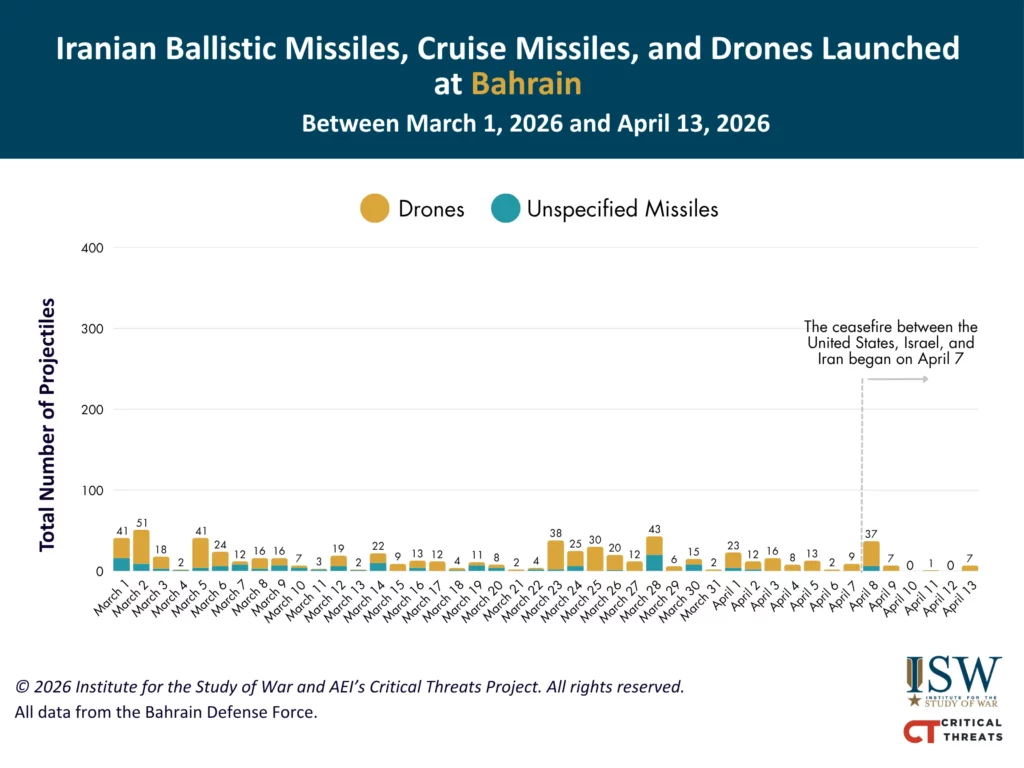
It is very unlikely that Iranian-backed Iraqi militias would conduct drone attacks against regional states if the Iranian regime opposed such attacks, which suggests that Iran has not ordered its militia partners to cease attacking regional states. Many Iranian-backed Iraqi militias answer to the IRGC, which provides guidance and support for their attacks.[7] The IRGC has previously demonstrated its ability to force Iraqi militias to halt their attacks, such as when IRGC Quds Force Commander Brigadier General Esmail Ghaani directed Iranian-backed Iraqi militias to halt their attacks against US forces in January 2024.[8] The fact that Iraqi militias continue to attack the Gulf states, therefore, suggests that Iran has not directed the militias to halt these attacks.
Some Iranian-backed Iraqi militias have continued to attack regional states despite the Shia Coordination Framework’s efforts to push the militias to agree to a “truce.”[9] An informed source told Iraqi media on April 5 that the framework authorized Iranian-backed Badr Organization head Hadi al Ameri to negotiate a “temporary truce” with the militias.[10] The source stated that Ameri’s negotiations focused on Iranian-backed Iraqi militias Kataib Hezbollah and Harakat Hezbollah al Nujaba, both of which are more loyal to Iran and are less responsive to domestic pressure than other Iraqi militias.[11] Framework member Amer al Fayez told Iraqi media on April 12 that Ameri’s committee successfully negotiated a “conditional truce” with the militias.[12] Fayez stated that the truce stipulated that Iranian-backed Iraqi militias would halt attacks on US interests and diplomatic facilities in exchange for a commitment from the United States and Israel to stop striking Popular Mobilization Forces (PMF) and militia bases in Iraq.[13] It is unclear whether the truce required the militias to halt attacks against US interests across the region, or only in Iraq. Iranian-backed Iraqi militias control multiple brigades within the PMF.[14] It is unclear which militias agreed to this truce.
Iran rejected a US proposal to pause uranium enrichment for 20 years in exchange for the unfreezing of some Iranian assets and ending the current war during talks in Islamabad, Pakistan, on April 11 and 12. A US official and a source with knowledge told Axios on April 13 that the United States demanded a 20-year moratorium on uranium enrichment, the removal of Iran’s highly enriched uranium (HEU) stockpile from Iran, and unfettered freedom of navigation through the Strait of Hormuz during the negotiations in Pakistan.[15] The US delegation offered to release a “certain portion” of frozen Iranian assets and end the current conflict in exchange for Iran meeting these demands.[16] Iran countered the 20-year moratorium on uranium enrichment with a “single-digit” number of years and offered to downblend its HEU instead of handing over its HEU stockpile.[17] Iran’s reported counterproposal to dilute its HEU is consistent with the position of some regime officials before the current conflict began, when Iran was in a relatively stronger position than it is now.[18] Iran presumably seeks to dilute rather than hand over its HEU stockpile so that it could re-enrich this stockpile at some point in the future.
An Israeli journalist reported on April 13 that the Iranian delegation in Islamabad, led by Parliament Speaker Mohammad Bagher Ghalibaf and Foreign Affairs Minister Abbas Araghchi, discussed Iran’s nuclear program “contrary to instructions from Tehran.”[19] The only Iranian officials who could presumably give such instructions are IRGC Commander Major General Ahmad Vahidi or Supreme Leader Mojtaba Khamenei. This report is consistent with CTP-ISW’s assessment that there appear to be internal divisions among regime power centers and that the regime appears to lack a unified negotiating strategy.[20]
It is unclear whether the above three US demands and Iranian counterproposal represent the full scope of each side’s demands. Regime-affiliated media reported on April 11 that Iranian demands included sovereignty over the Strait of Hormuz, compensation for war damages, and a region-wide ceasefire across the “Axis of Resistance.”[21] It is unclear whether the Iranian delegation raised these demands during the April 11-12 negotiations, however. It is also unclear whether recent reports capture the entirety of US demands during the talks in Islamabad. US demands have previously included limits to Iran’s ballistic missile program and funding for its regional proxies and partners.[22] It is possible that the negotiations in Islamabad concluded before these issues were raised because it was clear that the gap between the delegations’ positions on core demands was too wide to resolve. US President Donald Trump stated on April 13 that Iran contacted US officials about conducting a second round of negotiations.[23] A US official and a regional source told Axios on April 13 that regional mediators, including Pakistan, Turkey, and Egypt, will speak to US and Iranian officials in the coming days to “bridge the remaining gaps” between the two sides and seek to facilitate a second round of discussions before the two-week ceasefire ends on April 21.[24]
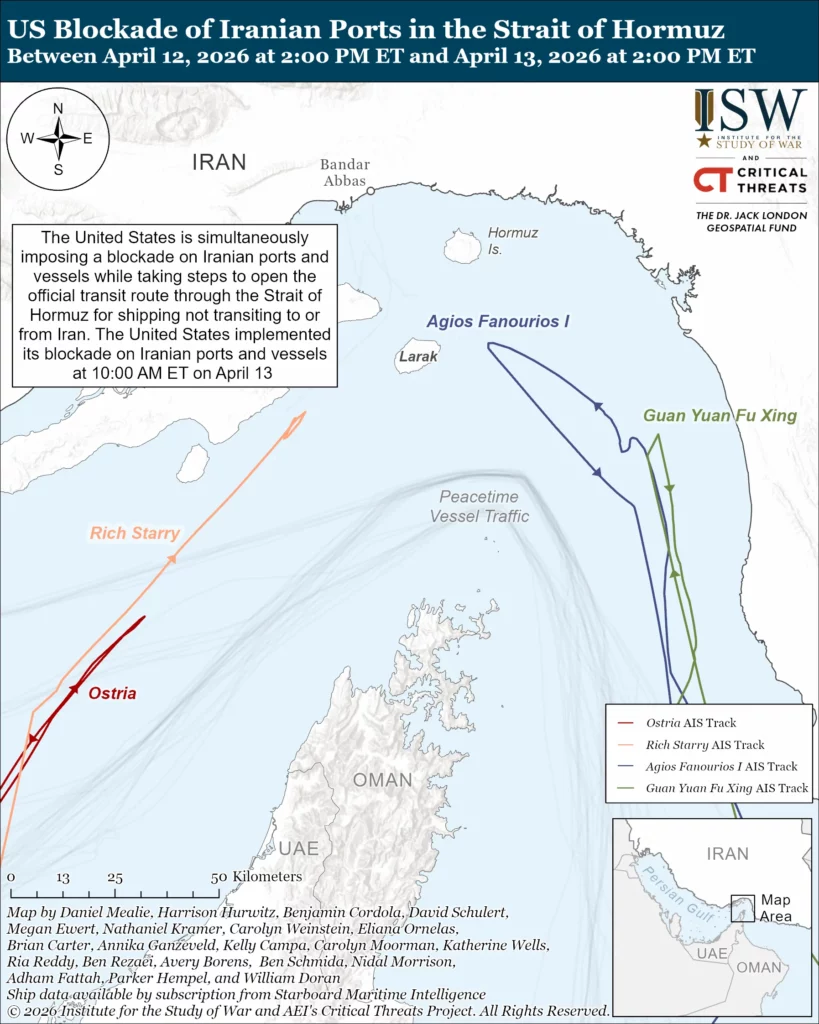
US Central Command (CENTCOM) is simultaneously imposing a blockade on Iranian ports and vessels while taking steps to open the official transit route through the Strait of Hormuz for vessels transiting to or from non-Iranian ports. CENTCOM implemented its blockade on Iranian ports and vessels at 10:00 AM ET on April 13.[25] CENTCOM announced on April 13 that it will enforce a blockade on vessels from all nations that enter or depart Iranian ports and coastal areas, including ports in the Persian Gulf and Gulf of Oman.[26] CENTCOM noted that it will not impede freedom of navigation for vessels transiting the Strait of Hormuz to or from non-Iranian ports.[27] United Kingdom Maritime Trade Operations (UKMTO) reported on March 13 that US forces are enforcing “maritime access restrictions” on Iranian ports and coastal areas in the Persian Gulf, Gulf of Oman, and parts of the Arabian Sea.[28] UKMTO reported that CENTCOM granted “neutral vessels” currently docked at Iranian ports a limited grace period to depart.[29] UKMTO did not specify the length of the “limited grace period,” however. UKMTO added that CENTCOM’s blockade will not impede traffic to or from non-Iranian ports, but that vessels may encounter US “military presence, directed communications, or right-of-visit procedures” while transiting the strait.[30] A senior US official told the Wall Street Journal on April 13 that over 15 US naval vessels are supporting the blockade.[31] The official did not specify which vessels are implementing the blockade, but CENTCOM currently has an aircraft carrier, multiple guided-missile destroyers, an amphibious assault ship, and several other warships deployed near the strait.[32] Two US missile destroyers also deployed to the Persian Gulf via the Strait of Hormuz on April 11.[33] CENTCOM did not specify what procedures it intends to use to enforce the blockade, but US forces have previously interdicted Venezuelan and Russian oil tankers using small boarding teams transported by helicopters deployed from naval vessels.[34] US President Donald Trump said on April 13 that he expects unspecified countries to assist CENTCOM with the blockade of Iranian ports and vessels.[35] Trump previously said on April 12 that some Gulf countries are supporting US naval mine-clearing efforts, but it is unclear whether they would help enforce the blockade.[36] The United Kingdom and France said that they will not take part in the blockade.[37]
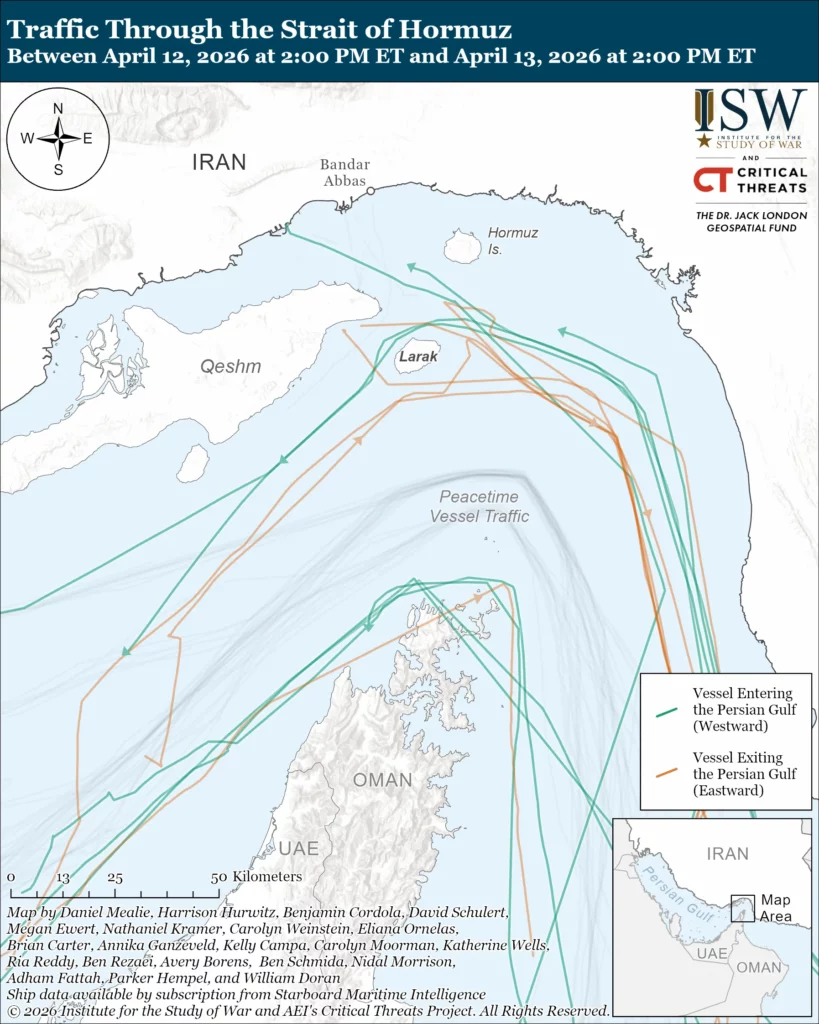
Iranian and Iranian-approved vessels continued to use the Iranian-approved transit route to cross the Strait of Hormuz before the blockade went into effect on April 13, but more vessels transited outside this route near the Omani coast than on April 12. Several Western media outlets reported that at least two Iranian-linked tankers, the Aurora and the New Future, departed the Strait of Hormuz on April 13 before CENCTOM implemented its blockade on Iranian ports and vessels.[38] Kpler and London Stock Exchange Group data indicate that the Aurora is transporting Iranian oil products, while the New Future is transporting diesel loaded from the Hamriyah Port in the United Arab Emirates (UAE) to Oman.[39] The New Future’s previous three “trades” were with Iran, according to the New York Times.[40] Commercially available shipping data also shows that at least six vessels entered the Strait of Hormuz via the Iranian-approved transit route, while at least four other vessels entered the strait outside the Iranian-approved route near the Omani coast on April 13. The shipping data further shows that at least five vessels departed the Strait of Hormuz via the Iranian-approved transit route, while one vessel departed outside the Iranian-approved route near the Omani coast on April 13. It is unclear whether the five vessels that departed the strait on April 13 are included in CENTCOM’s “limited grace period.”[41]
At least two oil tankers destined for China via the Iranian-approved transit route turned around after CENTCOM began blockading Iranian and Iranian-approved shipping.[42] CBS reported that two falsely flagged oil tankers, the Rich Starry and the Ostria, changed course less than an hour before CENTCOM began enforcing the blockade.[43] A successful US blockade of Iranian and Iranian-approved shipping would cut off Iran’s main source of revenue by disrupting its nearly 2 million barrel-per-day oil export trade.[44] A sanctions-focused US analyst estimated on April 13 that a successful blockade on Iranian ports and shipping would cost the regime around $435 million USD per day, leaving Iran with few alternatives to export and import goods.[45] The analyst added that Iran’s onshore oil storage capacity is 13 days, after which Iran would have to shut down its oil fields, potentially causing long-term damage to the oil fields.[46]
US and Israeli Air Campaign
Nothing significant to report.
Iranian Response
Nothing significant to report.
Israeli Campaign Against Hezbollah and Hezbollah Response
Israeli and Lebanese officials appear to disagree over the scope of the upcoming Lebanese-Israeli preparatory talks. Lebanese Ambassador to the United States Nada Hamadeh, Israeli Ambassador to the United States Yechiel Leiter, and US Ambassador to Lebanon Michel Issa are scheduled to meet in Washington, DC, on April 14.[47] Lebanese President Joseph Aoun’s office announced on April 10 that Hamadeh, Leiter, and Issa agreed to hold a preparatory meeting to discuss the declaration of a ceasefire and a date to begin direct Israeli-Lebanese negotiations under US auspices.[48] Leiter stated that Israel agreed to begin formal negotiations on April 14 but noted that Israel refuses to discuss a ceasefire with Hezbollah, however.[49] Israeli Prime Minister Benjamin Netanyahu similarly reiterated on April 12 that the preparatory talks will focus on disarming Hezbollah and efforts to reach “a lasting peace” between Israel and Lebanon.[50]
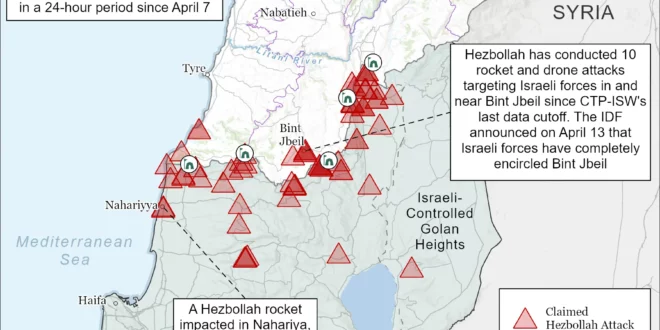
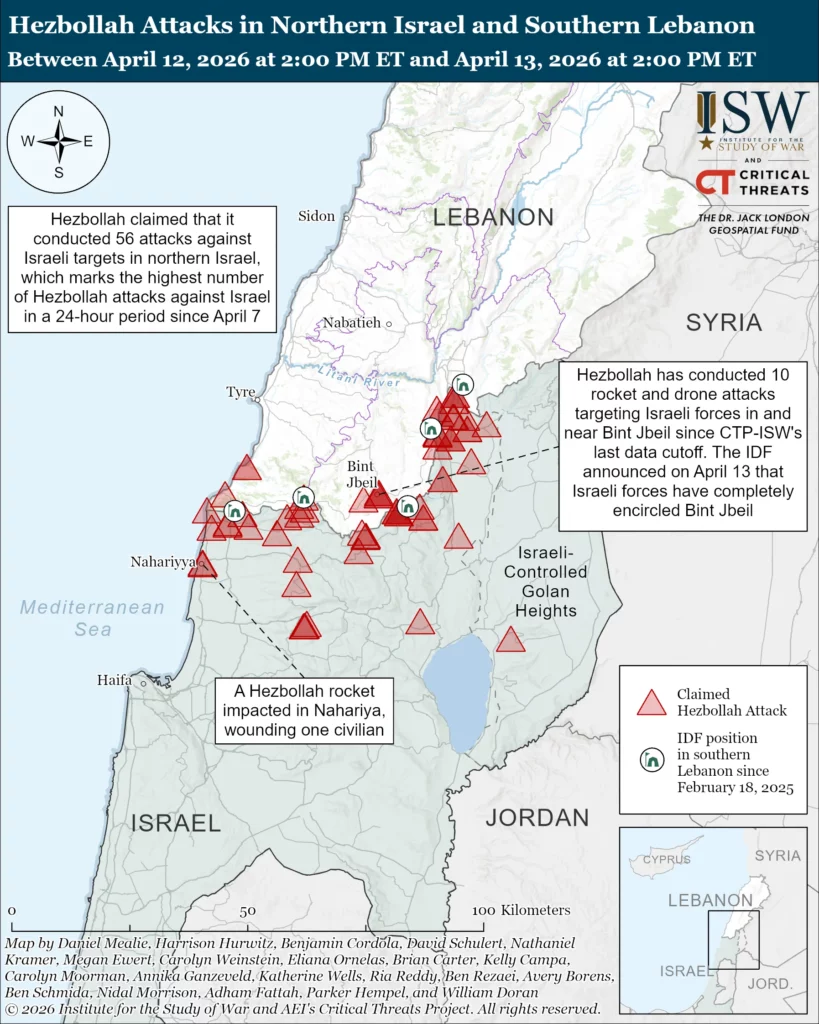
Hezbollah claimed that it has conducted 56 attacks targeting IDF infrastructure and Israeli communities in northern Israel since CTP-ISW’s last data cutoff on April 12.[51] Hezbollah has claimed 42 attacks against Israeli targets in northern Israel as of 2:00 PM ET on April 13, which is a relative increase from its claimed rate of fire targeting northern Israel on April 12 (see April 12 data in graphic below).[52] An Israeli military correspondent reported that Hezbollah launched a barrage of less than 10 rockets targeting Nahariya on April 13.[53] The correspondent reported that at least one rocket impacted in Nahariya, which wounded one civilian and caused material damage.[54] An Israeli military correspondent also reported that Hezbollah fired five rockets targeting Karmiel on April 13.[55] The correspondent reported that the IDF intercepted four of the rockets and allowed one to fall in an open area.[56] Hezbollah also claimed that it conducted seven drone and rocket attacks targeting Kiryat Shmona, which has been one of Hezbollah’s most frequent targets in northern Israel because of its proximity to the Israel-Lebanon border.[57]
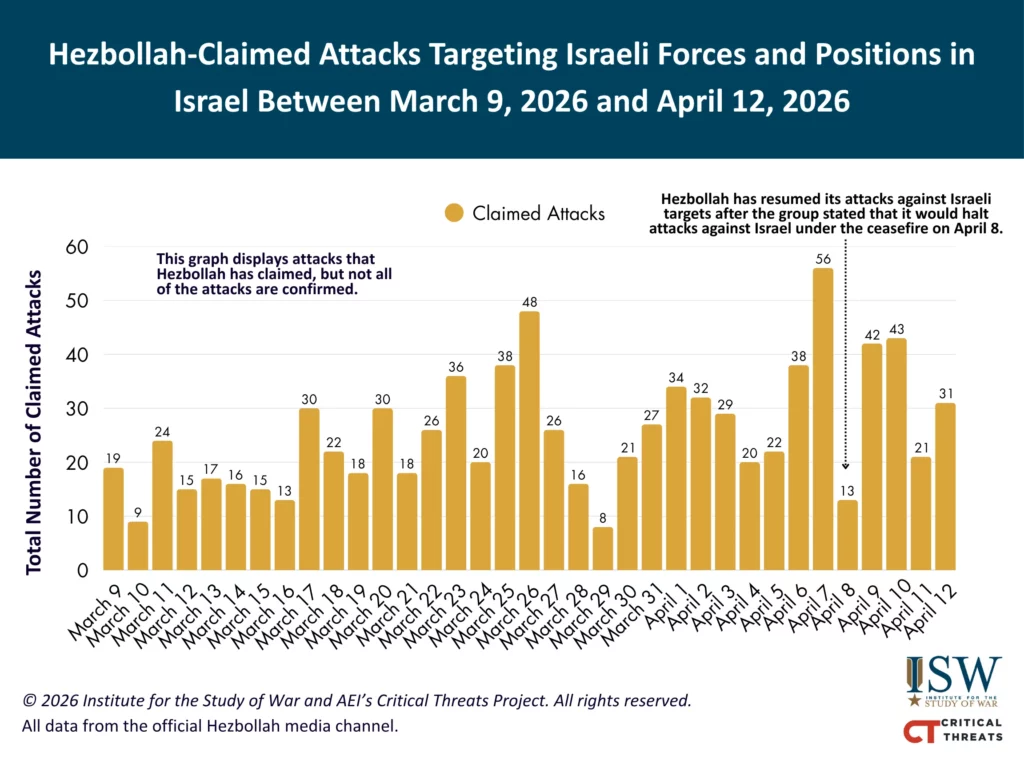
Hezbollah claimed that it has conducted 19 attacks targeting Israeli forces in southern Lebanon since CTP-ISW’s last data cutoff on April 12.[58] Hezbollah claimed 10 rocket and drone attacks targeting IDF forces in Bint Jbeil and surrounding villages amid the IDF’s isolation of and advance into Bint Jbeil on April 13.[59] An Israeli military correspondent reported that a Hezbollah drone attack wounded eight IDF personnel in southern Lebanon on April 13.[60]
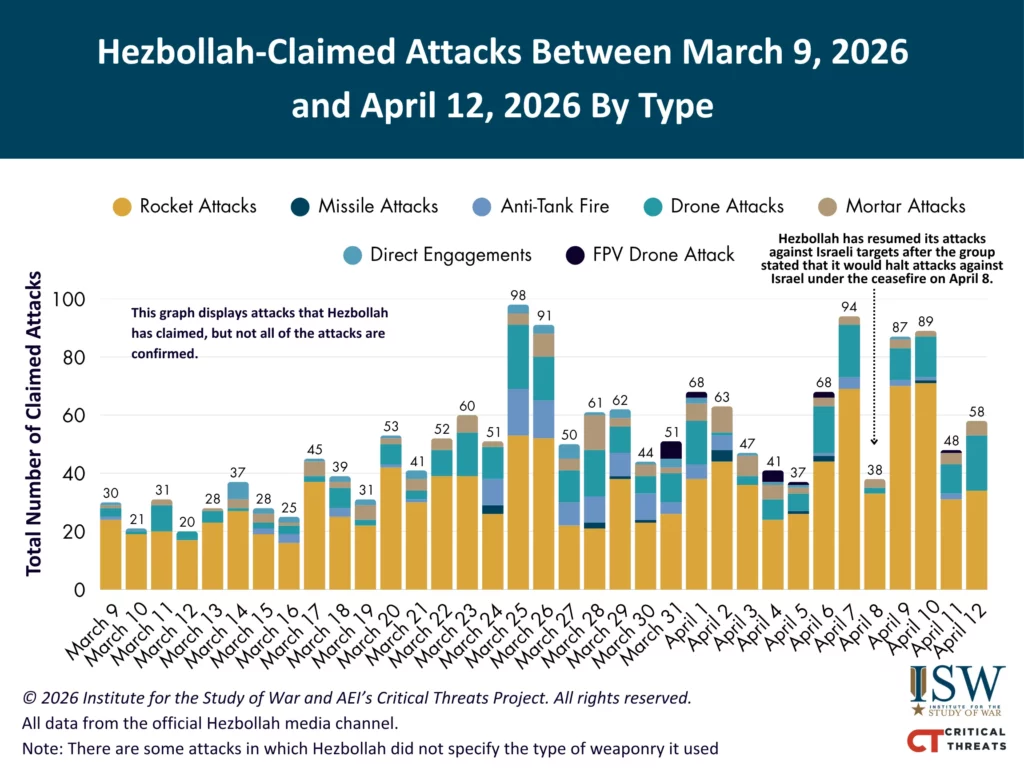
Hezbollah has sustained a high rate of drone attacks against Israeli targets since it resumed its attacks against Israeli targets on April 8 (see below). Hezbollah has claimed 22 drone attacks as of 2:00 PM ET on April 13.[61] Hezbollah previously claimed 19 drone attacks on April 12.[62] An Israeli think tank previously noted on March 23 that drones are increasingly becoming “a significant component of [Hezbollah’s] campaign.”[63] Hezbollah prioritized domestic drone production and shifted its munition rehabilitation budget to focus on drones after the Fall 2024 conflict.[64] Hezbollah has long assembled low-cost Ayoub and Mersad drones in Lebanon using civilian parts ordered online.[65]
The IDF has continued to conduct airstrikes targeting Hezbollah infrastructure and fighters across Lebanon. The IDF struck approximately 150 Hezbollah targets across Lebanon in the past 24 hours.[66] The IDF stated that it struck rocket and drone launchers, anti-tank guided missile (ATGM) launch sites, Hezbollah command centers, unspecified military buildings, and Hezbollah fighters.[67] The IDF confirmed that it killed over 250 Hezbollah fighters and commanders in its April 8 strikes on Beirut, the Bekaa Valley, and southern Lebanon.[68] The Lebanese Health Ministry reported that the IDF’s April 8 strikes killed 357 individuals.[69] The IDF confirmed that it killed the following Hezbollah commanders:
Hassan Mustafa Nasser.[70] Nasser was Hezbollah’s Logistics Support Staff Commander. The IDF stated that Nasser was a veteran commander responsible for acquiring and storing Hezbollah’s military equipment. The IDF added that Nasser was a central figure in Hezbollah’s reconstitution efforts.
Ali Qassem (“Abu Ali Abbas”).[71] Qassem was a senior commander in Hezbollah’s Intelligence Unit. The IDF stated that Qassem was one of the commanders responsible for collecting intelligence on Israel and identifying Israeli targets.
Ali Hijazi.[72] Hijazi was a senior commander in Hezbollah’s Intelligence Unit. The IDF stated that Hijazi was also responsible for collecting intelligence on Israel and identifying Israeli targets.
“Abu Muhammad Habib.”[73] Habib was the deputy commander of Hezbollah’s Missile Unit. This unit launched missiles targeting Israel during the Fall 2024 Israel-Hezbollah conflict and in the current war. The IDF added that Habib recently led operations to bolster the unit’s capabilities.
Israeli forces have continued to conduct ground operations in southern Lebanon since CTP-ISW’s last data cutoff at 2:00 PM ET on April 12. The IDF reported that the 7th Armored Brigade (36th Armored Division) and the “Yahalom” Special Operations Force Unit (IDF Combat Engineering Corps) destroyed an underground Hezbollah tunnel in Taybeh, southeastern Lebanon, on April 13.[74] Israeli forces located a Hezbollah cell planning to launch drone attacks targeting Israeli forces and directed an Israeli strike targeting one of the fighters on April 13.[75] Israeli soldiers also directed an airstrike on a loaded Hezbollah launcher on April 13.[76]
Israeli Defense Minister Israel Katz stated on April 12 that Israel’s “Operation Silver Plow” is focused on “leveling” Hezbollah infrastructure and houses that the group uses to launch projectiles at Israel.[77] Katz added that the goal of this operation is to disarm Hezbollah and evacuate all Lebanese residents south of the Litani River.[78] Israeli Prime Minister Benjamin Netanyahu stated on April 12 that Israeli forces are working to “push back” the threat of Hezbollah ATGMs and rocket attacks, but noted that the IDF will need to conduct further operations.[79] Katz’s announcement comes as the Israeli government tightened restrictions on public gatherings and reversed a decision to reopen schools in northern Israel on April 12.[80]
The IDF has nearly taken control of the town of Bint Jbeil in southeastern Lebanon.[81] The IDF had isolated Hezbollah fighters in Bint Jbeil as of April 9 and has conducted raids and engaged Hezbollah fighters in neighborhoods throughout the town since then.[82] The IDF has killed over 100 Hezbollah fighters in the area.[83] Three brigades—the 35th Paratrooper Brigade, 89th Commando Brigade, and 84th (Givati) Infantry Brigade—are currently operating to clear the town of remaining fighters.[84] An Israeli military correspondent said that there are a “few dozen” Hezbollah fighters left in the city.[85] The IDF estimated that at least 150 Hezbollah fighters were in Bint Jbeil before the IDF operation.[86] Hezbollah fighters fired rockets and drones targeting Israeli forces operating in and around Bint Jbeil on April 12 and 13.[87] Hezbollah can fire rockets and drones from a considerable distance and likely did not fire these munitions at Israeli forces from within the city.
An unspecified Israeli military official told Reuters on April 13 that the IDF will achieve full operational control of Bint Jbeil within days.[88] Securing Bint Jbeil is operationally significant for the IDF because it is located at the nexus of multiple main roads in southeastern Lebanon, including the Tebnine-Bint Jbeil road, that the IDF could use to advance north and link with Israeli forces advancing from other axes. Israeli political officials have expressed Israel’s intent to create a “security zone” that extends between eight and ten kilometers north of the Israeli border.[89] The IDF seized Bint Jbeil Stadium in the town center on April 13.[90] Former Hezbollah Secretary General Hassan Nasrallah delivered a victory speech in this stadium in 2000 following the IDF’s withdrawal from southern Lebanon.[91]