 Eurasia Press & News
Key Takeaways
Iranian Parliament Speaker Mohammad Bagher Ghalibaf appears to be engaged in a serious intra-regime debate with Islamic Revolutionary Guards Corps (IRGC) Commander Major General Ahmad Vahidi and other senior regime officials opposed to negotiations with the United States.
Vahidi appears to have the upper hand over Ghalibaf at the moment. Vahidi is reportedly the only Iranian official with direct access to Supreme Leader Mojtaba Khamenei and is serving as a conduit for relaying key decisions to other regime officials, according to Israeli media on April 19.
US and Iranian delegations will reportedly meet in Islamabad, Pakistan, for a second round of talks in the coming days. US and Iranian demands appear to have largely stayed the same, however.
The US Navy continued to enforce its blockade of Iranian ports, directing 27 vessels to change course since the start of the blockade. US forces likely forced two Iranian-linked vessels attempting to violate the Navy’s blockade to turn around.
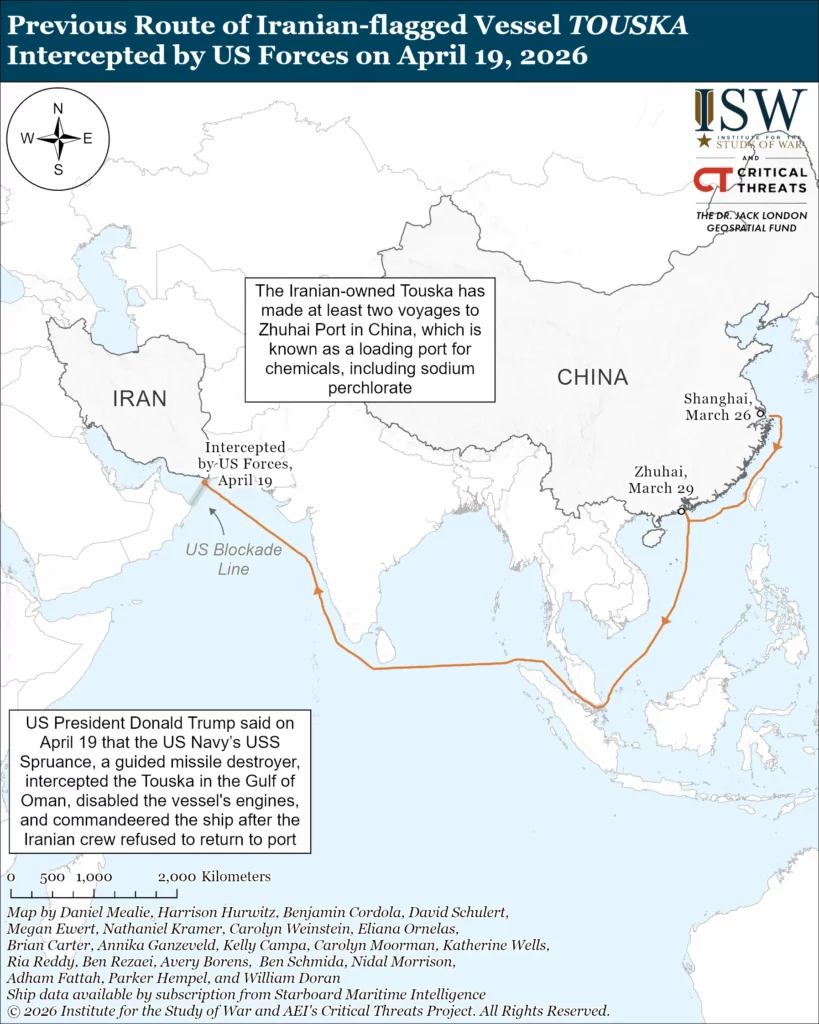
The Khatam ol Anbia Central Headquarters claimed that the April 19 seizure of the Iranian-flagged, US-sanctioned Touska by the US Navy violated the US-Iran ceasefire. Unspecified security sources told Reuters that the Touska was likely transporting dual-use items from China to Iran.
The Iranian Parliament is attempting to formalize Iranian “control” over the Strait of Hormuz by drafting a bill that would ban Israeli-linked vessels from transiting the Strait of Hormuz, require vessels from “hostile countries” to obtain approval from Iran’s Supreme National Security Council to transit the strait, and bar states that “caused damage” to Iran from transiting the strait until they paid reparations to Iran.
Toplines
Iranian Parliament Speaker Mohammad Bagher Ghalibaf appears to be engaged in a serious intra-regime debate with Islamic Revolutionary Guards Corps (IRGC) Commander Major General Ahmad Vahidi and other senior regime officials opposed to negotiations with the United States. Ghalibaf publicly defended negotiations on Iranian state television on April 18, arguing that diplomacy with the United States, alongside military power, is necessary to secure Iran’s objectives.[1] Ghalibaf also reportedly criticized hardline officials, including Supreme National Security Council (SNSC) member Saeed Jalili and hardline parliamentarian Amirhossein Sabeti, for their opposition to negotiations during a meeting with advisers, but his criticisms were likely implicitly directed at Vahidi. US officials separately told Axios on April 20 that the US negotiating delegation thought it was “negotiating with the right people“ in Islamabad on April 11 and 12 but that the IRGC effectively told the Iranian negotiating delegation upon their return to Tehran that they ”don’t speak for” the IRGC.[2] Senior regime officials, including former IRGC Intelligence Organization Chief Hossein Taeb, reportedly called the Iranian negotiating delegation back to Tehran after it surpassed its mandate.[3] A second US official told Axios that “we aren’t sure who’s in charge and neither do they.”[4] This report is consistent with ISW-CTP’s assessment that there is a division between Vahidi and his inner circle and members of Iran‘s negotiating team over Iran’s negotiations policy.[5] This report is also consistent with ISW-CTP’s assessment that Iranian Supreme Leader Mojtaba Khamenei has not played the role of cohering and arbitrating between various factions as his father used to do, which has likely exacerbated intra-regime fighting.[6]
Vahidi appears to have the upper hand over Ghalibaf at the moment. Vahidi is reportedly the only Iranian official with direct access to Supreme Leader Mojtaba Khamenei and is serving as a conduit for relaying key decisions to other regime officials, according to Israeli media on April 19.[7] Israeli media also reported on April 19 that Iranian officials‘ inability to contact Mojtaba is a significant obstacle to continued US-Iran negotiations.[8] Ghalibaf’s push for diplomacy and apparent effort to reach a deal may also be a bid to protect his domestic position and maintain credibility.[9] Ghalibaf reportedly fears that both his and Araghchi’s positions are at risk if the IRGC consolidates control.[10] Ghalibaf’s removal as the parliament speaker would represent a major defeat for Ghalibaf and his domestic positions and signify a victory for Vahidi. These reports are consistent with ISW-CTP’s ongoing assessment that Vahidi and members of his inner circle have likely consolidated control over not only Iran’s military response in the conflict but also Iran’s negotiations policy.[11]
US and Iranian delegations will reportedly meet in Islamabad, Pakistan, for a second round of talks in the coming days.[12] Two US officials speaking to the New York Times on April 20 stated that US Vice President JD Vance will travel to Pakistan on April 21. Two Iranian officials told the New York Times that Iranian Parliament Speaker Mohammad Bagher Ghalibaf, who led the Iranian delegation in the first round of talks, would attend the upcoming talks if Vance attended.[13] US and Iranian demands appear to have largely stayed the same. US officials speaking to the Wall Street Journal stated that the US delegation is pushing for the immediate reopening of the Strait of Hormuz, a pause in Iranian uranium enrichment for at least 20 years, and the removal of Iran’s highly enriched uranium (HEU) stockpile from Iran.[14] The Wall Street Journal reported that Iran’s demands are Iranian ”control” over the strait, the lifting of sanctions on Iran, and a shorter pause in uranium enrichment.[15] US President Donald Trump previously indicated that a pause in enrichment would be insufficient to meet US demands.[16]
The Khatam ol Anbia Central Headquarters claimed that the April 19 seizure of the Iranian-flagged, US-sanctioned Touska by the US Navy violated the US-Iran ceasefire.[17] The spokesperson for the Khatam ol Anbia Central Headquarters, which is functionally controlled by the IRGC, warned on April 19 that Iranian forces will respond to the US seizure of the Touska and asserted that the United States had “violated the ceasefire.”[18] Unspecified security sources told Reuters that the Touska was likely transporting dual-use items from China to Iran.[19] The sources added that the Touska had previously transported dual-use items to Iran.[20] US Central Command (CENTCOM) told United Kingdom Maritime Trade Operations (UKMTO) on April 16 that it considers raw materials such as oil, iron, steel, aluminum, and certain civilian goods with both civilian and military applications to be “conditional contraband.”[21] CENTCOM also defined electronic components, computer systems, machinery, and power generation equipment as “conditional contraband.”[22] The Touska visited the port of Zhuhai in China in March.[23] Zhuhai Port is considered a loading port for chemicals, including missile fuel precursor sodium perchlorate, according to the Washington Post.[24] The Wall Street Journal reported that a subsidiary of the US-sanctioned Islamic Republic of Iran Shipping Lines (IRISL), Rahbaran Omid Darya Ship Management, owns the Touska.[25] Two vessels owned by Rahbaran Omid Darya Ship Management transported approximately 1,000 tons of material used in missile propellant in 2025, according to the Wall Street Journal.[26]
Iran likely continued to prevent non-Iranian-linked vessels from transiting the Strait of Hormuz. Commercially available shipping data indicates that Iran forced the Marshall Islands–flagged Capetan Costas S and the Curaçao-flagged Lumina Ocean to alter course after they attempted to transit the strait via the Iranian-approved route following their departure from Basra, Iraq.[27] These incidents follow a similar incident on April 19, when the IRGC forced the Botswana-flagged Meda and the Angola-flagged G Summer to change course after the vessels attempted to cross the Strait of Hormuz.[28]
The Iranian Parliament is attempting to formalize Iranian “control” over the Strait of Hormuz.[29] Iranian parliamentary legislation requires additional approval from the Guardian Council before it is enacted into law.[30] Iranian media reported on April 19 that Iran’s parliament is drafting a bill that would ban Israeli-linked vessels from transiting the Strait of Hormuz, require vessels from “hostile countries” to obtain approval from Iran’s Supreme National Security Council to transit the strait, and bar states that “caused damage” to Iran from transiting the strait until they paid reparations to Iran.[31] The Iranian parliamentarian who announced the bill said that Iran would allocate some of the revenue from Strait of Hormuz transit fees to fund the Iranian armed forces’ reconstitution under the bill.[32] This report follows a similar report on March 26 that Iran’s parliament was working to formalize a process for vessels to pay Iran in exchange for safe passage through the Strait of Hormuz.[33] Iranian Parliamentary National Security and Foreign Policy Commission head Ebrahim Azizi told the BBC on April 20 that Iran will “never” be ready to give up its “control” of the Strait of Hormuz.[34] Azizi added that Iran’s “control” of the strait will be signed into law, in reference to the Iranian parliamentary bill described above.[35] Azizi characterized Iran’s “control” of the strait as “one of [Iran’s] assets to face the enemy.”[36] These comments reflect the Iranian regime’s view that the Strait of Hormuz is Iran’s main point of leverage vis-a-vis the United States.
The US Navy continued to enforce its blockade of Iranian ports and likely forced two Iranian-linked vessels attempting to violate the Navy’s blockade to turn around. CENTCOM announced on April 20 that US forces have directed 27 vessels to change course since the start of the blockade.[37] These vessels likely include the US-sanctioned Guinea-flagged Raine tanker and the Iranian-flagged Artman container ship, which both changed course after approaching the US blockade line on April 19, according to commercially available shipping data.[38] Both ships likely sought to pass the US blockade line before being forced to change course.[39]
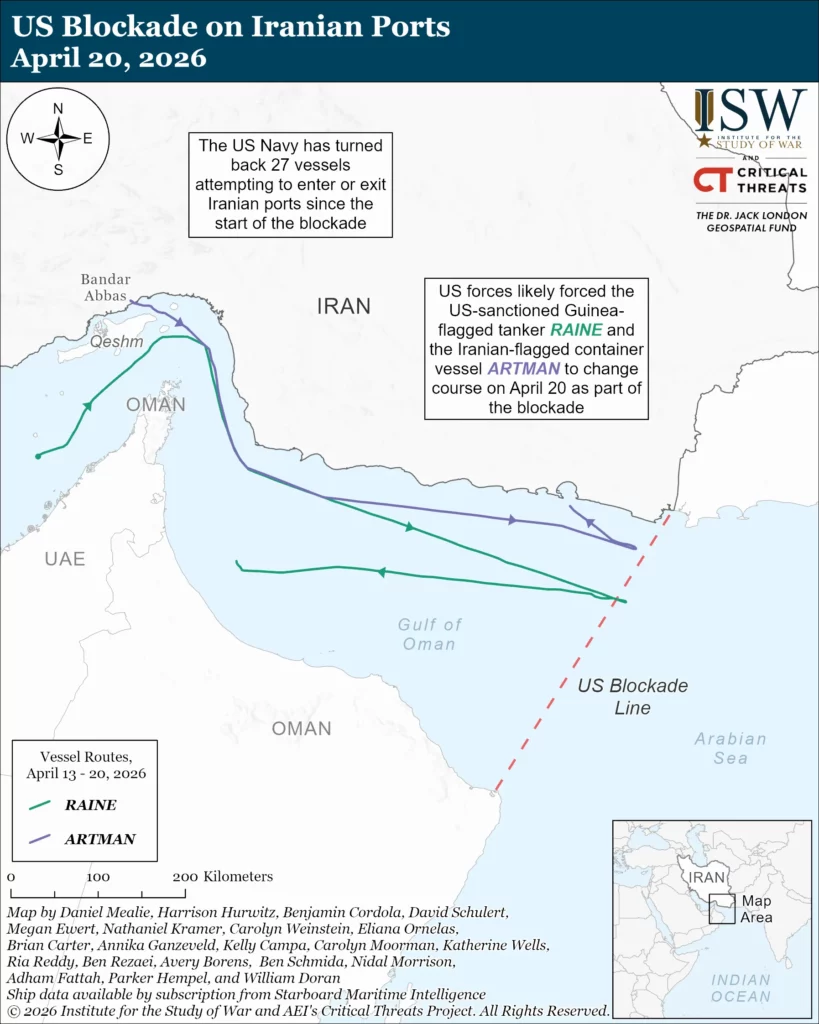
ISW-CTP is unable to assess whether two vessels that originated from Iranian ports and passed the US blockade line are in violation of or exempt from the US Navy’s blockade. Commercially available shipping data shows that the Liberian-flagged Basel and Marshall Islands–flagged CECI, which departed from Bandar Imam Khomeini Port, Khuzestan Province, on April 15 continued to transit along the Omani coast toward separate ports in Brazil on April 20.[40] CENTCOM announced on April 14 that it would not allow vessels to enter or exit Iranian ports.[41] UKMTO reported on April 16 that vessels carrying humanitarian goods are exempt from the blockade, however.[42] It is unclear what cargo the Basel and CECI are transporting.[43] CENTCOM has noted that all Iranian vessels, vessels under US sanctions, and vessels suspected of carrying contraband are subject to the right of visit and search, regardless of their location.[44] ISW-CTP previously noted that US forces can interdict vessels almost anywhere in international waters until they reach their final destination.[45]
A third vessel, the Vietnam-flagged NV Aquamarine, has also continued sailing, but this ship is likely exempt from the US blockade and considered “neutral shipping,” given that it departed from the United Arab Emirates (UAE) and is not under US sanctions.[46] ISW-CTP incorrectly attributed United Against Nuclear Iran’s blacklisting of the NV Aquamarine as evidence that the vessel was an Iranian-linked vessel attempting to pass the US Navy’s blockade line on April 19.[47]
US and Israeli Air Campaign
Satellite imagery confirms that the US-Israeli combined force conducted multiple strikes on a reported IRGC command center in the Jamaran complex in northern Tehran Province.[48] The strikes occurred before the ceasefire. An Iranian OSINT analyst assessed that the United States struck the site with massive ordnance penetrator bombs.[49] Iranian media previously described the site as the most important and “strategic” broadcast transmitter in Iran.[50] The analyst claimed that the site also serves as a surveillance, signal-jamming, and command center for the IRGC.[51] Fox News, citing unspecified high-level sources, reported on April 6 that the United States struck an underground IRGC headquarters in Tehran, which the analyst assessed was referring to the strike on the Jamaran complex.[52] The analyst claimed that the strike targeted a meeting of at least 50 IRGC officers at the underground complex.[53] ISW-CTP cannot independently verify that the targeted site was an IRGC command center, or that IRGC officers were meeting at the site at the time of the combined force strikes.
Iranian Response
Iran reportedly planned to conduct covert sabotage operations against Israeli-linked sites, energy infrastructure, and other unspecified sites in Azerbaijan in recent weeks.[54] An Israeli military correspondent reported that Mossad and Azerbaijani authorities thwarted several Iranian sabotage attempts and planned attacks in Azerbaijan “several weeks ago.”[55] Mossad stated that an Iranian-backed militant cell was preparing to target the Israeli Embassy in Azerbaijan, a synagogue in Baku, and the Baku-Tbilisi-Ceyhan oil pipeline with improvised explosive devices (IED) and drones.[56] Israeli airstrikes at the start of the war killed the senior IRGC leaders behind these planned operations, including Unit 4000 Chief Rahman Moghadam, IRGC Intelligence Organization Chief Majid Khademi, and covert operations official Mohsen Suri, according to Israeli media.[57]
The IRGC Intelligence Organization’s covert operations Unit 4000 also reportedly smuggled drones through Turkey and conducted reconnaissance against US forces at Incirlik Airbase in Turkey.[58] Israeli intelligence reported that a Unit 4000 officer coordinated the smuggling of drones from Iran to Cyprus via Turkey.[59] The same officer also reportedly headed operations to gather intelligence on US forces at Incirlik Airbase in southwestern Turkey.[60]
Emirati state media separately reported on April 20 that Emirati security forces arrested 27 members of a group with connections to the Iranian regime and external actors who were planning to conduct terrorist attacks.[61]
Israeli Campaign Against Hezbollah and Hezbollah Response
Lebanese and Israeli officials will meet in Washington, DC, on April 23 for the second round of direct ambassador-level talks.[62] Lebanese and Israeli officials met in Washington, DC, on April 14 for the first direct talks between the two countries in over 30 years.[63] Lebanese Ambassador to the United States Nada Hamadeh Moawad and Israeli Ambassador to the United States Yechiel Leiter will attend the talks.[64] It is unclear which US officials will attend the talks at the time of this writing. A Lebanese official told the Associated Press on April 20 that the upcoming talks will focus on “solidifying” the 10-day ceasefire and the logistics of future negotiations.[65] A Lebanese ministerial source previously told Saudi media that Lebanese officials’ top priority is to request an extension of the temporary ceasefire.[66] The proposed extension period would reportedly range from 10 days to one month.[67] Israel and Lebanon’s current 10-day ceasefire is set to expire on April 26.[68] These preparatory and logistical meetings aim to lay the groundwork for Israel and Lebanon to have direct negotiations in the future over long-standing issues, such as Israel’s presence in Lebanese territory and Hezbollah disarmament.[69]
US and Lebanese officials have held a series of meetings in recent days, likely in preparation for the upcoming direct Israeli-Lebanese talks.[70] Lebanese President Joseph Aoun spoke to US President Donald Trump on April 16 to discuss the Lebanese government’s request for a long-term ceasefire.[71] Aoun similarly spoke to US Secretary of State Marco Rubio on April 16.[72] Rubio affirmed that he will continue his efforts to achieve a lasting ceasefire.[73] Aoun and Lebanese Parliament Speaker Nabih Berri both met with US Ambassador to Lebanon Michel Issa on April 20 to discuss recent developments and means to extend the ceasefire.[74] These meetings come as Lebanese officials, specifically Aoun and Prime Minister Nawaf Salam, have taken steps to establish a unified Lebanese position and prepared the Lebanese government’s proposal for negotiations.[75] Aoun reiterated on April 20 that he seeks to halt Israeli operations in Lebanon, secure an Israeli withdrawal from Lebanese territory, and deploy the Lebanese army to Lebanon’s southern borders.[76]
Hezbollah is reportedly attempting to pressure the United States and Israel to agree to extend the temporary ceasefire between Israel and Lebanon. Hezbollah senior official and parliamentarian Hassan Fadlallah stated on April 20 that Hezbollah has contacted and briefed Iranian officials on Israel’s ceasefire “violations” so that the Iranian officials could convey this information to Pakistani mediators.[77] Fadlallah added that Hezbollah hopes that Pakistani mediators will exert pressure on the United States, presumably to get the United States to pressure Israel to extend the ceasefire.[78] Fadlallah emphasized that Hezbollah wants the ceasefire in Lebanon to continue and for Israeli forces to withdraw from Lebanese territory.[79] Sources familiar with ongoing discussions within Hezbollah’s leadership similarly told a Lebanese media outlet on April 18 that Hezbollah is warning the United States that Israel’s “violations” could cause “everything” to collapse.[80] Hezbollah sources and officials have warned that Hezbollah will not return to a policy of “strategic patience” or allow a “unilateral ceasefire,” noting that Hezbollah is prepared to resume fighting against Israel.[81] Hezbollah Secretary General Naim Qassem stated on April 18 that Hezbollah fighters will remain in “the field with their fingers on the trigger” and will respond to Israeli “violations” accordingly.[82]
The Israel Defense Forces (IDF) conducted at least three airstrikes in Lebanon on April 19 and 20, which marked the first Israeli strikes since the ceasefire came into effect on April 16.[83] The temporary ceasefire agreement contains a provision that permits Israel to act in self-defense against any “planned, imminent, or ongoing” Hezbollah threats against Israel.[84] The IDF stated that it struck a Hezbollah launcher, which was loaded and ready to launch projectiles at Israel, in Qalaouiyeh, central southern Lebanon, overnight between April 19 and 20.[85] The IDF reported on April 20 that forces under the IDF 98th Paratrooper Division directed an Israeli Air Force (IAF) strike on Hezbollah fighters in Bint Jbeil, southeastern Lebanon.[86] The IDF 98th Paratrooper Division recently deployed and began operations in southern Lebanon in early April.[87] The IDF reported that the 1st (Golani) Infantry Brigade (36th Armored Division) also directed an IAF strike on Hezbollah fighters near a bridge in Qaaqaait al Jisr, which is located along the Litani River.[88] The IDF previously conducted several airstrikes targeting bridges on the Litani River that Hezbollah used to move weapons and personnel from northern Lebanon to southern Lebanon.[89]
The IDF has continued to conduct ground operations in southern Lebanon in accordance with the temporary ceasefire agreement. The IDF reported on April 19 that the 769th (Hiram) Territorial Brigade (91st Territorial Division) is continuing to conduct operations in southern Lebanon to prevent any direct threats to northern Israeli communities.[90] The IDF stated that the brigade’s forces killed a Hezbollah fighter who crossed the IDF’s “forward defense line” in southern Lebanon on April 19.[91] The IDF Arabic-language spokesperson issued a warning on April 19 to southern Lebanese residents to refrain from returning to 58 towns in southern Lebanon and approaching the Litani River area.[92] The IDF spokesperson’s warning aligns with the IDF’s recent post identifying its “forward defense line” or “yellow line.”[93] The IDF’s “yellow line” extends several kilometers inside Lebanese territory and denotes the area where Israeli forces control approximately 55 southern Lebanese villages.[94] Israeli media noted on April 18 that the IDF is continuing to conduct ground operations up to the “line” to “cleanse the area of Hezbollah” and protect northern Israeli residents.[95] Lebanese media also reported that Israeli forces demolished buildings in several areas of southern Lebanon on April 20.[96]
Other Axis of Resistance Response
The US Embassy in Baghdad warned on April 20 that Iranian-backed Iraqi militias continue to plan attacks against US citizens and targets in Iraq and Iraqi Kurdistan.[97] This warning comes after Iranian-backed Iraqi militia Kataib Hezbollah appeared to confirm on April 18 that IRGC Quds Force Commander Brigadier General Esmail Ghaani discussed preparations for renewed conflict with the United States and Israel during his meetings with Iraqi militia leaders in Baghdad on April 18.[98] Kataib Hezbollah Security Chief Abu Mujahid Aasaf issued a statement after Ghaani’s visit to Baghdad that called for increased coordination between the “resistance forces and other parties,” which implicitly refers to military cooperation.[99] Iranian-backed Iraqi militias have launched drone and rocket attacks targeting US and foreign interests in Iraq and Iraqi Kurdistan throughout the war.[100]
The US government also urged US defense contractor V2X on April 9 to evacuate its employees from Kuwait and Iraq, according to four sources speaking to The Guardian on April 20.[101] Hundreds of US contractors, mostly from V2X, work at Iraq’s Balad Airbase to support the Iraqi government’s F-16 fighter jet program.[102] Likely Iranian-backed Iraqi militias have conducted multiple one-way drone attacks targeting Balad Airbase during the war.[103]
The United States suspended security coordination meetings with Iraqi leaders until the Iraqi government identifies the perpetrators of recent attacks targeting US interests in Iraq, according to unnamed sources speaking to Saudi media on April 20.[104] Saudi media also reported that the US government froze funding for unspecified Iraqi security institutions.[105] This report comes after the US Treasury Department sanctioned seven Iranian-backed Iraqi militia officials on April 17 for their involvement in attacks targeting US positions in Iraq.[106]
CORRECTION: On April 21, ISW-CTP removed the following sentence, “A senior Israeli political source recently told Israeli media that Israel assesses that it will need to agree to a ceasefire extension in Lebanon in the next few days.” from the Israeli Campaign Against Hezbollah and Hezbollah Response subsection. We apologize for the error.