 Eurasia Press & News
Key Takeaways
The Islamic Revolutionary Guards Corps (IRGC) Navy attacked and likely redirected two vessels towards Iran on April 22, likely to enforce Iranian claims of sovereignty over the strait to disrupt global shipping and extract US concessions. The IRGC also may have redirected the two vessels in response to the recent US Navy seizure of the Iranian-flagged, US-sanctioned Touska in the Gulf of Oman.
The IRGC’s attacks on shipping and IRGC Commander Major General Ahmad Vahidi’s apparent willingness to scrap US-Iran talks indicate that Vahidi is prepared to resume the war if needed. Vahidi appears willing to risk incurring a potential US military response to assert Iranian “control” over the strait.
Iranian decision-making remains fragmented and in disarray, which explains Iran’s inability to formulate and communicate a coherent negotiating position. Iranian officials have not reached a unified decision on whether to return to negotiations in recent days, and competing regime power centers appear to be blocking consensus on core issues. The regime’s formal decision-making and coordinating mechanisms are also not functioning effectively.
US officials have recently leaked quantitative estimates of the number of different Iranian assets remaining after the ceasefire. It is extremely difficult to deduce the degree of degradation to Iranian forces based on these estimates because the number of remaining systems is only one of many data points required to form a complete evaluation of military strength.
Toplines
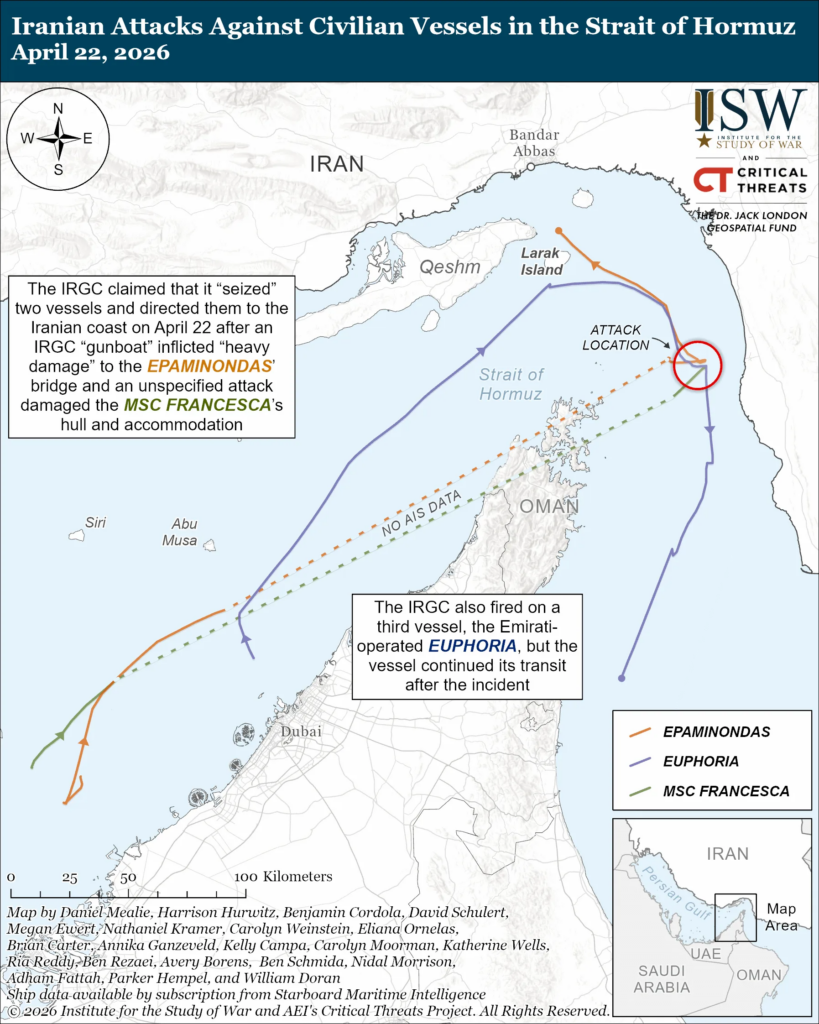
The Islamic Revolutionary Guards Corps (IRGC) Navy attacked and likely redirected two vessels towards Iran on April 22, likely to enforce Iranian claims of sovereignty over the strait to disrupt global shipping and extract US concessions. The IRGC claimed that it “seized” two vessels and directed them to the Iranian coast on April 22.[1] The two vessels — the Liberian-flagged, Greek-owned Epaminondas and the Panamanian-flagged MSC Francesca — appear to have been exiting the Strait of Hormuz at the time of the attacks.[2] An IRGC “gunboat” inflicted “heavy damage” to the Epaminondas’s bridge, and an unspecified attack damaged the MSC Francesca’s hull and accommodation.[3] Both vessels changed direction, sailed into Iranian territorial waters, and idled about seven nautical miles off the coast of Iran. Commercially available maritime tracking data showed that the Epaminondas continued to transit north in Iranian territorial waters. It is unclear why the vessels would have changed course and sailed further inland towards the Iranian coast if not under Iranian escort. The IRGC also fired on a third vessel, the Panamanian-flagged, Emirati-operated Euphoria, but the vessel continued its transit after the incident.[4] The IRGC has demanded that the United States lift its blockade over the Strait of Hormuz and effectively halted traffic through the strait on April 18 by attacking several vessels.[5] The IRGC likely aims to raise international shipping prices to extract concessions from the United States, such as ending the US blockade or yielding other demands. The IRGC also may have redirected the two vessels in response to the recent US Navy seizure of the Iranian-flagged, US-sanctioned Touska in the Gulf of Oman on April 19.[6] The Iranian regime had pledged to respond to the incident.[7]
The IRGC has also used its “control” over the strait as a means for IRGC Commander Major General Ahmad Vahidi to flex his own power over internal rivals, such as Parliament Speaker Mohammad Bagher Ghalibaf. Vahidi and his inner circle recently used the IRGC’s leverage over the strait to exercise influence over Iran’s negotiating position.[8] The United States extended the ceasefire yesterday to allow for Iranian leaders to produce a “unified proposal,” but Iranian leaders remain fragmented over Iran’s negotiating strategy, as noted below.[9]
The IRGC’s attacks on shipping and IRGC Commander Major General Ahmad Vahidi’s apparent willingness to scrap US-Iran talks indicate that Vahidi is prepared to resume the war if needed. Vahidi currently holds the most influential position in the regime at this time, apart from the Supreme Leader, who is reportedly seriously injured or incapacitated.[10] The IRGC’s recent attacks on commercial vessels suggest that Vahidi is willing to risk incurring a potential US military response to assert Iranian ”control” over the strait and achieve the subsequent intended effects, as described above. Vahidi also may seek to derail the negotiations and may be attempting to do so by introducing preconditions and interfering with efforts to produce a “unified proposal.”[11] These actions suggest that Vahidi and his inner circle have accepted and are prepared for the risks that such actions would lead to the resumption of the war with the United States.
Iranian decision-making remains fragmented and in disarray, which explains Iran’s inability to formulate and communicate a coherent negotiating position. ISW-CTP previously assessed on April 15 that the United States is negotiating with a divided committee of hardliners and pragmatists that lacks a cohesive and unified position.[12] This intra-regime division has continued in recent days as senior Iranian officials have publicly diverged over negotiations.[13] Some reporting indicates that key actors, including Parliament Speaker Mohammad Bagher Ghalibaf and Foreign Affairs Minister Abbas Araghchi, lack the authority to represent the regime’s position.[14] Iranian officials have not reached a unified decision on whether to return to negotiations in recent days, and competing regime power centers appear to be blocking consensus on core issues.[15] Iranian Foreign Affairs Ministry Spokesperson Esmaeil Baghaei told the BBC on April 21 that Iran has made “no decision” on whether to send a delegation to Islamabad and said officials continue to discuss conditions for returning to negotiations.[16] CNN reported on April 22 that US officials believe that intra-regime factions prevented a response to the US ”list of broad points.”[17] An unspecified US official told Axios on April 22 that there has been “an absolute fracture” between the negotiating team and the military and assessed that neither side has access to the supreme leader.[18] Axios added that IRGC leadership rejected much of what Iranian negotiators discussed with the United States after the first round of talks, which indicates that the negotiating team lacked the authority to represent the regime’s position.[19]
The regime’s formal decision-making and coordinating mechanisms are also not functioning effectively, instead reinforcing fragmentation. An unspecified US official told Axios on April 22 that Iran’s Supreme National Security Council (SNSC) Secretary Mohammad Bagher Zolghadr is not effectively coordinating between the IRGC, civilian leadership, and the supreme leader, which suggests that overlapping authorities and factional disputes are delaying Iranian decision-making and preventing the regime from presenting a unified negotiating position.[20] Vahidi reportedly pressured President Masoud Pezeshkian to appoint Zolghadr, which may have increased Zolghadr’s challenges in fulfilling his duties as a key coordinator between Vahidi and other leaders.[21] The SNSC is formally responsible for aligning national security and foreign policy decision-making across the Iranian system and for generating consensus among key regime stakeholders, including civilian leadership and military commanders.[22] The apparent inability of the SNSC to produce a unified negotiating position or coordinate between competing actors suggests that the regime’s primary decision-making mechanism is not functioning effectively.
US officials are increasing pressure on Iran to produce a unified response, however. Unspecified US officials told Axios on April 22 that US President Donald Trump is giving Iran a limited window of several days to present a coherent counteroffer before reconsidering military action.[23] Pakistani officials and intermediaries have simultaneously worked to keep talks “alive” and tried to secure a response from Iran, according to the Associated Press.[24] Iranian officials have continued to frame US actions, particularly the naval blockade, as the primary obstacle to negotiations, however.[25] Senior Iranian figures, including President Masoud Pezeshkian, have emphasized that “breach of commitments,” blockade measures, and threats prevent “genuine negotiations.”[26] An adviser to Ghalibaf stated on April 22 that the ceasefire extension ”has no meaning” and called for a military response to the US blockade.[27]
US officials have recently leaked quantitative estimates of the number of different Iranian assets remaining after the ceasefire. It is extremely difficult to deduce the degree of degradation to Iranian forces based on these estimates because the number of remaining systems is only one of many data points required to form a complete evaluation of military strength. Recent US intelligence assessments indicate that roughly 50 percent of Iran’s ballistic missile stockpile and its launch systems remain “intact,” about 60 percent of the IRGC Navy still exists, and two-thirds of Iran’s air force remains operational.[28] Some of these numbers are vague and incomplete. It is unclear, for example, what assets are included in the determination that 60 percent of the IRGC Navy is “still in existence.” Other issues exist with these numbers because military strength and the capabilities of a military organization rest on more than sheer numbers. The leaks assert that “two-thirds” of Iran’s Air Force remains operational, but it is unclear what that two-thirds includes and the quality of operational aircraft. There are significant qualitative differences between Iran’s F-4s and F-5s (both first flew in the late 1950s, and the United States flew in Vietnam) and the American and Israeli F-35. The size of the remaining missile stockpile is relevant, but a missile force is more than its stockpile; a more complete assessment would include assessments of the status of the personnel, command and control networks, production networks, logistics assets, and more. US air campaigns seek to achieve qualitative effects, some of which are invisible in the open-source information space, and others are difficult to observe because the effects take considerable time to become apparent.[29] Assessments that rely only on quantitative measures can overlook these critical effects and therefore fail to sufficiently evaluate the campaign.
Maritime Developments
ISW has observed reports citing maritime intelligence companies Vortexa and Lloyd’s List stating that a large number of ships have violated the US blockade without being stopped. US Central Command has issued a statement denying that any ships have breached the blockade and specifying the whereabouts of the three ships named in these reports, stating that two of them returned to the Iranian port of Chabahar and one is under US Navy escort in the Indian Ocean.[30] Vortexa has issued an update confirming the CENTCOM report about two of the ships and describing the challenges of satellite-based maritime tracking. ISW is unable to offer an assessment of its own of the competing statements at this time.
US and Israeli Air Campaign
See topline section.
Intra-Regime Dynamics
Some Iranian companies have laid off workers due to economic pressure from the war. Anti-regime media reported on April 22 that Rajaee Port in Bandar Abbas, Hormozgan Province, has laid off some workers because some ships are no longer working.[31] The combined force struck Rajaee Port on March 10.[32] Anti-regime media also reported that ”major industries such as Mobarakeh Steel” have had to lay off workers due to the war.[33] The combined force struck the Mobarakeh Steel Factory in Esfahan Province on March 27.[34]
Iranian security forces targeted Mobarizoun Popular Front (MPF) fighters, which is a coalition of Baloch anti-regime groups, in Rask, Sistan and Baluchistan Province on April 22.[35] The security forces killed several fighters and seized a weapons cache.[36]
Israeli Campaign Against Hezbollah and Hezbollah Response
Hezbollah has continued to conduct attacks for the second consecutive day despite the Israel-Lebanon ceasefire.[37] Hezbollah claimed that it conducted two attacks targeting Israeli forces in southern Lebanon on April 22.[38] Hezbollah previously conducted two attacks on Israeli forces in southern Lebanon and northern Israel on April 21, for the first time since the Israel-Lebanon ceasefire took effect on April 16.[39] Hezbollah claimed an attack with two first-person view (FPV) drones targeting IDF personnel and a command vehicle in Qantara, Marjaayoun District.[40] The Israel Defense Forces (IDF) intercepted one Hezbollah drone over Bayyada, Tyre District, and the attacks caused no reported casualties.[41]
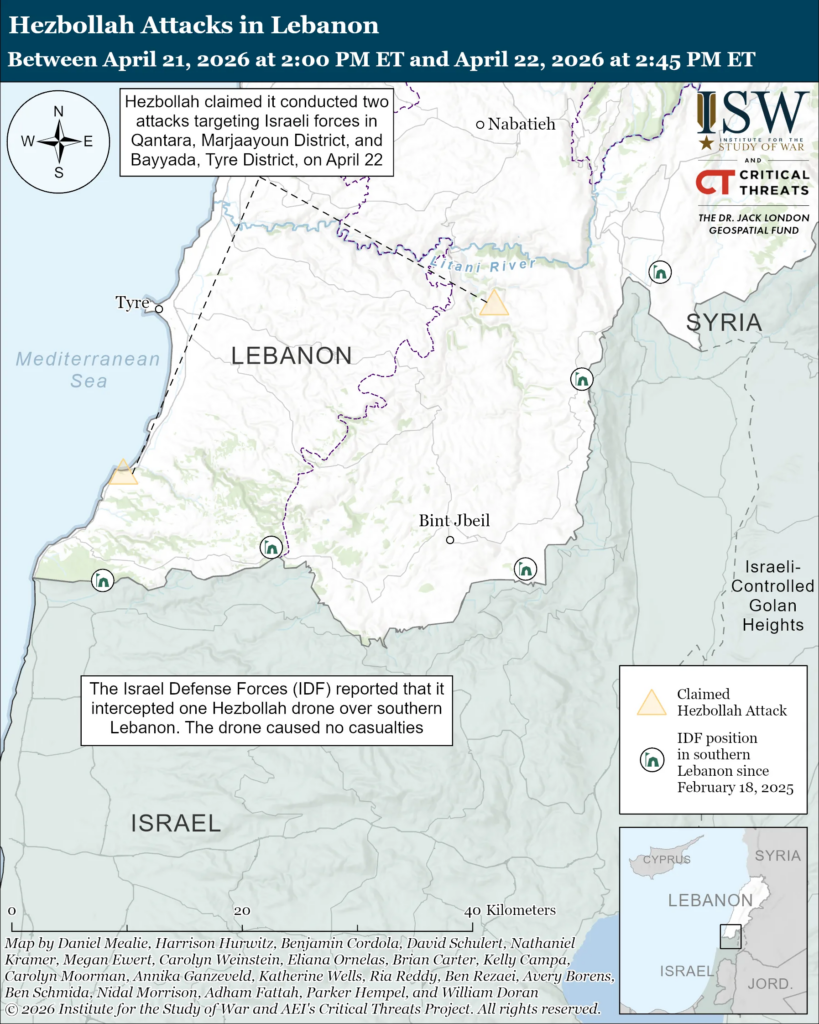
The IDF conducted at least four airstrikes in southern Lebanon since ISW-CTP ‘s last data cutoff on April 21.[42] The IDF stated that it conducted an airstrike targeting two Hezbollah fighters crossing Israel’s ”forward defense line” in the vicinity of Qantara after Israeli forces in the 7th Brigade (36th Division) identified the infiltrating fighters.[43] The Qantara strike may have been related to the Hezbollah FPV attack in Qantara described above. The temporary ceasefire agreement permits Israel to act in self-defense against any “planned, imminent, or ongoing” Hezbollah threats against Israel.[44]
The IDF has continued to conduct ground operations in southeastern Lebanon in accordance with the temporary ceasefire agreement. The IDF announced that the 769th “Hiram” Brigade (91st Territorial Division), 1st “Golani” Brigade (36th Armored Division), and 933rd “Nahal” Infantry Brigade (146th Reserve Division) seized Hezbollah weapons caches in southeastern Lebanese towns, including Khiam, Aadchit al Qoussair, and Taybeh, all in Marjaayoun District, and Beit Lif, Bint Jbeil District, respectively, on April 22.[45] Lebanese media reported that IDF units have continued to demolish buildings in southern Lebanese towns south of the “forward defense line” on April 21 and 22.[46] The IDF also announced that the 769th Brigade raided a Hezbollah compound and directed IDF airstrikes that struck over 70 targets and killed more than 20 Hezbollah fighters in Dibbine, before the start of the temporary ceasefire on April 16.[47]
The Lebanese government reportedly seeks a month-long extension to the temporary ceasefire amid preparations for the second round of the second round of direct ambassador-level talks on April 23. A Lebanese official told AFP that Lebanon will request a one-month ceasefire extension, an end to Israel’s bombing and demolitions in Lebanon, and a commitment to the ceasefire during a meeting in Washington, DC, on April 23.[48] Lebanese President Joseph Aoun said on April 22 that Lebanon’s primary objectives for the meeting are extending the April 16 ceasefire and halting Israeli demolitions in southern Lebanon.[49] Aoun said that Lebanon would provide “no concessions, no compromises, and no capitulation.”[50] Israel and Lebanon’s current 10-day ceasefire is set to expire on April 26.[51] Israeli Foreign Minister Gideon Saar said on April 22 that Israel has no “serious disagreements” with Lebanon and that Hezbollah remains the sole obstacle to peace and normalization between Lebanon and Israel.[52] Saar urged the Lebanese government to “work together” with Israel against Hezbollah.[53] Israeli and Lebanese officials continue to disagree on long-standing issues, including the presence of an Israeli buffer zone in southern Lebanon, however.[54]
The Lebanese government has continued to take steps to disarm Hezbollah in Lebanon. Lebanese President Joseph Aoun instructed the Lebanese Armed Forces (LAF) and other Lebanese security forces to intensify raids on weapons caches in Beirut and other areas of Lebanon during a security meeting on April 22.[55] Aoun said that Lebanese security services should show “no leniency” to “any party” since “no one” is allowed to obstruct the Lebanese government’s implementation of security measures and the Lebanese state’s monopoly over weapons.[56] Aoun emphasized that maintaining civil peace in Lebanon is a “red line.”[57] Lebanese Prime Minister Nawaf Salam ordered the LAF on April 9 to immediately enforce the Lebanese state’s monopoly over weapons in Beirut.[58] Lebanese media reported on April 10 that the Lebanese Armed Forces deployed units, including soldiers from its Commando Regiment, to secure the Government Palace and begin patrols in Beirut.[59]
Other Axis of Resistance Response
The United States has reportedly suspended its funding for some counterterrorism and Iraqi Security Forces (ISF) training programs until Iranian-backed Iraqi militia attacks cease and the Iraqi federal government takes unspecified steps to “dismantle” the militias.[60] An Iraqi Defense Ministry official told the New York Times on April 22 that the loss of funding would affect logistical support for the Iraqi Air Force and military training programs.[61] A security advisor to Iraqi Prime Minister Mohammad Shia al Sudani claimed that the United States suspended its funding due to Iraq’s continued failure to form a government following the November 2025 parliamentary elections.[62] The United States has continuously pressured the Iraqi federal government to disarm Iranian-backed Iraqi militias and dissolve the Iranian-backed Popular Mobilization Forces (PMF), which is an Iraqi state security service that consists of numerous militias that answer to Iran instead of the Iraqi Prime Minister.[63] Saudi media reported on April 20 that the US government postponed security coordination meetings with Iraqi leaders until the Iraqi government identifies the perpetrators of recent attacks targeting US interests in Iraq.[64] Iranian-backed Iraqi militias conducted numerous attacks targeting the US Embassy in Baghdad and US interests in Iraqi Kurdistan during the war, as well as a drone attack targeting a US security convoy transporting previously kidnapped US journalist Shelly Kittelson to Baghdad International Airport on April 8.[65]
US and Iraqi officials told the Wall Street Journal on April 22 that the US Treasury Department has temporarily halted shipments of Iraq’s oil export revenue via the US Federal Reserve due to concerns about Iranian-backed Iraqi militia behavior.[66] The officials said that the United States first blocked a shipment of dollars to the Central Bank of Iraq when the war began in late February 2026, and recently blocked a cargo plane delivery of nearly $500 million in US banknotes.[67] The Central Bank of Iraq has managed an account at the New York Federal Reserve on behalf of the Iraqi Finance Ministry since 2003 that holds the Iraqi federal government’s revenue from oil exports in US dollars.[68] Oil revenue accounts for about 90 percent of the Iraqi state’s budget.[69] US officials confirmed the temporary hold on Iraq’s dollar shipments to the Wall Street Journal.[70] The United States has previously threatened such action, such as when the United States reportedly warned Iraqi officials in early February 2026 that the United States would reduce Iraq’s access to oil export revenues if State of Law Coalition head Nouri al Maliki becomes prime minister again.[71]