 Eurasia Press & News
Key Takeaways
Iran is unlikely to make meaningful concessions in its next proposal to the United States, which is expected in the next several days. Islamic Revolutionary Guards Corps (IRGC) Major General Ahmad Vahidi, whose hardline position on negotiations the regime has adopted, appears unwilling to concede on Iranian control over the Strait of Hormuz and Iran’s nuclear program.
Mainstream Iranian politicians are consolidating around the decision to avoid discussing the nuclear issue before the United States lifts the naval blockade on Iranian ports, which was Vahidi’s preferred policy outcome. Other Iranian regime factions do not appear to materially constrain Vahidi’s uncompromising position.
The Iranian regime is likely attempting to modify and legitimize its plan to exert sovereignty over the Strait of Hormuz by including Oman in a scheme to collect tolls on shipping through the Strait. This would enable Iran to present a “new proposal” to the United States without compromising on any Iranian red lines. Oman rejected Iran’s proposal, however.
Iranian leaders are preparing for a variety of contingencies and risks that could result from a hardline negotiating position that fails to end the war, including an economic collapse that triggers economic unrest, a long-term blockade, or a resumption of the US-Israeli air campaign.
Iran has responded to growing pressure on the economy caused by the war, sanctions, and the blockade by shoring up internal unity, presumably as an initial step in a more comprehensive internal security plan.
Iran is reportedly exploring alternative methods to circumvent the US blockade of its ports, which is a suboptimal way to alleviate some of the economic pressure, including seizing US commercial vessels or Israeli-linked vessels, relying on trade with Russia and other countries bordering the Caspian Sea, or even the Houthis attacking vessels through the Bab el Mandeb Strait.
Iran has almost certainly used the ceasefire to reorganize and regenerate its missile and drone forces, which were badly degraded on the operational level prior to the ceasefire.
Toplines
Iran is unlikely to make meaningful concessions in its next proposal to the United States, which is expected in the next several days. Islamic Revolutionary Guards Corps (IRGC) Major General Ahmad Vahidi, whose hardline position on negotiations the regime has adopted, appears unwilling to concede on Iranian control over the Strait of Hormuz and Iran’s nuclear program. Iran’s delegation told Pakistani mediators on April 27 that it needed to consult Supreme Leader Mojtaba Khamenei before responding with an updated proposal following US President Donald Trump’s dissatisfaction with Iran’s lack of nuclear concessions in its April 26 three-stage plan.[1] Vahidi maintains near-exclusive access to Mojtaba and serves as a gatekeeper who conveys Mojtaba’s approval of decisions made by formal state institutions, according to several senior Iranian sources speaking to Western and anti-regime media in recent days.[2] The regime has adopted Vahidi’s hardline positions on negotiations, which indicates that Vahidi has significantly more power within the regime and influence over the outcome of policy decisions compared to other leaders who are more supportive of negotiations. The extent to which Vahidi or any other regime leader controls the decision making process is unclear, even though Vahidi seems to have significant influence over the outcome.
Mainstream Iranian politicians are consolidating around the decision to avoid discussing the nuclear issue before the United States lifts the naval blockade on Iranian ports, which was Vahidi’s preferred policy outcome. This illustrates that there is some level of political support for Vahidi’s policies within the broader regime, which suggests Iran’s negotiating stance will not soften in the near term. Mojtaba approved these policies in his role as supreme leader, but he lacks the stature of his father and has struggled to behave as a neutral arbiter in internal debates, according to Reuters.[3] Assembly of Experts members and members of parliament have voiced their support for Mojtaba’s directive against discussing the nuclear issue before the US lifts the naval blockade on Iranian ports.[4] These statements reflect the same logic that led Iranian decision makers to withdraw the Iranian negotiators from the April 11 Islamabad negotiations.[5]
Other Iranian regime factions do not appear to materially constrain Vahidi’s uncompromising position. Saeed Jalili — also on the SNSC — and his Stability (Paydari) Front continue to advocate an even more uncompromising stance against negotiations.[6] These ultra-hardliners reinforce Vahidi’s position against concessions in negotiations. Parliamentary Speaker Mohammad Bagher Ghalibaf appears sidelined.[7] Ghalibaf’s recent unity statement, urging loyalty to the supreme leader, followed by an unusual April 29 audio message reiterating support for the supreme leader, suggests he has acquiesced to the dominant hardline position on negotiations.[8] Reformist voices, such as Pezeshkian and former President Hassan Rouhani, who previously called for negotiations to prioritize Iran’s economy, appear absent from the current decision making and information space, further narrowing the range of policy options.[9] The regime-imposed internet shutdown, presumably enforced by the IRGC, is almost certainly contributing to the absence of dissenting views.[10]
The Iranian regime is likely attempting to modify and legitimize its plan to exert sovereignty over the Strait of Hormuz by including Oman in a scheme to collect tolls on shipping through the Strait. This would enable Iran to present a “new proposal” to the United States without compromising on any Iranian red lines. Iranian Foreign Affairs Minister Abbas Araghchi reportedly traveled to Oman to again float a proposal to split administrative control of the strait. Oman rejected this offer, according to multiple US and regional sources who spoke to the New York Post on April 29.[11] Araghchi’s reported proposal corroborates CTP-ISW’s previous assessments that Vahidi is prepared to risk a potential US military response and the continuation of the US naval blockade rather than concede in negotiations.[12]
Iranian leaders are preparing for a variety of contingencies and risks that could result from a hardline negotiating position that fails to lift the economic and military pressure Iran is under. Stalled negotiations could lead to an economic collapse that triggers economic unrest, a long-term blockade, or a resumption of the US-Israeli air campaign, among other courses of action that could become serious crises for the Iranian regime. None of these trajectories is mutually exclusive, and the preparations to meet each possible crisis will overlap.
Iran has responded to growing pressure on the economy caused by the war, sanctions, and the blockade by shoring up internal unity, presumably as an initial step in a more comprehensive internal security plan. The Iranian economy is under significant pressure, with the rial hitting a record low on April 29, on top of soaring costs, millions of job losses, and other challenges. Anti-regime media reported on April 28 that the Supreme National Security Council (SNSC) convened a meeting chaired by Zolghadr—a close ally of Vahidi—after intelligence assessments warned of a possible resumption of protests in the coming days due to growing economic pains on the Iranian people.[13] Such a meeting, if confirmed, likely sought to plan precautions to prevent widespread unrest given the timing and alleged subject matter. Islamic Republic of Iran Broadcasting published an audio message by Parliament Speaker Mohamad Bagher Ghalibaf on April 29 in which he emphasized the importance of the Iranian people’s unity.[14] It is highly unusual for a high-ranking official to release just an audio message when addressing the public. Ghalibaf stated that the US strategy is to impose economic pressure via the naval blockade and sow internal divisions in order to get Iran to capitulate to US demands.[15] The intention of Ghalibaf’s message is likely to place blame on the United States in order to build unity against an external enemy and prevent public outrage against the regime for Iran’s dire economic conditions. Ghalibaf added that the blockade will likely continue until Iran and the United States have reached an agreement.[16] Ghalibaf’s statement indicates that the regime’s decision makers understand that it is unlikely US-Iran talks will reach an agreement and accept the prospects of resumed conflict with the United States. Ghalibaf’s statement may also be a way to psychologically prepare the Iranian people that economic conditions will not improve in the near future. Building this internal unity could give way to a broader internal security plan that may or may not be visible in open-source reporting, given the internet blackout in Iran.
Iran is reportedly exploring alternative methods to circumvent the US blockade of its ports, which is a suboptimal way to alleviate some of the economic pressure Iran is currently under. Iranian Armed Forces General Staff (AFGS)-affiliated media Defa Press proposed multiple options Iran could utilize to break the US blockade on Iranian ports on April 29.[17] Defa said that Iran could seize US commercial ships or ships linked with Israel in retaliation for US forces interdicting several Iranian ships that violated the US blockade.[18] The Islamic Revolutionary Guards Corps (IRGC) Navy recently attacked and redirected two vessels towards Iran on April 22, in part, to extract concessions from the United States, such as ending the US blockade on Iranian ports.[19] Defa also hypothesized that Iran could circumvent the US blockade of Iranian ports by relying on trade with Russia and other countries bordering the Caspian Sea to export or import essential and strategic goods.[20] This report follows Iranian Foreign Minister Abbas Araghchi’s meeting with Russian President Vladimir Putin in St. Petersburg on April 27.[21] This also follows an April 27 Wall Street Journal report that Iran is attempting to export oil to China via rail.[22] Defa also hinted that Iran could coordinate further with the Houthis to convince them to close the Bab al Mandab Strait to further constrain international shipping and impose costs on the United States and Israel.[23] CTP-ISW continues to assess that the Houthis are unlikely to impose a blockade on the Bab al Mandab, given it would likely jeopardize their domestic position, however.[24]
The regime has also accepted the risk of and prepared for a resumption of the war. Iran has almost certainly used the ceasefire to reorganize and regenerate its missile and drone forces, which were badly degraded on the operational level prior to the ceasefire.[25] This includes tasks such as digging out buried launchers, stockpiles, and launcher crews.[26] It also includes reorganizing command structures and removing incompetent commanders.[27] Other assets, like the factories and logistics apparatus that sustain these forces, will be difficult to rapidly reconstitute, however.
Maritime Development
See the topline section.
US and Israeli Air Campaign
Nothing significant to report.
Iranian Internal Security
Iran continues to face threats from anti-regime militant groups on its northwestern and southeastern borders. IRGC Ground Forces dismantled a four-member “terrorist” cell in Kurdistan Province, northwestern Iran, on April 28, seizing their weapons and communications devices.[28] Likely Mobarizoun Popular Front (MPF) fighters attacked an IRGC vehicle in Rask, Sistan and Baluchistan Province on April 29.[29] The MPF is a coalition of Baloch anti-regime groups operating in southeastern Iran. Likely MPF fighters killed two Law Enforcement Command (LEC) officers in Zahedan, Sistan and Baluchistan Province, on April 29.[30] LEC officers also clashed with likely MPF fighters in Iranshahr, Sistan and Baluchistan Province, on April 29, and killed two fighters, wounding two others, and seized their weapons.[31]
Israeli Campaign Against Hezbollah and Hezbollah Response
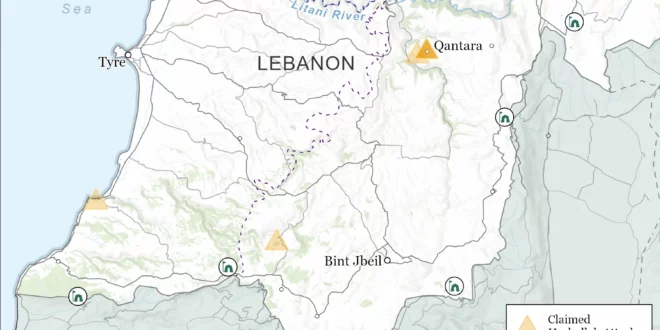
The Israel Defense Forces (IDF) is implementing battlefield adaptations to address the threat of Hezbollah’s first-person view (FPV) drones, amid Hezbollah’s increased use of FPV drones to target IDF units in southern Lebanon. Israeli Army Radio reported that the IDF presented possible drone countermeasures for Israeli units operating in Lebanon to the Israeli Knesset in the past week.[32] The IDF discussed multiple drone countermeasures, including reducing the permitted amount of time an Israeli helicopter is allowed to land in Lebanon, deploying unspecified radar systems “extensively” inside the Israeli “security zone” in southern Lebanon to increase drone detection capability, and issuing additional smart gun sights and anti-drone nets to Israeli forces in Lebanon.[33] Hezbollah FPV drones targeted an Israeli helicopter that was evacuating casualties near Taybeh, Marjaayoun District, on April 26, which presumably triggered a review of standard operating procedure.[34] Israeli media reported on April 28 that the IDF is examining the use of “lightweight acoustic radars” to improve IDF drone detection capabilities.[35] Multiple open-source intelligence (OSINT) accounts published footage on April 28 that purportedly shows a rifle‘s sight picture while using an Israeli Dagger smart gun sight mounted to an M4 rifle to improve their accuracy and shoot down two Hezbollah drones.[36] Israeli media and a Lebanese OSINT analyst published footage on April 29 of an Israeli unit using anti-drone netting to protect a vehicle operating in southern Lebanon.[37] Ukraine and Russia have extensively used anti-drone netting to protect personnel and vehicles against FPV drones.[38] The IDF has upgraded certain IDF vehicles, including Merkava tanks, with anti-drone armor in response to Hamas’s use of FPV drones in Gaza.[39]
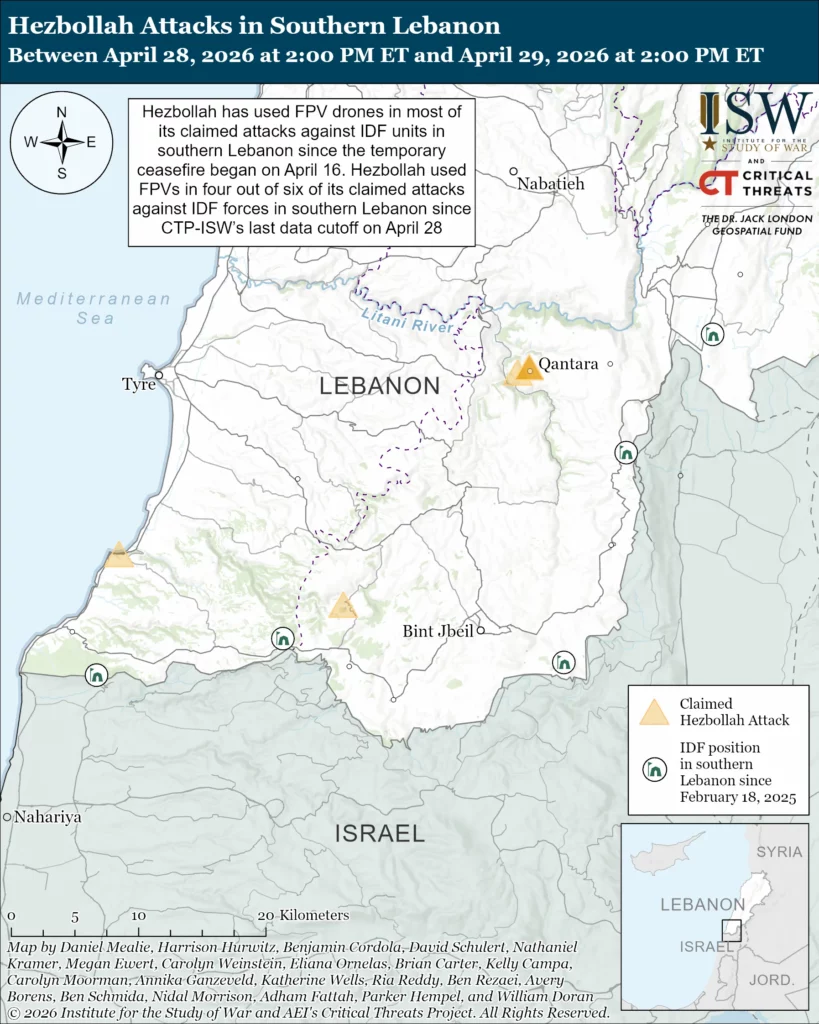
The rate of Hezbollah FPV attacks remains relatively low compared to the way both sides employ drones in Ukraine. The majority of Hezbollah’s claimed attacks against IDF units have used FPV drones since the start of the temporary ceasefire on April 16, however.[40] Hezbollah used FPVs in four out of six claimed attacks against IDF forces in southern Lebanon since CTP-ISW’s last data cut off on April 28.[41] 1st (Golani) Infantry Brigade (36th Armored Division) soldiers seized a Hezbollah weapons cache that included partially assembled FPV drones, remote detonators, and rocket-propelled grenade (RPG) warheads in southern Lebanon on April 27.[42] The seizure of the partially assembled FPV drones, spare drone components, and RPG-7 warheads suggests that Hezbollah is at least partially assembling its drones domestically, rather than receiving pre-assembled drones from Iran.
Israeli leaders have asked the United States not to extend the temporary ceasefire in Lebanon past its scheduled expiration on May 17, according to Israeli media.[43] Unnamed Israeli political officials argued on April 29 that the IDF’s current restraint under the ceasefire is weakening Israeli deterrence against Hezbollah, whose attacks are “undermining the prospects of reaching agreements” with the Lebanese government.[44] The Israeli government asked US President Donald Trump to approve of expanded IDF operations in Lebanon if negotiations with the Lebanese government do not “bear fruit” by May 17.[45] IDF Chief of Staff Eyal Zamir said during a visit to Israeli soldiers in Taybeh, Marjaayoun District, that there is “no ceasefire” in Lebanon and cited Hezbollah’s attacks targeting Israeli soldiers in southern Lebanon and communities in northern Israel.[46] Zamir said that the IDF will conduct military action against all threats to Israeli soldiers and civilians, including targets north of the Litani River and outside the IDF’s buffer zone in southern Lebanon.[47]
An Israeli airstrike killed three Lebanese Civil Defense personnel during a search-and-rescue mission in southern Lebanon on April 28, according to Lebanese authorities.[48] The IDF conducted two successive airstrikes targeting a building in Majdal Zoun, in Lebanon’s South Province.[49] The Lebanese Civil Defense said that its rescuers were responding to civilian casualties from the IDF’s first airstrike on Majdal Zoun when a second airstrike trapped and killed the rescuers.[50] Lebanese Prime Minister Nawaf Salam called the IDF airstrikes on Majdal Zoun a “flagrant violation of the principles and rules of international humanitarian law.”[51]
Other Axis of Resistance Response
Likely Iranian-backed Iraqi militia front group Saraya Awliya al Dam released fiber-optic FPV drone footage on April 28 showing an attack targeting a communications tower at Camp Victory, a former US military base located at Baghdad International Airport, on April 8.[52] This militia previously conducted two FPV drone attacks targeting fuel tanks at Camp Victory on April 2 and 7.[53] Iranian-backed Iraqi militias repeatedly targeted Baghdad International Airport and its co-located facilities, including Camp Victory and the diplomatic support center, before the US-Iran ceasefire.[54]