 Eurasia Press & News
Introduction: A World on the Edge – Why Stability is Becoming a Rare Thing
The last century seemed like an era of predictability and relative order, albeit sustained by a balance of forces of fear. But the reality of 2026 tells a different story: we live in a world where tensions have accumulated to such a scale that any spark could detonate across several continents at once [1, 10].
Geopolitics has ceased to be a diplomatic game or a cerebral exercise. It has become a harsh, transparent, and deadly reality, where the struggle is for resources, transportation routes, technological dominance, and the very right to exist on the world map [13]. Old treaties are obsolete, guarantees no longer guarantee anyone, and fault lines run where peaceful borders and trade routes once stood.
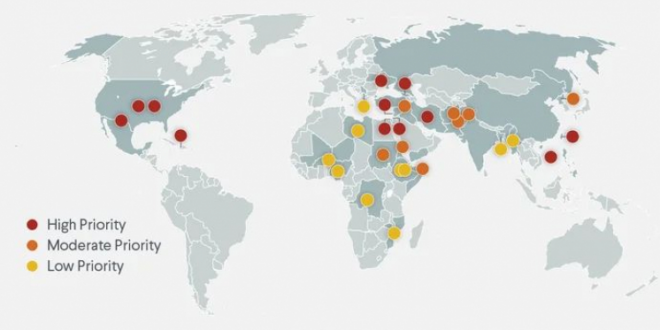
In this article, we examine in detail a world map that highlights the hottest spots, the most likely flashpoints of conflict, and the regions where the likelihood of armed conflict or full-scale war reaches its peak in 2026 and the near future. We analyze not only the obvious fronts but also the hidden, latent conflicts that simmer beneath the surface for the time being, but are ready to erupt at any moment [10].
Chapter 1: The Taiwan Strait – A Powder Keg in the Central Pacific Ocean
There is perhaps no place on the planet more tense or more significant for the global economy than the Taiwan Strait [6]. This narrow stretch of water separates not just two shores or two political regimes—it is here that the interests of the world’s largest economies converge, and here lies the key to producing the most important components of modern civilization.
Why is this the center of the world?
It’s all about technology and manufacturing. Taiwan controls over 60% of the global semiconductor market and nearly 90% of the market for cutting-edge chips (processors smaller than 10 nanometers) [12]. Without these small components, factories grind to a halt, and smartphones, computers, cars, military equipment, and data centers around the world don’t work. Control over this production means control over the entire global economy and military might [6].
On one side stands China, which considers the island its integral territory and is consistently increasing its military power, pressure, and diplomatic isolation of the regime on the island [6]. On the other side stands Taiwan itself, which over the decades has transformed into a thriving democracy, a technology giant, and enjoys the powerful support of the United States and its allies in the region [1, 6].
Development scenarios
In 2026, the situation looks like a coiled spring. Any misstep, any provocation, any attempt at a blockade or a violent takeover could instantly escalate into an armed conflict, automatically drawing in dozens of countries [1].
- Blockade: Even without direct conflict, a complete naval and air blockade of the island would paralyze the global economy, causing a chip shortage, rising prices, and a worldwide recession [13].
- War: A direct clash would mean the largest naval and air battle since World War II, with catastrophic consequences for the planet [10].
This is point #1 in our risk ranking – the most likely and the most destructive [1, 6].
Chapter 2: The South China Sea: The Fight for Islands, Fish, and Oil
If Taiwan is a matter of technology and prestige, then the South China Sea is a matter of resources and communications [6]. This vast body of water, through which up to a third of global trade passes, conceals vast reserves of oil, natural gas, and other minerals within its depths, and is also home to one of the richest fisheries on the planet [12].
Labyrinth of claims
Here, the interests of several states collide: China, Vietnam, the Philippines, Malaysia, Brunei, and Taiwan. China makes maximalist claims to almost the entire sea, drawing a “nine-dashed line” and building actual military bases with airfields and missiles on remote reefs and rocks [6]. Other countries defend their exclusive economic zones and continental shelf rights.
In 2026, we see constant pressure: clashes between fishing vessels, the displacement of competitors, the construction of artificial islands, and the militarization of the region [6]. This is not a united front, but a thousand small conflicts that could merge into one big conflagration at any moment.
Control over the paths
The main strategic significance of this sea is control over the Strait of Malacca and other transport arteries through which energy and goods flow from Africa and the Middle East to East Asia [13]. Whoever controls this sea holds a tight rein on global trade. Therefore, aircraft carrier groups and submarines from the major players are constantly stationed here, and tensions never subside [1].
Chapter 3: The Korean Peninsula – A Frozen War Ready to Unfreeze
The Korean War of 1950-1953 never formally ended in peace; only an armistice was signed. And for over 70 years, the two armies have stood facing each other, separated by the most fortified border in the world [3].
But in 2026, the situation here changed dramatically. North Korea has achieved success in its nuclear missile program, creating not only weapons of mass destruction but also delivery systems capable of reaching not only its neighbors but also the continent [10]. The regime in Pyongyang feels confident and is using tension as a tool for internal mobilization and external bargaining.
Powder keg
South Korea and the United States maintain a high level of readiness, conducting regular exercises and deploying modern missile defense systems [1]. Any incident—a border attack, a provocation, an attempted landing, or a technical failure—could be interpreted as the beginning of an attack and trigger a retaliatory strike that would instantly transform the region into a battlefield [10].
The peculiarity of this conflict is that it is very fast and very bloody. The capital of the South is within direct range of the North’s artillery, so the outbreak of war would mean immediate and massive losses and destruction even before the main forces enter the game [10].
This is one of the most unpredictable and dangerous regions, where the logic of containment works with varying success [10].
Chapter 4: Europe and the East – The Junction of Blocks and the Fault Line
Europe, long considered a symbol of peace and stability, in 2026 once again becomes a theater of war and a zone of high tension [1]. The conflict that began earlier not only has not subsided, but has taken on the character of a protracted trench war, drawing in ever new resources and forces.
NATO versus new alliances
The line of contact runs not only along the front line, but also through the entire continent’s security system. The expansion of blocs and the deployment of new types of weapons, medium-range missiles, hypersonic systems, and air defense systems are making the situation increasingly tense [1].
The risk here lies not only in the continuation of existing clashes but also in the possibility of a direct confrontation between the largest military powers. Any mistake, an accidental salvo, a downed aircraft or satellite could cross a red line, triggering an escalation that would be virtually impossible to stop [1, 14].
Energy and infrastructure war
A distinctive feature of the current era is that warfare is waged not only on land, but also underwater, in the air, and in cyberspace. Attacks on pipelines, energy infrastructure, ports, and logistics hubs have become common practice [13]. This makes not only the warring parties vulnerable, but also neighboring countries, which find themselves drawn into the process unwittingly.
Europe lives under a constant sword of Damocles, where balance is maintained only by mutual fear and a huge concentration of military power on both sides of the border [1].
Chapter 5: New Frontiers: The Arctic – The Struggle for Dwindling Riches
If the previous points are classic flashpoints, then the Arctic is a conflict of the future that is rapidly becoming the present [13]. Global warming is causing glaciers to melt, opening the Northern Sea Route to shipping and making vast deposits of minerals, oil, and gas, previously hidden beneath thick ice and permafrost, accessible for development [13].
Whose land is this?
Six countries—Russia, Canada, the United States, Norway, Denmark (via Greenland), and Iceland—are asserting their rights to the Arctic shelf by conducting expeditions, planting flags, and increasing their military presence in the region [13]. New bases and an icebreaker fleet are being established, and patrols are becoming permanent.
In 2026, the Arctic will cease to be a peaceful zone. It will become a new battleground for influence and resources. The Northern Sea Route could become an alternative to the Suez Canal, shortening the route between Europe and Asia by thousands of kilometers, and control of this new “superhighway” has strategic significance on a global scale [13].
There are no shots fired here yet, but a quiet, persistent expansion is underway, which will sooner or later lead to legal and then to violent clashes [13].
Chapter 6: Latin America and Africa – Forgotten Fronts and Resource Wars
We must not forget about other regions of the world where conflicts are not as prominent in the news, but are no less brutal and intense than those in Europe or Asia [10].
Venezuela and Latin America
Venezuela is one of the richest countries in terms of oil reserves, but one of the poorest in terms of living standards. Ongoing political crises, regime conflicts, external intervention, and the struggle for control of energy resources make the region a constant source of instability [10]. At any moment, internal conflict could escalate into civil war or conflict between neighboring states, drawing in the United States and other power centers [1].
The African continent
Africa is a continent of young populations, growing economies, and vast untapped resources. But it is also a continent of borders drawn by rulers who ignored the ethnic, religious, and clan characteristics of their peoples [10].
In 2026, new conflicts continue and flare up here:
- The struggle for water and fertile land in the context of climate change [13].
- The struggle for control over deposits of rare earth metals, uranium, diamonds and gold, without which high-tech industries around the world cannot operate [13].
- Religious and ethnic clashes, which are often fueled and financed from outside as part of a geopolitical game [10].
Africa is becoming a field of competition for influence and resources, where local wars are part of a large global chess game [13].
Chapter 7: Threat Assessment: What’s Likely and What’s Most Dangerous
To summarize our geopolitical analysis, we can classify risks along two main axes: the likelihood of occurrence and the scale of potential consequences [10]. This allows us not only to list hot spots but also to understand the location of the most dangerous “epicenter” of the future.
Red Zone: High Probability + Catastrophic Consequences
- Taiwan Strait: This is the highest score on both scales. A conflict here is not only the most likely due to the heightened tensions and military activity, but also has the potential to collapse the entire global economy in a matter of weeks [1, 6]. This is not just a local war; it is a blow to the nervous system of modern civilization.
- Eastern Europe: The region is in a state of ongoing war, which is taking on new forms and dimensions [1]. The risk of escalation into a wider conflict remains constant, and the consequences are felt worldwide through energy, food and inflation.
- South China Sea: Constant pressure, maneuvers, and incidents create a backdrop in which an accidental encounter or a miscalculation by a commander on the ground could trigger an escalation mechanism that would be extremely difficult to stop [6].
Orange Zone: Medium Probability + Extreme Consequences
- The Korean Peninsula: The risk here lies in its suddenness and lightning speed. If war breaks out, it will be the most brutal and bloody in decades, with the full arsenal of available means being used [10].
- The Middle East: This region has always been a powder keg, and in 2026 it remains a constant boiling point. The struggle for influence, resources, and religious tensions could give rise to both local clashes and a full-scale coalition war [10].
Yellow Zone: Low probability now, but tension rising
- The Arctic: A slow-burning conflict that will grow in intensity each year as the ice melts and new opportunities open up [13].
- Africa and Latin America: Numerous localized pockets of instability that can merge into larger, protracted conflicts, especially in the context of the struggle for resources [10].
Chapter 8: Hidden Fronts: Cyberwar and the Fight for Information
In 2026, war is no longer confined to land, sea, and air. The fiercest battles increasingly take place in invisible spaces—in cyberspace and the information sphere [7].
Cyberattacks as a first strike weapon
Before or even instead of direct military conflict, the sides strike the enemy’s infrastructure: power plants, transportation control systems, banking systems, government websites, and databases [7]. The goal is to paralyze the country, cause panic, and disrupt governance even before the first soldiers launch an attack.
By 2026, the capabilities of such attacks have increased exponentially. Killer viruses have been created that can disable industrial equipment, power plants, and even military vehicles remotely. This is a war without gunfire, but with destruction and casualties no less than those from conventional bombs [2].
Information battlefield
The battle for minds is no less important. In the modern world, control over reality is exercised through control over information [14]. Whoever sets the agenda, who explains the reasons for events, and who presents the picture wins the war.
We are seeing the widespread use of deepfakes, fake news, bots, and algorithms that shape public opinion [7]. Reality is becoming multidimensional, and it is becoming increasingly difficult for the average person to distinguish truth from fiction, fact from propaganda. This is also part of the risk map—the war for truth that is waged every day and everywhere [14].
Chapter 9: What to Do? Forecasts and Recommendations
Looking at this risk map, it’s hard to remain optimistic. But understanding the threat is half the defense. What can we expect and how can we prepare?
Short term (1-2 years)
- Increased volatility: The world’s economies will be in a state of constant flux. Exchange rates, energy prices, and food prices will fluctuate sharply depending on news from hot spots [4].
- Tightening of regimes: In conditions of the threat of war, control, censorship and mobilization measures will be strengthened in almost all countries [14].
- Restructuring of logistics: Companies and states will actively seek ways to bypass dangerous zones, create alternate routes and warehouses, which will affect prices and availability of goods [5].
Long-term period (5-10 years)
The world will likely be finally divided into zones of influence and economic blocs with different standards, rules, and currencies [13]. Globalization in its previous form is disappearing, being replaced by regionalization and the creation of “fortress economies.”
For the average person
The main advice in the world of 2026 is to increase your resilience.
- Financial diversification (don’t keep all your eggs in one basket and in one currency) [13].
- Skills and professions that will be needed in any scenario.
- Information hygiene and the ability to think critically in order to avoid becoming a victim of propaganda and fakes [7].
- Creating communities and connections to rely on in difficult times [14].
Conclusion
We’ve taken a detailed look at the risk map for 2026 and the foreseeable future. It looks alarming and complex. From Taiwan to the Arctic, from the Korean Peninsula to Africa, the planet resembles a field strewn with time bombs [10].
But history is not predetermined. It is written here and now, by the actions of leaders, the decisions of diplomats, and the behavior of millions of people. Perhaps it is precisely the recognition of the cost of a potential catastrophe that will force the parties to seek compromises, negotiate, and find ways to peaceful coexistence.
However, as experience shows, one should always hope for the best, but be prepared for any development. Because in the ruleless world we are analyzing, the only guarantee of safety is one’s own vigilance and preparedness [13].