 Eurasia Press & News
The Institute for the Study of War (ISW) and The Critical Threats Project (CTP) at the American Enterprise Institute are publishing daily updates to provide analysis on the war with Iran. The updates focus on US and Israeli strikes on Iran and Iran and the Axis of Resistance’s response to the strikes. The updates cover events from the past 24-hour period.
Key Takeaways
Iran and the United States have not bridged key differences on all the major demands in the US-Iran talks. Iranian officials said that they are unwilling to discuss their nuclear program on May 25, and Iranian regime media on May 25 insisted that the United States observe Iran’s right to enrich uranium on Iranian territory.
Granting Iran economic relief by unfreezing funds or removing sanctions would likely decrease Iranian military reconstitution timelines. Iran reportedly demanded that the US immediately release the first half of frozen Iranian assets upon signing the agreement and the second half of the assets within 60 days, according to Islamic Revolutionary Guards Corps (IRGC) media on May 26.
Iran is also refusing to reopen the Strait of Hormuz and using force to ensure the recognized traffic separation scheme remains closed. Iran used force again on May 25 to maintain its illegitimate traffic separation scheme when it attempted to deploy mines in the Strait of Hormuz.
Iranian Supreme Leader Mojtaba Khamenei released a statement on May 26 reaffirming the regime’s commitment to the principles of the Islamic Revolution and his father’s grand strategy – namely, a commitment to the destruction of Israel, the expulsion of US forces from the region, and the formation of a “new Islamic civilization” united against the United States. Khamenei emphasized that “Death to America [and Israel]” will again be the slogan of Iran and the Islamic world.
Toplines
Iran and the United States have not bridged key differences on all the major demands in the US-Iran talks. Iranian officials said that they are unwilling to discuss their nuclear program on May 25, and Iranian regime media on May 25 insisted that the United States observe Iran’s right to enrich uranium on Iranian territory.[1] Mediators and US officials added that the United States will not provide economic relief to Iran without serious commitments from Iran on its nuclear program.[2] This represents a major impasse in talks because Iran refuses to discuss its nuclear program without economic relief. US President Donald Trump stated on Truth Social on May 26 that Iran’s highly enriched uranium (HEU) must be “immediately turned over” to the United States or else destroyed where it is within Iran or at another “acceptable location” with verification.[3] The two sides remain far apart on the Strait of Hormuz, as well, which is discussed in greater detail below.
Granting Iran economic relief by unfreezing funds or removing sanctions would likely decrease Iranian military reconstitution timelines. Iran reportedly demanded that the US immediately release the first half of frozen Iranian assets upon signing the agreement and the second half of the assets within 60 days, according to Islamic Revolutionary Guards Corps (IRGC) media on May 26.[4] The exact amount of these assets is unclear.[5] The Iranian Foreign Affairs Ministry spokesperson explicitly said that Iran would use its unfrozen assets to reconstitute and improve the ballistic missile and drone programs.[6] Iranian officials have also called for the United States to lift the US Navy blockade and sanctions on oil as part of the deal for at least 30 to 60 days.[7] Detailed reconstitution timelines do not exist in the open-source, and intelligence leaks about these timelines are impossible to judge on their own merits due to the lack of context provided in leaks.[8] ISW-CTP has previously assessed that Iran would likely need a longer period of time to reconstitute its missile program than it did after the June 2025 strikes because the combined force struck many more production targets than Israel did in June 2025.[9] This relative assessment — as well as any more detailed assessment — relies on various assumptions about the amount of funds Iran can put towards reconstitution and rebuilding of its military forces, among other factors. Unfreezing funds or dropping sanctions gives Iran relatively more funds to put towards reconstitution.
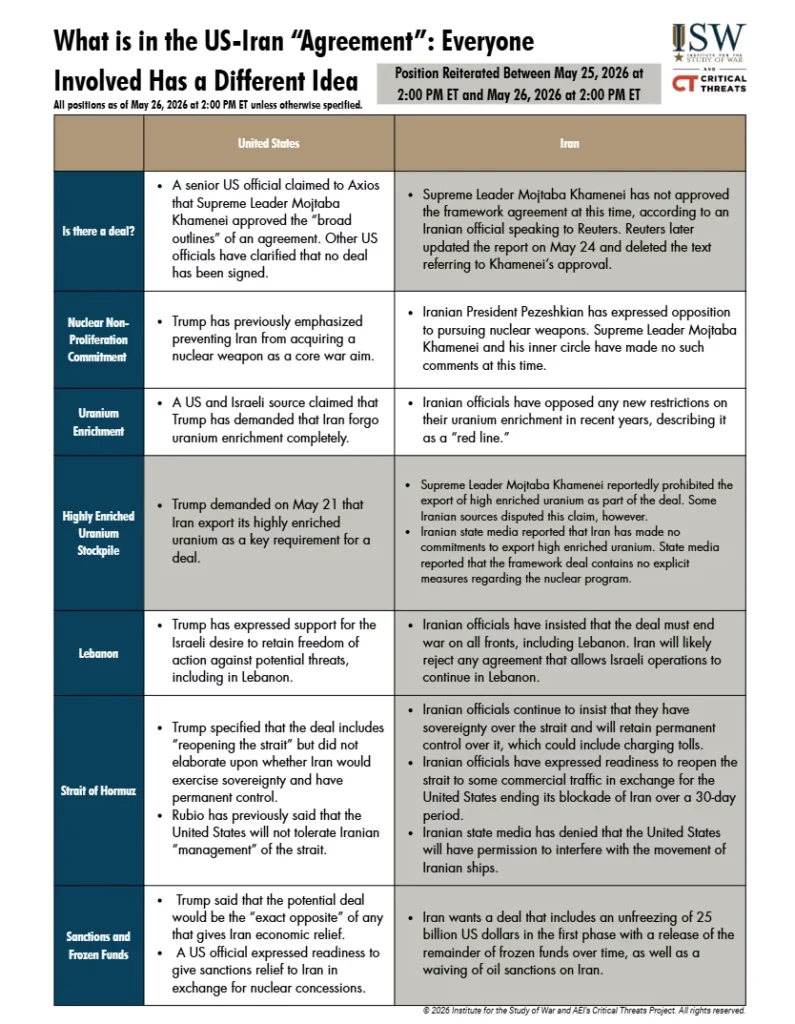
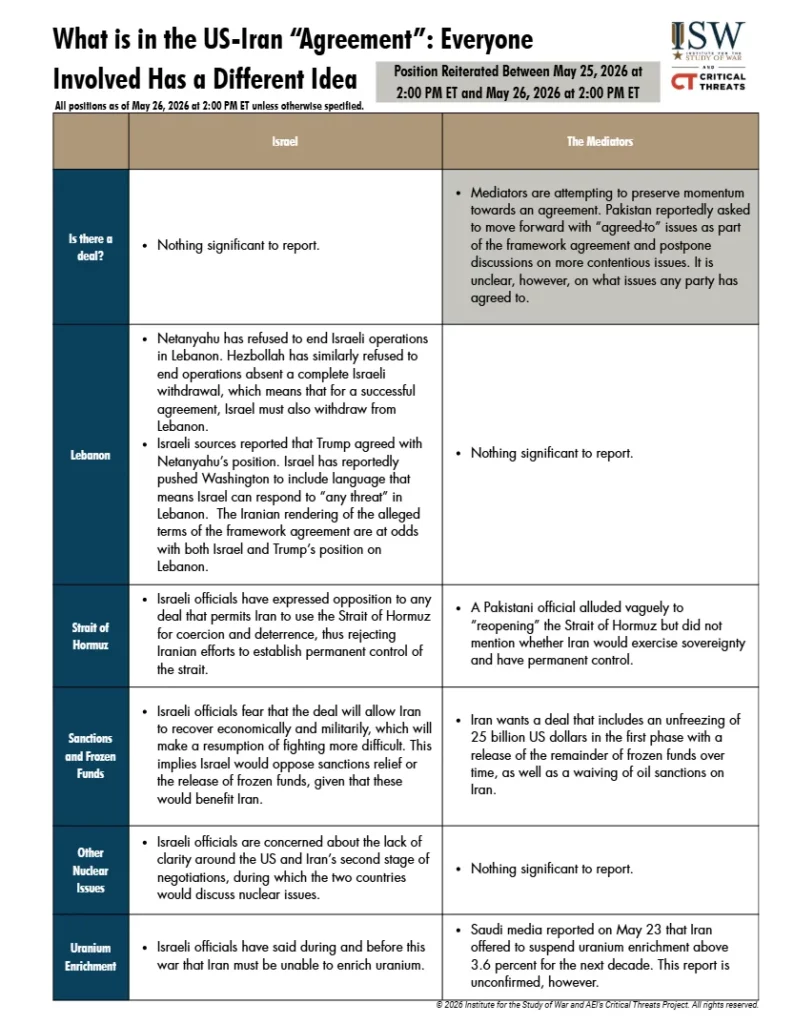
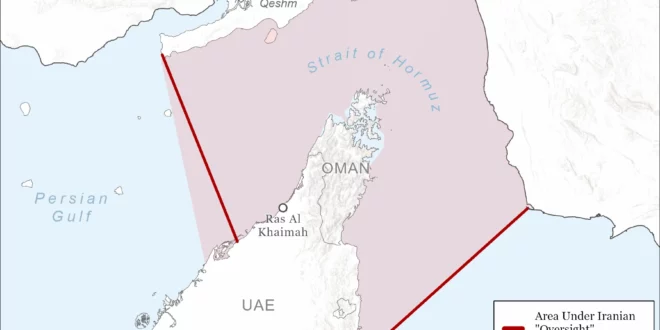
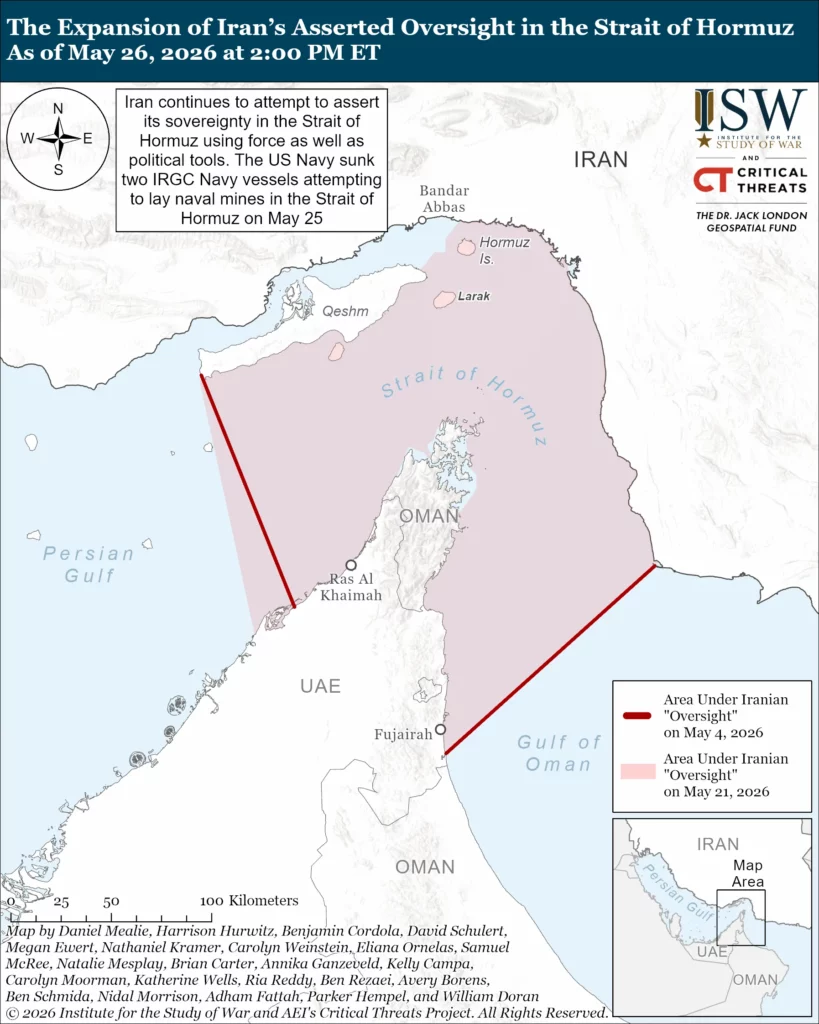
Iran is also refusing to reopen the Strait of Hormuz and using force to ensure the recognized traffic separation scheme remains closed. Iranian officials continue to state Iran will only re-open the strait to civilian ships under “Iranian arrangements,” and Supreme Leader Mojtaba Khamenei’s guidance to the Iranian government on May 25 said Iran must leverage the strait for economic gain.[10] This position directly contradicts the US position on freedom of navigation, because freedom of navigation through an international waterway has no ”arrangements” imposed by another state. Iran has forced vessels to proceed through the strait using its territorial waters and an illegitimate (but unmined) traffic separation scheme by mining the recognized traffic separation scheme (which is in an international waterway) and threatening to fire at any vessel that uses it.
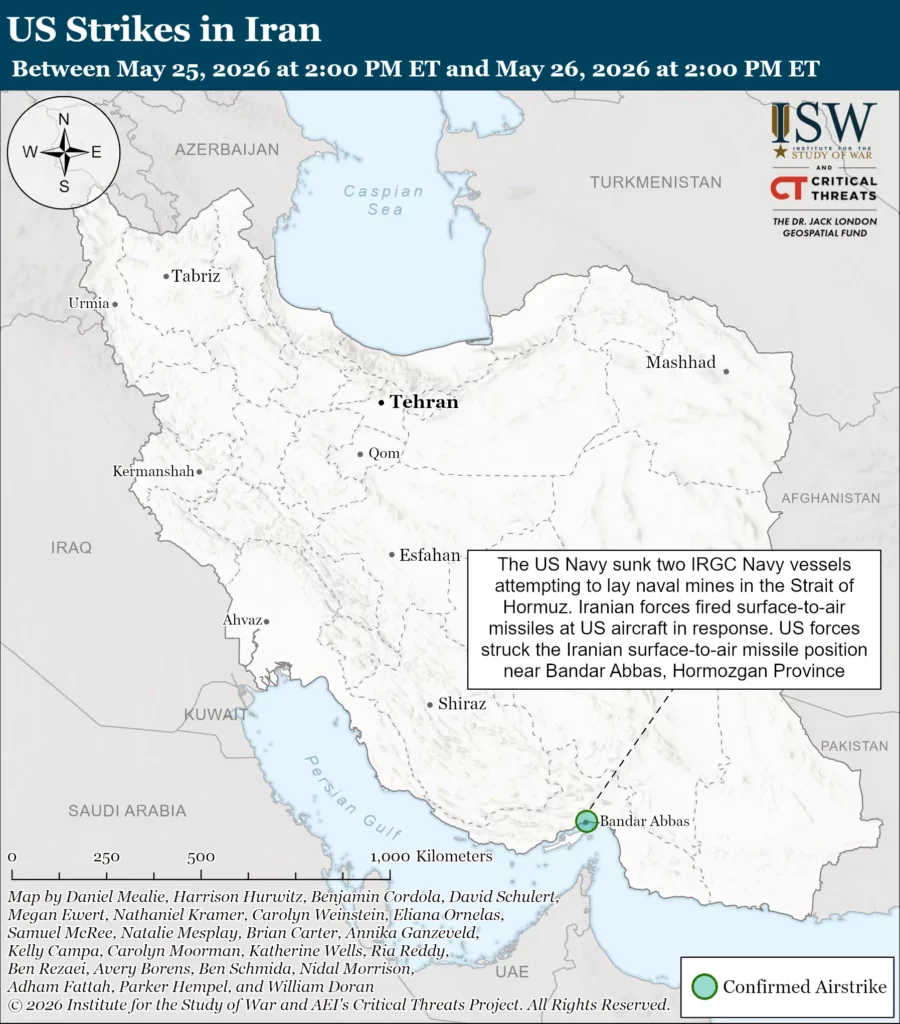
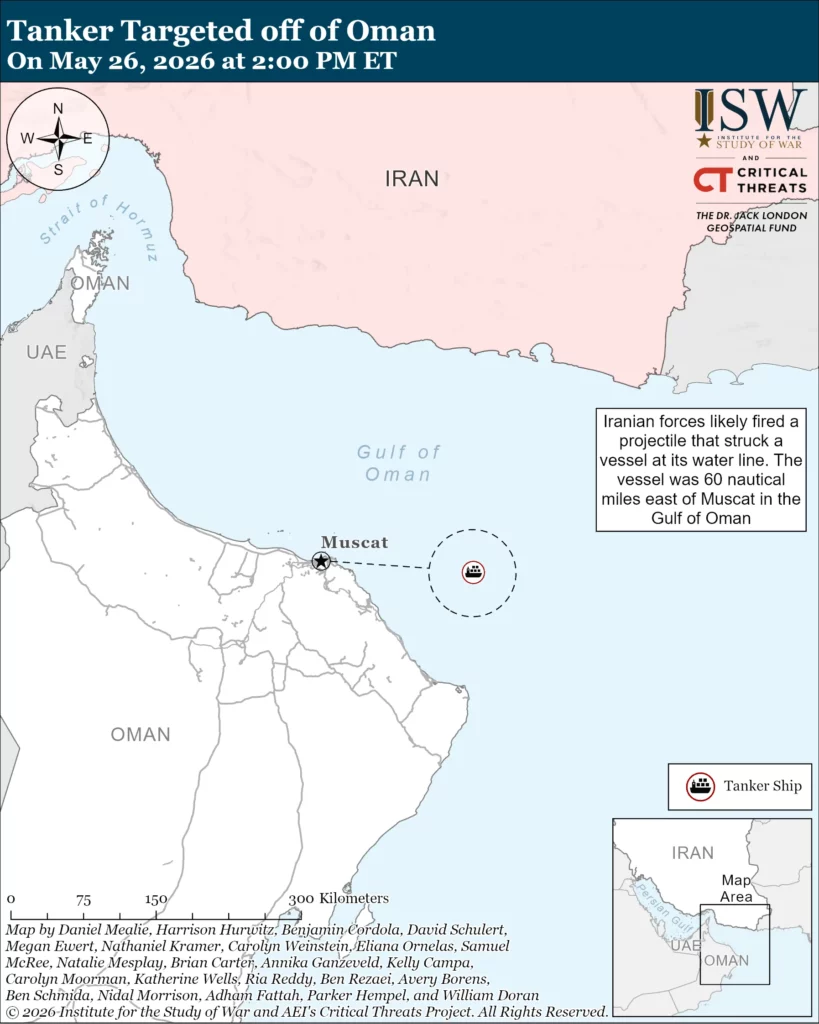
Iran used force again on May 25 to maintain its illegitimate traffic separation scheme when it attempted to deploy mines in the Strait of Hormuz.[11] US Navy aircraft sank the two IRGC Navy vessels responsible for the mine-laying effort. Iran fired at the US Navy aircraft with surface-to-air missiles, but the surface-to-air missile batteries were subsequently struck as well.[12] Iran then separately likely fired an unspecified projectile at and struck the water line of a vessel 60 nautical miles east of Muscat in the Sea of Oman on May 26.[13
US Central Command (CENTCOM) denied reports that it had resumed Project Freedom and that US forces were escorting vessels through the strait.[14] US President Donald Trump halted the project on May 5 to pursue US-Iran negotiations after announcing the start of it on May 4.[15]
Iranian Supreme Leader Mojtaba Khamenei released a statement on May 26 reaffirming the regime’s commitment to the principles of the Islamic Revolution and his father’s grand strategy – namely, a commitment to the destruction of Israel, the expulsion of US forces from the region, and the formation of a “new Islamic civilization” united against the United States.[16] Khamenei emphasized that “Death to America [and Israel]” will again be the slogan of Iran and the Islamic world.[17] Khamenei stated that Iran defeated US and Israeli forces in the recent war and highlighted the “martyrs” of Iran’s partners and proxies in the region, particularly Hezbollah in Lebanon.[18] Khamenei emphasized the need to unite the Islamic world to “solve the problems” of the region, including preventing the presence of US forces.[19]
Maritime Developments
See topline section.
US and Israeli Air Campaign
Nothing significant to report.
Iranian Internal Dynamics
The Iranian regime has restored some international internet access to Iran, amid growing public discontent with the regime’s economic mismanagement. Iranian President Masoud Pezeshkian ordered the Communications Ministry on May 25 to end the internet shutdown that Iran began in response to the January 2026 protest movement.[20] Internet monitor NetBlocks reported on May 26 that Iran has “partially” restored international internet access and that citizens have gradually increased their internet connectivity.[21] The internet shutdown has exacerbated problems with Iran’s already struggling economy, which has been one of Pezeshkian’s main domestic policy concerns.[22] Pezeshkian has previously emphasized the importance of financial gains from negotiations as necessary for Iran to pay for the estimated $300 billion USD in losses from the war with the United States and Israel, for example.[23] There are still restrictions on internet access, however. NetBlocks reported that the popular messaging platform WhatsApp is restricted, Iran’s heavily monitored domestic intranet remains active, and that some users are still offline.[24] The Iranian Supreme National Security Council (SNSC) has not yet publicly approved Pezeshkian’s order. Anti-regime media previously reported that the SNSC, led by hardliner Secretary Mohammad Bagher Zolghadr, expressed concern about the potential for renewed protests due to worsening economic conditions.[25] Internet monitor Filter Watch reported during the internet shutdown in the most recent protest wave that the regime would whitelist select individuals to permit them internet access, rather than allow internet access for all Iranians.[26]
Lebanese Hezbollah and the Israeli Campaign in Lebanon
The IDF has increased its airstrikes and expanded its ground operations against Hezbollah targets in Southern Lebanon and the Bekaa Valley in response to continued Hezbollah attacks against the IDF in southern Lebanon and northern Israel in recent days. Israeli Prime Minister Benjamin Netanyahu said on May 25 that he has told the IDF to increase its operations against Hezbollah.[27] Netanyahu separately stated on May 26 that the IDF is “seizing dominant terrain” and “fortifying” the IDF buffer zone in southern Lebanon to protect northern Israeli communities from Hezbollah attacks.[28] The IDF has conducted over 270 strikes in Lebanon between May 24 and 26.[29] The IDF struck over 100 Hezbollah weapons depots, headquarters, and observation posts in southern Lebanon and the Bekaa Valley overnight between May 25 and May 26, and around 10 command centers and weapons depots in Tyre on May 25.[30] Lebanese media reported at least 100 IDF strikes in Lebanon on May 24, marking the first time the IDF has conducted at least 100 strikes in a 24-hour period since the start of the temporary ceasefire on April 16.[31] The IDF’s strikes have remained geographically limited to southern Lebanon and the Bekaa Valley.[32] ISW-CTP has not observed any reports of strikes in the vicinity of Beirut since the IDF’s targeted strike in Beirut’s southern suburbs on May 6 that killed Hezbollah Radwan Force Commander Ahmad Ghaleb “Malik” Balout.[33]
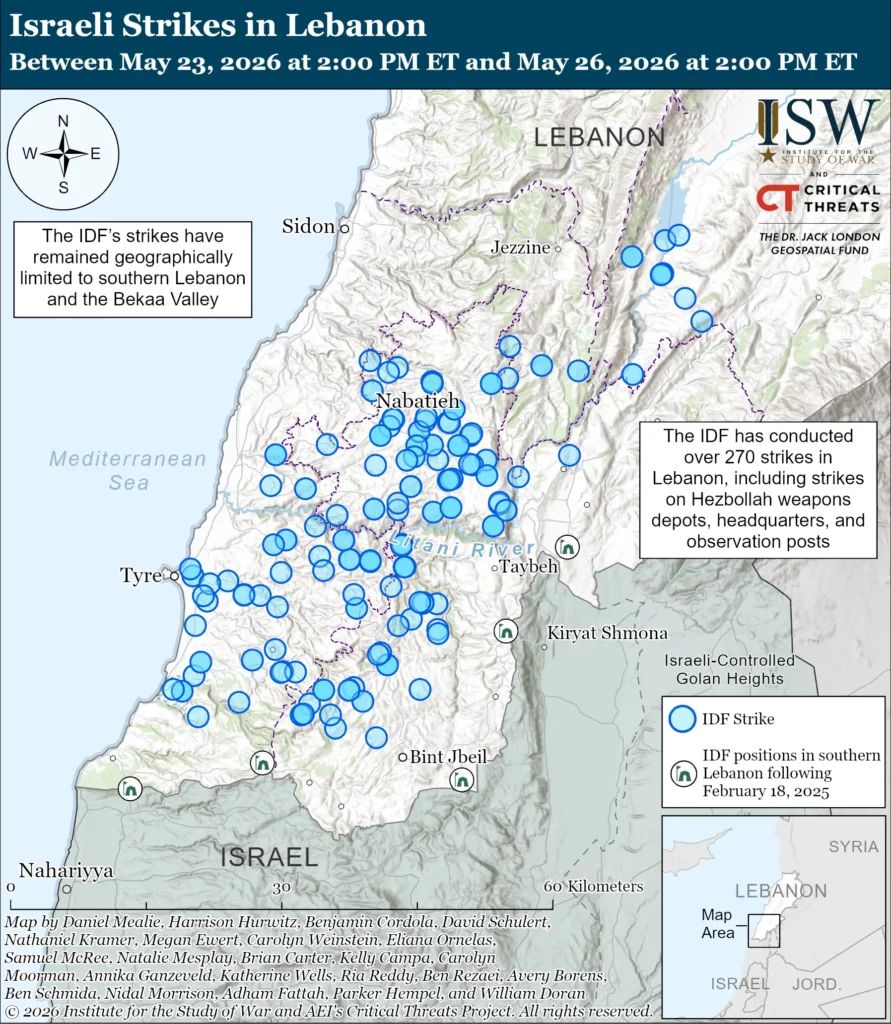
An Israeli military official and another unspecified source told Reuters on May 26 that it is conducting ground operations beyond the IDF’s “yellow line” in southern Lebanon.[34] The IDF previously deployed the 1st (Golani) Infantry Brigade (36th Division)’s Reconnaissance Unit to establish “operational control” over the area surrounding Zawtar al Chariqyeh, which is located on the edge of the IDF’s “yellow line” on the right bank of the Litani River, on May 12.[35] An Israeli military correspondent reported on May 12 that the 1st Infantry Brigade did not advance beyond the “yellow line” at that time.[36]
Senior Israeli officials have recently called for the IDF to expand its operations, including resuming strikes in Beirut, to counter Hezbollah drone attacks. Israeli media reported that IDF Chief of Staff Lieutenant General Eyal Zamir told the Security Cabinet that the IDF needs to strike buildings in Beirut and Tyre to deter drone attacks.[37] An unnamed senior Israeli official said that Israel has decided to “act more broadly in Lebanon in response to the drones.”[38] An unspecified Israeli official told CNN that the IDF is pushing to expand its operations against Hezbollah drone infrastructure and renew attacks against Hezbollah leaders in Beirut, but that the plans are awaiting Israeli government approval.[39] US officials have reportedly supported allowing the IDF to conduct targeted strikes against Hezbollah commanders in Beirut.[40] A senior US official told Axios that Israel is not required to passively tolerate continued Hezbollah attacks on IDF forces and Israeli communities.[41] The official noted that Hezbollah has repeatedly ignored requests to halt its attacks on northern Israel, including a recent but unspecified ultimatum.[42] A senior Israeli official said that the United States told Israel not to conduct large attacks in Beirut but authorized Israel to conduct targeted strikes against Hezbollah commanders, including in Beirut.[43]
Hezbollah has continued to conduct attacks against IDF units in southern Lebanon and northern Israel. Hezbollah has repeatedly launched drones at targets in northern Israel throughout the start of the temporary ceasefire on April 16, including at least four waves of drone attacks on May 26, for example.[44] Hezbollah has also consistently attacked IDF forces operating in southern Lebanon with first-person view (FPV) drones, fixed-wing drones, rockets, and mortar fire throughout the ceasefire.[45]
Other Axis of Resistance Activity
Nothing significant to report.