 Eurasia Press & News
The proliferation of UAVs is expanding maritime surveillance capabilities while simultaneously enabling malign actors to disrupt global shipping—exposing a critical gap in the maritime security architecture.
The growing access to unmanned aerial vehicles (UAVs) in the Western Indian Ocean (WIO) is transforming maritime security across East Africa’s coastal regions.
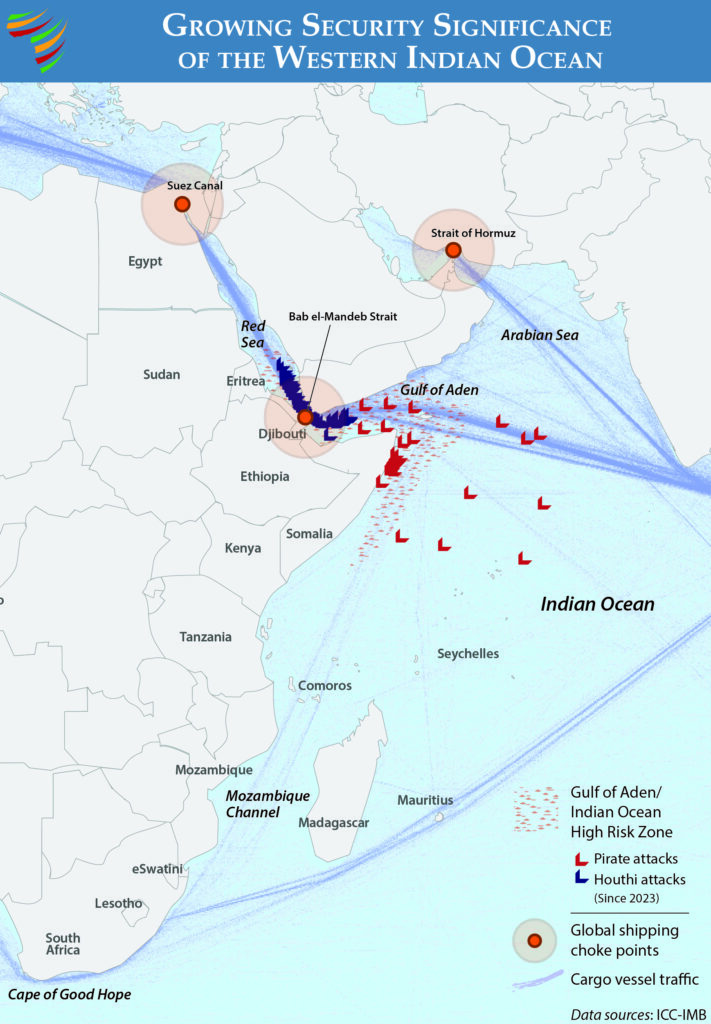
The Western Indian Ocean is a strategically vital network of maritime corridors connecting global trade through chokepoints such as the Bab al Mandeb Strait, the Mozambique Channel, and routes around the Cape of Good Hope. These corridors collectively facilitate roughly a quarter of global maritime traffic, making the region a central transport hub for the global economy.
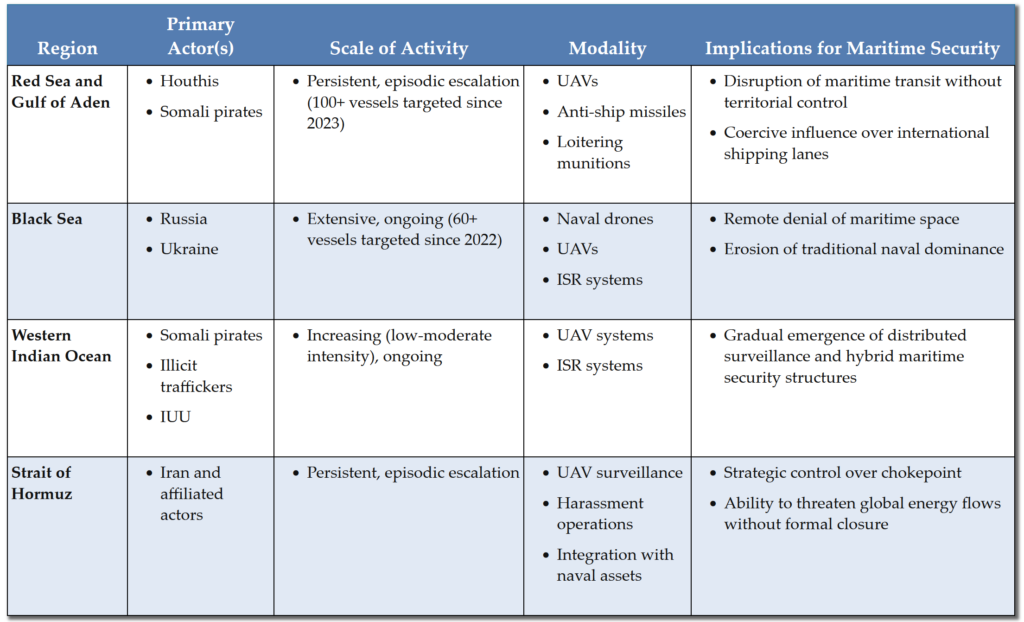
With the growing accessibility of UAVs, the WIO is characterized by enhanced visibility to counter threats, but constrained enforcement and significant legal gaps.The WIO faces persistent maritime security challenges, including piracy, trafficking, and illegal, unreported, and unregulated (IUU) fishing. In the Red Sea, Houthi militants based in Yemen have attacked commercial vessels using missiles and unmanned surface systems, affecting over 100 vessels since late 2023. These attacks have forced rerouting of shipping via the Cape of Good Hope, increased insurance costs, and extended maritime transport times. Shipping traffic in the Gulf of Aden has also been a persistent target of attacks by Somali pirates.
These vulnerabilities are compounded by the growing accessibility of unmanned technologies. This proliferation is reshaping maritime security in the region, transforming both operational practices and the safeguarding of sovereignty at sea. This transformation has been powerfully illustrated by global trade disruptions caused by restrictions on maritime traffic through the Strait of Hormuz, where drones and other unmanned systems have been used to target commercial shipping.
UAV-Enabled Maritime Threats in Comparative Perspective
Distributed Maritime Operations: Expansion and Constraints
These developments demonstrate a shift in maritime security governance. Maritime access is increasingly exercised indirectly through disruption, risk imposition, and remote targeting rather than continuous territorial presence. UAVs are central to this transformation. Governments deploy UAVs to enhance maritime domain awareness through ongoing, low-cost surveillance of vast exclusive economic zones (EEZs). This enables governments to extend surveillance across expansive maritime spaces, contributing to a model of distributed maritime operations. In this evolving configuration, states are expanding their authority through persistent monitoring systems, integrated data and command networks, and information-sharing architectures—rather than physical deterrence. This model expands visibility and enhances situational awareness.
Meanwhile, drones enhance destabilizing actors’ capacity to monitor, threaten, and influence maritime activity without deploying conventional naval assets. In other words, Somali pirates or Houthi militants do not need to maintain a naval presence in the Red Sea or Gulf of Aden to be a threat. Rather, they only need to pose a credible risk to maritime traffic to disrupt it—and therefore advance their financial or political aims.
The expanded use of drones in the maritime security space, thus, is a double-edged sword. While they enable governments to extend their surveillance and monitoring capacity, they simultaneously advance the capacity of malign actors to conduct reconnaissance, coordinate attacks, and directly target vessels.
While the capacity to monitor maritime territories is extended, enforcement remains contingent on physical presence and legal recourse. Distributed maritime operations, therefore, are inherently constrained.
A defining feature of UAV deployment is the structural separation between detection and enforcement. This creates a system in which detection exceeds response capacity.This duality reflects a broader transformation in how authority over maritime space is exercised. Historically, protecting maritime spaces depended on physical presence—naval patrols for visible enforcement. UAVs alter this model by enabling authority to be exercised remotely through data, networks, and distributed sensing systems.
A defining feature of UAV deployment in the WIO is the structural separation between detection and enforcement. While drones enable continuous surveillance and rapid intelligence generation, enforcement remains dependent on naval and coast guard assets constrained by geography, resources, and coordination.
This creates a two-tier system in which detection exceeds response capacity. Disruptive actors exploit this imbalance, operating within compressed timelines that limit effective interdiction.
Addressing this gap requires integrating surveillance systems with enforcement capacity, legal authority, evidentiary frameworks, and institutional coordination capable of completing the enforcement cycle.
Legal Framework and the Legal–Policy Gap in UAV Operations
UAV operations in the WIO are governed by a patchwork of international air law, maritime law, and national regulations. A key feature of this framework is the relationship between the 1944 Convention on International Civil Aviation (Chicago Convention) and the 1982 United Nations Convention on the Law of the Sea (UNCLOS). The Chicago Convention establishes the principle of complete and exclusive state sovereignty over national airspace. UNCLOS Article 2(1) affirms that a coastal state’s sovereignty over its territorial sea extends to the airspace above it. At the same time, UNCLOS delineates maritime zones and the rights and jurisdiction attached to each.
Read together, these instruments form an interlocking, vertically structured regime. UNCLOS defines the spatial scope of maritime jurisdiction, while the Chicago Convention—together with the general principles of air law—governs the legal regime applicable to the superjacent airspace.
This interaction is clearest in the territorial sea, where coastal states exercise sovereignty over both water and airspace, requiring authorization for UAV operations. In EEZs, coastal states have sovereign rights over resources, while other states retain freedoms of navigation and overflight—though the scope of these freedoms, particularly for UAV-based intelligence, surveillance, and reconnaissance (ISR), remains contested. On the high seas, the concept of state sovereignty does not apply. UAV operations are generally permitted under the freedom of overflight, subject to due regard for other states’ rights.
UAVs operate within a vertically integrated jurisdictional space shaped by UNCLOS and the Chicago Convention. However, their hybrid and remotely operated nature may create legal ambiguities and complicate attribution, evidence, and enforcement processes. This ties into a broader structural legal-policy gap, particularly the limited legal finish. “Legal finish” refers to the formal adjudication of law enforcement actions, ensuring that detected and interdicted activities result in prosecution or administrative penalties supported by admissible evidence. It represents the final stage in the enforcement chain, linking criminal actions to justice.
Circular flow chart with four steps: 1. UAVs detect suspicious activity 2. Intelligence is generated and shared 3. Interdiction may occur 4. Legal adjudication often fails or does not occurIn practice, the enforcement chain is often incomplete. Attacks in the Red Sea and Gulf of Aden highlight this gap. Attacks on vessels are observed and sometimes countered, yet legal accountability remains inconsistent. This reflects persistent challenges in jurisdiction, attribution, evidentiary chain of custody, and institutional coordination between operational and judicial actors.
UAVs also introduce legal challenges with regard to assessing accountability. Distributed systems diffuse responsibility across multiple actors. This often requires faster (thus sloppier) decision-making and an overreliance on technology to make those decisions, complicating attribution and responsibility.
While UNCLOS and the Chicago Convention together establish a foundational legal architecture, they do not fully address the operational realities of drone-enabled surveillance and unmanned maritime activity.
Effective maritime control, therefore, depends not only on legal frameworks but also on the integration of ISR, physical enforcement capacity, and judicial mechanisms capable of completing the enforcement chain. In this way, legal finish complements the need for sustained naval presence and coordinated maritime governance.
Completing the Enforcement Chain
Experiences from the Red Sea and Strait of Hormuz demonstrate that drones are reshaping maritime security across the WIO and its connected corridors. These technologies enable distributed maritime operations by expanding ISR and indirect control through disruption.
The critical task for policymakers is to ensure that maritime governance systems can complete the full enforcement cycle—from detection to legal finish.This transformation remains incomplete, however. The central challenge is not simply technological or legal in isolation, but systemic: the failure to integrate detection, enforcement, and adjudication into a coherent framework. This is one of the objectives under review by the 22 member states of the Djibouti Code of Conduct coalition aimed at strengthening maritime governance and regional security cooperation in the Western Indian Ocean.
In the WIO context, the anti-piracy prosecution frameworks developed during the Somali piracy crisis—including Kenya’s transfer and prosecution arrangements—offer an instructive legal-finish model for addressing the enforcement challenges associated with UAV-supported maritime security operations. In 2009, the Government of Kenya and the European Union established the conditions and modalities for transferring detained piracy suspects and property seized by the European Union-led naval force (EUNAVFOR) to Kenya for prosecution and adjudication.
Kenya’s framework demonstrates how the legal-finish problem can be addressed through a combination of universal jurisdiction under UNCLOS, bilateral transfer agreements, and domestic legal reform. Kenya strengthened its maritime legal regime by incorporating internationally recognized definitions of piracy and extending jurisdiction over offences committed beyond its territorial waters. More broadly, the Kenya example demonstrates that maritime interdictions conducted in African waters can be converted into judicially sustainable prosecutions.
While such mechanisms will need to be adapted to incorporate UAV-specific prosecution or evidentiary frameworks in the WIO, building on analogous existing maritime legal architecture provides transferable legal design principles for bridging the interdiction–prosecution divide.
With the growing accessibility of drone technologies, the WIO is characterized by enhanced visibility to counter the persistent threats, though with constrained enforcement and significant gaps in legal outcomes.
Without complementary enhancements to physical enforcement capacity, coordinated institutional response, and effective legal finish, maritime security operations risk ending at disruption rather than resolution.
The critical task for policymakers, therefore, is not only to use UAVs to expand ISR but also to ensure that maritime governance systems can complete the full enforcement cycle—from detection to interdiction to legal finish—necessary for effective and legitimate control of the maritime domain.