 Eurasia Press & News
Toplines
Russian forces may launch an Oreshnik intermediate-range ballistic missile (IRBM) at Ukraine in the next 24 to 48 hours. The Ukrainian Air Force warned on June 12 that there is a “high probability” that Russian forces will launch an unspecified IRBM from the Kapustin Yar missile launch site in Astrakhan Oblast within the next day.[1] Ukrainian outlet RBK Ukraine reported on June 12, citing an informed source in the Ukrainian government, that the United States warned Ukraine about the threat of a Russian Oreshnik IRBM strike.[2] The Kremlin has launched Oreshniks at Ukraine at least three times in the missile’s operational history, at least two of which were in 2026.[3] The Kremlin has particularly escalated its long-range strike campaign against Ukraine since Ukraine’s own long-range strike campaign exposed Russian President Vladimir Putin’s inability to reliably defend his capital, St. Petersburg, and other Russian cities from Ukrainian strikes, underlined in how Putin had to ask Ukrainian President Volodymyr Zelensky for permission to hold Russia’s May 9 Victory Day celebration in Moscow.[4] The Kremlin’s possible decision to launch another Oreshnik at Ukraine would be part of this escalation pattern and would likely be an effort to posture strength following the June 12 Russia Day holiday.
Russian President Vladimir Putin continued to posture Russian military strength during Russia’s June 12 Russia Day holiday while also acknowledging some of the battlefield setbacks Russian forces have faced in recent months. Putin and Russian Defense Minister Andrey Belousov met with Russian soldiers who emphasized their commitment to a military victory in Ukraine and achieving Putin’s goals and objectives on June 12.[5] Putin lauded Russian military technological innovations, particularly in first-person view (FPV) drones, integrating artificial intelligence (AI) into drones, scaling up tactical electronic warfare (EW) systems, and Russian efforts to create a satellite constellation alternative to Starlink in order to present the Russian military as a technologically advanced and developing force. Putin also emphasized recent social support measures for Russian soldiers, veterans, and their families. Putin also reiterated long-held Kremlin rhetorical lines portraying Russia as fighting a war against NATO and reiterated Russia’s strength in fighting this war. Putin likely intended to use the meeting with Russian servicemembers to project strength for the Russia Day celebrations following the embarrassment of his scaled-down Victory Day Parade on May 9 and successful Ukrainian long-range strikes on Russian military assets in St. Petersburg, Leningrad Oblast during the St. Petersburg International Economic Forum (SPIEF) from June 3 to 6.[6]
Putin seems to have started acknowledging some of the setbacks the Russian military is currently facing but did not discuss the full extent of Russia’s military challenges. Putin claimed that Ukraine’s drone strikes are an effort to sow discord in Russian society and cause economic damage, likely referring to Ukraine’s long-range strike campaign against Russian military assets and oil infrastructure in Russia and intermediate-range interdiction campaign in occupied Ukraine that is causing fuel shortages and major logistics problems.[7] Putin claimed that Russia is strengthening its air defenses and the Russian economy is quickly recovering from Ukrainian strikes, however, and threatened retaliatory strikes against Ukraine. Putin also acknowledged that Russian forces are not advancing “as quickly as we [Russia] would like” but hedged that Russian forces are still advancing “every day gradually.”[8] Putin notably did not acknowledge that Ukrainian counterattacks have made tactical gains in Zaporizhia and Dnipropetrovsk Oblasts since March 2026. The Russian rate of advance across the battlefield has been steadily declining since November 2025 and Russian forces suffered a net loss of territory (not counting areas into which Russian troops have infiltrated) in April and May 2026.[9] Putin likely chose to acknowledge some of the setbacks Russian forces are facing to appear more in touch with the battlefield realities to Russian servicemembers who have directly experienced these setbacks. Ukraine has been increasing the scale and scope of its long-range and intermediate-range strike campaign against Russian logistics, military equipment, and manpower since early Spring 2026, which has impeded Russian advances across the theater and is disrupting Russian logistic routes across occupied Ukraine, particularly in southern Ukraine and into occupied Crimea.[10]
A Russian State Duma Deputy from the Communist Party criticized the Kremlin and the broader Russian war-waging strategy ahead of Russia Day, contradicting the Kremlin’s narrative. State Duma Deputy Vyacheslav Markhaev published a post on both his personal Telegram and VKontakte channels on June 11 accusing the Kremlin of using events such as the Russian Victory Day and SPIEF to demonstrate a false sense of prosperity and “personal enrichment of the elite” amid ongoing bans, restrictions, and a growing financial burden on regular Russians while not taking measures to help Russians with these issues.[11] Markhaev acknowledged that Ukrainian forces are expanding the geographical extent of their long-range strikes against Russia and accused the Russian political elite of losing touch with the needs of the Russian people. Markhaev criticized the Kremlin for publicly limiting its war goals from all of Ukraine to just the areas of Ukraine that Russia has claimed to have annexed and asserted that Russia needs a clear, public plan for finishing the war in Ukraine based on Russia’s national interests. ISW has observed no indication that Markhaev‘s social media accounts have been hacked. Russian state-owned media and Russian milbloggers, including those affiliated with the Kremlin, have not amplified Markhaev’s statements as of this writing.
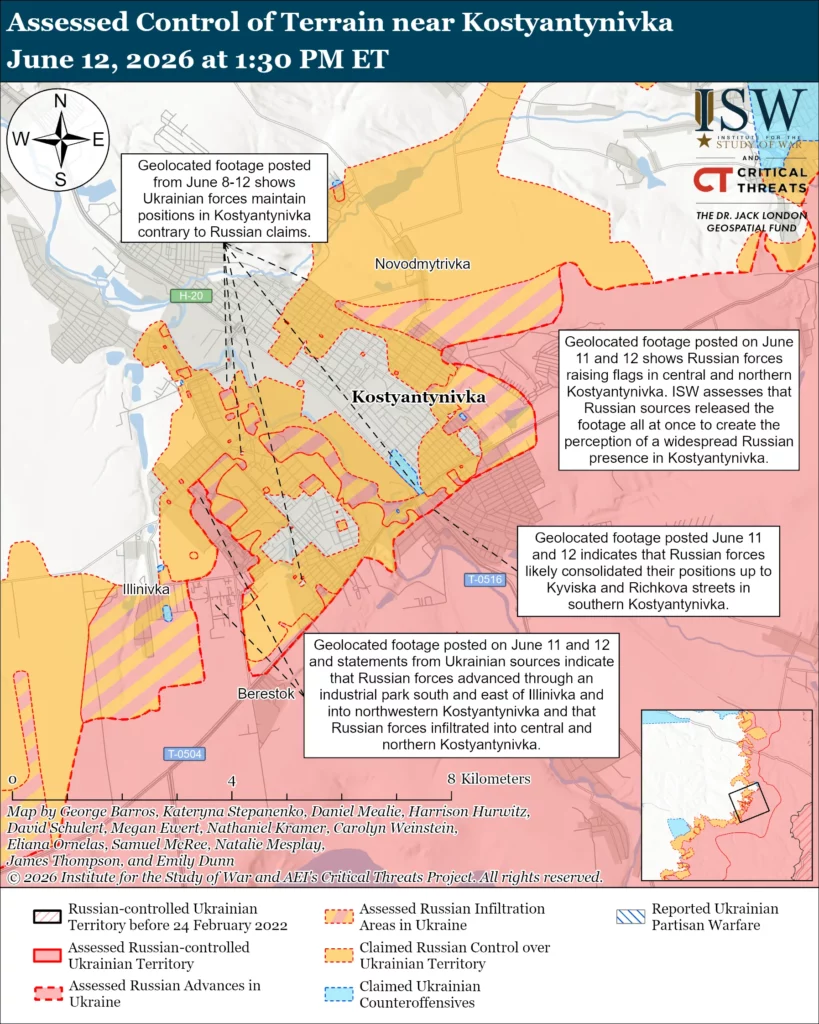
Russian sources released several pieces of footage showing Russian forces operating in Kostyantynivka as part of a deliberate cognitive warfare effort to exaggerate the Russian presence in the city. Russian forces continue to make tactical gains within Kostyantynivka, however, and Ukraine’s ability to defend the southeastern sections of the city is deteriorating. Russian sources, including a Telegram channel associated with the Russian 4th Separate Motorized Rifle Brigade and Russian state newspaper Izvestia, published several pieces of geolocated footage on June 11 and 12 of Russian servicemembers operating in northern, western, central, and southwestern Kostyantynivka in what ISW assesses were a series of Russian infiltration missions likely conducted over several days.[12] Ukrainian servicemembers told independent Ukrainian online media outlet Hromadske in an article published on June 12 that there are between 100 and 250 Russian servicemembers operating in Kostyantynivka’s center and that Russian soldiers infiltrate into Kostyantynivka one at a time every six to seven hours.[13] The geolocated footage is geographically dispersed across a wider area than that which a force of 100 to 250 Russian servicemembers could effectively hold, however, indicating that Russian servicemembers filmed infiltration missions over a period of time so that Russian sources could release the footage all at once in order to create the perception that the Russian presence in Kostyantynivka is more widespread than it actually is. ISW continues to assess that Russian forces curated the release of some combat footage, and the timing and sequencing of those releases are part of the Kremlin’s cognitive warfare effort aimed at aggrandizing Russian advances to falsely portray the Ukrainian line as collapsing across the theater.[14] Russian forces have previously released flag raisings and AI-generated videos as part of this cognitive warfare effort.[15] Footage showing Russian servicemembers during and after infiltration missions — many of which are ultimately not successful — does not intrinsically indicate Russian control of terrain or a change in the forward edge of the battle area (FEBA), although Russian forces are advancing in Kostyantynivka at a rate slower than what the Kremlin would have observers believe. These Russian sources likely released the footage in a coordinated manner as part of a broader Kremlin effort to project strength, possibly in connection with the June 12 Russia Day holiday.
Russian forces continue making tactical gains in Kostyantynivka — Russia’s assessed main effort for the Spring-Summer 2026 offensive — and have likely consolidated some tactical positions within the city beyond infiltration. These gains have taken Russian forces a long time to achieve and have come at a great cost. The depth of the Russian infiltrators in the geolocated footage published on June 11 and 12 suggests that Russian forces have likely consolidated positions in southern Kostyantynivka and south of the T-0504 highway west of Kostyantynivka at a prior date.[16] Geolocated footage published June 11 and 12 also suggests and statements from Ukrainian officials confirm that Russian forces advanced in northwestern Kostyantynivka at a prior date.[17] A Ukrainian servicemember told Hromadske in an article published on June 12 that Russian servicemembers move through Berestok (south of Kostyantynivka) to Illinivka (north of Berestok) before infiltrating into Kostyantynivka, indicating that Russian forces have likely consolidated positions between Berestok and Illinivka.[18] A Ukrainian officer told Hromadske that Russian forces have wedged themselves into an unspecified part of the center of Kostyantynivka and explicitly stated that Russian actions within the city are ”no longer infiltration.” ISW has adjusted its control of terrain assessment by expanding Russian advances in Kostyantynivka on the basis of the available footage and reporting and will continue to update its assessment as more evidence becomes available.
Russian forces have been attempting to seize Kostyantynivka for 10 months after the seizure of Toretsk (southeast of Kostyantynivka) in August 2025, and have only advanced roughly a depth of eight to 10 kilometers toward and into Kostyantynivka in that time.[19] Russian forces significantly intensified offensive operations against Kostyantynivka in March 2026, and Ukrainian officials reported that the Russian military command set the deadline to seize Kostyantynivka by May 2026 — a deadline Russian forces have since failed to meet.[20] Russian forces conducted a roughly platoon-sized mechanized assault in Kostyantynivka in March 2026.[21] Russian forces also reportedly redeployed elements of the Russian 70th Motorized Rifle Division (18th Combined Arms Army [CAA], Southern Military District [SMD]) to the Kostyantynivka-Chasiv Yar area in December 2025, likely in preparation for the Spring 2026 offensive operations against Kostyantynivka.[22] Russian forces have concentrated at least one CAA and army corps (AC) in the Kostyantynivka area and have also deployed elements of several other armies to support offensive operations against the city.[23] Russian forces also reportedly replenished 80 percent of their units attacking Kostyantynivka as of June 6.[24] Russian forces’ redeployment pattern in the Kostyantynivka direction indicates that Russian forces have sustained significant losses in their effort to advance on Kostyantynivka.
Russian forces will likely make tactical gains in Kostyantynivka in Summer 2026 but remain unlikely to achieve a rapid operational breakthrough against the Fortress Belt writ large. Russian forces will likely continue to infiltrate throughout Kostyantynivka and consolidate positions in certain areas of the city but will likely suffer high casualties in doing so.[25] Russia’s 3rd AC (under the operational control of the Southern Grouping of Forces) appears to be struggling to push Ukrainian forces from Chasiv Yar (northeast of Kostyantynivka), inhibiting their ability to envelop Kostyantynivka from the north.[26] A Kremlin-affiliated Russian milblogger claimed on June 12 that Ukrainian forces cleared part of the industrial zone in central Kostyantynivka and multi-story buildings on the western outskirts of Kostyantynivka.[27] The milblogger acknowledged that Russian forces are a long way from seizing Kostyantynivka. Russian forces have also struggled to make significant advances in Lyman and toward Slovyansk, despite prioritizing the area since March 2026.[28] ISW is not prepared to forecast whether or when Russian forces may seize Kostyantynivka. The loss of Kostyantynivka likely would not collapse the larger Fortress Belt or enable a Russian operational breakthrough as Russian forces would also need to continue fighting through the rest of the Fortress Belt’s fortified cities and their environs, and Russian forces have not optimized their force for maneuver warfare.
Russia is building at least five long-range drone launch sites in western Russia close to the border with Belarus likely to support drone strikes against Ukraine, possibly by exploiting Belarusian airspace. Radio Free Europe/Radio Liberty’s (RFE/RL) Belarusian service reported on June 10 that Russia began constructing five drone launch sites at existing airfields or brand-new sites in Bryansk, Oryol, and Smolensk oblasts between 45 and 200 kilometers from Russia’s international border with Belarus since Summer 2024.[29] RFE/RL reported that Russian forces are actively launching long-range strike drones against Ukraine from four of the sites — the Shatalovo Military Airfield in Smolensk Oblast, the Tsymbulova drone port in Oryol Oblast, and the launch sites near Navlya and Osavitsa, Bryansk Oblast. RFE/RL reported that Russian forces launched drones from the Seshcha Military Airfield in Bryansk Oblast from 2022 to 2023 and currently only use the airfield as a hub for military aviation and cargo. RFE/RL noted that Russia has been expanding most of these sites’ storage and launch capabilities, including installing launchers for jet-powered Shahed drones at the Shatalovo Airfield. Ukrainian military expert Anatoly Khrapchinsky stated to RFE/RL that the geographical location of these sites allows Russian forces to conduct direct strikes on Kyiv City or along the border to western Ukraine and can pass through Belarusian airspace to reach western Ukraine. Khrapchinsky noted that Russian drones can use Belarusian-based communication and relay channels to maintain stable communication with drones and added that the proximity of the launch sites to the Belarusian border increases the likelihood of Russian drones flying into Belarusian airspace due to technical malfunctions or electronic warfare (EW) interference. Ukrainian Air Forces Spokesperson Colonel Yuriy Ihnat stated that close proximity of the launch sites to the Ukrainian border allows Russia to increase the payloads of these drones without requiring more fuel. ISW continues to assess that Russia is establishing military infrastructure in and around Belarus and is setting informational conditions to further use Belarus for its own military purposes and may seek to justify launching drone strikes at Ukraine from Belarus.[30] Russia’s growing drone infrastructure in the vicinity of Belarus and the ability to operate drones in Belarusian airspace can additionally support future Russian military contingencies against NATO’s eastern flank.
Key Takeaways
 Russian forces may launch an Oreshnik intermediate-range ballistic missile (IRBM) at Ukraine in the next 24 to 48 hours.
Russian President Vladimir Putin continued to posture Russian military strength during Russia’s June 12 Russia Day holiday while also acknowledging some of the battlefield setbacks Russian forces have faced in recent months.
A Russian State Duma Deputy from the Communist Party criticized the Kremlin and the broader Russian war-waging strategy ahead of Russia Day, contradicting the Kremlin’s narrative.
Russian sources released several pieces of footage showing Russian forces operating in Kostyantynivka as part of a deliberate cognitive warfare effort to exaggerate the Russian presence in the city. Russian forces continue to make tactical gains within Kostyantynivka and Ukraine’s ability to defend the southeastern sections of the city is deteriorating, however.
Russian forces continue making tactical gains in Kostyantynivka — Russia’s assessed main effort for the Spring-Summer 2026 offensive — and have likely consolidated some tactical positions within the city beyond infiltration. These gains have taken Russian forces a long time to achieve and have come at a great cost.
Russian forces will likely make tactical gains in Kostyantynivka in Summer 2026 but remain unlikely to achieve a rapid operational breakthrough against the Fortress Belt writ large.
Russia is building at least five long-range drone launch sites in western Russia close to the border with Belarus likely to support drone strikes against Ukraine, possibly by exploiting Belarusian airspace.
Ukrainian forces recently advanced in the Kostyantynivka-Druzhkivka tactical area and in the Oleksandrivka direction.
Ukrainian forces struck Russian oil infrastructure on the night of June 11 and 12. Russian forces launched 117 drones against Ukraine overnight.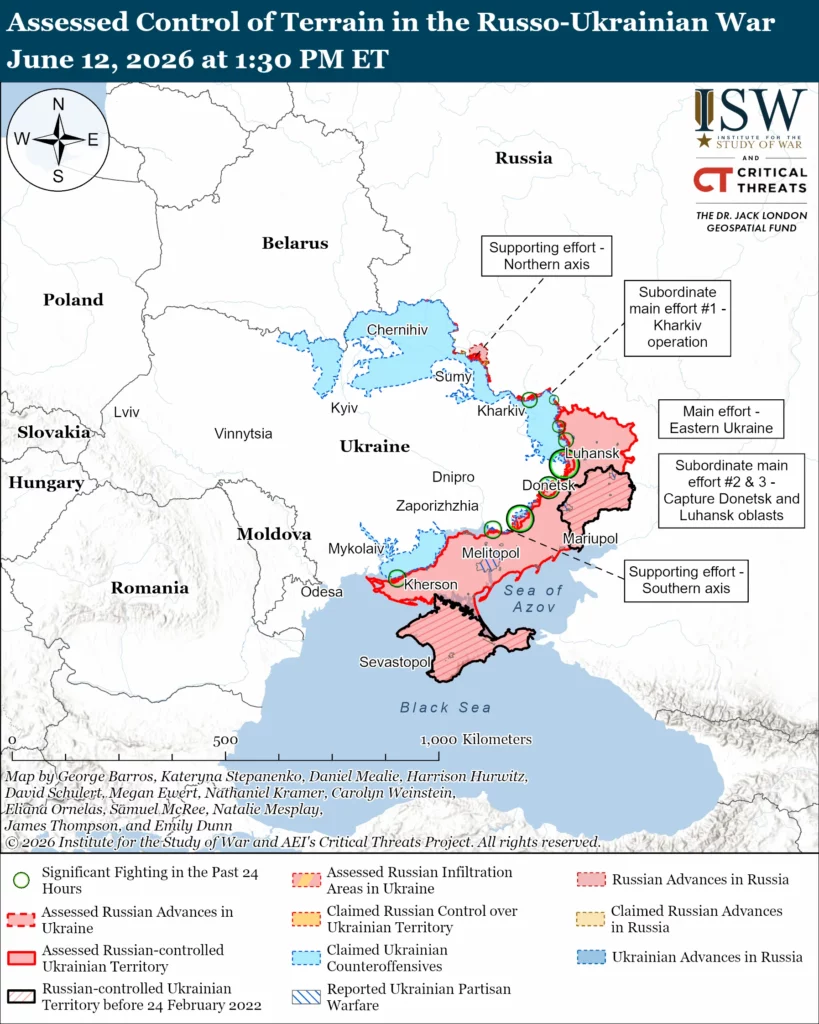
We do not report in detail on Russian war crimes because these activities are well-covered in Western media and do not directly affect the military operations we are assessing and forecasting. We will continue to evaluate and report on the effects of these criminal activities on the Ukrainian military and the Ukrainian population and specifically on combat in Ukrainian urban areas. We utterly condemn Russian violations of the laws of armed conflict and the Geneva Conventions and crimes against humanity even though we do not describe them in these reports.
Ukrainian Operations in the Russian Federation
Ukrainian forces continued their strike campaign against Russian oil infrastructure on the night of June 11 and 12. The Ukrainian General Staff reported on June 12 that Ukrainian forces struck the Tolyattikauchuk Chemical Plant near Tolyatti, Samara Oblast, causing a fire.[31] The Ukrainian General Staff noted that the plant produces synthetic rubbers, which Russia uses to produce solid rocket fuel for tactical and ballistic missiles, as well as monomers and high-octane additives for gasoline. Ukrainian Unmanned Systems Forces (USF) Commander Major Robert “Magyar” Brovdi added that the plant produces 25 percent of Russia’s synthetic rubber.[32] Geolocated footage published on June 12 shows smoke and fires at the Tolyattikauchuk Chemical Plant.[33] Satellite imagery collected on June 12 shows a damaged extractive distillation hydrocarbon separation unit at the chemical plant following the Ukrainian strike.[34]
The Ukrainian General Staff also reported on June 12 that Ukrainian forces struck the TANEKO and TAIF-NK Oil Refineries in Nizhnekamsk, Republic of Tatarstan, causing fires.[35] The Ukrainian General Staff noted that the TANEKO refinery is one of the largest in Russia and produces fuel and lubricants, including diesel and aviation fuel, with a refining capacity of over 16 million tons of oil per year. The Ukrainian General Staff noted that TAIF-NK has a high oil processing depth (the refining complexity or conversion rate) of over 95 percent. Ukraine’s Special Operations Forces (SSO) reported that the Ukrainian strike against the TANECO Oil Refinery significantly damaged the ELOU AVT-7.[36] Russian opposition source Astra reported that the strike set fire to the TANECO refinery’s ELOU AVT-9 crude oil refining unit and ELOU AVT-8 column.[37] Geolocated footage published on June 11 shows smoke rising from the Slavyansk Oil Refinery in Slavyansk-on-Kuban, Krasnodar Krai.[38]
The Ukrainian General Staff and the Ukrainian USF confirmed the June 11 Ukrainian strike against the Afipsky Oil Refinery in Krasnodar Krai.[39]
Russian Supporting Effort: Northern Axis
Russian objective: Create defensible buffer zones in Sumy Oblast along the international border
Russian forces continued offensive operations in northern Sumy Oblast on June 11 and 12 but did not advance.[40]
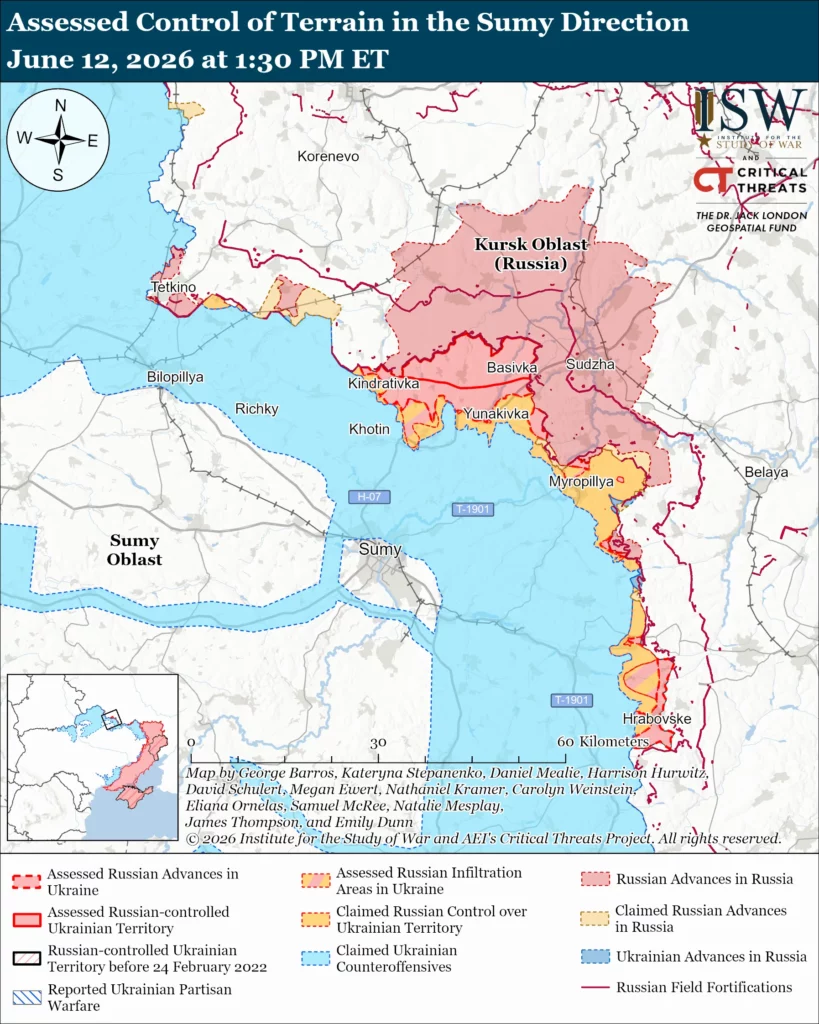
Russian forces continue their artillery strikes against Sumy City. The Ukrainian State Emergency Service reported on June 12 that Russian forces conducted long-range artillery shelling of Sumy City, injuring six residents and damaging residential and civilian infrastructure.[41] Ukrainian authorities noted that this is the third artillery strike on Sumy City since the beginning of 2026.
Ukrainian forces continued their frontline strike campaign against Russian military assets in Bryansk and Kursk oblasts. Geolocated footage published on June 11 shows Ukrainian forces striking a Russian 2S19 Msta-S self-propelled howitzer near Sudzha, Kursk Oblast (approximately 13 kilometers from the frontline and northeast of Sumy City).[42] Acting Bryansk Oblast Governor Yegor Kovalchuk claimed on June 11 and 12 that Ukrainian forces struck a gas station near Starodub (approximately 35 kilometers from the Chernihiv Oblast border) and an energy infrastructure facility near Novozybkov (approximately 37 kilometers from the international border).[43]
Russian Main Effort: Eastern Ukraine
Russian Subordinate Main Effort #1 – Kharkiv Oblast
Russian objective: Push Ukrainian forces back from the international border to create a defensible buffer zone with Belgorod Oblast and approach to within tube artillery range of Kharkiv City
Russian forces continued offensive operations in northern Kharkiv Oblast on June 11 and 12 but did not advance.[44]
Neither Russian nor Ukrainian sources reported ground activity in the Velykyi Burluk direction on June 12.
Russian Subordinate Main Effort #2 – Oskil River
Russian objective: Cross the Oskil River in Kharkiv Oblast and push westward into eastern Kharkiv Oblast and northern Donetsk Oblast
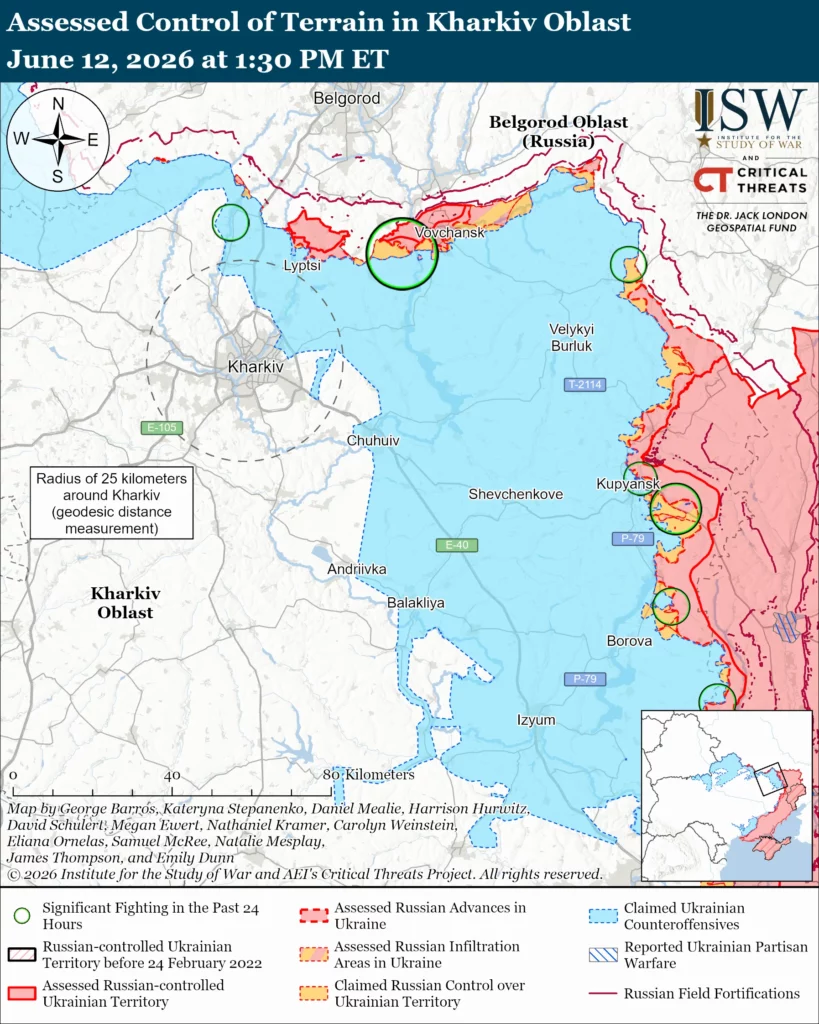
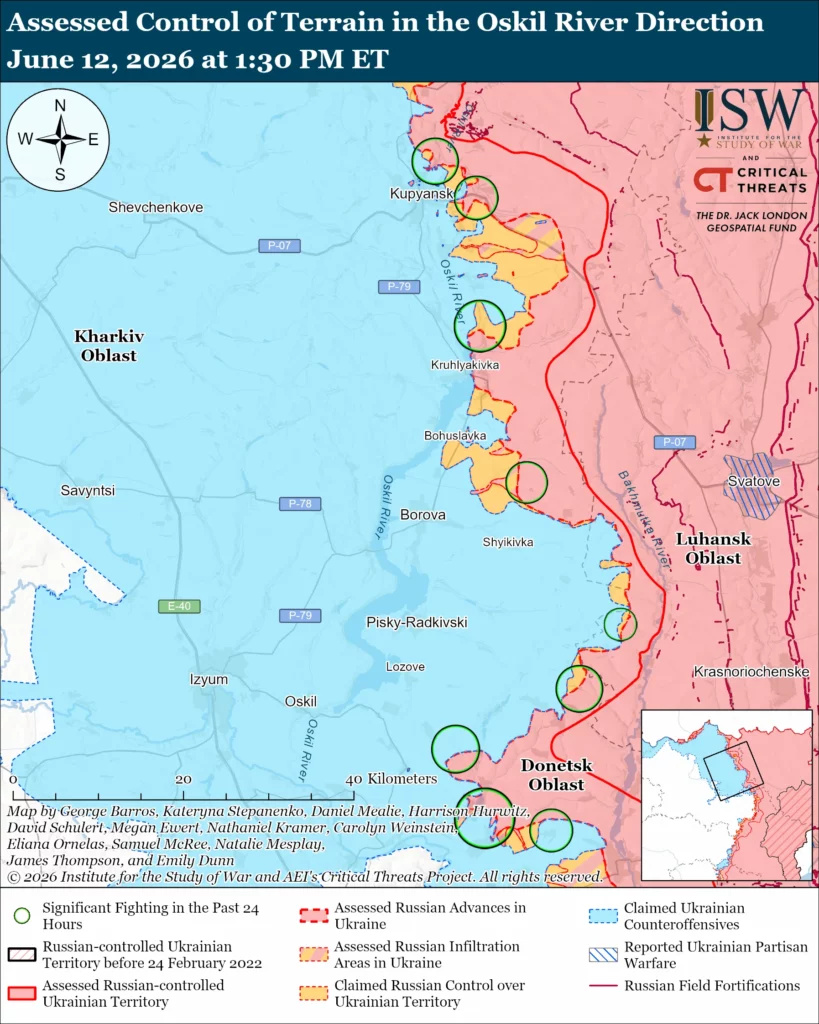
Russian forces continue infiltration missions in the Kupyansk direction. Geolocated footage published on June 11 shows Ukrainian forces striking Russian forces in northern and central Kupyansk after what ISW assesses were Russian infiltration missions.[45]
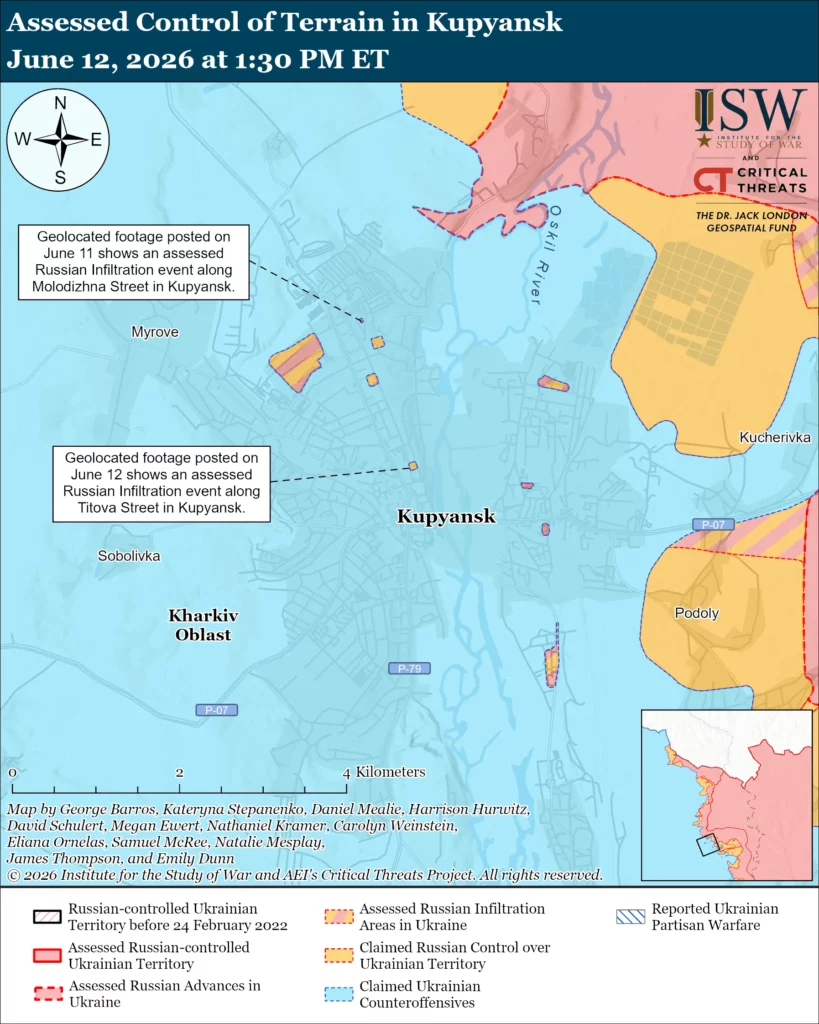
Russian forces continued offensive operations in the Borova direction on June 11 and 12 but did not advance.[46]
Ukraine’s intermediate-range strike campaign against occupied Luhansk Oblast continues to affect Russian operational rear logistics. Ukrainian Joint Forces Task Force Spokesperson Colonel Viktor Trehubov reported on June 12 that Ukrainian strikes against occupied Luhansk Oblast are affecting Russian supplies, logistics, and support for troops at the front.[47] Trehubov added that Russian forces are currently unable to effectively accumulate forces in the rear. Trehubov assessed that issues for Russian forces in the Kupyansk and Lyman directions are not as noticeable as those in the Kherson direction since Russia has a long border with occupied Luhansk Oblast which provides Russian forces alternative supply routes. The Ukrainian General Staff reported on June 11 and 12 that Ukrainian forces struck a Russian field artillery depot near Rybyantseve (roughly 85 kilometers from the frontline); Russian control points near Davydivske (either about 30 or 80 kilometers from the frontline) and Novoznamyanka (roughly 25 kilometers from the frontline); and a Russian drone unit near Dovzhasnk (roughly 150 kilometers from the frontline).[48] Ukrainian Unmanned Systems Forces (USF) Commander Major Robert “Magyar” Brovdi reported on June 11 that Ukrainian forces struck a command post of the Russian 88th Separate Motorized Rifle Brigade (3rd Combined Arms Army [CAA], formerly 2nd Luhansk People’s Republic Army Corps [LNR AC], Southern Military District [SMD]) near Sentyanivka (roughly 60 kilometers from the frontline); a Russian drone unit and personnel of the 4th Nevsky Volunteer Reconnaissance-Assault Brigade (Russian Volunteer Corps) near Miusynsk (roughly 95 kilometers from the frontline); and an electrical substation near Zolote (roughly 35 kilometers from the frontline).[49] Geolocated footage published on June 11 confirms the strikes against the command post of the 4th Brigade and the electrical substation.[50]
Russian Subordinate Main Effort #3 – Donetsk Oblast
Russian objective: Capture the entirety of Donetsk Oblast, the claimed territory of Russia’s proxies in Donbas, and advance into Dnipropetrovsk Oblast
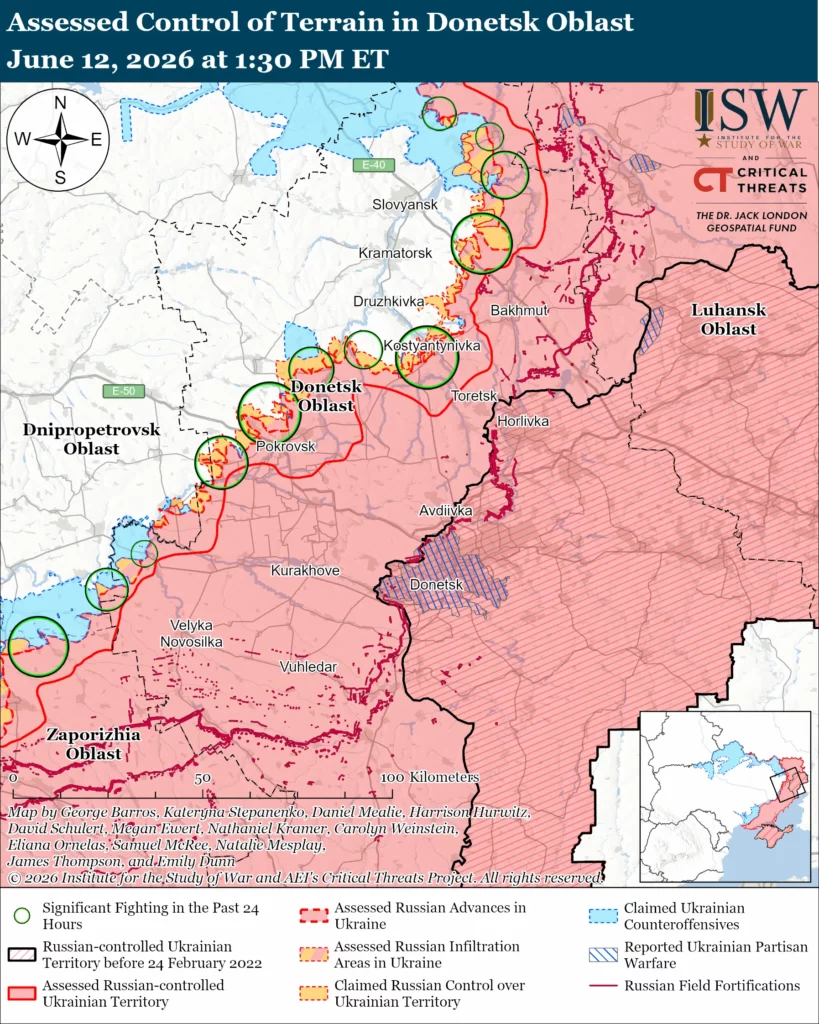
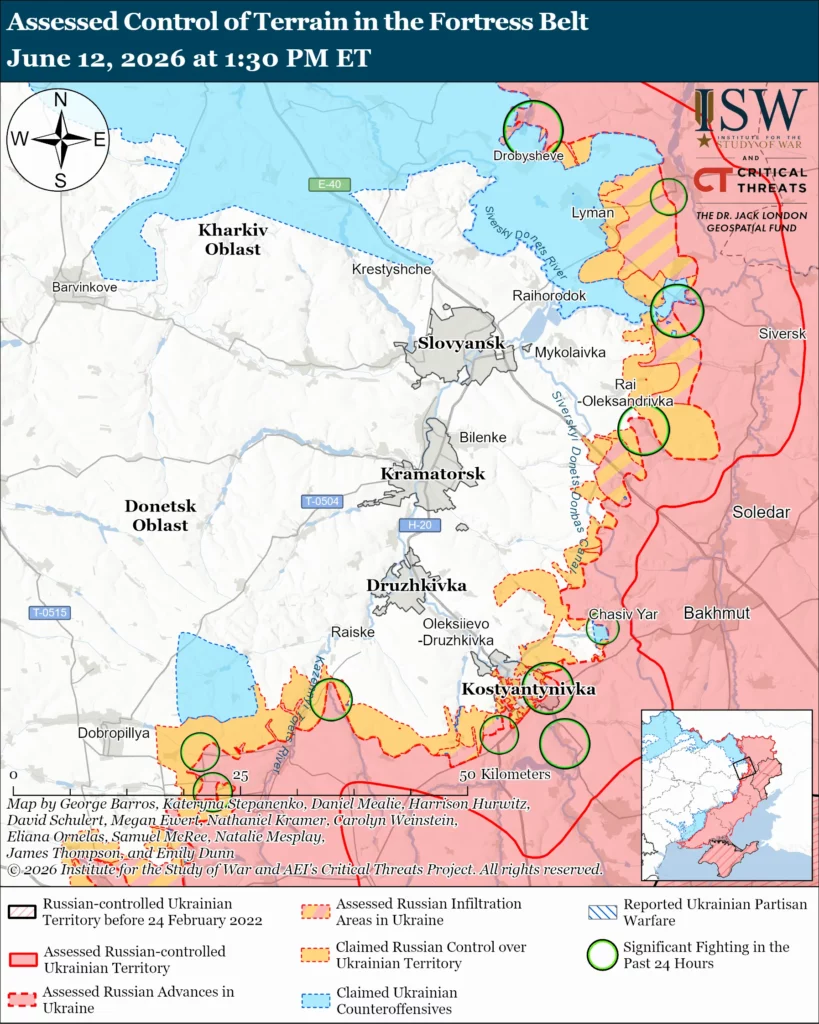
Russian forces continued offensive operations in the Slovyansk direction on June 11 and 12 but did not make confirmed advances.[51]
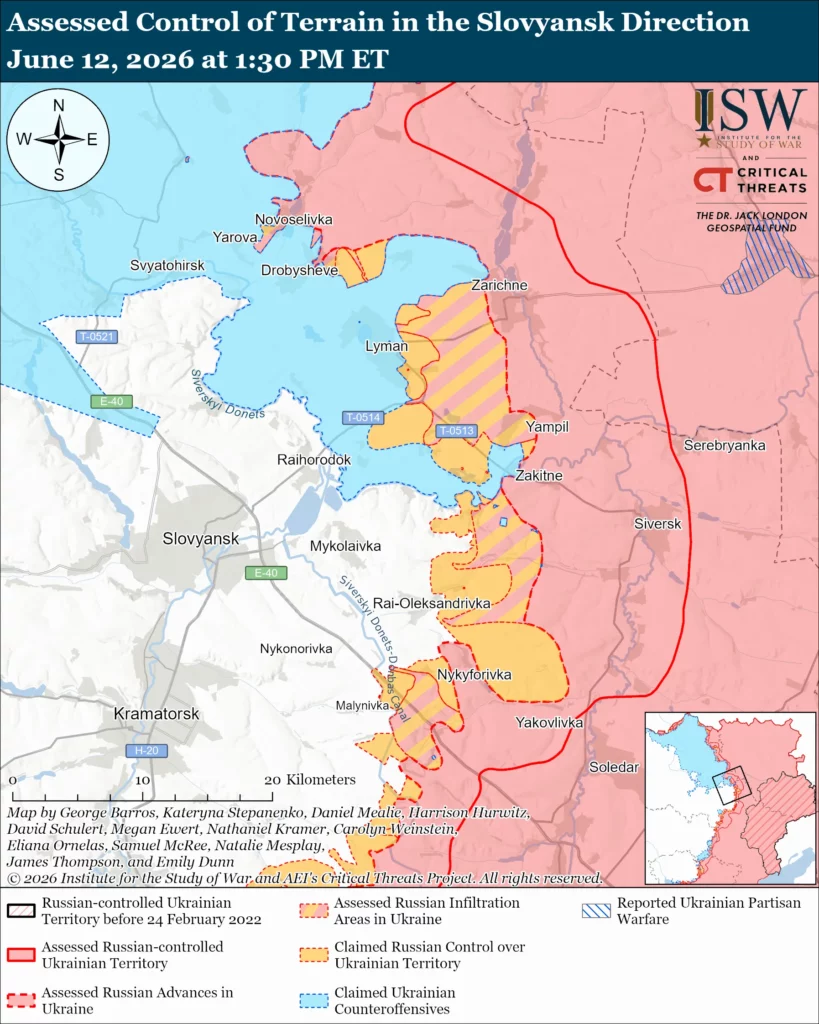
Russian forces continue infiltration missions in the Lyman direction. The deputy commander of a Ukrainian battalion operating in the Lyman direction reported on June 11 that Russian forces continue infiltration missions through open fields, moving along the same path as previously killed Russian soldiers.[52]
See topline text for reports on Russian offensive operations in the Kostyantynivka-Druzhkivka tactical area.
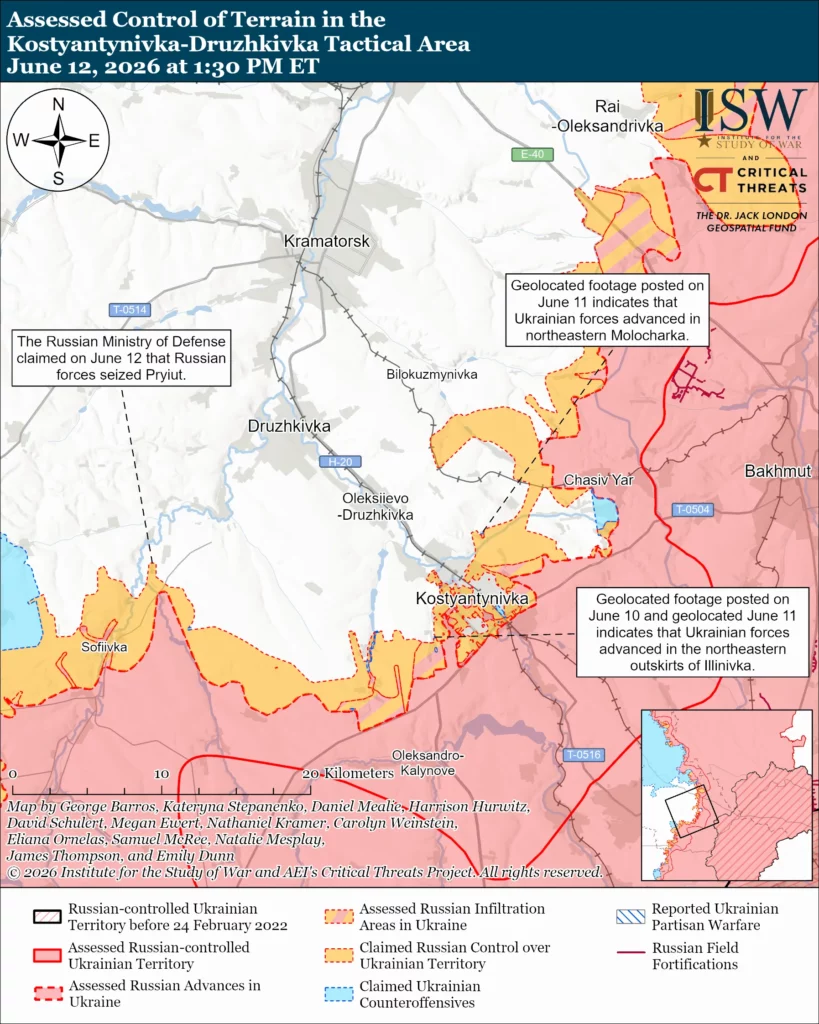
Ukrainian forces recently advanced in the Kostyantynivka-Druzhkivka tactical area. Geolocated footage published on June 10 shows Russian forces striking Ukrainian positions in northeastern Molocharka (north of Kostyantynivka) and on the northeastern outskirts of Illinivka (south of Kostyantynivka), indicating that Ukrainian forces recently advanced in the area.[53] Geolocated footage published on June 8, 10, 11, and 12 shows Russian forces striking Ukrainian forces in northern Molocharka; in northern Illinivka; north and west of Illinivka; and in northeastern, northern, western, central, and southern Kostyantynivka — areas in which Russian sources previously claimed that Russian forces maintained a presence.[54] The Russian Ministry of Defense (MoD) claimed on June 12 that the Russian Central Grouping of Forces seized Priyut (southwest of Druzhkivka).[55] A Russian milblogger claimed that Russian forces seized Tykhonivka (north of Kostyantynivka).[56]
Russian forces recently conducted an infiltration mission in the Dobropillya tactical area. Geolocated footage published on June 12 shows Ukrainian forces striking a Russian servicemember north of Shakhove (east of Dobropillya) after what ISW assesses was a Russian infiltration mission.[57]
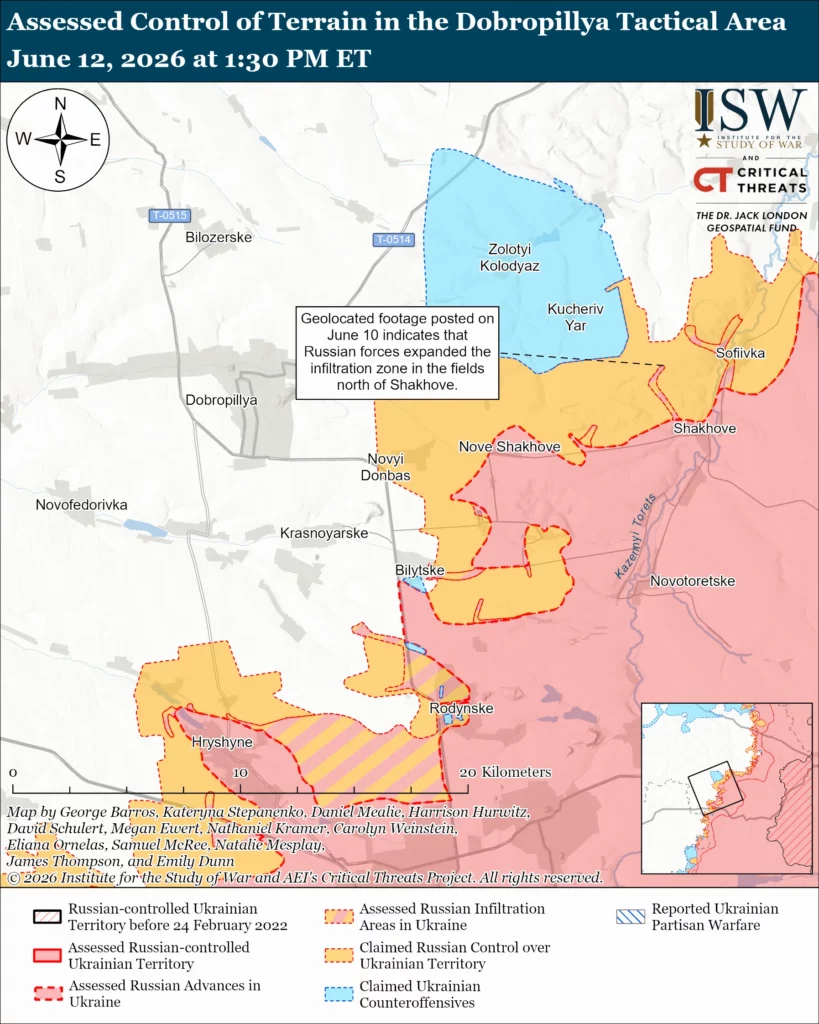
Russian forces continued offensive operations in the Pokrovsk direction on June 11 and 12 but did not make confirmed advances.[58] A Russian milblogger claimed on June 11 that Russian forces advanced north and northeast of Novooleksandrivka (northwest of Pokrovsk).[59]
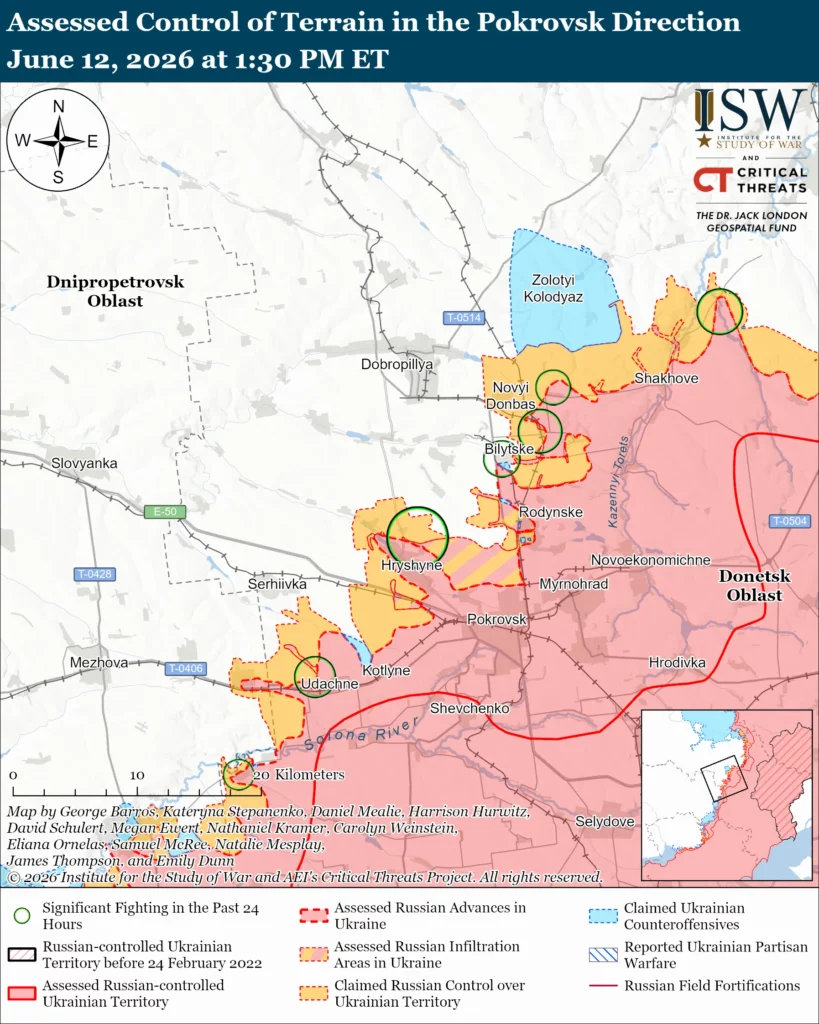
Russian forces continue to reinforce units in the Pokrovsk direction due to heavy manpower losses. The chief of staff of a Ukrainian battalion operating in the Pokrovsk direction reported on June 12 that Russian forces are losing manpower, electronic warfare (EW) systems, and unmanned aerial vehicle (UAV) assets.[60] The chief of staff added that Russian forces are constantly receiving reinforcements in order to continue assaults. A Russian milblogger claimed on June 12 that Russian forces are struggling to advance in the Pokrovsk direction due to the large number of Ukrainian drones in the area.[61]
Ukrainian forces recently thwarted a Russian mechanized assault in the Pokrovsk direction as Ukrainian strikes against roads in the area continue. Ukrainian Unmanned Systems Forces (USF) Commander Major Robert “Magyar” Brovdi reported on June 12 that Ukrainian intelligence indicated that Russian forces were preparing a mechanized assault from the Stakhanov mine in Myrnohrad (east of Pokrovsk).[62] Brovdi reported that Ukrainian forces conducted a preemptive strike on the mine on June 10 with fiber-optic drones and destroyed four Russian armored vehicles and six quad bikes. The Ukrainian 7th Rapid Reaction Corps of the Air Assault Forces reported on June 12 that Ukrainian forces destroyed about 100 Russian soldiers on a two-kilometer section of the T-0508 Pokrovsk-Hryshyne highway in the past 50 days (since roughly April 23).[63] The Corps noted that the highway has few shelters and damaged windbreaks that do not offer concealment.
Russian forces continued offensive operations in the Novopavlivka direction on June 11 and 12 but did not advance.[64]
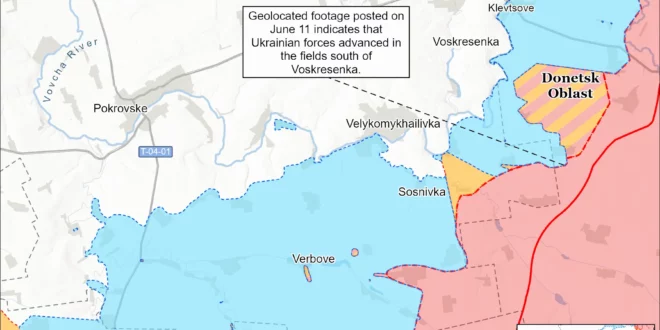
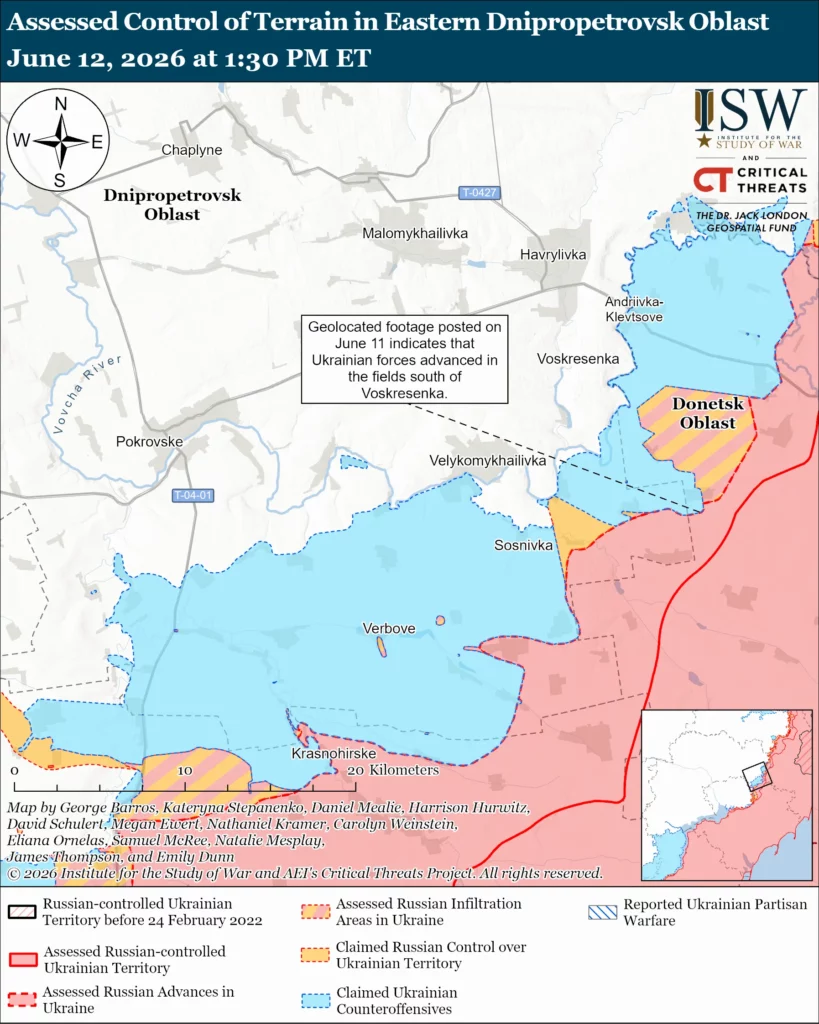
Ukrainian forces recently advanced in the Oleksandrivka direction. Geolocated footage posted on June 11 shows Russian forces shelling Ukrainian positions south of Voskresenka (east of Oleksandrivka), indicating that Ukrainian forces recently advanced in the area.[65] A Russian milblogger claimed that Russian forces seized Vorone (southeast of Oleksandrivka).[66]
Ukrainian forces continue their intermediate-range strike campaign against the occupied Donetsk City area. A regiment of the Ukrainian Unmanned Systems Forces (USF) reported on June 12 that Ukrainian forces are keeping Russian ground lines of communication (GLOCs) in and near Donetsk City under drone-enabled fire control.[67] Geolocated footage published on June 11 shows a fire at a gas station in Makiivka (just east of Donetsk City) after a Ukrainian drone strike, and geolocated footage published on June 12 shows a Ukrainian drone strike against a Russian fuel tank south of Donetsk City.[68] The occupied Donetsk People’s Republic (DNR) announced a ban on nighttime passenger transportation on roads in occupied Donetsk Oblast starting June 12.[69] The occupation administration also banned the movement of organized recreational children’s groups to areas outside of occupied Donetsk Oblast.
Ukrainian forces continue their intermediate-range strike campaign against Russian military assets elsewhere in occupied Donetsk Oblast. Ukrainian Unmanned Systems Forces (USF) Commander Major Robert “Magyar” Brovdi reported on June 11 that Ukrainian forces struck a Buk-M3 air defense system near Shevchenko (roughly 60 kilometers from the frontline); fuel tank cars near Mariupol; a military equipment storage site near Novoazovsk (roughly 140 kilometers from the frontline); and an electrical substation near Debaltseve (roughly 50 kilometers from the frontline).[70] Geolocated footage published on June 11 confirms the strikes against the Buk system and equipment storage site.[71] The Ukrainian General Staff reported on June 11 and 12 that Ukrainian forces struck a Russian logistics depot in Mariupol; a Russian control point near Pokrovsk, Selydove (roughly 20 kilometers from the frontline), and Bakhmut (roughly 15 kilometers from the frontline); a drone control point near Novoandriivka (either about 10 or 65 kilometers from the frontline); and a drone production and repair workshop near Avdiivka (roughly 45 kilometers from the frontline).[72] Additional geolocated footage published on June 11 shows elements of the Russian BARS-Sarmat (Russian Combat Army Reserve) intercepting Ukrainian drones along the H-20 Donetsk City-Mariupol highway near Pryvilne (roughly 90 kilometers from the frontline) and the aftermath of a Ukrainian drone strike against a Russian military truck along the H-20 in Berezove (roughly 65 kilometers from the frontline).[73]
Russian Supporting Effort: Southern Axis
Russian objective: Maintain frontline positions, secure rear areas against Ukrainian strikes, and advance within tube artillery range of Zaporizhzhia City
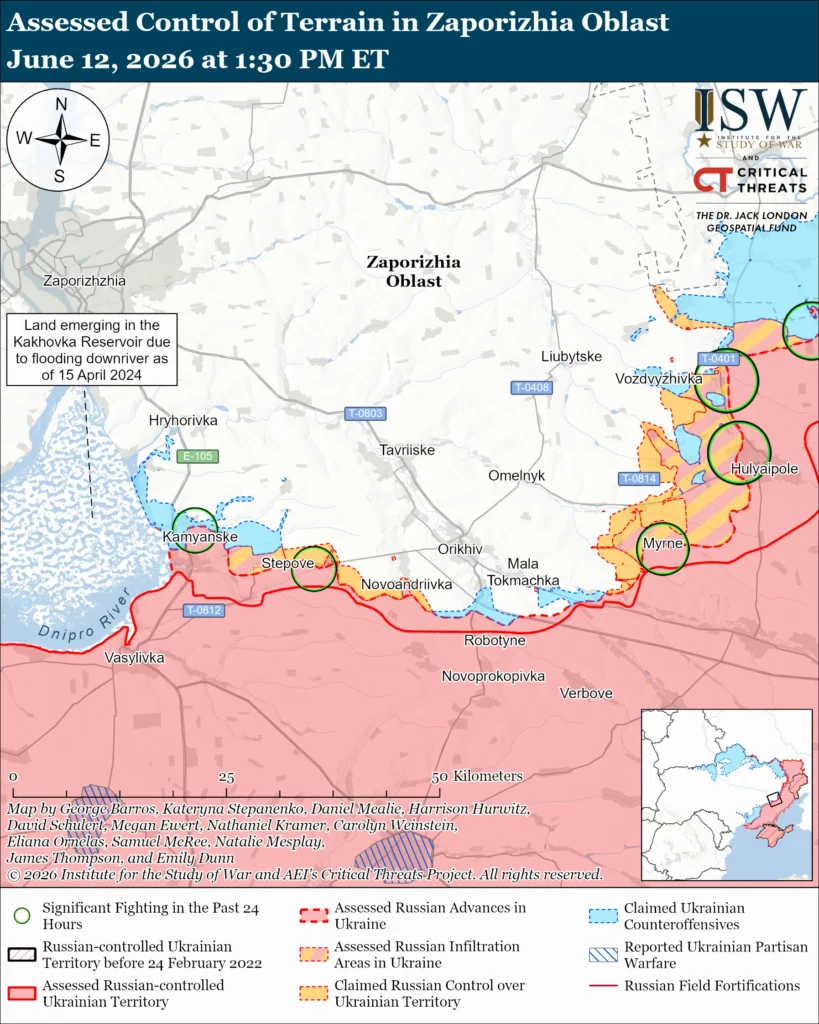
Russian forces conducted an infiltration mission southwest of Hulyaipole. Geolocated footage published on June 12 shows Ukrainian forces striking a Russian servicemember north of Luhivkse (southwest of Hulyaipole) after what ISW assesses was a Russian infiltration mission.[74]
A Kremlin-affiliated Russian milblogger acknowledged that Russian forces have lost almost all the territory they had gained in the Spring 2025 offensive in the Orikhiv direction.[75] The milblogger reported that Ukrainian forces are building up their presence in eastern Stepnohirsk (east of Orikhiv) and are advancing southeast of the settlement. The milblogger noted that there has been no evidence of a Russian presence in or near Pavlivka (east of Stepnohirsk) for some time. Another Russian milblogger refuted Russian claims that Russian forces advanced south of Novoandriivka (southwest of Orikhiv).[76]
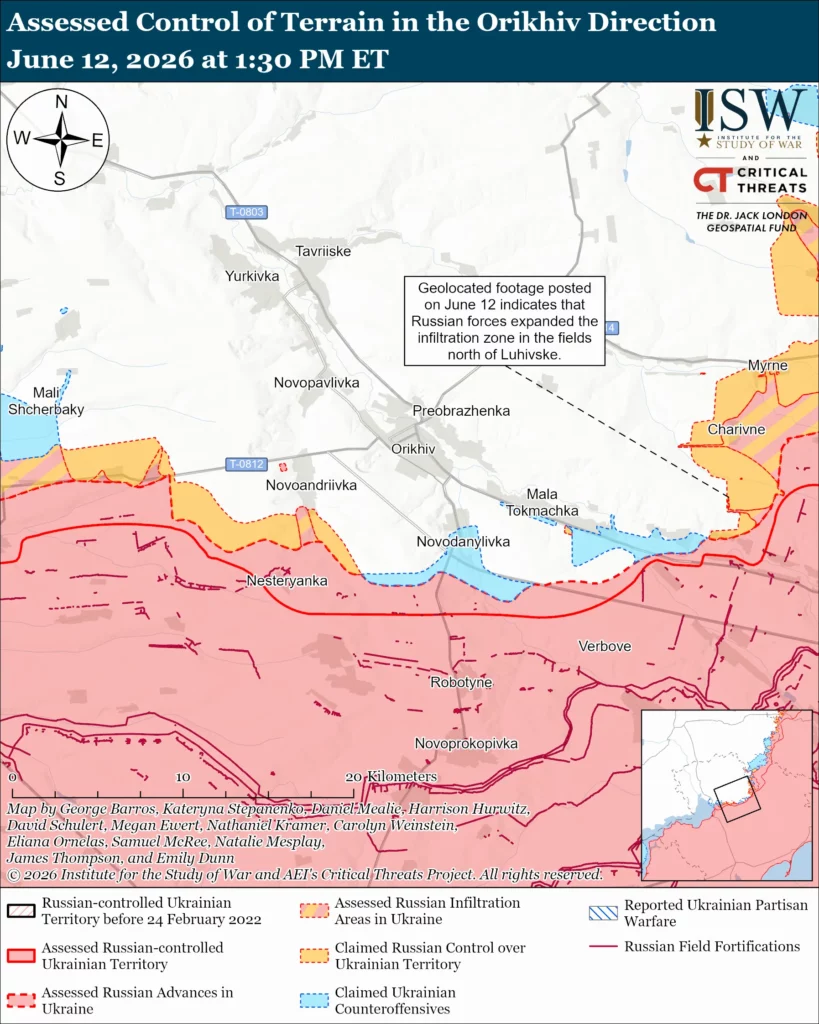
Ukrainian forces continue their intermediate-range strike campaign against occupied Zaporizhia Oblast, including against a Russian training ground. The Ukrainian General Staff reported on June 12 that Ukrainian forces struck a Russian personnel concentration at the Vostochny Training Ground near Novopetrivka (just east of Berdyansk).[77] Ukrainian Unmanned Systems Forces (USF) Commander Major Robert “Magyar” Brovdi reported on June 11 that Ukrainian forces struck a tugboat near Berdyansk; an electrical substation near Melitopol; and the command post of the Russian 429th Motorized Rifle Regiment (19th Motorized Rifle Division, 58th Combined Arms Army [CAA], Southern Military District SMD]) near Rozdol (roughly 30 kilometers from the frontline).[78]
Russian forces attacked northeast of Kherson City toward the Antonivskyi Bridge on June 12 but did not advance.[79]
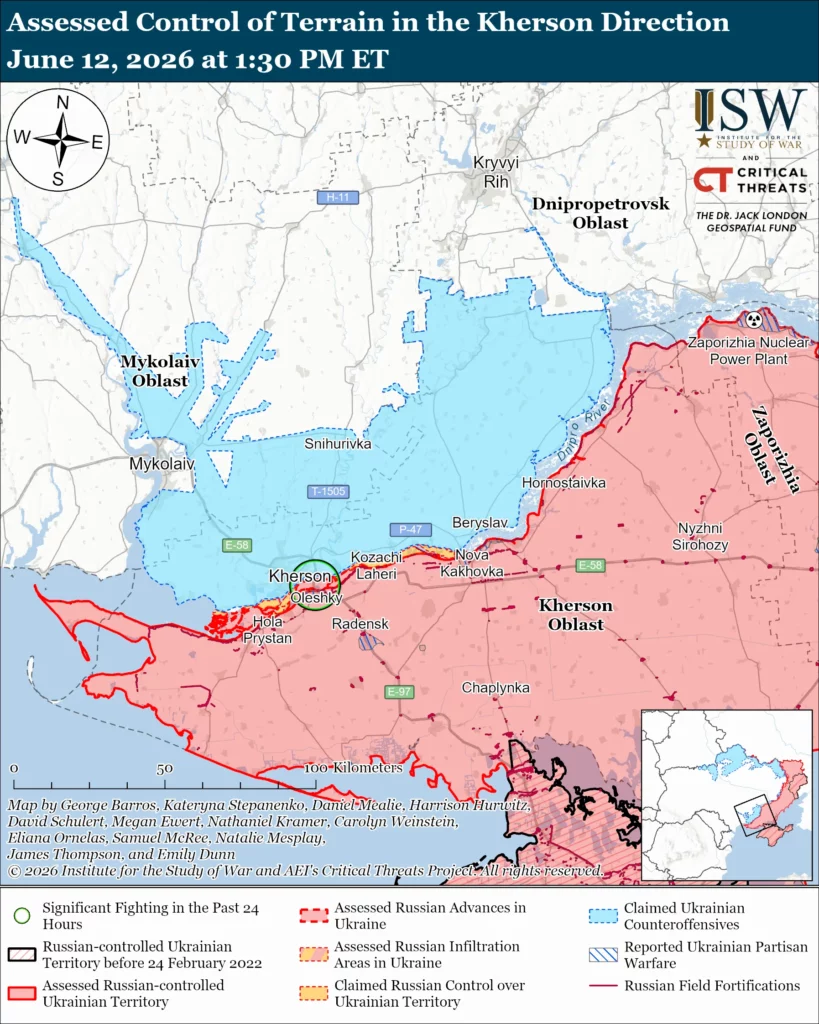
Ukrainian forces continue striking Russian military assets in occupied Crimea. The Ukrainian General Staff reported that Ukrainian forces struck a Russian drone warehouse near occupied Hryhorivka (about 109 kilometers from the frontline) on June 10 or the night of June 10 to 11.[80] The Ukrainian General Staff clarified that Ukrainian forces struck a Russian unmanned surface vehicle (USV) warehouse in occupied Sevastopol (about 238 kilometers from the frontline).[81]
Ukraine’s interdiction campaign against occupied Crimea is reducing traffic along key logistics routes and forcing the Russian military to disguise fuel vehicles. Ukrainian Unmanned Systems Forces (USF) Commander Major Robert “Magyar” Brovdi told Reuters in an interview published on June 11 that Ukraine’s interdiction campaign has reduced traffic along the M-14 Rostov-Crimea highway by over two-thirds in the past month (since about mid-May 2026).[82] Brovdi forecasted that Ukrainian forces will have “total control” (likely referring to fire control) over the highway within another month (by about mid-July) and will be able to “isolate” occupied Crimea “in the near future.” Russian forces continue efforts to mitigate the Ukrainian strike campaign. Footage published on June 12 shows reported Russian fuel tankers driving in occupied Crimea that Russian forces have altered and painted to appear like trucks hauling lumber — consistent with similar reports in recent days.[83] A Russian milblogger criticized Russian efforts to combat the Ukrainian interdiction campaign thus far, complaining that bureaucracy is slowing down the official reaction and that authorities failed to recognize the start of Ukraine’s interdiction campaign when Russian forces could have more easily combatted it.[84]
Russian occupation authorities continue to impose price caps on gasoline and diesel in occupied Crimea as a result of Ukraine’s interdiction campaign. Crimea occupation head Sergei Aksyonov announced on June 12 that Crimean occupation authorities reached agreements with major Crimean fuel operators TES and ATAN to cap fuel prices at 85 rubles per liter (about $4.43 per gallon) for diesel, 79 rubles per liter (about $4.12 per gallon) for AI-92 gasoline, and 86 rubles per liter (about $4.48 per gallon) for AI-95 gasoline.[85]
Russian Air, Missile, and Drone Campaign
Russian Objective: Target Ukrainian military and civilian infrastructure in the rear and on the front line
Russian forces conducted a series of long-range drone strikes against Ukraine on the night of June 11 to 12. The Ukrainian Air Force reported that Russian forces launched 117 Shahed-type, Gerbera-type, and Italmas-type strike drones and Parodiya-type decoy drones from the directions of Kursk and Oryol cities; Millerovo, Rostov Oblast; and occupied Cape Chauda and Hvardiiske, Crimea.[86] The Ukrainian Air Force reported that Ukrainian forces downed 102 drones, that 14 drones struck seven locations, and that debris fell on eight locations. Ukrainian officials reported that Russian forces struck residential, industrial, civilian, and railway infrastructure in Chernihiv, Mykolaiv, Poltava, Odesa, and Sumy oblasts.[87] The Ukrainian Energy Ministry reported that Russian strikes and fighting caused power outages in Dnipropetrovsk, Donetsk, Sumy, Kharkiv, and Chernihiv oblasts.[88]
Significant Activity in Belarus
Russian efforts to increase its military presence in Belarus and further integrate Belarus into Russian-favorable frameworks
See topline text.
Note: ISW does not receive any classified material from any source, uses only publicly available information, and draws extensively on Russian, Ukrainian, and Western reporting and social media as well as commercially available satellite imagery and other geospatial data as the basis for these reports. References to all sources used are provided in the endnotes of each update.