 Eurasia Press & News
Key Takeaways
The United States and Iran signed the memorandum of understanding (MoU) on June 17. Iran is claiming that the final MoU text satisfies some of its key war aims related to Lebanon and the Strait of Hormuz. The final MoU is basically unchanged from the version provided to Bloomberg on June 16, except for text changes in clauses one and five that Iran reportedly requested.
Top Iranian officials are using these changes to imply that they have satisfied their key war aims of controlling the Strait of Hormuz and preserving Hezbollah. This demonstrates the degree of ambiguity inherent in this MoU and suggests that the United States and Iran have divergent views of the agreed-upon text.
Iran will likely use renewed economic access under the MoU to reconstitute members of the Axis of Resistance, particularly Hezbollah, during the 60-day negotiation period. Iran has already told Hezbollah that Iran will increase its funding as soon as possible once the United States unfreezes Iranian assets.
The United States reportedly conditioned economic support for Iraqi Prime Minister Ali al Zaydi’s government on its ability to meet several conditions, including disarming Iranian-backed Iraqi militias and dismantling their financial networks. The United States demanded the removal of Popular Mobilization Forces (PMF) leaders associated with Iranian-backed Iraqi militias before integrating the PMF into official Iraqi security institutions, according to political sources speaking to Iraqi media on June 17.
Toplines
The United States and Iran signed the memorandum of understanding (MoU) on June 17.[1] Iran is claiming that the final MoU text satisfies some of its key war aims related to Lebanon and the Strait of Hormuz.[2] US officials briefed US media, including the New York Times, CNN, Axios, and others, on the contents of the MoU before Iran and the United States signed it.[3] The final MoU is basically unchanged from the version provided to Bloomberg on June 16, except for text changes in clauses one and five that Iran reportedly requested.[4] Islamic Revolutionary Guards Corps (IRGC)-affiliated Fars News reported on June 15 that Iran had earlier secured important changes to the draft MoU.[5] These changes included the addition of the phrase “guaranteeing sovereignty and respect for the territorial integrity of Lebanon” to the first clause, references to a joint Iranian-Omani maritime services administration in the Strait of Hormuz to the fifth clause, and an addition that the MoU would bar fee collection in the strait for 60 days, also in the fifth clause.[6] All three of these changes are reflected in the version briefed to US media but not in the earlier version leaked to Bloomberg (changes highlighted below in bold).[7] IRGC-affiliated Tasnim News Agency noted on June 17—before the signing and the briefing to US media—that Bloomberg’s reported text was inaccurate and had “numerous flaws” related to Lebanon and the Strait of Hormuz.[8]
Clause 1: “The United States of America and the Islamic Republic of Iran and their allies in the current war by signing this MoU declare the immediate and permanent termination of military operations on all fronts, including in Lebanon, and undertake from now on not to initiate any war or any military operation against each other, and to refrain [from] the threat or use of force against each other and ensuring the territorial integrity and sovereignty of Lebanon. The final deal will confirm the permanent termination of the war on all fronts, including in Lebanon, and other provisions of this paragraph.”[9]

Clause 5: “Upon the signing of this MoU, the Islamic Republic of Iran will make arrangements using its best efforts for the safe passage of commercial vessels with no charge for 60 days only from the Persian Gulf to the Sea of Oman, and vice versa. The traffic of commercial vessels will immediately start, and considering the need for removing the technical and military obstacles and demining by the Islamic Republic of Iran, will be instated within 30 days. The Islamic Republic of Iran will conduct dialogue with the Sultanate of Oman to define the future administration and maritime services in the Strait of Hormuz, in discussion with other Persian Gulf littoral states in line with the applicable international law and the sovereign rights of coastal states of the Strait of Hormuz.”[10]
Top Iranian officials are using these changes to imply that they have satisfied their key war aims of controlling the Strait of Hormuz and preserving Hezbollah. Iranian First Vice President Mohammad Reza Aref said that Iran would retain control over the Strait of Hormuz and that vessels transiting the waterway should pay service fees for safe navigation of the strait.[11] Iran continues to be the only threat against commercial shipping in the strait. Aref said that the Strait of Hormuz “belongs to Iran” and that its management will remain Iran’s responsibility.[12] Clause 5 indicates that Iran would need to negotiate with the Gulf Arab states to ensure its management of the strait, however, and it remains unlikely that the Gulf Arab states would acquiesce to Iranian demands without Iranian coercion.[13] The fact that Iran can negotiate the status of an international waterway is nonetheless an erosion of long-established international law and norms enshrined in the UN Convention on the Law of the Sea (UNCLOS).[14]
Iran also appears to believe that the MoU requires Israel to withdraw from Lebanon, which would help preserve Hezbollah. A Hezbollah source told Emirati media on June 16 that Iran told Hezbollah that the withdrawal of Israeli troops from Lebanon is included in the US-Iran MoU and is expected to occur over a phased 60-day period.[15] The source added that the withdrawal of Israeli troops from Lebanon now depends on Israel, because Israel is not a party to the MoU and remains in Lebanon.[16] A Lebanese political source told Emirati media on June 16 that Lebanon has received “no official guarantees” over an Israeli withdrawal and has not yet discussed the issue with US officials, which is at odds with Iranian claims that the MoU clearly requires Israel to withdraw from Lebanon.[17] This demonstrates the degree of ambiguity inherent in this MoU and suggests that the United States and Iran have divergent views of the agreed-upon text.
Iran is already taking positive action regarding Lebanon and the Strait of Hormuz to enforce its interpretation of the MoU’s terms. Iran threatened retaliation against Israel if Israeli operations in Lebanon continue. The Khatam ol Anbia Central Headquarters characterized continued Israeli operations in southern Lebanon as “ceasefire violations” on June 16 and warned that Israel should expect a “harsh [Iranian] response” if the IDF does not cease its operations in southern Lebanon.[18] These threats are designed to force the United States to pressure Israel to end its operations in southern Lebanon to preserve the agreement. Iran is also continuing to maintain its ”management” of the Strait of Hormuz by demanding vessels adhere to IRGC requirements and threatening those that do not. Iranian media reported that vessels are still waiting for IRGC approval to move through the strait.[19] An unspecified US official told NBC on June 16 that the US military has intercepted drones that the IRGC has fired toward commercial ships in the Strait of Hormuz every night since the MoU’s announcement on June 14.[20]
The Iranian factions that secured and approved the deal are trying to sell the agreement, which appears somewhat politically sensitive in Tehran. ISW-CTP continues to assess that IRGC Commander Major General Ahmad Vahidi and his inner circle are predominant in Iranian policymaking, but others—including pro-negotiations figures like Parliament Speaker Mohammad Bagher Ghalibaf and Foreign Affairs Minister Abbas Araghchi—were also deeply involved in negotiations. Some Iranian parliamentarians and regime-linked media have criticized the agreement, however. Parliamentary National Security and Foreign Policy Commission spokesperson Ebrahim Rezaei described the MoU as “imbalanced” and said that it did not observe all of the regime’s red lines[21] Rezaei also rejected accusations that critics of the MoU[22] Hardline media outlet Kayhan separately wrote on June 17 that the [23] Kayhan criticized Iranian officials for withholding the text from the Iranian public and said Parliament must prevent the “secret implementation” of a document that Parliament does not know[24] The figures opposing the agreement are not particularly influential in Tehran, but they do represent a regime faction that Iranian leaders may find it necessary to placate, especially if the promised economic dividends fail to come to fruition.
Iranian media is also using potential, early economic benefits that Iran would receive under the MoU to argue that Iran secured tangible and irreversible benefits without abandoning its core demands. Iranian media have highlighted meetings and discussions with Russian and Chinese counterparts and heavily publicized Iranian oil tankers crossing or approaching the blockade line.[25] Islamic Development Organization (IDO)-affiliated outlet Mehr News Agency reported on June 16 that the MoU gives Iran “cash” benefits, including access to part of its frozen assets, a suspension of oil sanctions, and free access to oil revenue.[26] Mehr estimated that Iran could earn up to $10 billion USD from 60 days of oil sales and that Iran’s total revenue during this period could exceed $30 billion USD.[27] This messaging suggests that the regime may be using ambiguity over Lebanon and the Strait, alongside early economic benefits, to frame the MoU as a victory and manage domestic criticism.
Iran will likely use renewed economic access under the MoU to reconstitute members of the Axis of Resistance, particularly Hezbollah, during the 60-day negotiation period. Iran has already told Hezbollah that Iran will increase its funding as soon as possible once the United States unfreezes Iranian assets.[28] Israel badly degraded Hezbollah during the October 7 War.[29] The collapse of the Assad regime in Syria made Hezbollah’s resupply more difficult, and Iran’s competing priorities—including rebuilding its own assets without any financial relief after June 2025—made funding the reconstitution of Hezbollah and other Axis members relatively more challenging.[30] Iran did provide Hezbollah with roughly $1 billion USD between the 2024 war and the 2026 war, but relaxing sanctions and providing Iran with greater access to revenue will provide Iran with more money it can choose to provide to Hezbollah.[31] Clause 11 of the MoU, as reported by Bloomberg, states that the United States may unfreeze Iranian assets in response to “progress of negotiations towards a final agreement.”[32] Lebanese and regional sources told Reuters on June 17 that Iran has promised Hezbollah that it will increase the group’s funding ”as soon as possible,” once the United States unfreezes Iranian assets as a part of the MoU.[33] The degree to which Axis of Resistance factions remain contained or weakened after the last nearly three years of war is in large part contingent on how much funding Iran can provide to them.
The United States reportedly conditioned economic support for Iraqi Prime Minister Ali al Zaydi’s government on its ability to meet several conditions, including disarming Iranian-backed Iraqi militias and dismantling their financial networks.[34] Iraqi government sources told regional media on June 17 that the United States recently delivered two shipments of an unspecified amount of US dollars to the Central Bank of Iraq, which coincided with US Special Envoy Tom Barrack‘s visit to Baghdad.[35] The sources described the shipments as ”economic cover” for Zaydi’s government that is ”contingent“ on Iraq meeting US conditions.[36] These cash shipments were the first the United States has sent to Iraq since the US Treasury Department halted shipments of US dollars in April 2026 due to concerns about militia attacks during the war.[37] The Central Bank of Iraq has managed an account at the New York Federal Reserve on behalf of the Iraqi Finance Ministry since 2003 that holds the Iraqi federal government’s revenue from oil exports in US dollars.[38] Oil revenue accounts for about 90 percent of the Iraqi state’s budget.[39] Sources also told Iraqi media on June 17 that US Special Envoy Tom Barrack also threatened “unlimited options,” which could refer to US sanctions or future cessations of US dollar transfers to Iraq, if Zaydi fails to meet US conditions.[40]
The United States demanded the removal of Popular Mobilization Forces (PMF) leaders associated with Iranian-backed Iraqi militias before integrating the PMF into official Iraqi security institutions, according to political sources speaking to Iraqi media on June 17.[41] The PMF is an Iraqi state security service that currently operates separately from the Iraqi security establishment and includes many Iranian-backed Iraqi militias that answer to Iran instead of the Iraqi prime minister.[42] Many Iranian-backed Iraqi militia commanders simultaneously command official PMF Brigades.[43] The Iraqi federal government has recently taken initial steps to disarm the militias, including receiving files and data on Iranian-backed Iraqi militia Kataib al Imam Ali’s assets and forming a joint disarmament committee with representation from the PMF, Kataib al Imam Ali, and Asaib Ahl al Haq.[44] Both Kataib al Imam Ali and Asaib al Haq have indicated their interest in disarmament, in order to possibly lessen US opposition to their participation in the next Iraqi government. It is also possible that these militias seek to receive some of the 35,000 jobs that jobs in Iraqi security institutions that Zaydi has reportedly proposed to be allocated to militia members who disarm.[45] ISW-CTP continues to assess that any Iraqi federal government attempt to disarm the militias and integrate them into the Iraqi security establishment that does not address the militias’ networks and allegiance to Iran will likely further embed Iranian influence within the Iraqi state.[46]
Political sources also told Iraqi media on June 17 that Barrack demanded that the Iraqi government dismantle Iraqi militia-associated financial networks.[47] Iraqi media added that the United States demanded the closure of at least 10 banks accused of dollar smuggling and money laundering.[48] The US Treasury Department sanctioned several Iraqi bank executives in 2025 for exploiting their position to launder money and generate revenue for Iranian-backed Iraqi militias.[49] The US and Iraq have also banned several Iraqi banks from engaging in US dollar transactions since 2022 for laundering money for the IRGC Quds Force and Iranian-backed Iraqi militias.[50]
US-Iran Negotiations
See the topline section.
Maritime Activity in the Strait of Hormuz and Persian Gulf
See the topline section.
US and Israeli Air Campaign
Nothing significant to report.
Iranian Domestic Affairs
See the topline section.
Iran’s Axis of Resistance
Lebanese Hezbollah and the Israeli Campaign in Lebanon
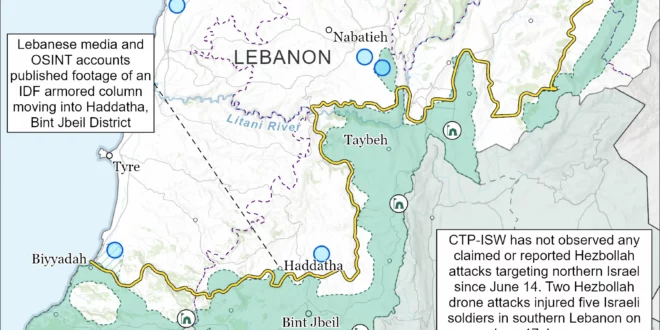
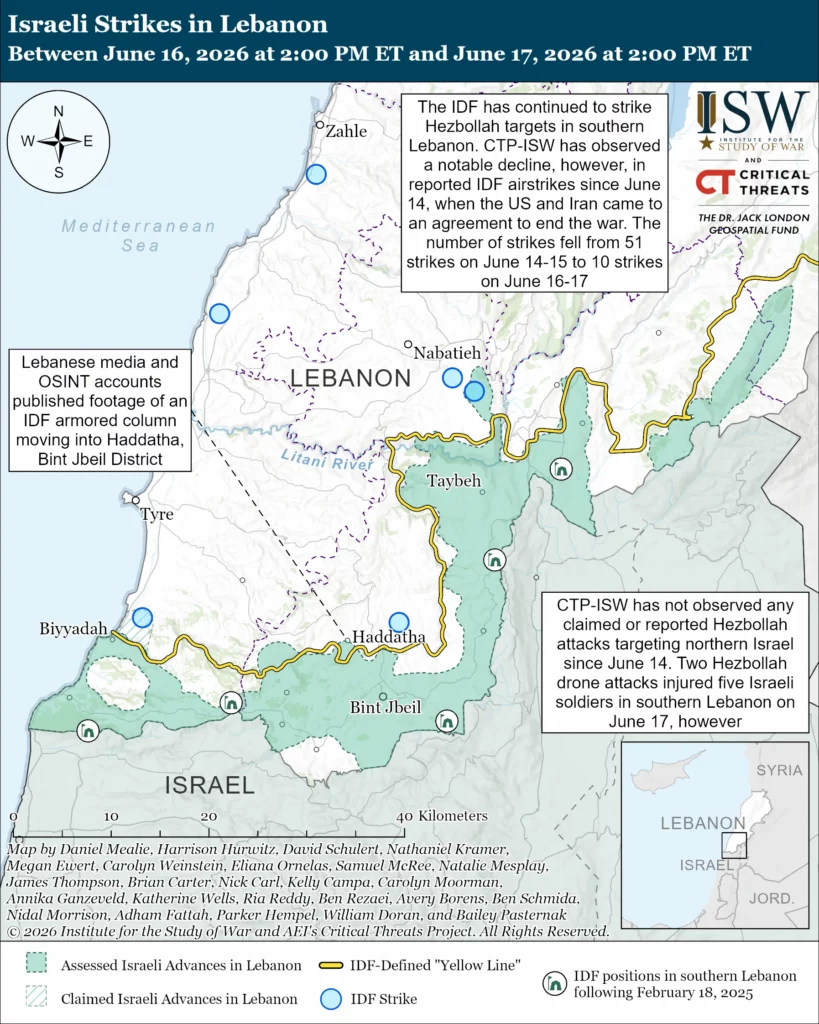
The Israel Defense Forces (IDF) and Hezbollah have continued to engage one another in southern Lebanon, in spite of the US-Iran MoU. The IDF continued to strike Hezbollah targets in southern Lebanon on June 17.[51] ISW-CTP has observed a notable decline, however, in reported IDF airstrikes since June 14, when the US and Iran came to an agreement to end the war.[52] The number of strikes fell from 51 strikes on June 14-15 to 10 strikes on June 16-17.[53] Hezbollah has not claimed an attack against Israeli forces since June 15, but the IDF reported on June 17 that Hezbollah has continued to conduct rocket and drone attacks targeting Israeli forces in southern Lebanon.[54] The IDF reported on June 17 that two Hezbollah drone attacks injured five Israeli soldiers in southern Lebanon, for example.[55] ISW-CTP has not observed any claimed or reported Hezbollah attacks targeting northern Israel since June 14, however. Israeli media reported on June 16 that the IDF will continue its operations ”as normal” south of the IDF’s Yellow Line, and Israeli officials have repeatedly emphasized that Israeli forces will remain in southern Lebanon.[56] Israeli forces have also continued to advance beyond the Yellow Line in order to combat Hezbollah. Lebanese media and OSINT accounts published footage of an IDF armored column advancing into Haddatha, Bint Jbeil District, on June 17.[57] Hezbollah previously defended against an IDF assault on Haddatha on May 19 and 20.[58]
Hezbollah, Iranian officials, and Iranian media continued to claim on June 17 that the US-Iran agreement requires Israel to cease operations against Hezbollah and ultimately withdraw from southern Lebanon (see topline text above).[59]
Other Axis of Resistance Activity
Iraqi Prime Minister Ali al Zaydi reinstated Saraya al Salam-affiliated Popular Mobilization Forces (PMF) commander Ali al Aqili as Samarra Operations Command commander, according to an unnamed Saraya al Salam source speaking to Iraqi media on June 17.[60] Aqili’s reinstatement comes after Popular Mobilization Commission (PMC) Chairman Faleh al Fayyadh replaced Aqili with an Asaib Ahl al Haq member on June 16.[61] Saraya al Salam is the armed wing associated with nationalist Iraqi Shia cleric Moqtada al Sadr. The PMC chairman is roughly equivalent to a service chief in the US military and controls the PMF, which is an Iraqi security service that contains many Iranian-backed Iraqi militias.[62] Iraqi media reported on June 16 that Sadr’s Shia Nationalist Movement ordered Saraya al Salam to accept Fayyadh’s decision to remove Aqili.[63] Sadr previously announced the dissolution of Saraya al Salam and the full integration of the militia’s members into the Iraqi state on May 27.[64] The replacement of a Saraya al Salam-affiliated commander with an Asaib Ahl al Haq member was notable, given the long-standing tensions between these two groups. Asaib Ahl al Haq head Qais al Khazali formed Asaib Ahl al Haq as a splinter group from Sadr’s Mahdi Army, which preceded Saraya al Salam, in the years following the 2003 US invasion of Iraq.[65] Forces from Saraya al Salam and Asaib Ahl al Haq have clashed sporadically in southern Iraq in recent years[BS2] [CM3] .[66]