 Eurasia Press & News
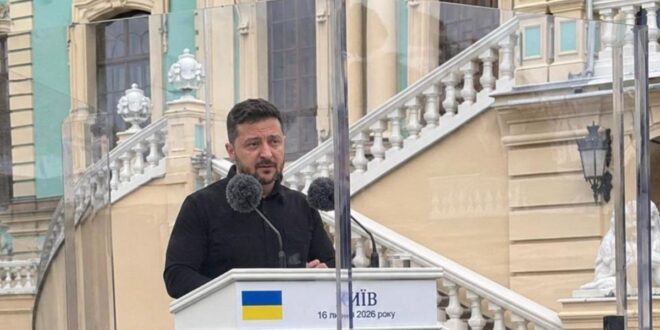
By all appearances, the winds of revolution are stirring through Ukraine.
Large crowds have gathered in protest of President Zelensky for his decision to remove the popular Defense Minister Mykhailo Fedorov.
Since his appointment early this year, Fedorov was said to have been instrumental in fighting corruption and transforming the AFU into even more of a technologically dominant force.
At only 35 years of age, Fedorov was young, dashing, intelligent, energetic, and because of these things, posed a direct threat to Zelensky who, rumor had it, feared that Fedorov was gearing up to eventually vie for the presidency himself.
But the main reasons Fedorov was dismissed was reportedly over a loggerheads with Syrsky, who himself told Zelensky in no uncertain terms that it was either “me or him”.
In short, Syrsky made Zelensky choose between the two all because Fedorov had criticized Syrsky and wanted him removed. Perhaps even more importantly, Fedorov was fighting to stop the massive grift in the Defense Ministry, which was a big no-no as the “senior officials” making a killing off of military contracts had essentially turned it into a mob and did not want anyone cutting off their tap of Western funds.
In his briefing, Fedorov listed 11 major problems he found with Ukraine’s Armed Forces:
Fedorov outlined 11 major problems:

1. Ukraine’s Armed Forces are fighting at the tactical level, although increasingly at the operational level too. Still, fundamentally, “we are still fighting tactically”.

2. The corps system has not yet fully taken shape. “We have corps that are successful, that advance every month and do not lose territory. And we have corps where the commander is replaced every month. There are corps that have developed their own school of thought and philosophy, and there are corps where we do not even know how many brigades they have or what is happening inside them. Everything depends on organisation, but there are corps that do not distribute all their resources internally,” Fedorov said.

3. Brigades and corps have been fragmented. “There are brigades that cannot even determine how many battalions they have. A battalion is pulled out of one brigade and thrown into another. It is impossible to build a management system under conditions like these,” the defence minister said.

4. No one is held accountable for anything. “Responsibility is always pushed down the chain. Someone else is always made to carry the blame, there is always talk of an investigation and of ‘finding out who is guilty’,” Fedorov said.

5. Supplies are not routed through the corps. Fedorov said the supply problem is “fundamental”: “Over the past five months, we have bought more drones than in the whole of last year, but most units have not felt the impact, because everything is distributed manually: if you are loyal, you get something, if you are not, you don’t... That is why we launched this system. It was four months of hell, because it took us four months to agree on a simple project for baseline drone provision to brigades.”

6. Constant replacement of commanders.

7. Isolation and toxic treatment of those who deliver results. “If you succeed, you become a star, and then you hit a dead end. [General Mykhailo] Drapatyi received his third reprimand, goodbye. Sorry, Drapatyi, I think after this speech there will be a fourth reprimand for you. I wouldn’t want that to happen, but we have no choice left but to talk about it,” Fedorov said.

8. It is impossible to carry out any systemic project. “Because you constantly run into the same questions: ‘But why?’ and ‘But how?’” the acting defence minister explained.

9. Human capital is being worn down without proper analysis. Fedorov said they had carried out “a great deal of work”, including analysing losses. “But decisions about who should be supported, who should not, who should be reinforced and who should not are not based on data. They are based on loyalty,” he said.

10. The blocking of initiatives and the “bureaucratic crossfire”. “In six months at the Defence Ministry, we have not been able to change the organisational structure because the General Staff refuses to approve it: the name is supposedly wrong, something else is not right, or there is allegedly no need to bring in new people,” Fedorov explained.

11. Constant dishonesty. “This applies to me too: claims that I ordered the investigation into Skelia, that I launched a media campaign, that I did this or that,” the acting defence minister said. [The Ukrainian State Bureau of Investigation is conducting a criminal probe into the Skelia unit – 425th Separate Assault Regiment – following reports of at least 26 noncombat deaths, physical abuse, and inadequate medical care for recruits. The unit’s commander was suspended, and authorities are currently investigating allegations of systemic abuse – ed.]
To the above, Fedorov proposed his own changes:
He added that he had proposed changes on all points.

“What solutions were proposed at the time? Radical personnel decisions. That meant changing both the Commander-in-Chief and the Chief of the General Staff… It meant creating an environment where strong leaders could develop instead of being held back or constantly reprimanded. It meant working with IT specialists and smart people. It meant a different management approach. It meant appointing strong corps commanders. Drone-assault units are a fundamental change in the way we think about deploying infantry: technology must be at the forefront of combat. We should lose drones, not people, and only then should infantry move in,” Fedorov said.

He also proposed “levelling out” the front line and implementing a doctrine based on the principle of “not losing personnel where it can be avoided”, while taking the terrain and the situation into account.

“The allocation of all resources through corps – that means personnel, drones, artillery, training… Because there are situations where, ultimately, no one is responsible for a section of the front line,” said the acting minister.

He also said he had proposed establishing an Academy of Modern Warfare to train new leaders capable of commanding headquarters and units, creating a consortium of Ballistics and Anti-Ballistics units, closing the skies, achieving victory in the economic war and, more broadly, transforming the defence forces and rooting out corruption in procurement.
As one can see, he is an intelligent and creative forward-thinker. One of his main complaints was the use of “meat assaults” by Syrsky: you can see he notes that drones should be used first, and only then troops sent in. But this perhaps exposes a fundamental misunderstanding of the AFU and Syrsky’s process. Syrsky uses meat assaults because he has no real choice, it’s the only way to wedge troops into Russian flanks and create difficulties for active Russian fronts—essentially, to stall the advances that are seeping through Ukrainian lines everywhere.
One cannot apply such simple, clear-cut logic to war as Fedorov does. If the AFU stuck rigidly to such a new doctrine, with the current disproportionate levels of capabilities between the two sides, then Russian troops would likely be advancing even more rapidly, and Ukrainian lines collapsing. In short: Ukrainian meat assaults used in the manner of tactical “active defense”—which consists of small harrying counter-attacks—is one of the few Ukrainian saving graces, bloody as they are.
Now many top figures have come out against Zelensky, including respected Joint Forces Commander Mykhailo Drapatyi in his own Facebook post.
Even the official AFU-linked Deep State account called for Syrsky’s removal in favor of Fedorov with a huge amount of positive “likes”:
Many other people have been affected—for instance, famed Ukrainian radio-electronics expert Serhiy Flash angrily announced that he has been removed from his duties owing to the fact that he worked directly under Defense Minister Fedorov, and has now effectively lost access to all his previous tools and means:
As of today, I am no longer an advisor to the Minister of Defense, Fedorov.

Dear manufacturers, developers, and military personnel, I can no longer assist you in any way at the level of the Ministry of Defense 😞. I apologize.

Being part of Fedorov's team was an honor for me. There were many plans and ideas for the future, but unfortunately...

I cannot talk about my personal challenges and projects that I will now be unable to complete. Someone else needs to continue working on them. The war continues.

I had access to various systems and was able to analyze the actions of our enemy and predict their future steps. I will no longer be able to do that :-((.

The enemy groups are rejoicing that I am no longer at the Ministry of Defense 😞. My mood is terrible. But I will not abandon my path and will continue to defend the country and help my military comrades.

Mykhailo Fedorov, thank you for everything.
It all comes amidst a wider shake-up by Zelensky which saw the resignation of Prime Minister Svyrydenko:
The overhaul, which Zelenskyy has yet to explain in detail, would be the fourth major reorganization of his government since the start of Russia's full-scale invasion.The upheavals come at a critical time when Ukraine was said to be achieving a major “turning point” in the war. Zelensky had announced his “40-day” secret operation that was supposed to end with Russia on its knees, and Putin begging for ceasefire. Instead, it appears Ukraine itself is in turmoil, with Zelensky earlier today forced to make a speech behind bullet proof glass for fear that his own angered nationalists could turn against him.
Not exactly the ‘optics’ of overwhelming confidence.
It appears more and more that our analysis here was accurate about Ukraine’s “40-day” PR campaign being nothing more than a desperate diversionary ploy to deflect from Ukraine’s terminal deterioration. If the current events seen in Ukraine were happening in Russia, the tone of global headlines would rival the euphoria witnessed in 1991.
Sure, Ukraine has been achieving some remarkable successes, particularly with hitting Russian ships in the Azov Sea in the past week. But the successes were supposed to translate into Putin’s downfall, not Zelensky’s—and the latter looks far more likely than the former at the moment. That’s not to mention the fact that Russia has begun to respond in kind, and has laid waste to Odessa and any ship entering the port now.
Video of Geran drone striking a container ship en route to Odessa yesterday:
Reuters reports the outcome:
The article notes Odessa handles 6 million tons of cargo a month, and only 1 million of those maximum can be redirected to ports on the Danube due to logistical reasons.
FT chimes in:
At the same time, for the moment Kiev has completely run out of Patriot missiles which has resulted in a series of damaging ballistic strikes that Russia is now carrying out at-will, with zero interceptions. Even Ukraine’s Serhiy Flash was forced to respond as to why the last few strikes on Kiev had no sirens or advance warnings at all. His reason is quite informative—read the bolded below:
Why do ballistic missile alerts sometimes go off after the missile has already hit?

All information about launches or preparations for launches comes to us from our partners. None of us know, and we shouldn't know, how they obtain this information, but it doesn't take a genius to understand that the primary source of information is satellite monitoring of launch sites and a system for recording launch events.

A missile can reach Kyiv in 2-4 minutes, so the time is very limited. Any system failure will lead to a delay in receiving information. No system can be perfect, so failures happen, and the alert signal may be delayed.

It also happens frequently that an alert is issued, but there is no launch. This is because satellites detect activity at launch sites that precedes a missile launch, but for some reason, the actual launch may not occur.

Remember how many times the false alarm sounded in Oreshk? This is because reconnaissance satellites visually detect activity at the launch site, but it is unclear whether a launch will actually take place or not.
In short, he confirms that all advance warning of Russian strikes comes completely from Ukraine’s Western “partners”—Ukraine itself has no capability to detect this.
He also ended up confirming that in recent strikes, Belarusian “relay towers” appeared to be functioning again in support of Russian Geran drones, which according to him skirted Belarus’s borders to hit gas stations in Malyn, Ukraine:
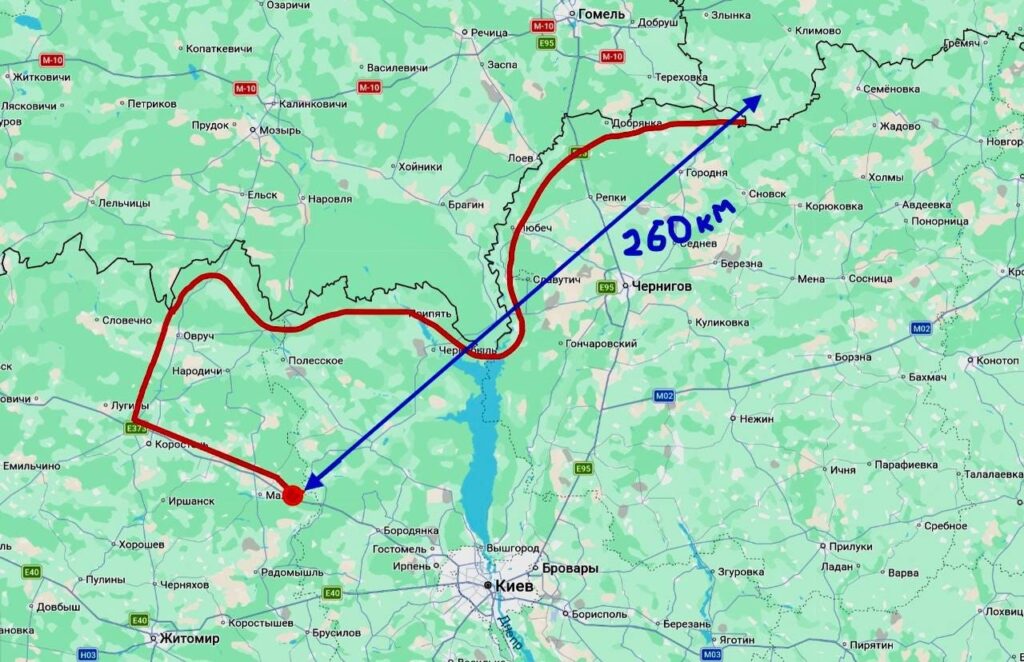
It's possible that repeaters in Belarus are still occasionally used to launch attacks on Ukraine.

This morning at 7:11 AM, a Shahed kamikaze drone attacked a gas station in Malyn. According to our radar data, the Shahed flew along the border with Belarus, then reached Korostyn directly over the highway, after which it turned and flew directly over the railway line to Malyn, where it attacked the gas station. This behavior is typical of manual control of a drone using a camera.
The distance from the attack point to the borders of the Russian Federation is 260 kilometers. This is too far for a direct radio link to function. There were no other Shaheds (possible repeaters) in the air at that time.

The relevant services and units will draw final conclusions after a detailed study of the situation.

The enemy desperately needs to attack the western part of Ukraine with Shaheds using online control, but without repeaters in Belarus, they cannot do so.

I don't know if Lukashenko will be able to resist the "persistent requests" for repeaters. I also don't rule out that repeaters may be installed without the knowledge of the Belarusian authorities. This can be done quickly and easily. Therefore, they should monitor more closely what is happening in their country.
So much for Zelensky’s threats, which Lukashenko allegedly “backed down” from.
As of now, the Ukrainian Rada has adjourned for a month-long summer break without having approved a new Defense Minister:
Ukraine’s Parliament (Rada) has gone on a month-long summer break without appointing a new Defense Minister or Foreign Minister, local media report.

Key personnel decisions remain pending, with the next plenary session not scheduled until August 18.
That means the crisis is now stuck unresolved like an open wound, which does not bode favorably for Zelensky and his coterie, particularly at a time when he’s meant to be portraying major “confidence” against a putatively “reeling” Russia.
It seems his 40-day special military operation is backfiring, while Russia has again recorded major advances all across the front this week, with Russian forces closing in on Slavyansk-Kramatorsk as well as pushing forward in Zaporozhye and the northern Kharkov front, as well.
Will more hits on Russian refineries or empty cargo vessels in the Azov Sea save Zelensky’s crumbling reputation?