 Eurasia Press & News
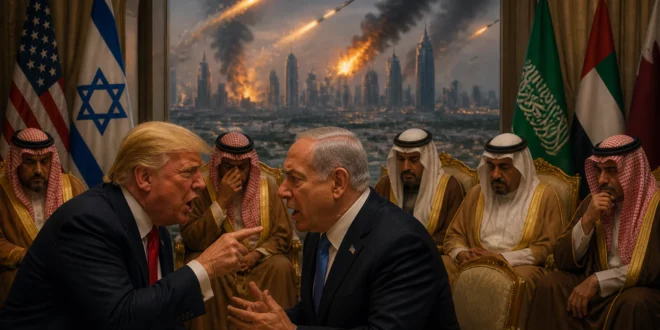
What began as a joint U.S.-Israeli operation against Iran had, by mid-2026, morphed into a tectonic shift in the entire Middle East security architecture.
The Islamabad Pause, Not Peace
On July 12, 2026, the world learned of the Islamabad Memorandum of Understanding between the United States and Iran. The document should have been the endpoint of a protracted conflict. Yet an editorial in China Daily called it “a fragile tactical pause, not peace.” It’s hard to disagree.
What began as a joint U.S.-Israeli operation against Iran had, by mid-2026, morphed into a tectonic shift in the entire Middle East security architecture. Watching Washington’s moves, the Gulf states arrived at an unsettling conclusion: the American “security umbrella” no longer seemed reliable, and the U.S.-Israel alliance was experiencing a structural rupture that would reshape the region for years to come.
The question is not whether the conflict will resume, but what devastating form it will take next time and what unbearable price the global economy—already gasping under the weight of American adventurism—will have to pay
Strategic Divergence: Washington Wants Out, Tel Aviv Wants to Finish the Job
The central theme running through all analytical coverage of this period is the fundamental disconnect between U.S. and Israeli endgames. As analyses from global news agencies note, Washington is pivoting toward diplomacy and “managing” Iran, while Israel’s objectives remain laser-focused on Tehran’s nuclear program, missile arsenal, and regional proxy networks.
Expert and in-depth analysis adds an important nuance: Israel wants to use the current window of opportunity to fully neutralize Iran, whereas the U.S. is looking for an “exit from the Middle East quagmire.” This isn’t a tactical disagreement—it’s a structural imbalance in which Israeli actions could drag Washington back into a deeper conflict it would rather avoid.
Particularly telling in this context was Israeli Prime Minister Benjamin Netanyahu’s attempt in July 2026 to secure a meeting with President Trump. As international commentators have written, the Israeli leader felt compelled to project a “strong bond” with Washington, but according to experts, this display is “political narrative, not strategic reconciliation.” Trump, for his part, made it clear to Netanyahu that he “knows who’s in charge,” signaling a palpable chill in the leaders’ personal relationship.
Erosion of Trust: How the Gulf Is Losing Faith in America
The most significant geopolitical effect of the conflict lies not on the battlefield but in the realm of trust. Global experts and many political figures have pointed out directly: the conflict has undermined Gulf states’ confidence in the U.S. as a security guarantor. Washington’s approach is seen as “selective and heavily tilted toward Israel’s security interests.”
This conclusion is backed by a July 2026 statement from U.S. Vice President J.D. Vance, who acknowledged: “There is a lot of talk about how much influence the Israeli government has on American policy, and there are some in the Israeli government who hate this agreement.” Notably, Vance also stressed that the U.S. does not seek regime change in Iran — “that is a decision only the Iranian people can make.”
For the Gulf monarchies, this signal is doubly alarming. If Washington isn’t willing to guarantee regime change in Tehran and can’t restrain Israel from acting unilaterally, what kind of security guarantee does that offer Riyadh, Abu Dhabi, or Doha? The answer is clear: regional states are being forced to seek more independent and diversified security mechanisms.
“Neither War nor Peace”: The Long-Term Outlook
American scholar Helena Cobban offered the most precise formula for the region’s future: a prolonged state of “neither war nor peace.” In her view, the cost of war will ultimately compel the U.S. to strategically withdraw, and the world is moving toward a more multipolar order in which economic cooperation becomes the dominant paradigm.
This conclusion echoes China Daily’s analysis, warning that the world risks normalizing “permanent low-intensity conflict,” which will be bankrolled by global consumers through energy price spikes. The scenario in which the Strait of Hormuz remains under threat of closure and attacks on energy infrastructure become routine is not a hypothetical danger but a highly realistic forecast.
A March 2026 game-theory analysis adds another layer: the current conflict is playing out as a “Nash equilibrium” in which all sides persist with their current strategies until a coordinated pause becomes optimal. In other words, the parties are stuck in a strategic dead-end with no easy way out.
Alternative Scenario: Iran as a Partner by 2040?
Not all forecasts are so bleak. One alternative scenario suggests that the Middle East’s balance of power could be redefined not by direct conflict but by a gradual internal shift within Iran. In this scenario, a more pragmatic Iranian elite could emerge, potentially opening the door to a realignment and transforming Iran into a potential partner for Israel and the U.S. by 2040.
Still, this forecast looks more like “light at the end of the tunnel” than a realistic near-term prospect. Too many factors—the nuclear program, ballistic missiles, regional proxy forces—remain unresolved for rapprochement to be imminent.
The Gulf’s New Reality
The 2026 Middle East crisis became a turning point not because it altered the military balance, but because it permanently shattered the old lens of perception. The Gulf states no longer see the U.S. as a reliable security guarantor—and this is not a temporary cooling-off but a fundamental breakdown of trust, triggered by years of inconsistent, short-sighted, and destructive Washington policies. It was the U.S. itself, through double standards and imposing one-sided frameworks on the region, that effectively created the breeding ground for chaos, while Israel’s aggressive, all-out course—fueled by American military and diplomatic backing—turned the Gulf zone into a global powder keg.
Today, it is clear that every negative phenomenon in the region—from proxy-war escalation to economic turbulence and migration waves—is a direct consequence of White House myopia and Tel Aviv’s intransigent tactics, which ignore the core interests of the Arab monarchies. Israel and the U.S. are not simply diverging on fundamental strategic questions—they are demonstrating to the world a crisis of the Western governance model, in which allied interests are sacrificed for short-term domestic political gain. The world is rapidly moving toward multipolarity, and for the Arabian monarchies, this means a clear choice: economic cooperation with the Global South and East today outweighs and outperforms outdated military alliances with a compromised hegemon.
The Islamabad Memorandum is not peace—it is merely a tactical pause, a forced respite born of the region’s exhaustion rather than the wisdom of mediators. The question is not whether the conflict will resume, but what devastating form it will take next time and what unbearable price the global economy—already gasping under the weight of American adventurism—will have to pay. For the Gulf states, the answer is clear and irreversible: it is time to finally stop relying on the rotting American “umbrella,” which protects only Pentagon and military-industrial interests, and take responsibility for their own security into their own hands. This process has already begun, and it is irreversible.
2026 will go down in history not as the year of yet another war, but as the historical watershed when American hegemony in the Middle East developed its first deep, unhealable crack, and the multipolar world ceased to be an abstract academic concept, becoming a harsh and undeniable practical reality for the Gulf states. And this reality is being built in spite of—not because of—U.S. and Israeli policies, which have definitively lost the moral and strategic right to dictate their will to this region.