 Eurasia Press & News
Hezbollah’s ability to develop and refine its use of tactical first-person view (FPV) systems represents a significant development that could alter the character of future conflicts between Israel and Hezbollah. Hezbollah increasingly deployed FPV systems in its asymmetric campaign against Israel between March and June 2026, likely as part of an early effort to integrate more precise FPV strike capabilities into its operations. Hezbollah’s current challenges with scale and integration have likely thus far limited Hezbollah’s ability to impose serious operational or strategic effects upon Israel, but Hezbollah will almost certainly work to expand and refine its FPV capabilities in the coming months if given time and space to do so. Hezbollah’s ability to develop a more robust FPV drone program represents a serious medium-term threat to Israel, which will need to not only rapidly adapt appropriate countermeasures to counter the current threat but also anticipate Hezbollah’s future adaptations and prepare accordingly.
Hezbollah’s flawed military campaign between October 7, 2023, and the end of the Israeli campaign in Lebanon in 2024 likely helped trigger tactical innovation within Hezbollah that led to the adoption of tactical FPV drones on a greater scale. Hezbollah had long relied on rockets, missiles, and anti-tank guided missiles as the backbone of its military forces.[1] These systems were designed to deter an Israeli attack into southern Lebanon by holding the security of northern Israeli towns at risk.[2] This strategic concept presupposed that Israel was unwilling to accept the risk required to launch a major campaign into southern Lebanon to silence the rocket fire, especially after the challenges Israel had in ending Hezbollah’s rocket fire in the 2006 war.[3] Any Israeli attack on Lebanon would be answered with rocket fire into northern Israel, and Israeli leaders would therefore be unwilling to attack. This theory failed when former Hezbollah Secretary General Hassan Nasrallah initiated fires at Israel on October 8, 2023, and could not stop the fire lest he be seen as abandoning Hamas.[4] Israel made the decision to stop the rocket fire through military force, and Hezbollah’s strategic concept collapsed.[5]
Hezbollah’s defense of southern Lebanon in Fall 2024 similarly failed. Hezbollah was unable to organize a serious defense of southern Lebanon, likely due in some part to its initial shock and disruption following the Israeli Defense Forces’ (IDF) pager attack and air campaign.[6] Hezbollah was therefore unable to meaningfully disrupt Israeli operations in southern Lebanon or force an Israeli withdrawal with its attacks.[7] The IDF was able to clear surrounding border towns in Lebanon and deprived Hezbollah of some of its capabilities to attack Israel by seizing ridgelines from which Hezbollah would fire direct fire anti-tank guided missiles into northern Israel.[8]
Hezbollah’s integration of tactical FPV systems into its operations is likely part of the group’s efforts to learn and adapt from these failures. Hezbollah began to operate FPV systems as early as June 2024 but did not deploy these capabilities at any meaningful scale until after the group’s Fall 2024 conflict with Israel.[9] Hezbollah’s long-term strategic reliance on rocket, missile, and anti-tank guided missile forces probably created organizational inertia that discouraged senior commanders from investing heavily in small, tactical drones like those now used by Hezbollah. The failures outlined above — in combination with the loss of Hezbollah’s primary smuggling conduit through Syria after the fall of Assad in December 2024 — almost certainly contributed to Hezbollah’s decision to devote time and resources to developing cheaper, more precise weaponry rather than replenishing its missile and rocket stockpiles as the group’s main priority.[10]
Hezbollah designed its most recent campaign to diminish Israel’s political will to continue its operations in Lebanon by maximizing Israeli casualties and demoralizing the Israeli population. Hezbollah officials, including Secretary General Naim Qassem, openly stated that Hezbollah has sought to maximize Israeli casualties as a means to compel an Israeli withdrawal from southern Lebanon.[11] This attrition-based concept is based on previous Hezbollah experience in the 1990s, when Hezbollah used small-scale guerrilla attacks to cause Israeli casualties.[12] This strategy ultimately led to increasing pressure from the Israeli public on the Israeli government to withdraw from southern Lebanon as “[Israeli] society grew increasingly intolerant of IDF casualties.”[13] Hezbollah has drawn on this legacy in its most recent campaign by using FPV drones to conduct small-scale attacks against Israeli targets in southern Lebanon and northern Israel, particularly since the April 16 ceasefire.[14]Hezbollah’s FPV drone attacks caused the majority of IDF deaths in Lebanon between the April ceasefire and mid-June 2026.[15] Hezbollah likely calculated that the increasing casualties—in addition to widespread reports that the IDF is struggling to develop countermeasures to protect soldiers from drones—would increase public pressure in Israel for a withdrawal.[16] The IDF has faced significant domestic criticism over the casualties from Hezbollah’s FPV strikes, but this domestic consternation has not yet led to any significant change in Israeli policy in the way that Hezbollah hoped.[17]
Hezbollah’s campaign is intended to be cumulative, however. Recent political agreements between Israel, the Lebanese government, and the United States have largely paused the active fighting between Hezbollah and the IDF.[18] Hezbollah appears willing to refrain from launching attacks against the IDF for now, but Hezbollah leaders and officials have made it clear that Hezbollah will not tolerate any long-term Israeli presence in Lebanon.[19] Rising Israeli casualties from future attacks — whether from larger attacks or ineffective Israeli countermeasures — could further reduce Israeli willingness to continue operations in Lebanon.
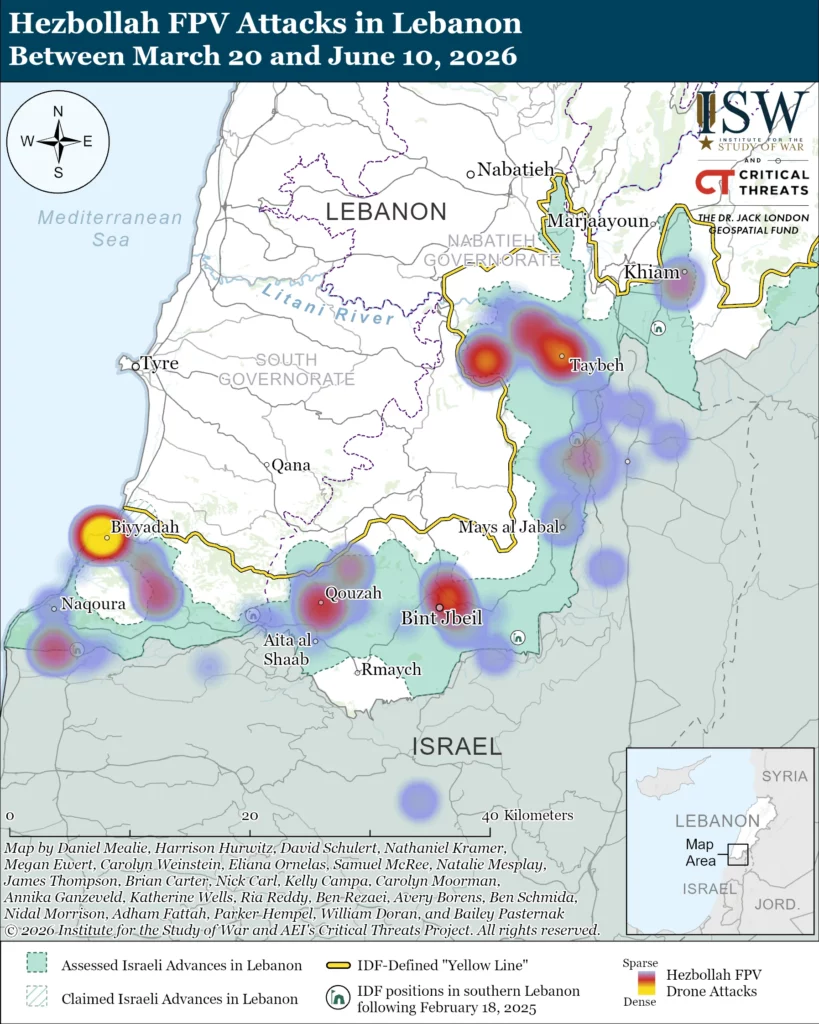
Hezbollah’s use of FPV systems imposed some operational challenges on the IDF due to the IDF’s inadequate counter-drone measures, but Hezbollah is unlikely to force an IDF withdrawal on military grounds while sustaining its current scale of FPV strikes. It is unclear to what degree Hezbollah prevented the IDF from accomplishing its missions under adapted circumstances. The IDF’s fear of Hezbollah attacks nonetheless drove reactive operational adaptations by IDF units.Hezbollah attacks restricted IDF movement in southern Lebanon, for example, including by forcing many units to operate at night.[20] Some Israeli officials have characterized the IDF’s expansion of the security zone in southern Lebanon as a response to the drone threat.[21] Hezbollah FPV strikes at their current scale have not yet generated sufficient pressure on Israeli political and military officials to compel a withdrawal, however.
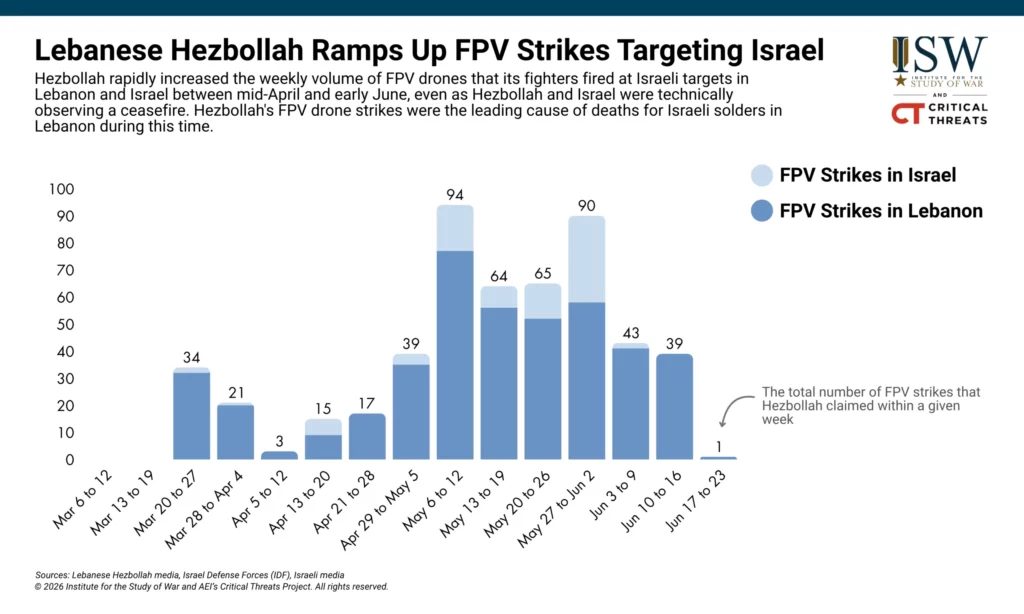
Hezbollah’s current challenges with scale and integration likely limited Hezbollah’s ability to impose serious operational or strategic effects upon Israel. Hezbollah drone operators are organized into small, decentralized cells that are dispersed among the regional units of Hezbollah’s ground forces.[22] Hezbollah’s FPV drone operations are decentralized, and it is unclear to what degree these operators are integrated into regional ground units.[23] Decentralizing drone cells makes coordinating large strikes more difficult. Assigning these cells to regional units could, in principle, enable better coordination between infantry and drone forces in the future.
Hezbollah has struggled to conduct complex strikes that provide coordinated air support to ground units. Hezbollah has been able to execute at least some complex attacks that would require coordination between several FPV operators, such as several “swarming” attacks in which operators employ three or more drones operating in a staggered but near-simultaneous manner.[24] These ”swarming” attacks have been operational-level strikes against Israeli laagers in Lebanon or outposts in northern Israel—similar to how Hezbollah has long employed larger, Iranian-made drones—rather than tactical-level strikes designed to support ground maneuver or defense, however.[25] Supporting ground maneuver would require greater coordination with ground commanders at the tactical level.
Hezbollah is suffering from a relative lack of experience piloting FPVs at scale in combat and has so far employed relatively rudimentary tactics.[26] This conflict marks the first time that Hezbollah has deployed these systems in any serious way.[27] Operators are still largely relying upon rudimentary, slow targeting cycles and rudimentary tactics. The current approach uses a static targeting model in which Hezbollah conducts drone reconnaissance to identify targets, requires a commander to approve the strike, and then uses an attack drone to strike.[28] The subsequent attack drones in “swarming” attacks conduct a hasty battle damage assessment, both to acquire propaganda footage and probably to determine if a second strike is required.[29] This approach makes dynamic targeting very difficult.
Hezbollah’s early battlefield successes with tactical FPV systems in this campaign will almost certainly lead Hezbollah to invest further in its development of FPV systems, including by refining strike tactics to improve the effectiveness of its attacks. The sophistication of Hezbollah’s recent operations and attacks suggests that it is still in the early, experimental stages of integrating FPV drone systems into its warfare. Hezbollah has demonstrated increasingly complex capabilities since March 2026, which suggests that the group will continue to refine its tactics and attempt more complex strikes, particularly as operators gain more experience. The “swarm” attacks noted above demonstrate that Hezbollah already appears to be improving coordination between drone operators, for example. Hezbollah has also demonstrated its ability to quickly adapt to and overcome relatively rudimentary Israeli countermeasures.[30] Hezbollah, for example, adapted to IDF night operations by fielding thermal camera-equipped FPV drones that enable nighttime attacks.[31]
Hezbollah will develop the capacity to scale up its operations if allowed the time and space to do so. Hezbollah reportedly has at least 90 operators in southern Lebanon, which may be temporarily constraining the group’s ability to execute strikes at a greater scale.[32] This relatively small number of trained operators is likely to expand in the coming months. A Ukrainian drone operator, for example, only needs three to five weeks of training.[33] A normal Hezbollah fighter undergoes 33 days of basic training, which means a drone operator could be ready to deploy in around two months, and even less if he does not attend basic training.[34] Hezbollah is training additional operators, according to Israeli assessments.[35] The operators are not a bottleneck for Hezbollah’s drone program in the same way that rocket or missile operators are not a bottleneck for those Hezbollah units, even though their operators also undergo specialized training.[36]
Hezbollah can use the current ceasefire to reconstitute its military forces and prepare for renewed fighting with Israel. Hezbollah has largely paused defensive operations against Israeli forces since Israel committed to a ceasefire under the Israel-Lebanon-United States Trilateral Framework on June 26.[37] The group likely calculates that the pause gives it time to rebuild and reorganize before any potential resumption of fighting. Hezbollah has repositioned fighters in unspecified parts of southern Lebanon in recent weeks in anticipation of a resumption of conflict, according to Israeli officials.[38] Ongoing disagreements between Israel and the Lebanese government about the timeline and requirements for implementing ”pilot zones” to disarm Hezbollah will likely give Hezbollah additional time to prepare.[39]
Hezbollah’s ability to develop a more robust FPV drone program represents a serious threat to Israel and Israeli forces over the medium term. This threat will require Israel to anticipate Hezbollah’s future adaptations and prepare accordingly. The current Israeli approach to developing countermeasures, which remains largely reactive to Hezbollah adaptations as they arise, is necessary in that the immediate priority must be protecting forces in the field.Israeli forces have implemented relatively rudimentary passive defenses on the battlefield in Lebanon and in northern Israeli townswhile the IDF makes significant investments to procure and develop counter-drone systems.[40] The IDF is currently testing systems intended to intercept Hezbollah’s fiber-optic drones, which are immune to jamming and therefore pose one of the most urgent threats to Israeli forces.[41] Hezbollah has used fiber-optic systems in most of its recent FPV strikes.[42] The development and deployment of counter-drone systems can fill the existing gaps in Israeli defenses, but this approach is insufficient on its own.
The likelihood that Hezbollah will attempt to improve upon its preexisting FPV capabilities underscores the need for the IDF to achieve overmatch vis-à-vis Hezbollah’s nascent precision strike complex. Improved integration and coordination between Hezbollah ground units and drone operators could rapidly improve Hezbollah’s drone capabilities and Hezbollah’s ability to overcome IDF defenses, such as through massed fire. Hezbollah may pursue longer-range FPV systems that would allow Hezbollah to launch from positions much further north of the Litani River, which would make Israeli efforts to target operators and launch positions much more challenging.
The IDF will ultimately need to invest significant intellectual and financial resources into developing countermeasures for determining where Hezbollah’s FPV drone and strike complex will be in the medium term. This approach will force Hezbollah to react to IDF countermeasures in the next war and allow the IDF to play to its relative advantages, such as the financial resources of the state and its preponderance in technology, including artificial intelligence. Hezbollah is still in the early stages of integrating FPV systems into its operations. The limitations of Hezbollah’s drone capabilities at this time mean that the IDF has an opportunity to recalibrate its approach to create long-term overmatch.