Eurasia Press & News
Toplines
Russia is reportedly planning to launch a large-scale strike campaign against energy infrastructure in Kyiv City over the coming weeks. Ukraine’s Strategic Communications Center reported on August 8, citing US intelligence, that Russia is preparing to conduct a major strike campaign against energy infrastructure in Kyiv City ahead of Ukraine’s Independence Day on August 24.[1] Russia could reportedly draw on its strategic reserve of ballistic missiles in order to cause maximum damage by August 24.
Russia began its Fall 2025 and Winter 2025-2026 strike campaign against Ukraine’s energy infrastructure in early September 2025, and Russia may aim to start its 2026-2027 strike campaign in August in order to take advantage of Ukraine’s ongoing shortages of ballistic missile interceptors.[2] Ukrainian President Volodymyr Zelensky noted on August 5 that Ukraine has been receiving almost three times fewer anti-ballistic missile interceptors as compared to the start of 2026.[3] Russia has been exploiting Ukraine’s insufficient interceptor stockpiles in recent months and has been able to launch relatively small numbers of quasi-ballistic and ballistic missiles in recent weeks that have caused significant damage nonetheless.[4] Russian ballistic missile strikes against Kyiv City energy infrastructure will likely cause significant damage as Ukraine struggles to defend against these missiles.
Russian strikes against Kyiv City’s energy infrastructure in the coming weeks will disrupt Ukrainian efforts to repair and strengthen the energy facilities that Russia damaged in Winter of 2025-2026. Ukraine has been working to repair and fortify previously damaged energy infrastructure ahead of expected Russian energy strikes in Winter 2026-2027.[5] Russia may aim to start its strikes against energy infrastructure earlier than anticipated in 2026 in order to interrupt these ongoing Ukrainian efforts. Russia will likely still conduct strikes against Ukrainian energy infrastructure in the upcoming winter, which will likely be more destructive after Russia hinders Ukrainian efforts to fortify its facilities in August.
Russian strikes against Kyiv City’s energy infrastructure in August may force Russia to adjust the size and composition of its strike packages. Russia has been conducting coordinated strike campaigns against Ukrainian gas stations, port infrastructure, and logistics in Summer 2026.[6] Upcoming strikes against energy infrastructure may require Russia to deintensify or stop these other strike campaigns or to expand the size of its strike packages in order to accommodate a larger target set. Russia has largely been using Geran-type drones to strike port infrastructure, however, so Russia may be able to continue such drone strikes while using its ballistic missiles to strike energy infrastructure.[7]
It is unclear how many energy facilities Ukraine has been able to repair since last winter and therefore how many energy targets are available for Russia to strike in 2026. Russian strikes on Ukraine’s energy infrastructure during its Fall 2025 and Winter 2025-2026 campaign inflicted significant damage by mid-January 2026 that required an estimated $64 to 70 billion to repair.[8] Ukrainian First Deputy Prime Minister Denys Shmyhal stated on August 3 that last year’s strike campaign damaged or destroyed facilities accounting for about 80 percent of Ukraine’s power generation and left Ukraine with a six-gigawatt power generation shortfall.[9]
Unspecified drones conducted multiple overflights over a Patriot air defense system repair base in Germany on August 7. German news outlet Tagesschau reported on August 7, citing a police report, that two drones conducted six overflights overnight of the Bundeswehr base in Mechernich, which houses German military equipment and maintains and repairs US Patriot air defense systems.[10] One of the drones reportedly approached the base at a distance of 40 kilometers and may have been a Fly-380 vertical take-off and landing (VTOL) drone for surveying, mapping, and surveillance. German officials have not attributed a specific actor to the drone incident as of this writing. The repeated pattern of reconnaissance over the site suggests a coordinated and planned series of reconnaissance missions characteristic of sophisticated coordinated activity.
Western media reported on August 7, citing US officials familiar with intelligence reports, that a drone containing explosives at Germany’s Leipzig/Halle Airport that German officials discovered on August 5 belonged to a Russian intelligence service.[11]
A Ukrainian Maya decoy drone reportedly exploded in Bulgaria on the morning of August 8. Bulgarian Prime Minister Rumen Radev stated on August 8 that an unidentified drone, likely a Ukrainian “Maya” decoy drone, exploded in a field in Bulgaria about 100 meters from the Bulgaria-Romania border, about 200 meters from a Romanian gas compressor station, and about one kilometer from a Bulgarian gas compressor station along the Trans-Balkan gas pipeline.[12] Bulgarian Defense Minister Dimitar Stoyanov stated on August 8 that the strength of the explosion indicates that the drone was carrying a significant amount of explosives but that there is no reason to believe that the incident was intentional. Ukrainian Foreign Ministry Spokesperson Heorhii Tykhyi stated that Ukraine did not deliberately target Bulgaria.[13] It is unclear as of this writing why a decoy drone included explosives.
Key Takeaways
Russia is reportedly planning to launch a large-scale strike campaign against energy infrastructure in Kyiv City over the coming weeks.
Russia began its Fall 2025 and Winter 2025-2026 strike campaign against Ukraine’s energy infrastructure in early September 2025, and Russia may aim to start its 2026-2027 strike campaign in August in order to take advantage of Ukraine’s ongoing shortages of ballistic missile interceptors.
Russian strikes against Kyiv City’s energy infrastructure in the coming weeks will disrupt Ukrainian efforts to repair and strengthen the energy facilities that Russia damaged in Winter of 2025-2026.
It is unclear how many energy facilities Ukraine has been able to repair since last winter and therefore how many energy targets are available for Russia to strike in 2026.
Unspecified drones conducted multiple overflights over a Patriot air defense system repair base in Germany on August 7.
A Ukrainian Maya decoy drone reportedly exploded in Bulgaria on the morning of August 8.
Ukrainian forces recently advanced northeast of Kharkiv City.
Russia launched six missiles and 151 drones against Ukraine overnight.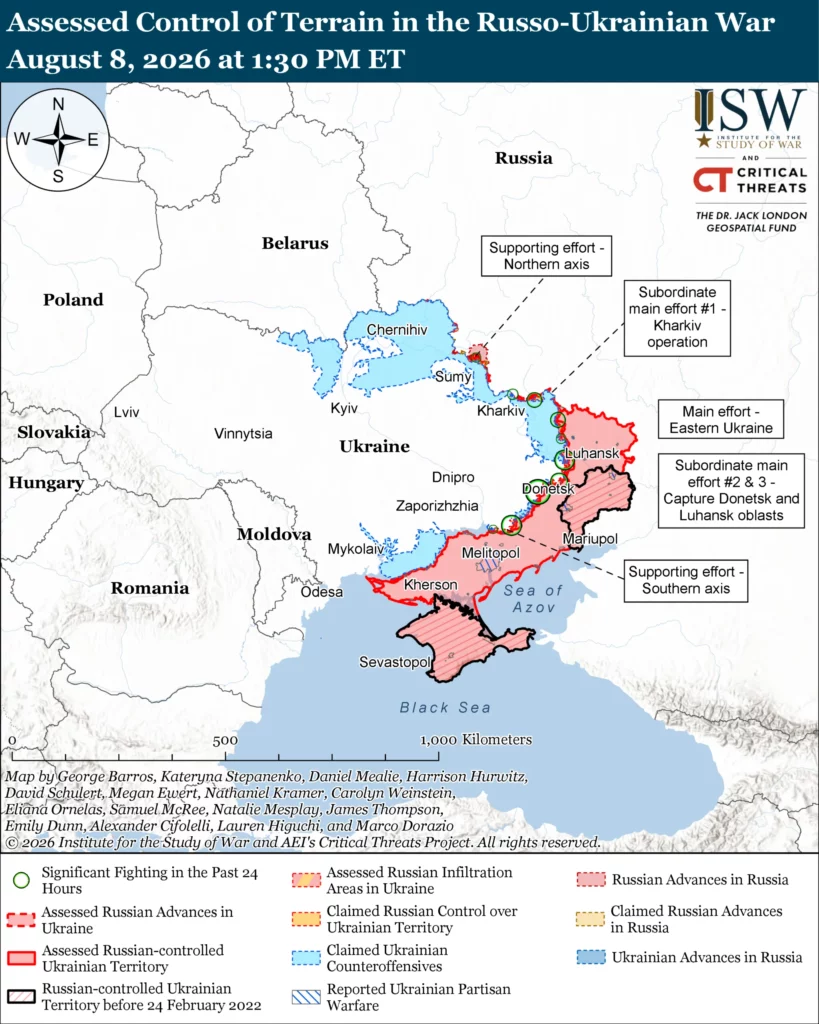
We do not report in detail on Russian war crimes because these activities are well-covered in Western media and do not directly affect the military operations we are assessing and forecasting. We will continue to evaluate and report on the effects of these criminal activities on the Ukrainian military and the Ukrainian population and specifically on combat in Ukrainian urban areas. We utterly condemn Russian violations of the laws of armed conflict and the Geneva Conventions and crimes against humanity even though we do not describe them in these reports.
Ukrainian Operations in the Russian Federation
Ukrainian forces continued their long-range strike campaign against Russian oil infrastructure and shadow fleet vessels on August 8. The Ukrainian General Staff reported on August 8 that Ukrainian forces struck the Ilsky Oil Refinery in Krasnodar Krai that produces petroleum products and has a total refining capacity of about 6.6 million tons of oil per year (roughly 160 kilometers from the international border).[14] Footage published on August 7 shows fire at the refinery following the Ukrainian strike.[15] The Krasnodar Krai Operational Headquarters acknowledged on August 8 that drone debris caused a fire at the refinery.[16] The Ukrainian General Staff reported on August 8 that Ukrainian forces also struck the Syzran Oil Refinery in Samara Oblast that produces more than 20 types of petroleum products and has a refining capacity of about 8.5 million tons of oil per year (roughly 700 kilometers from the international border).[17] Geolocated imagery published on August 7 and 8 shows a fire at the refinery.[18] Samara Oblast Governor Vyacheslav Fedorishchev acknowledged on August 8 that a Ukrainian drone struck an industrial enterprise in Samara Oblast on the night of August 7 to 8.[19] Ukrainian Unmanned Systems Forces (USF) Commander Major Robert “Magyar” Brovdi reported on August 8 that Ukrainian forces struck a Russian shadow fleet tanker off the coast of Gelendzhik, Krasnodar Krai (roughly 150 kilometers from the international border).[20] Footage published on August 7 shows a vessel on fire off the coast of Gelendzhik.[21] Gelendzhik Mayor Alexei Bogodistov announced on August 8 that municipal authorities closed all beaches in the Gelendzhik, Kabardinsky, and Divnomorsky rural districts due to the threat of Ukrainian drones and air defense operations.[22]
Russian Supporting Effort: Northern Axis
Russian objective: Create defensible buffer zones in Sumy Oblast along the international border
Ukrainian forces recently advanced or maintained positions in northern Sumy Oblast. Ukrainian Joint Forces Task Force Spokesperson Colonel Viktor Trehubov stated on August 8 that Russian forces maintain positions on the eastern outskirts of Ryasne (southeast of Sumy City), indicating that Ukrainian and Russian forces are likely intermixed in the area and that Ukrainian forces advanced or restored positions in western Ryasne.[23]
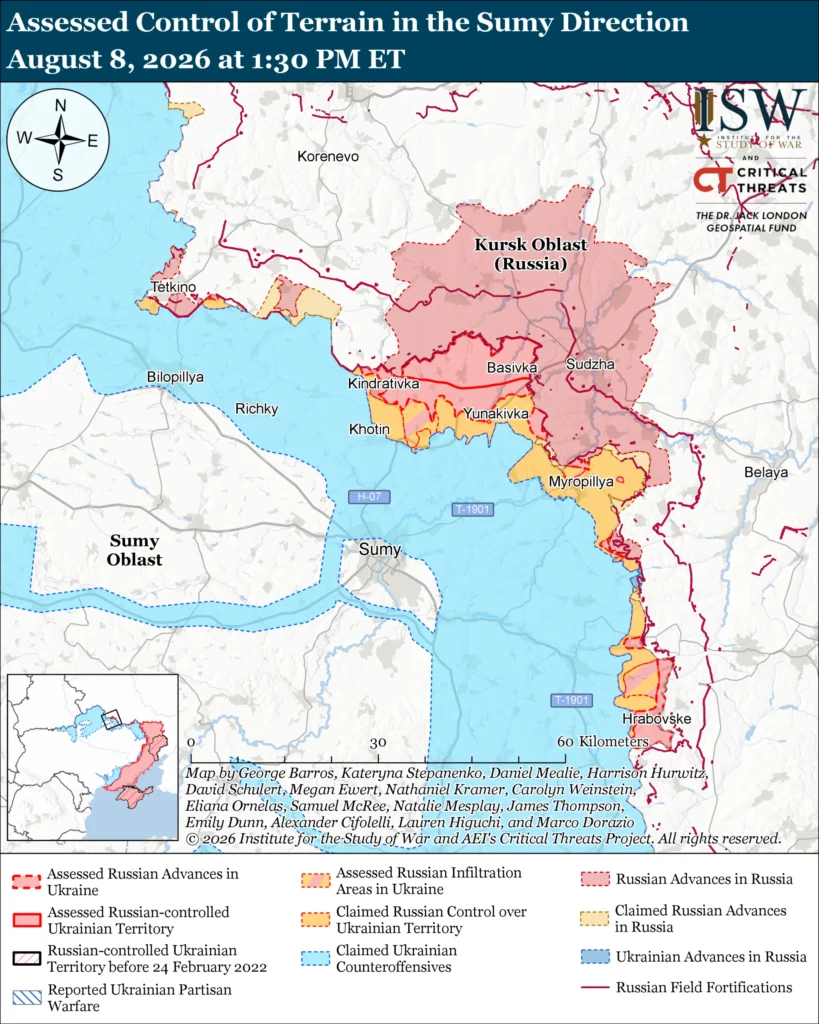
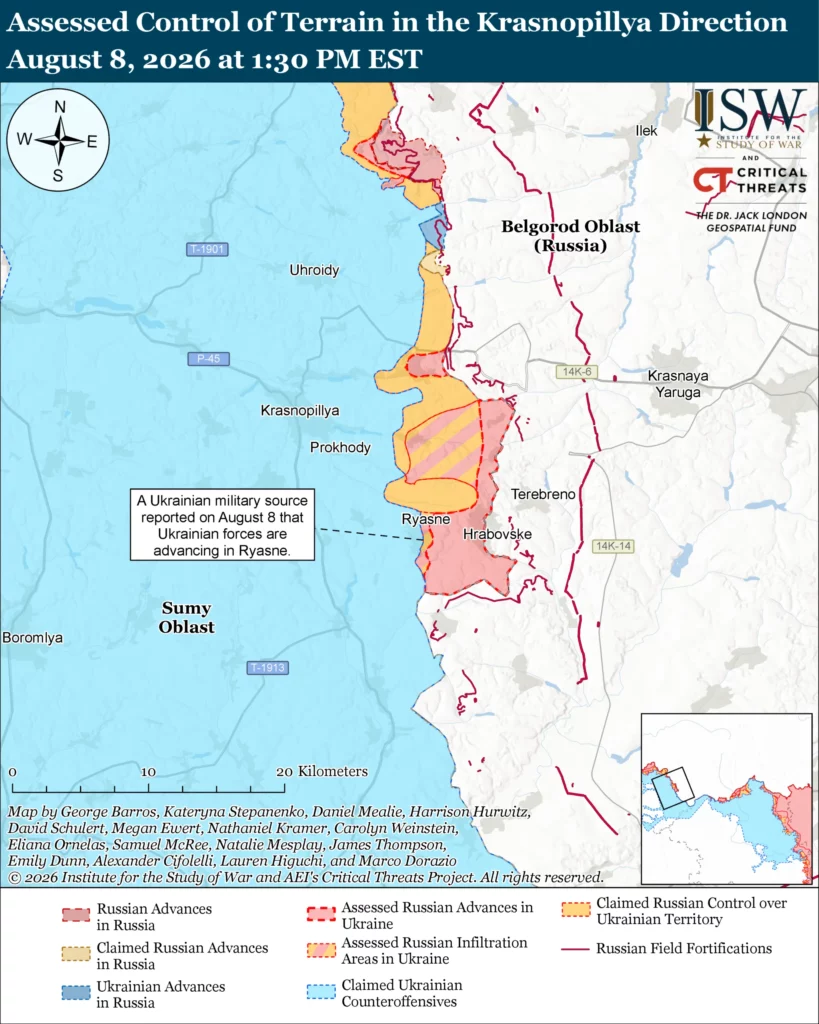
Russian forces continued limited offensive operations in the Velykyi Burluk direction on August 8 but did not advance.[28]
Russian Main Effort: Eastern Ukraine
Russian Subordinate Main Effort #1 – Kharkiv Oblast
Russian objective: Push Ukrainian forces back from the international border to create a defensible buffer zone with Belgorod Oblast and approach to within tube artillery range of Kharkiv City
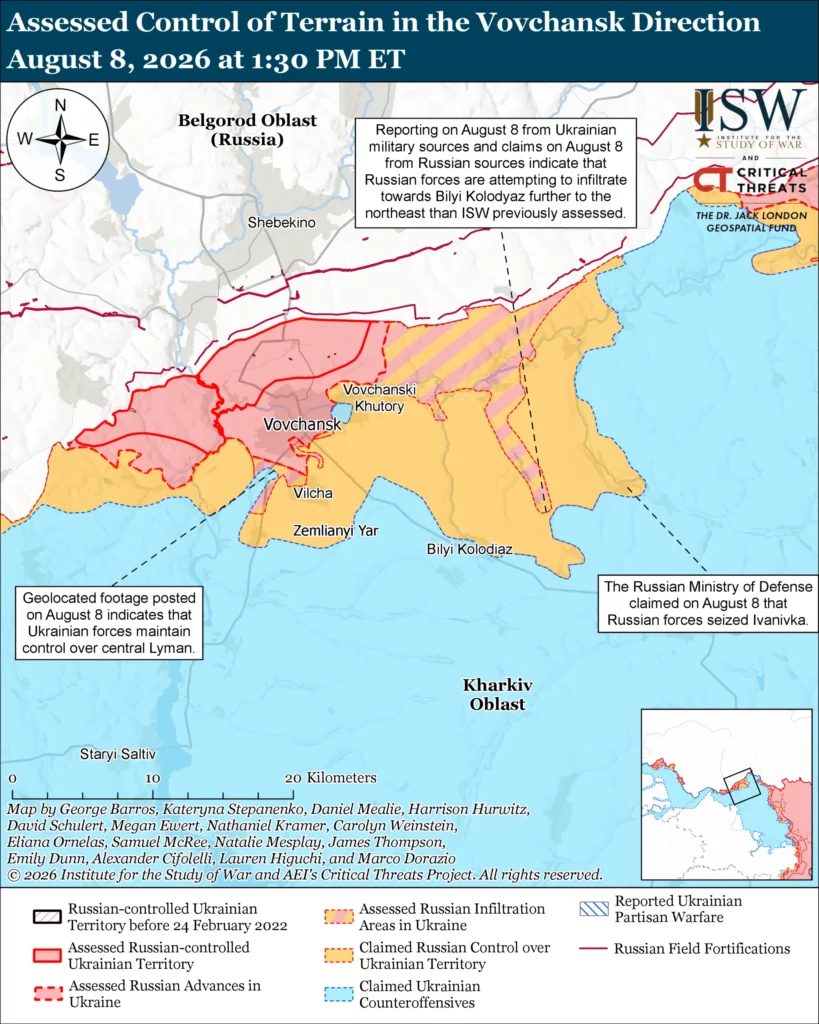
Ukrainian forces recently advanced in northern Kharkiv Oblast. Geolocated footage published on August 6 and 8 shows Russian forces striking Ukrainian positions south of Tsehelne and within and north of Lyman (both northeast of Kharkiv City).[24] The Russian Ministry of Defense (MoD) claimed on August 8 that Russian forces seized Ivanivka (northeast of Kharkiv City).[25]
Russian forces are likely infiltrating toward Bilyi Kolodyaz (northeast of Kharkiv City) from the northeast. ISW previously assessed that Russian forces were infiltrating toward Bilyi Kolodyaz from Pokalyne (north of Bilyi Kolodyaz) after a Ukrainian source reported on July 31 that Russian forces were trying to infiltrate the settlement from the north.[26] Ukrainian Joint Forces Task Force Spokesperson Colonel Viktor Trehubov reported on August 8, however, that Russian forces are not near Bilyi Kolodyaz, and two Russian milbloggers claimed that Russian forces are infiltrating towards Bilyi Kolodyaz from the northeast near Volokhivske.[27]
Russian Subordinate Main Effort #2 – Oskil River
Russian objective: Cross the Oskil River in Kharkiv Oblast and push westward into eastern Kharkiv Oblast and northern Donetsk Oblast
Russian forces recently conducted an infiltration mission in the Kupyansk direction. Geolocated footage published on August 8 shows Ukrainian forces striking a Russian-occupied building in central Kupyansk-Vuzlovyi (south of Kupyansk) after what ISW assesses was a Russian infiltration mission.[29] A Russian milblogger claimed on August 8 that Russian forces advanced west of Podoly (east of Kupyansk) and in central Kupyansk-Vuzlovyi.[30]
Russian forces are reportedly using infiltration tactics to attempt to advance toward Kupyansk from the north and east. Ukrainian Joint Forces Task Force Spokesperson Colonel Viktor Trehubov stated on August 8 that Russians are increasingly trying to infiltrate north of Kupyansk and the eastern parts of Ukrainian-controlled positions on the right bank of the Oskil River.[31] Trehubov stated that Russian forces are also attempting to advance toward Kindrashivka (north of Kupyansk), cut off the Ukrainian bridgehead on the left bank of the Oskil River, and reinforce their positions in Kupyansk-Vuzlovyi (south of Kupyansk), and infiltrate into settlements on the outskirts of Kupyansk. Trehubov noted that the presence of Russian troops around Kupyansk allows them to use drones more effectively in the area to pressure Ukrainian logistics.
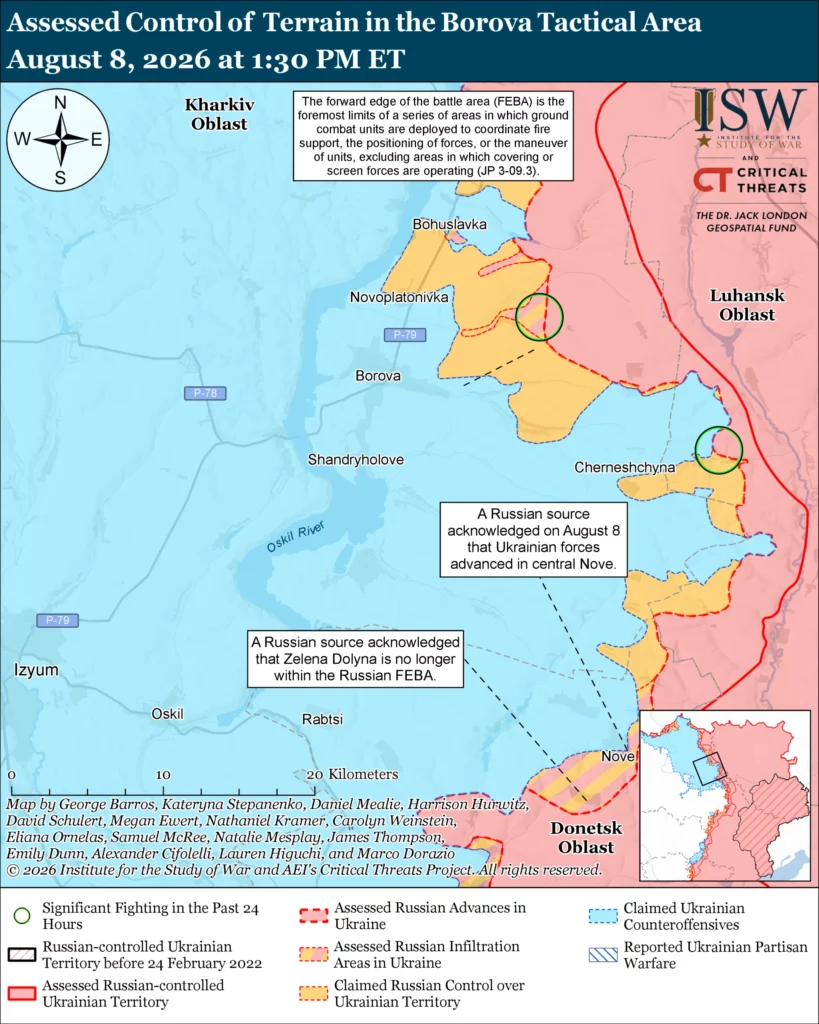
Ukrainian forces recently advanced or maintained positions in the Borova direction. A Russian milblogger acknowledged on August 8 that Ukrainian forces advanced into western Katerynivka and central Nove (both southeast of Borova) on prior dates and that central and eastern Katerynivka, eastern Nove, southern Lypove, and Zelena Dolyna (all southeast of Borova) are not within the Russian forward edge of the battle area.[32]
Russian Subordinate Main Effort #3 – Donetsk Oblast
Russian objective: Capture the entirety of Donetsk Oblast, the claimed territory of Russia’s proxies in Donbas, and advance into Dnipropetrovsk Oblast
Ukrainian forces recently advanced or maintained positions in the Slovyansk direction. A Russian milblogger acknowledged on August 8 that Ukrainian forces advanced into northern Shandryholove (northwest of Lyman) and maintain control over southern Novoselivka (also northwest of Lyman), central Drobysheve (also northwest of Lyman), western Lyman, and central Yampil (southeast of Lyman) and that the settlements are not within the Russian forward edge of battle.[33] The milblogger claimed that Russian forces advanced east of Mykolaivka (east of Slovyansk).[34]
Russian forces continue to strike bridges in the Slovyansk direction in order to shape the battlefield for offensive operations in the Fortress Belt in Donetsk Oblast. Russian milbloggers claimed on August 8 that Russian forces struck a road bridge over the Kazennyi Torets River in Slovyansk, likely referring to the Cherivkovsky bridge connecting Slovyansk to the H-20 highway and Kramatorsk.[35] ISW has not observed geolocated footage of the reported strike. ISW previously observed Russian forces conducting a multiple launch rocket system (MLRS) strike against the Cherivkovsky Bridge on August 2.[36]
Russian forces continued offensive operations in the Kostyantynivka-Druzhkivka tactical area on August 7 and 8 but did not advance.[37]
Russian forces continued offensive operations in the Dobropillya direction on August 7 and 8 but did not make confirmed advances.[38] A Russian milblogger claimed on August 8 that Russian forces advanced south of Novyi Donbas (southeast of Dobropillya).[39]
Russian forces continued offensive operations in the Pokrovsk direction on August 7 and 8 but did not advance.[40]
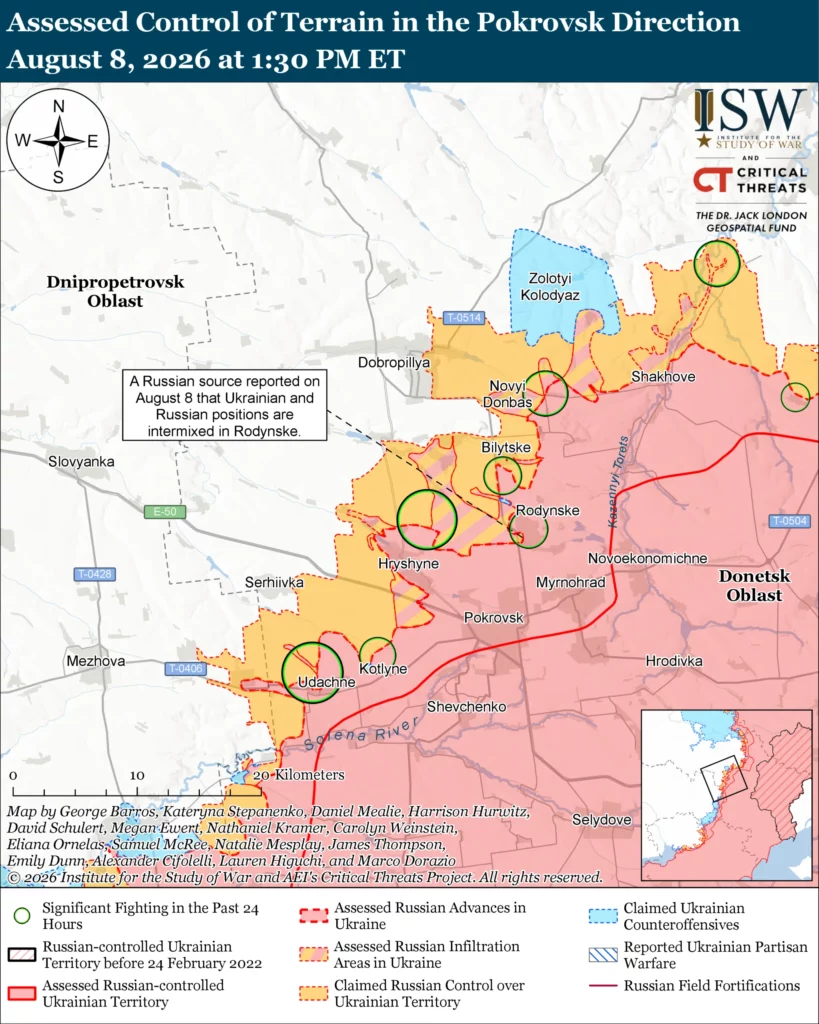
Russian forces are reportedly increasing the number of infiltration missions in the Pokrovsk direction after recently conducting a personnel rotation in the area. The deputy commander of a Ukrainian battalion operating in the Pokrovsk direction reported on August 8 that Russian forces are increasingly conducting infiltration missions in the brigade’s area of responsibility (AoR) after having deployed additional units in the area.[41] The commander noted that the kill zone covers 20 kilometers in the Pokrovsk direction.
Russian forces continued limited offensive operations in the Novopavlivka and Oleksandrivka directions on August 7 and 8 but did not advance.[42]
Ukrainian forces are targeting Shahed-type drones before Russian forces can launch them from the occupied Donetsk City Airport. Serhii Sternenko, a former advisor to former Ukrainian Defense Minster Mykhailo Fedorov, posted footage on August 8 of Ukrainian first-person view (FPV) drones striking and destroying a Russian jet-powered Shahed-type drone on a drone launcher at the Donetsk City Airport.[43]
Russian Supporting Effort: Southern Axis
Russian objective: Maintain frontline positions, secure rear areas against Ukrainian strikes, and advance within tube artillery range of Zaporizhzhia City
Russian forces continued offensive operations in the Hulyaipole direction on August 7 and 8 but did not advance.[44] A Russian milblogger claimed that Ukrainian forces are counterattacking from the Novoselivka and Charivne directions (both southwest of Hulyaipole).[45]
A Russian prisoner of war (POW) confirmed that the Russian military command is ordering flag raisings in the Hulyaipole direction in order to generate propaganda effects. A Ukrainian brigade operating in the Hulyaipole direction reported that it took a Russian soldier prisoner whom Russian military authorities had ordered to conduct a flag raising in Zirnytsya (northwest of Hulyaipole) for a video to allege false Russian advances.[46] Geolocated footage published on August 5 showed a Russian servicemember raising a flag east of Zirnytsya, and the Russian Ministry of Defense (MoD) claimed on August 5 that Russian forces seized the settlement.[47] ISW assesses that Ukrainian forces still control Zirnytsya.
Ukrainian military authorities continue to describe Russian infiltration tactics in the Hulyaipole direction. The commander of a Ukrainian regiment operating in the Hulyaipole direction reported that Russian forces continue small group infiltration missions, sometimes up to 10 kilometers deep into Ukrainian defenses.[48] The commander reported that Russian forces do not concentrate all of their forces in one place but rather operate along the entire width of the sector, find Ukrainian weak spots, and then dramatically increase their presence to exploit weak spots.
Ukraine’s intermediate-range drone strikes against Russian ground lines of communication (GLOCs) are reportedly limiting Russian movement in the rear. A Ukrainian regiment commander operating in the Hulyaipole direction reported that Ukrainian strikes against Russian transport routes have reduced Russian forces’ movement in rear areas 60 to 100 kilometers from the frontline.[49] Geolocated footage published on August 7 shows Ukrainian forces striking cargo trucks along the M-14 Berdyansk-Melitopol highway southwest of Melitopol.[50] A Russian milblogger refuted Russian officials’ claims that they have restored traffic along the M-14 highway, claiming that Ukrainian drone strikes against trucks along the highway continue daily and that Russia needs more mobile fire groups to cover the entire road.[51]
Russian forces are attempting to infiltrate into Orikhiv and shape the battlefield for future offensive operations against the town. Russian milbloggers claimed that Russian forces advanced into southern Orikhiv and southern Preobrazhenka (just north of Orikhiv).[52] One milblogger claimed that Russian infiltrators are operating near Yurkivka (northwest of Orikhiv).[53] The spokesperson of a Ukrainian brigade operating in the Orikhiv direction reported that Ukrainian forces recently destroyed a Russian sabotage and reconnaissance group that attempted to enter Orikhiv.[54] Another Russian milblogger claimed that Russian forces conducted a FAB-3000 glide bomb strike against a roadway in northern Orikhiv — likely to disrupt Ukrainian logistics and/or control points in the town and to set conditions for future Russian offensive operations.[55] The milblogger claimed that Russian drone strikes are preventing Ukrainian forces from restoring the road.
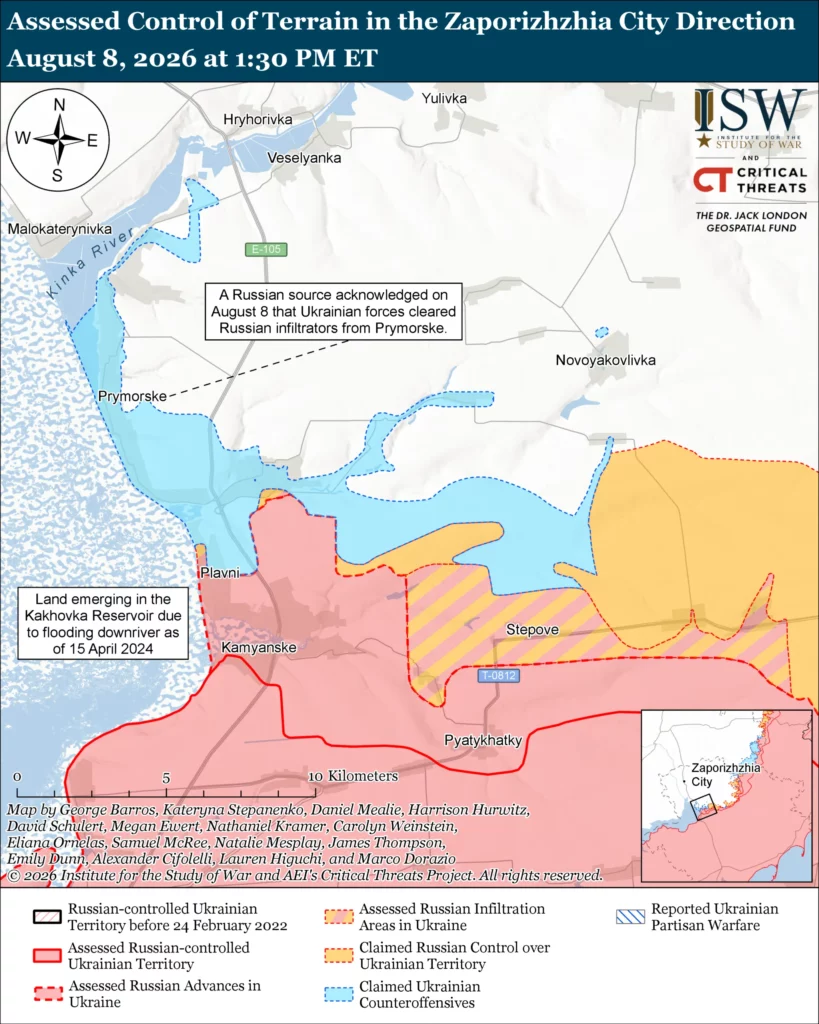
Russian sources claimed that Ukrainian and Russian forces advanced elsewhere in the Orikhiv direction. A Russian milblogger acknowledged on August 8 that Russian forces no longer maintain positions in southern Prymorske (west of Orikhiv).[56] Russian milbloggers claimed that Russian forces seized Novodanylivka (southwest of Orikhiv) and advanced northeast of Nesteryanka (southwest of Orikhiv), northeast and north of Mali Shcherbaky (west of Orikhiv), in eastern Bilohirya, and south of Mala Tokmachka (both southeast of Orikhiv).[57]
A Russian military source claimed that Ukrainian forces unsuccessfully attempted to cross the Dnipro River from near Inhulets (northeast of Kherson City).[58]
Russian forces are reportedly intensifying their “human safari” tactics against vehicles in occupied Kherson Oblast. Kherson Oblast Military Administration Head Oleksander Prokudin stated that Russian drone operators are intensifying their “free hunt” for vehicles in the region.[59] Prokudin stated that Russian forces are trying to strike vehicles with external military markings but that the risk of drone strikes in civilian areas, such as supermarkets, markets, and gas stations, has risen.
Ukrainian forces continue to innovate by using unmanned surface vehicles (USVs) to carry unmanned aerial vehicles (UAVs). A Ukrainian brigade reported that Ukrainian Barracuda USVs penetrated Russian coastal defenses, landed near Zaliznyi Port (on the southern coast of occupied Kherson Oblast), and launched UAVs that struck Russian landing boats in the area.[60] The Ukrainian brigade reported that the Ukrainian strikes disrupted a Russian rotation and that two Russian attempts to repel the USVs with Geran-4 drones only destroyed one of them.
Russian milbloggers continue to complain about successful Ukrainian strikes against occupied Crimea. A Russian milblogger criticized Russian efforts to use machine guns and assault rifles to defend against more technologically advanced Ukrainian drone strikes against Crimea that use AI and satellite communications.[61] Crimea-based Telegram channel Crimean Wind claimed that Russian mobile fire groups have damaged cars and houses in Sevastopol with machine gun fire while trying to intercept Ukrainian drones.[62]
Russian insurance companies are reportedly refusing to ensure vessels due to Ukrainian strikes against Russian vessels in the Black and Azov seas. Russian business outlet RBK stated, citing sources in the Russian shipping and insurance industries, that Russian insurance companies have effectively stopped insuring cargo ships travelling in the Black and Azov seas for protective coverage concerning military and terrorist risks.[63] Russian insurance companies reportedly notified market participants that insurance would no longer cover areas that navigational warnings have temporarily declared dangerous. The Russian Ministry of Defense (MoD) reportedly issued a navigational warning about the threat of strikes in the Black and Azov seas from July 12 to 18.
The Ukrainian Navy reported on August 8 that Ukrainian forces struck Russian facilities on the Syvash drilling rig in the Black Sea that Russian forces used to control and adjust strikes against Ukraine and to reconnoiter and defend against Ukrainian UAVs and USVs.[64]
Russian Air, Missile, and Drone Campaign
Russian Objective: Target Ukrainian military and civilian infrastructure in the rear and on the front line
Russia’s use of a relatively small number of ballistic and quasi-ballistic missiles against Ukraine continues to cause high degrees of damage due to Ukraine’s insufficient stocks of interceptors. The Ukrainian Air Force reported that Russian forces launched six Iskander-M ballistic missiles and S-400 air defense missiles from Bryansk Oblast and 151 Shahed-type, Gerbera-type, and Italmas-type strike drones and Parodiya-type decoy drones from the directions on Kursk and Oryol cities; Primorsko-Akhtarsk, Krasnodar Krai; Millerovo, Rostov Oblast; occupied Donetsk City; and occupied Hvardiiske, Crimea.[65] The Ukrainian Air Force reported that Ukrainian forces downed 135 drones, that the missiles and 13 strike drones hit 12 locations, and that debris fell at seven locations. The Ukrainian Air Force noted that several missiles did not reach their intended targets. Ukrainian officials reported that Russian forces struck civilian and logistics infrastructure in Chernihiv, Odesa, and Kyiv oblasts; a passenger train in Sumy Oblast; and gas stations in Dnipropetrovsk Oblast.[66] Ukrainian President Volodymyr Zelensky reported that Russian strikes killed at least three civilians in Kyiv City overnight.[67] The Russian Ministry of Defense (MoD) claimed that Russian forces struck Ukrainian defense industrial enterprises in Kyiv City overnight, but a Kremlin-affiliated Russian milblogger noted that there is no visual confirmation of the MoD’s claimed strikes.[68] Ukraine’s Southern Operational Command reported on August 8 that Russian forces struck Odesa Oblast with two Onyx anti-ship missiles.[69]
Russian strike campaign against Ukraine’s Black Sea ports is hurting Ukraine’s agricultural exports. The Russian Ministry of Defense (MoD) claimed on August 8 that Russian forces struck Ukrainian military warehouses in the Odesa City port, a dry cargo ship in the Mykolaiv City port, and three dry cargo ships in the Black Sea.[70] German outlet BILD reported on August 7 that Russian drones struck the Liberian-flagged EMIL cargo ship off the coast of Odesa City and then struck the ship again while the crew was evacuating.[71] BILD reported that Russian forces also struck the Guinea-Bissauan-flagged Mera Queen cargo ship in the Black Sea as it was carrying wheat.
Bloomberg reported on August 7 that the Ukrainian Agriculture Ministry forecasted that Ukraine’s exports of agricultural products may be 54 percent less in the 2026-2027 marketing year than previously estimated, with Ukraine’s wheat exports possibly falling by 53 percent.[72] Bloomberg added that Ukraine’s grain storage may reach its full capacity by early November 2026 and that Ukraine is trying to direct grain through Romania, Slovakia, and Hungary, but that these routes cannot fully replace Ukrainian exports via Odesa City ports.
Significant Activity in Belarus
Russian efforts to increase its military presence in Belarus and further integrate Belarus into Russian-favorable frameworks
Nothing significant to report.
Note: ISW does not receive any classified material from any source, uses only publicly available information, and draws extensively on Russian, Ukrainian, and Western reporting and social media as well as commercially available satellite imagery and other geospatial data as the basis for these reports. References to all sources used are provided in the endnotes of each update.