 Eurasia Press & News
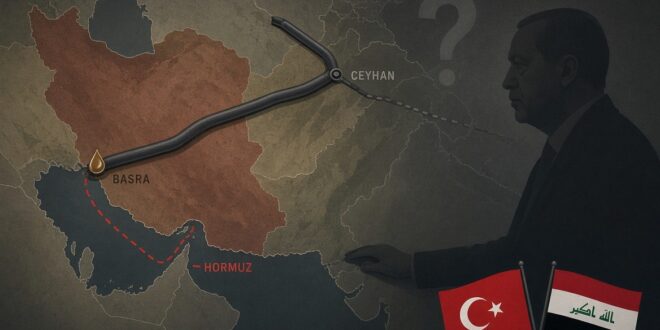
Against the backdrop of the blockage of the Strait of Hormuz due to the Iran–US conflict, Turkey and Iraq have agreed to expand the pipeline network, which allows Baghdad to diversify its oil exports and Ankara to strengthen its position as an indispensable energy hub in the region.
As the US-Iran confrontation continues to disrupt shipping through the Strait of Hormuz, Iraq is being forced to confront a vulnerability it can no longer treat as a distant geopolitical risk. For a country whose oil revenues depend heavily on crude exports from its southern terminals, every disruption in the Gulf carries a direct cost. Iraq has long lacked a reliable overland alternative. It is now trying to build one – and Turkey is positioning itself at its Mediterranean end.
A One-Year Deal with Strategic Implications
On August 1, 2026, Turkey and Iraq signed a one-year agreement covering the transit of Iraqi crude through the Kirkuk–Ceyhan pipeline. The deal, struck between Turkish state firm BOTAŞ and Iraq’s SOMO and NOC, provides for transit capacity of up to 750,000 barrels per day for Iraqi crude. Energy Minister Alparslan Bayraktar estimated the arrangement could generate approximately $500 million a year in transit revenue for Turkey.
Ankara has demonstrated that NATO membership does not prevent it from maintaining working relationships with Russia, negotiating with Iran, and cultivating the Gulf states at the same time
The contrast is telling. The pipeline system has a nominal capacity of 1.5 million barrels per day, yet actual flows were only around 170,000 barrels per day in recent months. Disputes over Iraqi and Kurdish oil exports, compounded by a long-running legal battle between Baghdad and Ankara, have kept the system well below its nominal capacity for years. Flows resumed in September 2025 after a two-and-a-half-year halt, but the pipeline remains heavily underutilized.
The longer-term ambition is to extend the route southward to Basra, where much of Iraq’s oil is produced, and raise its capacity to 2.5 million barrels per day. Crude from other regional producers, including Kuwait, could eventually be carried through the same route. Bayraktar has made no secret of the ambition: Ceyhan, he argued, is not simply a terminal but a gateway – and potentially a Mediterranean trading hub for oil and petroleum products. He has gone further, describing the ambition as turning Ceyhan into something closer to a Mediterranean Rotterdam – a place where oil and petroleum products are stored, traded and priced, rather than merely loaded onto ships.
What Iraq Gains, What Turkey Gains
For Baghdad, the attraction is straightforward. Extending the pipeline southward to Basra would connect the country’s southern oil fields to Turkey’s Mediterranean coast without requiring the oil to pass through the Strait of Hormuz – which has been almost entirely closed to traffic since the Iran war began in February 2026. It would give Iraq something it currently lacks: an export route whose security is not dependent on the Gulf remaining open.
For Turkey, the calculation is different. A pipeline of this scale would generate transit revenues, strengthen Ceyhan’s position as an export hub, and give Ankara greater influence over one of the routes through which Iraqi oil reaches international markets. It would also deepen Iraq’s reliance on Turkish territory at precisely the point where energy security becomes a matter of national revenue.
Iraq gets insurance. Turkey gets leverage.
Basra–Haditha: The Iraqi-Led System Turkey Wants to Join
Nor is this simply about one pipeline. Iraq has already launched the Basra–Haditha pipeline project, a 700-kilometre system designed to carry 2.5 million barrels per day to three export points – Baniyas in Syria, Aqaba in Jordan, and Ceyhan in Turkey. The project, which has secured $1.5 billion in initial funding and is expected to create 15,000 jobs, is part of Baghdad’s broader strategy to diversify its export routes. Turkey’s interest, therefore, is not in building an entirely new system from scratch. It is in positioning Ceyhan as the key Mediterranean node of a larger Iraqi-led network.
Turkey’s Infrastructure Strategy
For Ankara, the logic is straightforward: strategic infrastructure can create dependence, and dependence can create leverage.
The proposal fits into a broader effort to connect Iraq’s southern oil fields with Turkey’s Mediterranean infrastructure and, ultimately, with European markets. The Development Road project, a planned 1,200-kilometre transport corridor linking Iraq’s Grand Faw Port with Turkey and Europe, fits naturally into the same strategy. Turkey, Iraq, Qatar and the UAE have already agreed on the project, which is expected to contribute approximately $55 billion to the Turkish economy over a decade.
The value of such infrastructure goes beyond transit fees. Once major energy and trade flows depend on a particular route, the country controlling that route acquires influence over producers, consumers, and competing transit corridors. Turkey already occupies an unusually important geographical position between the Black Sea, the Caucasus, the Middle East, and the Mediterranean. The more infrastructure Ankara builds around that position, the more difficult it becomes for regional networks to bypass it.
This is not about “helping” Iraq. It is about making Turkey difficult to bypass.
Iran: A Competitor, Not the Target
Nor does the project need to be understood as an attempt to displace Iran. Ankara has little reason to make the viability of the route dependent on Iran’s exclusion. Ankara and Tehran have spent years combining competition with cooperation, and Ankara has little interest in turning an infrastructure project into a direct confrontation. The opportunity lies in the gap created by instability, not in Iran’s exclusion.
Ankara’s Multi-Alignment Strategy
The irony is difficult to miss. Washington’s campaign of military pressure against Iran has helped turn the security of Hormuz into a much more immediate problem for the very oil-producing states that depend on the waterway. For Iraq, the distinction between deterrence and disruption is largely academic. Its oil still has to move.
Turkey is turning precisely this vulnerability into an opportunity. Ankara’s strategy is not to make Hormuz safe. It is to make Turkey useful when Hormuz is not.
Ankara has demonstrated that NATO membership does not prevent it from maintaining working relationships with Russia, negotiating with Iran, and cultivating the Gulf states at the same time. These relationships are not treated in Ankara as mutually exclusive commitments. The pipeline proposal is therefore less an isolated response to the latest crisis than another expression of the same strategic logic.
The Ceyhan terminal is a physical manifestation of this approach – infrastructure built to serve multiple directions, multiple partners, and multiple geopolitical alignments simultaneously.
The Limits of the Turkish Gambit
The proposed system may never reach its full 2.5-million-barrel-per-day ambition. The obstacles are substantial.
First, financing and security. Building major infrastructure across a region with multiple overlapping conflicts is neither cheap nor safe. Political violence, instability, and the sheer cost of construction could derail the project before it reaches commercial viability.
Second, Iraqi domestic politics. Baghdad’s ability to guarantee security and maintain consistent policy over the long term cannot be taken for granted. Changes in government, shifting alliances, and the ever-present tension between federal authorities and the Kurdistan Regional Government add layers of uncertainty.
Third, commercial viability. Announcing a route is easy. Securing sufficient volumes, locking in long-term contracts, and ensuring that producers actually commit to the alternative is considerably harder. The pipeline would need to compete with existing maritime routes and other overland options.
But the proposal remains significant even if the full project never materialises. Turkey is repeatedly pursuing ways to turn its geographical position into practical leverage, whether through pipelines, transport corridors, or its position between competing regional powers.
Drawing the Map
The significance of the Basra proposal goes beyond the pipeline itself. If the project succeeds, Turkey will not simply provide Iraq with another export route; it will strengthen its own position inside the network that carries Iraqi energy to world markets.
In a region where energy routes are being redrawn, Ankara is not waiting to be assigned a role. It is drawing the map.