 Eurasia Press & News
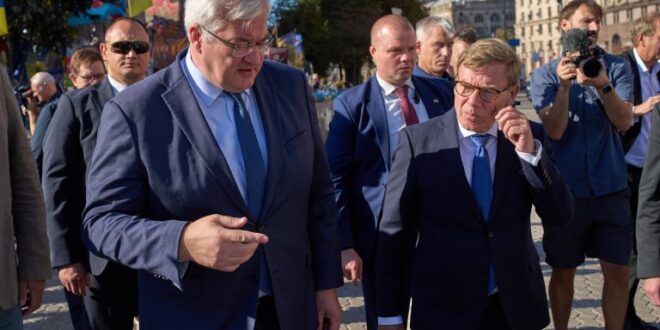
Moscow continues its campaign of sabotage, cyberattacks, and other asymmetric tactics in an attempt to extend the battlefield and make it more painful for NATO countries to continue supporting Ukraine.
Russian operations in Europe have become increasingly brazen with little concern about attribution.
After Ukraine’s use of UK-made missiles, a former high-level Russian official explicitly said that UK drone manufacturers could face operations.
European publics appear to have grown more attuned to Russian external operations, undercutting its objectives.
While the Iran War dominates headlines, Russia continues to conduct increasingly brazen external operations on European soil. In August, an agent believed to be acting on behalf of the Kremlin attempted to murder an American of Ukrainian origin in Warsaw. The murder plot was disrupted, but it shows a logic in which ‘plausible deniability’ is increasingly replaced by overt signaling. Taking stock of Russian operations in Europe over the past month, a picture emerges of state-sponsored assassination attempts, arson attacks, meddling in the information environment, and continued drone incursions, accompanied by officials issuing threats to European capitals and ongoing rumors of a second offensive in northern Ukraine.
As described recently by Yaroslav Trofimov in The Wall Street Journal, there is a “geopolitical mismatch” that functions as a core mechanism behind Russia’s hybrid warfare campaign in the West. This is because Ukraine enjoys the advantage of “defense in depth,” at least insofar as Europe can provide economic assistance and military logistics for Kyiv. Russia enjoys no such advantage, and accordingly, Moscow has attempted to offset this dynamic by keeping the West off balance through a steady and continuous campaign of sabotage, cyberattacks, and other asymmetric tactics, including the use of so-called ‘disposable agents.’
The visit of CIA Director John Ratcliffe to Moscow last week seems to indicate that the Trump administration is growing increasingly concerned with Russian President Vladimir Putin’s intentions, stopping in Riga before visiting the Kremlin, perhaps as a demonstration of solidarity with the Baltic States and as a signal to Russia not to attack a NATO ally. Russia’s hybrid warfare approach is an attempt to extend the battlefield and make it more painful for NATO countries to continue supporting Ukraine. This approach combines kinetic and non-kinetic actions, including hacking campaigns, cyberwarfare, and disinformation.
A key tenet of Russian hybrid warfare has been plausible deniability — denying responsibility for operations to European audiences and governments, and, occasionally, domestic audiences. However, Russia is increasingly and blatantly insinuating its involvement in such operations on European soil and appears to be syncing official government responses and sub-threshold operations executed by covert operatives and disposable agents. As seen in the case of the UK, Moscow sometimes signals, through both official channels and its operatives, that it disapproves of an action. After Kyiv used UK-made Storm Shadow missiles for deep strikes into Russian territory, also targeting civilian infrastructure, officials in Russia denounced the UK. Moscow has since outlined that it has a right to respond both against UK targets inside Ukraine and beyond. Former Foreign Affairs Deputy Minister Andrei Federov meanwhile suggested that UK drone manufacturers could face targeting by “unknown sources.” Fedorov said he could not exclude “semi-military” operations targeting the UK in response to its support to Kyiv.
Another key tenet of Russia’s hybrid tactics is cost asymmetry and scalability: these operations are comparatively cheap for Russia to conduct, but they impose disproportionately high costs on their targets. While Russia has escalated its tactics this summer, concerns about a direct kinetic operation against NATO states, such as those in Eastern Europe or the Baltics, may be overstated considering the strategic advantages it gains from maintaining this cost asymmetry. One incident marking this escalation was the planting of an explosive-laden drone at Germany’s Leipzig airport, likely targeting a Ukrainian cargo plane, which authorities believe was carried out by Russia. In another such incident, Estonian drone manufacturer Milrem Robotics was the target of an arson attack widely believed to have been conducted or facilitated by Russia.
These operations represent a distinctly higher rung on the escalation ladder and appear not to necessarily seek obscure attribution. Indeed, it has been increasingly argued by experts that these types of attacks should not always be defined as hybrid incidents, which obscures the fact that they are increasingly kinetic and in many cases more clearly attributable to Russia. It thus becomes important to address these incidents accordingly — the classification of a “hybrid” tactic can underplay the seriousness of these incidents and overall can reduce the perception of the Russian threat in the public eye.
However, as Russia has grown more brazen, European publics appear to have grown more attuned to the threat. This undercuts one of Moscow’s primary goals, which is to undermine aid to Ukraine. Russia-aligned anti-Ukraine narratives have seemed to gain traction in recent years as right-wing politicians gained popularity across Europe and the West, in ways that threatened to slow financial and military support to Kyiv. However, the more brazen Russia’s attacks have become, the more unified the continent has seemingly grown in its commitment to supporting Ukraine across the political spectrum. Where Russia has been more successful, however, is in sowing disunity within NATO, its other central objective. As the United States continues to distance itself from the alliance, Russia scores a strategic win, allowing it to keep pressuring Europe through both hybrid and increasingly overt operations.
At the same time, however, Putin is under mounting pressure at home as the war continues to drag on and Ukraine’s ability to strike deep within Russia is growing more sophisticated. As recently reported by The Economist, Putin is determined to continue the war at all costs, fearing that if he fails to take the Donbas before the war ends, it will spell his demise in Russia. He reportedly told some of his confidants that “They will hang me” if he is unable to turn the tide of the conflict. Not only is Putin losing his luster domestically, but on the global stage he is also dealing with pushback from other world leaders. At a recent meeting in the Kyrgyz capital of Bishkek, Indian Prime Minister Narendra Modi seemed to chastise Putin, calling for an end to the war and imploring him to reach a peace agreement with Ukraine. As pressure on Putin mounts, Russia will likely continue to escalate its tactics against Europe, short of declaring open war.